


Imogen Gabriel
@imogengabriel.bsky.social
Interested in past volcanism and the impact of these events on climate, people and their environments
Reposted by Imogen Gabriel

I am hiring 4 postdoctoral researchers for up to 4 years each. Topics include ice sheet reconstruction, GIA, spatial stats, and satellite geodesy. Based in Tasmania.
All details are here: careers.utas.edu.au/en/listing/ with titles below
I am also recruiting multiple PhD students (see below)
1/n
All details are here: careers.utas.edu.au/en/listing/ with titles below
I am also recruiting multiple PhD students (see below)
1/n

Current Vacancies
careers.utas.edu.au
November 13, 2025 at 3:04 AM
I am hiring 4 postdoctoral researchers for up to 4 years each. Topics include ice sheet reconstruction, GIA, spatial stats, and satellite geodesy. Based in Tasmania.
All details are here: careers.utas.edu.au/en/listing/ with titles below
I am also recruiting multiple PhD students (see below)
1/n
All details are here: careers.utas.edu.au/en/listing/ with titles below
I am also recruiting multiple PhD students (see below)
1/n
Reposted by Imogen Gabriel

#Eruption nr 9 in the Reykjanes-Svartsengi system started on 16 July. The plume of SO2 and fine particulates is causing #airpollution in North and North West Iceland, which is a bit unusual. Also it's reaching the East coast of Greenland today! Image credit #Iceland Met Office

July 18, 2025 at 10:42 AM
#Eruption nr 9 in the Reykjanes-Svartsengi system started on 16 July. The plume of SO2 and fine particulates is causing #airpollution in North and North West Iceland, which is a bit unusual. Also it's reaching the East coast of Greenland today! Image credit #Iceland Met Office
Reposted by Imogen Gabriel

🌋 Lewotobi Laki-laki volcano is at it again. Biggest hazards are lahars and volcanic ash (the latter being particularly bad for air traffic). Stay safe, Indonesians!
www.bbc.com/news/article...
www.bbc.com/news/article...

Indonesian volcano Mount Lewotobi Laki-laki spews massive ash cloud as it erupts again
Following a series of eruptions three weeks ago, Mount Lewotobi Laki-laki has begun spewing hot ash and lava again.
www.bbc.com
July 8, 2025 at 5:20 AM
🌋 Lewotobi Laki-laki volcano is at it again. Biggest hazards are lahars and volcanic ash (the latter being particularly bad for air traffic). Stay safe, Indonesians!
www.bbc.com/news/article...
www.bbc.com/news/article...
Reposted by Imogen Gabriel

Here's the link: theconversation.com/volcanic-ash...

Volcanic ash is a silent killer, more so than lava: What Alaska needs to know with Mount Spurr likely to erupt
When volcanoes like Alaska’s Mount Spurr erupt, the ash can damage people’s lungs, smother crops and kill animals, and the harm can continue to spread long afterward.
theconversation.com
June 18, 2025 at 5:01 PM
Here's the link: theconversation.com/volcanic-ash...
Reposted by Imogen Gabriel

Does the ocean warm when the AMOC weakens? 🌊 Our new ice-core noble-gas data say it does, at least during the last four deglaciations. A warmer ocean stores a lot of energy but also expands and has lower solubility, which has implications for CO2, sea level, and climate.
doi.org/10.1029/2024...
doi.org/10.1029/2024...

AMOC Modulates Ocean Heat Content During Deglaciations
First ocean heat content (OHC) record covering the last four deglaciations All studied deglaciations show millennial OHC variability anti-correlated with Atlantic meridional overturning circulati...
doi.org
March 30, 2025 at 8:04 PM
Does the ocean warm when the AMOC weakens? 🌊 Our new ice-core noble-gas data say it does, at least during the last four deglaciations. A warmer ocean stores a lot of energy but also expands and has lower solubility, which has implications for CO2, sea level, and climate.
doi.org/10.1029/2024...
doi.org/10.1029/2024...
Reposted by Imogen Gabriel

This will get a bit lost in the shuffle of everything, but glaciologists in Antarctica have finally drilled a continuous ice core stretching past 1 million years. Congrats to the Beyond EPICA team! Can't wait to see the results.
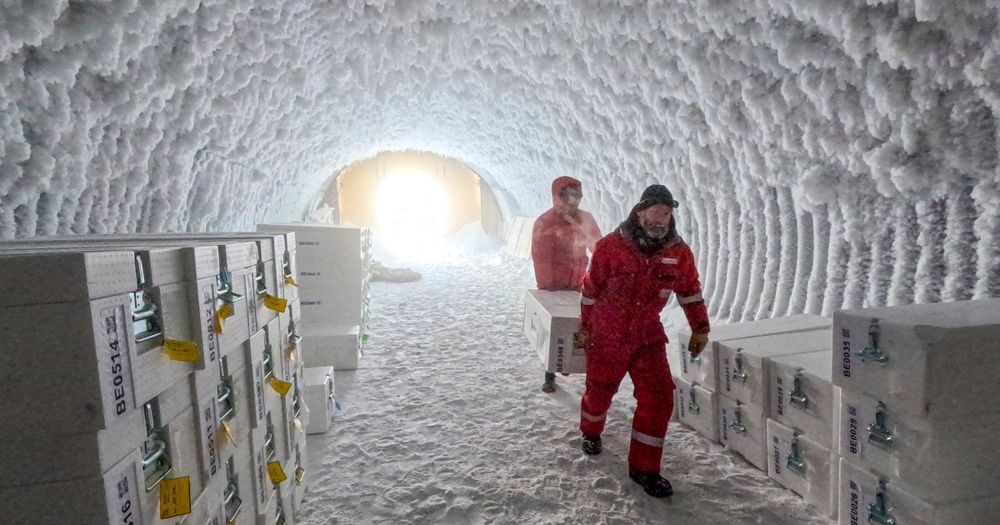
Scientists drill nearly 2 miles down to pull 1.2 million-year-old ice core from Antarctic
Analysis of the ancient ice is expected to show how Earth’s atmosphere and climate have evolved.
www.nbcnews.com
January 9, 2025 at 7:33 PM
This will get a bit lost in the shuffle of everything, but glaciologists in Antarctica have finally drilled a continuous ice core stretching past 1 million years. Congrats to the Beyond EPICA team! Can't wait to see the results.