


Humane Stats
@hyperon.bsky.social
This isn't a statistically significant difference, but YouGov had a separate poll out at the same time asking about "Eliminating ICE as a federal agency". "Eliminate" got 74/42/13 support from D/I/R, while "Abolish" got 77/47/14. So all that talk that "abolish" puts people off seems to be false.

January 13, 2026 at 4:04 PM
This isn't a statistically significant difference, but YouGov had a separate poll out at the same time asking about "Eliminating ICE as a federal agency". "Eliminate" got 74/42/13 support from D/I/R, while "Abolish" got 77/47/14. So all that talk that "abolish" puts people off seems to be false.
Is it true though?

November 19, 2025 at 3:42 AM
Is it true though?
Without blaming Biden or crediting Trump, in terms of explaining election outcomes, the decline in poverty from 2015-2020 was huge (more than 50%, much of it preceding the stimulus), and the rise under Biden was also huge (due to the stimulus ending but also inflation). These were immense changes.

September 30, 2025 at 3:13 PM
Without blaming Biden or crediting Trump, in terms of explaining election outcomes, the decline in poverty from 2015-2020 was huge (more than 50%, much of it preceding the stimulus), and the rise under Biden was also huge (due to the stimulus ending but also inflation). These were immense changes.
Pew also has the data through 2024, though no surprises in the last decade: www.pewresearch.org/politics/202...

August 30, 2025 at 3:02 PM
Pew also has the data through 2024, though no surprises in the last decade: www.pewresearch.org/politics/202...
It's a fine metaphor, but it's not actually true about reviews. Individual reviews are slightly bimodal (mostly high, but with slightly more 1's than 3's), but product averages are highly unimodal, so the social process he describes is a nice story but not real. nycdatascience.com/blog/student...

August 24, 2025 at 2:38 AM
It's a fine metaphor, but it's not actually true about reviews. Individual reviews are slightly bimodal (mostly high, but with slightly more 1's than 3's), but product averages are highly unimodal, so the social process he describes is a nice story but not real. nycdatascience.com/blog/student...
Immigration and trans rights used to split Republicans. Instead of running from those issues or pursuing other issues that split the left, they persuaded both Republicans and Independents to move rightward, unified the party, and created wedges that the Democrats are now running from.


June 7, 2025 at 5:08 PM
Immigration and trans rights used to split Republicans. Instead of running from those issues or pursuing other issues that split the left, they persuaded both Republicans and Independents to move rightward, unified the party, and created wedges that the Democrats are now running from.
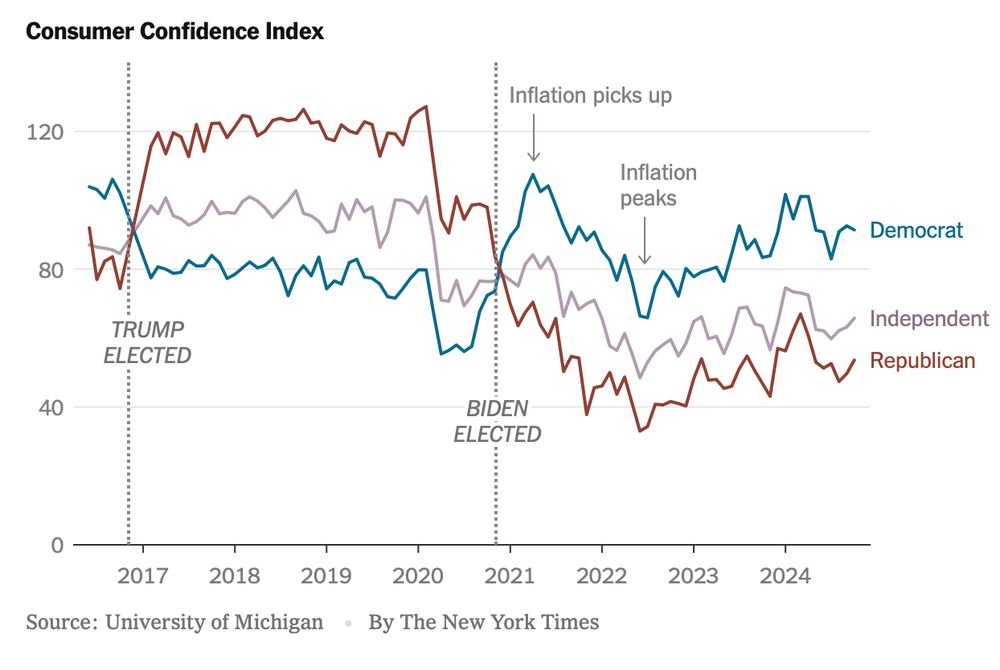
Michigan measures D, R and I sentiment, and the mean trend is very close to the trend for Independents. The partisan asymmetry between D and R is small, so the flip-flops after each election largely cancel out.

May 31, 2025 at 10:35 PM
Michigan measures D, R and I sentiment, and the mean trend is very close to the trend for Independents. The partisan asymmetry between D and R is small, so the flip-flops after each election largely cancel out.
There's an ongoing divergence between Michigan Consumer Sentiment and CB Consumer Confidence, and it's not just party. CS is more in line with inflation-based models, and in any case elections can be modeled directly on inflation. But it's an interesting debate -- that Stancil et al totally ignore.

May 31, 2025 at 5:34 PM
There's an ongoing divergence between Michigan Consumer Sentiment and CB Consumer Confidence, and it's not just party. CS is more in line with inflation-based models, and in any case elections can be modeled directly on inflation. But it's an interesting debate -- that Stancil et al totally ignore.
Nobody contests that inflation was high or that people dislike inflation. The question is whether that affected the election. That's debatable, but the research shows that the effect of inflation on sentiment can persist long after inflation has fallen, because people acclimate to new prices slowly.

May 29, 2025 at 3:54 PM
Nobody contests that inflation was high or that people dislike inflation. The question is whether that affected the election. That's debatable, but the research shows that the effect of inflation on sentiment can persist long after inflation has fallen, because people acclimate to new prices slowly.
Those are all good points, and there is research touching on all of them. My main points here are (1) that literature exists and you should call some experts about it, and (2) the historical results suggest that hig(ish) inflation during Biden predicts low(ish) vote share, which is what happened.


May 28, 2025 at 3:25 PM
Those are all good points, and there is research touching on all of them. My main points here are (1) that literature exists and you should call some experts about it, and (2) the historical results suggest that hig(ish) inflation during Biden predicts low(ish) vote share, which is what happened.
Please look at the literature, it addresses these questions systematically. The effect of inflation is lagged, presumably because price effects build slowly. Maybe new media changed things, but nothing "completely breaks down" because 2024 was on trend -- see my crude graph below.
May 28, 2025 at 3:15 PM
Please look at the literature, it addresses these questions systematically. The effect of inflation is lagged, presumably because price effects build slowly. Maybe new media changed things, but nothing "completely breaks down" because 2024 was on trend -- see my crude graph below.
The thing about academia is that everyone only knows their tiny subfield; I can look it up, but any journalist can do the same by calling up a few experts on the phone. The objection was to arguing a strong point for years while aggressively ignoring pleas to do the research or call some experts.
May 28, 2025 at 2:11 AM
The thing about academia is that everyone only knows their tiny subfield; I can look it up, but any journalist can do the same by calling up a few experts on the phone. The objection was to arguing a strong point for years while aggressively ignoring pleas to do the research or call some experts.
Independents are down, so it's not just partisanship; the world is negative, so it's not just the US; low-media consumers are negative; and everyone has been getting gradually happier since inflation rates peaked in mid-2022. Party and media effects are real, but the main driver is just inflation.
November 21, 2024 at 6:54 PM
Independents are down, so it's not just partisanship; the world is negative, so it's not just the US; low-media consumers are negative; and everyone has been getting gradually happier since inflation rates peaked in mid-2022. Party and media effects are real, but the main driver is just inflation.
Also just look at the polling on immigration. It was created almost de novo as a major issue by the Republican party. You can see the spikes at the elections of 2006, 2010, 2014, and then the rise with Trump. Nothing grassroots, just a creation of a party sowing hate to win.

November 21, 2024 at 2:28 AM
Also just look at the polling on immigration. It was created almost de novo as a major issue by the Republican party. You can see the spikes at the elections of 2006, 2010, 2014, and then the rise with Trump. Nothing grassroots, just a creation of a party sowing hate to win.
Isn't HICP showing the same thing as CPI, just lowered? CPI was ~2% for 2010-2020 and is now ~3%. HICP was ~1.5% for 2010-2020 and is now a bit over 2%. So HICP shows the exact same "problem," if we believe it's a problem.

June 16, 2024 at 9:40 PM
Isn't HICP showing the same thing as CPI, just lowered? CPI was ~2% for 2010-2020 and is now ~3%. HICP was ~1.5% for 2010-2020 and is now a bit over 2%. So HICP shows the exact same "problem," if we believe it's a problem.