




House of Byrne Lab
@hob-lab.bsky.social
Research lab of @drl-bo.bsky.social based @ucl-hd.bsky.social @uclqsion.bsky.social working on adult and Juvenile-onset Huntington's Disease biomarkers.
And finally, the biggest thank you to the participants who contributed their time and blood samples for this work. You are the reason we do what we do! 😘
July 10, 2025 at 4:42 PM
And finally, the biggest thank you to the participants who contributed their time and blood samples for this work. You are the reason we do what we do! 😘
This work was funded by the Medical Research Council under @drl-bo.bsky.social CDA fellowship. We are so grateful to them for enabling this work.
July 10, 2025 at 4:42 PM
This work was funded by the Medical Research Council under @drl-bo.bsky.social CDA fellowship. We are so grateful to them for enabling this work.
In conclusion, we have technically validated this finger-prick collection approach for remote quantification of NfL. We are working on applying this to our clinical cohorts so watch this space for upcoming publications on how this approach could impact clinical monitoring.
July 10, 2025 at 4:42 PM
In conclusion, we have technically validated this finger-prick collection approach for remote quantification of NfL. We are working on applying this to our clinical cohorts so watch this space for upcoming publications on how this approach could impact clinical monitoring.
The HD-YAS cohort is a unique cohort of far from onset HD mutation carriers were NfL was shown to diverge from age-matched controls up to 24 years from predicted onset. The longitundinal analysis was recently published in Nature Medicine & we recommend you check it out www.nature.com/articles/s41...
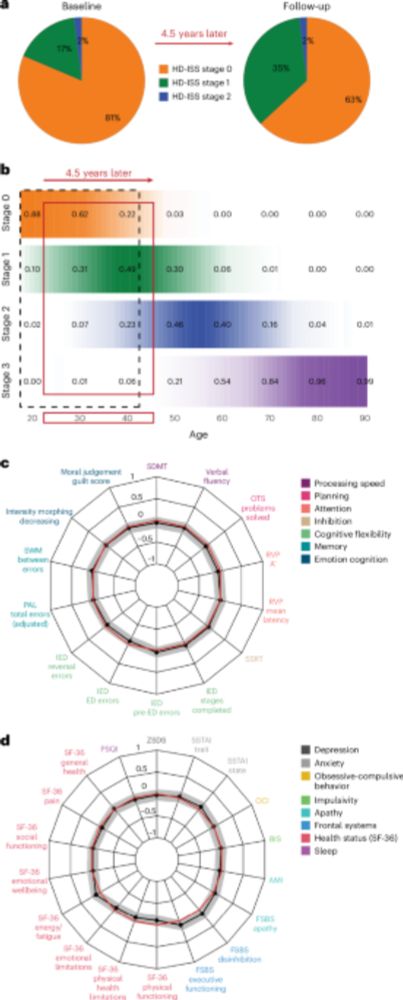
Somatic CAG repeat expansion in blood associates with biomarkers of neurodegeneration in Huntington’s disease decades before clinical motor diagnosis - Nature Medicine
A comprehensive longitudinal analysis of individuals with preclinical Huntington’s disease identifies biomarkers of neurodegeneration and somatic expansion in blood DNA, detectable years before sympto...
www.nature.com
July 10, 2025 at 4:42 PM
The HD-YAS cohort is a unique cohort of far from onset HD mutation carriers were NfL was shown to diverge from age-matched controls up to 24 years from predicted onset. The longitundinal analysis was recently published in Nature Medicine & we recommend you check it out www.nature.com/articles/s41...
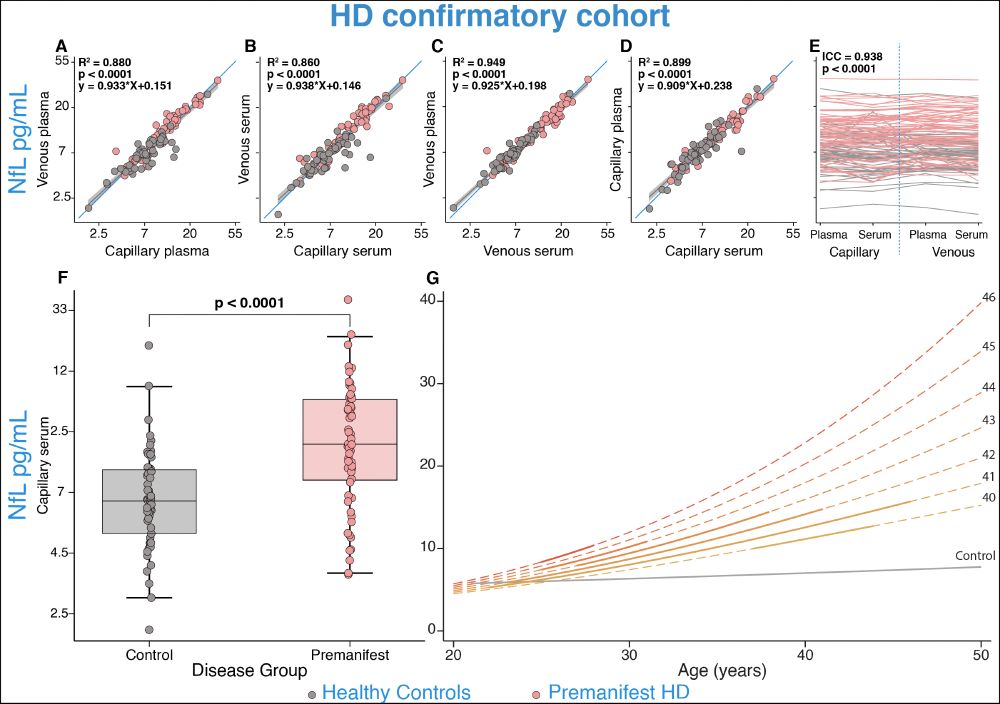
We replicated the consistency between NfL concentrations in venous and capillary blood samples in a confirmatory cohort (recruited from the HD-Young Adult Study). We also replicated NfL’s disease group differences and CAG dependent relationship witg age.
July 10, 2025 at 4:42 PM
We replicated the consistency between NfL concentrations in venous and capillary blood samples in a confirmatory cohort (recruited from the HD-Young Adult Study). We also replicated NfL’s disease group differences and CAG dependent relationship witg age.
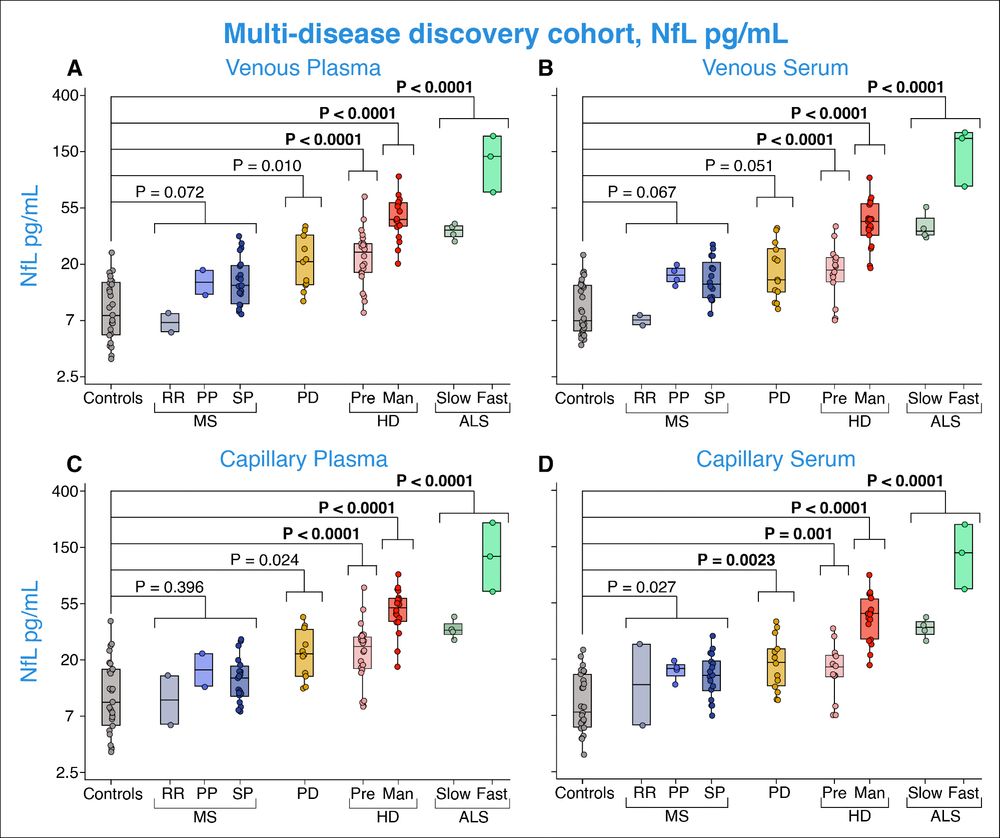
Capillary NfL showed the same clinical disease group differences as venous NfL in the multi‑disease discovery cohort.
N.B. We were not powered for these group comparisons but did this to illustrate that the pattern is the same as the gold standard
N.B. We were not powered for these group comparisons but did this to illustrate that the pattern is the same as the gold standard
July 10, 2025 at 4:42 PM
Capillary NfL showed the same clinical disease group differences as venous NfL in the multi‑disease discovery cohort.
N.B. We were not powered for these group comparisons but did this to illustrate that the pattern is the same as the gold standard
N.B. We were not powered for these group comparisons but did this to illustrate that the pattern is the same as the gold standard
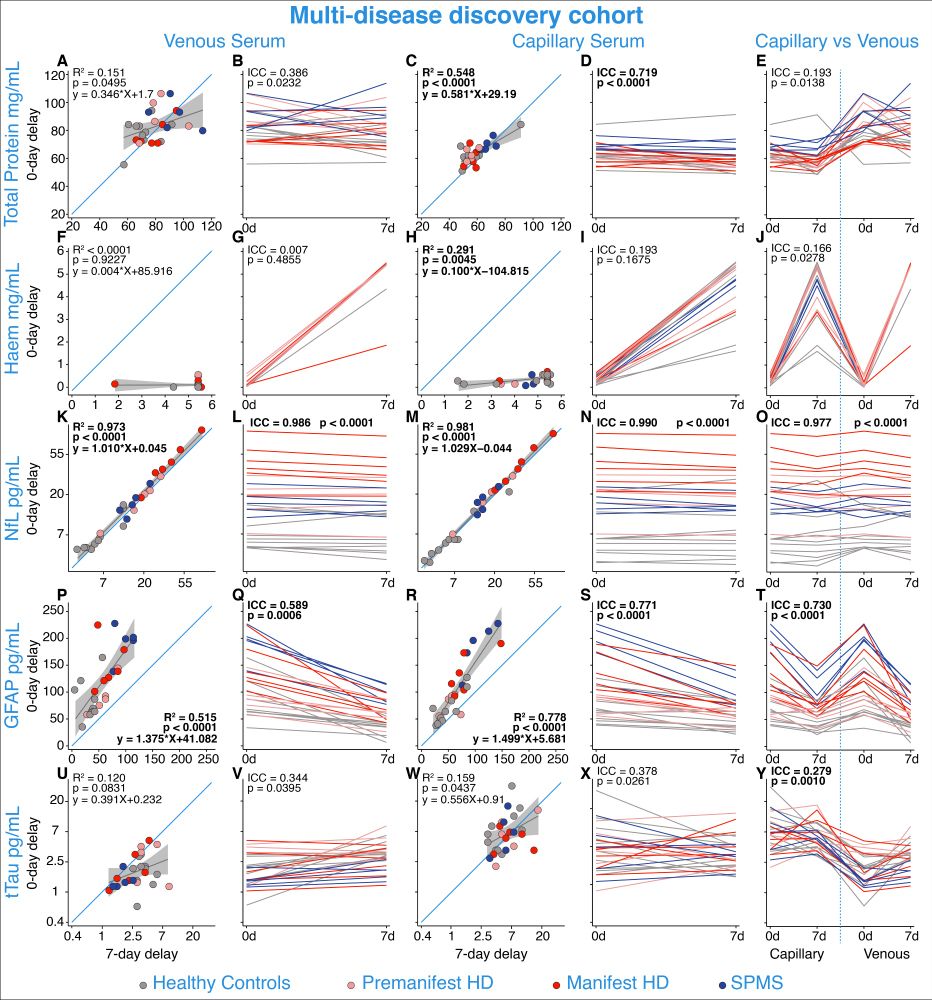
Only NfL showed high stability after seven‑day delayed processing in venous and capillary serum and plasma in the multi‑disease discovery cohort despite a huge amount of haemolysis evident in the samples. GFAP was still correlated but clearly started to go down after 7 days delay.
July 10, 2025 at 4:42 PM
Only NfL showed high stability after seven‑day delayed processing in venous and capillary serum and plasma in the multi‑disease discovery cohort despite a huge amount of haemolysis evident in the samples. GFAP was still correlated but clearly started to go down after 7 days delay.
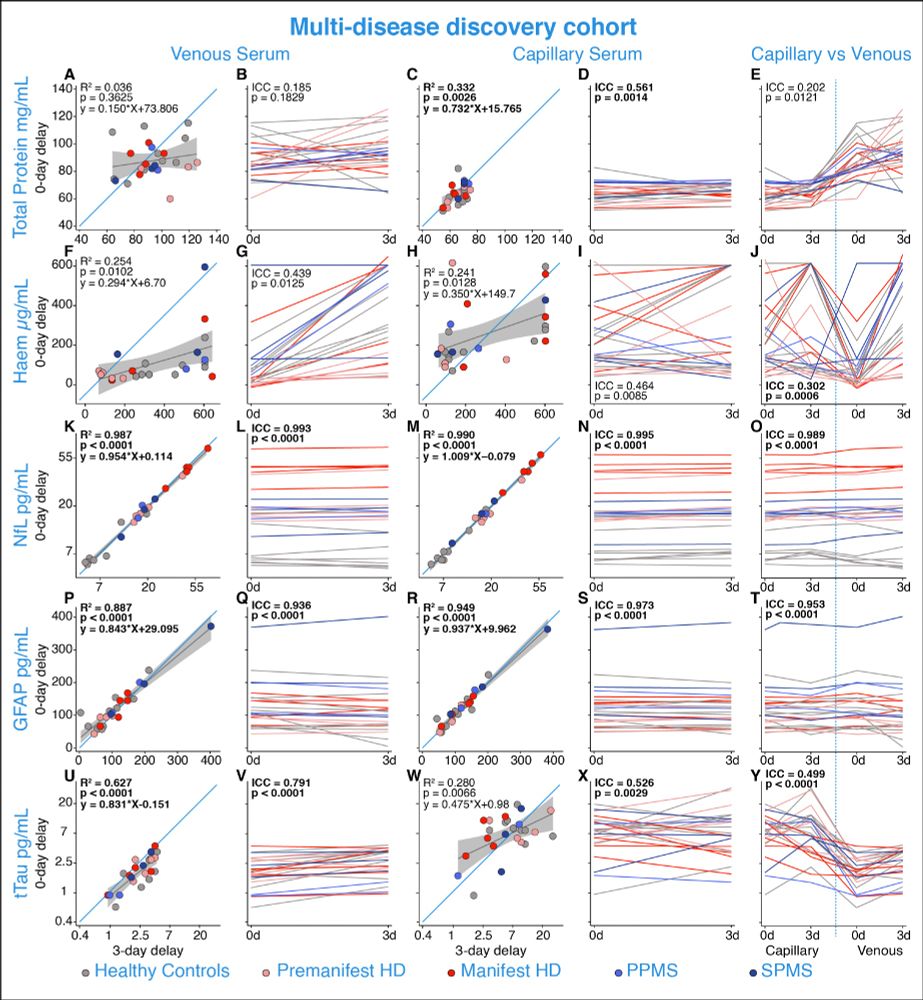
NfL and GFAP showed high stability after three‑day delayed processing in venous and capillary serum and plasma in the multi‑disease discovery cohort. Again data falls on y=x
Total protein and haemoglobin were included to the impact of delayed process on the average protein.
Total protein and haemoglobin were included to the impact of delayed process on the average protein.
July 10, 2025 at 4:42 PM
NfL and GFAP showed high stability after three‑day delayed processing in venous and capillary serum and plasma in the multi‑disease discovery cohort. Again data falls on y=x
Total protein and haemoglobin were included to the impact of delayed process on the average protein.
Total protein and haemoglobin were included to the impact of delayed process on the average protein.
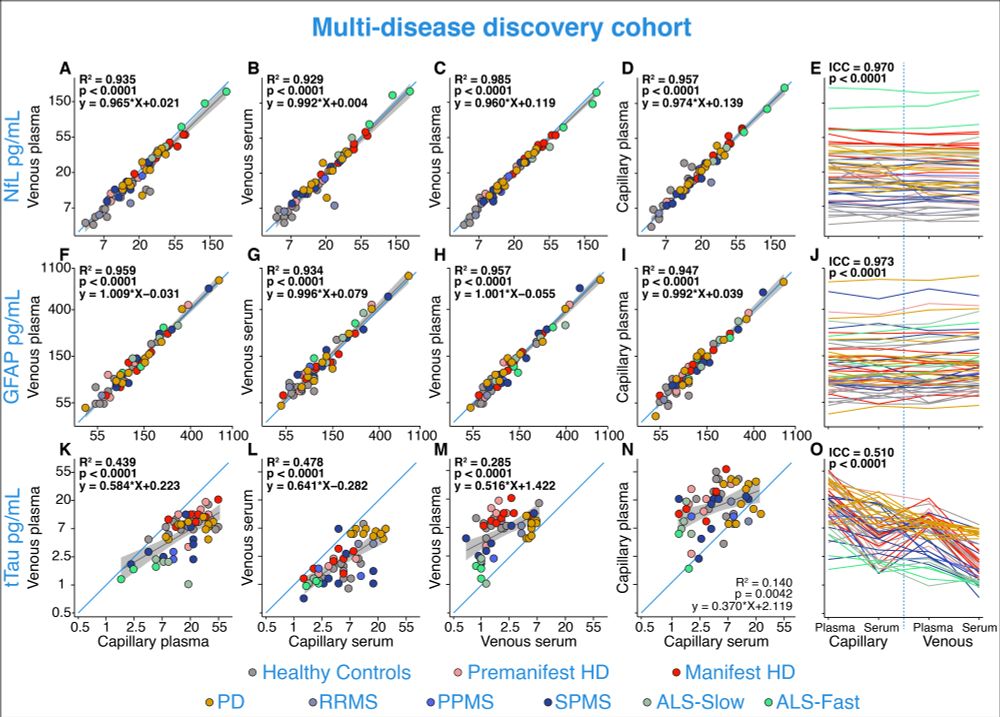
NfL and GFAP concentrations were highly correlated in venous and capillary serum and plasma in a multi‑disease discovery cohort including MS, ALS, HD, and PD participants. Notice how values lie along the y=x line of equality!
July 10, 2025 at 4:42 PM
NfL and GFAP concentrations were highly correlated in venous and capillary serum and plasma in a multi‑disease discovery cohort including MS, ALS, HD, and PD participants. Notice how values lie along the y=x line of equality!
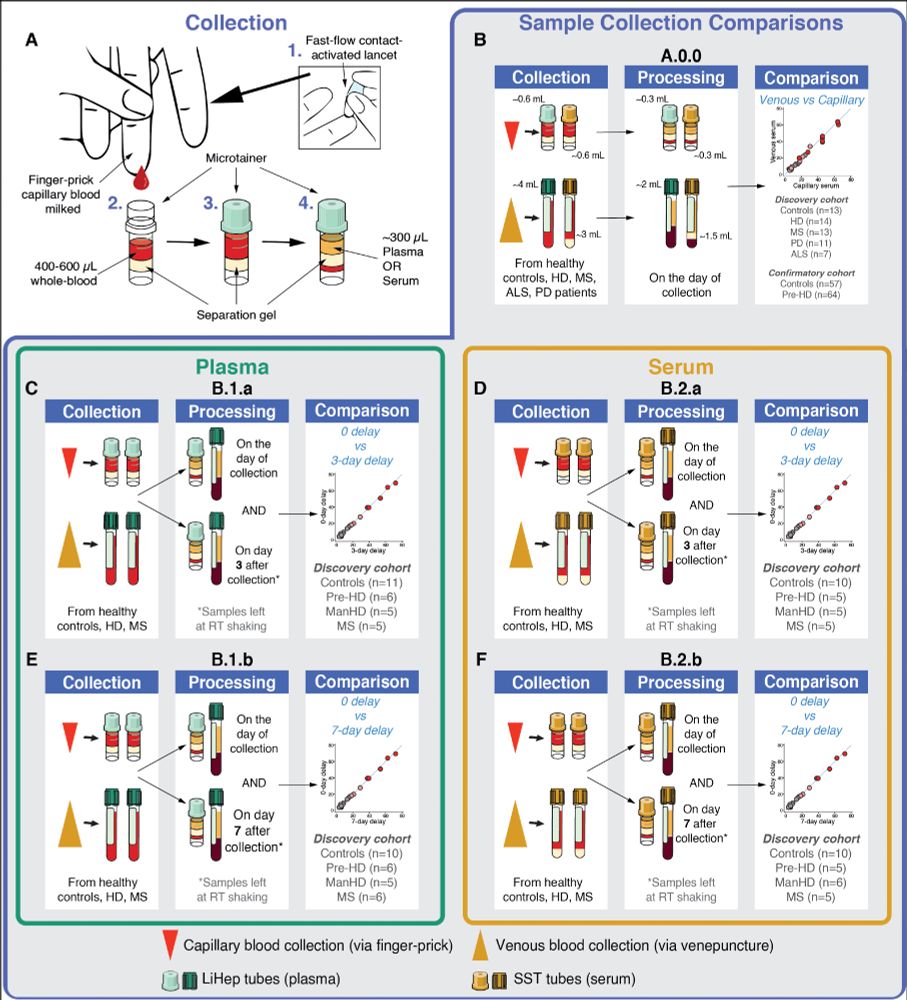
We first adapted a finger‑prick collection approach for NfL quantification and set up several experiments to assess whether it was the same as the gold standard venepuncture, and whether delayed sample processing would impact NfL values. We tested other potential biomarkers GFAP and Total Tau
July 10, 2025 at 4:42 PM
We first adapted a finger‑prick collection approach for NfL quantification and set up several experiments to assess whether it was the same as the gold standard venepuncture, and whether delayed sample processing would impact NfL values. We tested other potential biomarkers GFAP and Total Tau
Being able to monitor NfL levels remotely could minimise patient burden, increase geographical outreach for research, and allow for more frequent sampling.
July 10, 2025 at 4:42 PM
Being able to monitor NfL levels remotely could minimise patient burden, increase geographical outreach for research, and allow for more frequent sampling.
Neurofilament light (NfL) in blood is an indicator of ongoing neuronal injury, and so, is a strong candidate biomarker for many neurological conditions including Multiple Sclerosis (MS), Amyotrophic Lateral Sclerosis (ALS), and Huntington's Disease (HD)
July 10, 2025 at 4:42 PM
Neurofilament light (NfL) in blood is an indicator of ongoing neuronal injury, and so, is a strong candidate biomarker for many neurological conditions including Multiple Sclerosis (MS), Amyotrophic Lateral Sclerosis (ALS), and Huntington's Disease (HD)