




Giulia Baracchini
@giuliaabaracc.bsky.social
CIHR Postdoc fellow 🇮🇹🇨🇦 at The University of Sydney 🇦🇺. https://giuliabaracchini.academic.ws
Reposted by Giulia Baracchini

New preprint: "Identifying statistical indicators of temporal asymmetry using a data-driven approach"
arxiv.org/abs/2511.15991
_Can we statistically distinguish the forward- versus reverse-time dynamics of a system from a finite time series?_
arxiv.org/abs/2511.15991
_Can we statistically distinguish the forward- versus reverse-time dynamics of a system from a finite time series?_

November 21, 2025 at 3:26 AM
New preprint: "Identifying statistical indicators of temporal asymmetry using a data-driven approach"
arxiv.org/abs/2511.15991
_Can we statistically distinguish the forward- versus reverse-time dynamics of a system from a finite time series?_
arxiv.org/abs/2511.15991
_Can we statistically distinguish the forward- versus reverse-time dynamics of a system from a finite time series?_
Reposted by Giulia Baracchini

I once saw a (very interesting) talk about sleep in which the speaker started by saying that we don't really know how to define sleep, and then proceeded to operationalize sleep in flies as basically periods when they are still for a long time. This got me thinking...
September 21, 2025 at 12:29 PM
I once saw a (very interesting) talk about sleep in which the speaker started by saying that we don't really know how to define sleep, and then proceeded to operationalize sleep in flies as basically periods when they are still for a long time. This got me thinking...
Reposted by Giulia Baracchini

Neuromorphic hierarchical modular reservoirs | doi.org/10.1101/2025...
How does hierarchical modularity shape computational function? ⤵️
How does hierarchical modularity shape computational function? ⤵️

September 17, 2025 at 5:23 PM
Neuromorphic hierarchical modular reservoirs | doi.org/10.1101/2025...
How does hierarchical modularity shape computational function? ⤵️
How does hierarchical modularity shape computational function? ⤵️
Reposted by Giulia Baracchini

Thrilled to share that our work is now published in Science! ✨
We found a preference for visual objects in the mouse spatial navigation system where they dynamically refine head-direction coding. In short, objects boost our inner compass! 🧭
www.science.org/doi/10.1126/...
🧵1/
We found a preference for visual objects in the mouse spatial navigation system where they dynamically refine head-direction coding. In short, objects boost our inner compass! 🧭
www.science.org/doi/10.1126/...
🧵1/

September 11, 2025 at 8:14 PM
Thrilled to share that our work is now published in Science! ✨
We found a preference for visual objects in the mouse spatial navigation system where they dynamically refine head-direction coding. In short, objects boost our inner compass! 🧭
www.science.org/doi/10.1126/...
🧵1/
We found a preference for visual objects in the mouse spatial navigation system where they dynamically refine head-direction coding. In short, objects boost our inner compass! 🧭
www.science.org/doi/10.1126/...
🧵1/
Reposted by Giulia Baracchini

🚨The first paper of my postdoc is out now in @elife.bsky.social! 🚨 We explored the role of attention in planning. Thank you 🙏 to the reviewers for their helpful comments & suggestions. Keep your 👀 peeled for additional analyses and our response. elifesciences.org/reviewed-pre...
How attention simplifies mental representations for planning
elifesciences.org
September 10, 2025 at 8:51 AM
🚨The first paper of my postdoc is out now in @elife.bsky.social! 🚨 We explored the role of attention in planning. Thank you 🙏 to the reviewers for their helpful comments & suggestions. Keep your 👀 peeled for additional analyses and our response. elifesciences.org/reviewed-pre...
Reposted by Giulia Baracchini

🔥ATTENTION!🔥
Registration for the 2026 Noosa Brain Workshop is now open!
Join us for some amazing science, sun, and surf in one of Australia's most beautiful beach towns.
Details:
tinyurl.com/arbc5pp6
Check out or incredible list of confirmed speakers. More to come...
Registration for the 2026 Noosa Brain Workshop is now open!
Join us for some amazing science, sun, and surf in one of Australia's most beautiful beach towns.
Details:
tinyurl.com/arbc5pp6
Check out or incredible list of confirmed speakers. More to come...

September 5, 2025 at 1:29 AM
🔥ATTENTION!🔥
Registration for the 2026 Noosa Brain Workshop is now open!
Join us for some amazing science, sun, and surf in one of Australia's most beautiful beach towns.
Details:
tinyurl.com/arbc5pp6
Check out or incredible list of confirmed speakers. More to come...
Registration for the 2026 Noosa Brain Workshop is now open!
Join us for some amazing science, sun, and surf in one of Australia's most beautiful beach towns.
Details:
tinyurl.com/arbc5pp6
Check out or incredible list of confirmed speakers. More to come...
Reposted by Giulia Baracchini

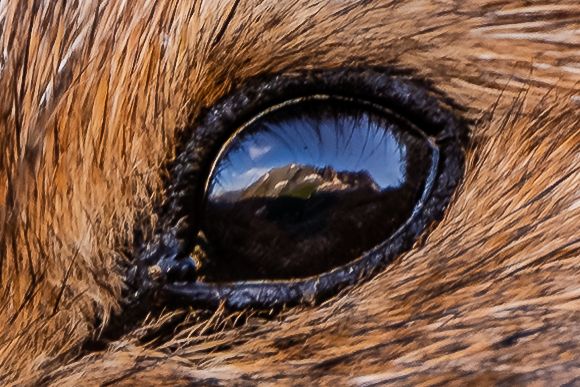
"Pat, why do you carry that ridiculous 600mm lens on long hikes?"
Buddy, I can see mountains reflected in the eyes of a trailside pika.
Buddy, I can see mountains reflected in the eyes of a trailside pika.


August 28, 2025 at 4:18 PM
"Pat, why do you carry that ridiculous 600mm lens on long hikes?"
Buddy, I can see mountains reflected in the eyes of a trailside pika.
Buddy, I can see mountains reflected in the eyes of a trailside pika.
Reposted by Giulia Baracchini
Adaptive learning is coordinated across behaviour, time and neurobiology (from synapses and dendrites, to astrocytes and the systems level).
If you’ve ever wondered how noradrenaline helps shape these multiscale learning processes, you might like this: www.cell.com/trends/cogni...
If you’ve ever wondered how noradrenaline helps shape these multiscale learning processes, you might like this: www.cell.com/trends/cogni...
August 29, 2025 at 1:35 AM
Adaptive learning is coordinated across behaviour, time and neurobiology (from synapses and dendrites, to astrocytes and the systems level).
If you’ve ever wondered how noradrenaline helps shape these multiscale learning processes, you might like this: www.cell.com/trends/cogni...
If you’ve ever wondered how noradrenaline helps shape these multiscale learning processes, you might like this: www.cell.com/trends/cogni...
Reposted by Giulia Baracchini
Interested in Network hubs, cortical hierarchies, and gradients? Ever wonder where they come from? Check our latest review, where we cover different approaches to mapping hubs, models for their evolution, and mechanisms for how they develop:
osf.io/preprints/os...
osf.io/preprints/os...

August 17, 2025 at 4:27 AM
Interested in Network hubs, cortical hierarchies, and gradients? Ever wonder where they come from? Check our latest review, where we cover different approaches to mapping hubs, models for their evolution, and mechanisms for how they develop:
osf.io/preprints/os...
osf.io/preprints/os...
Reposted by Giulia Baracchini

1
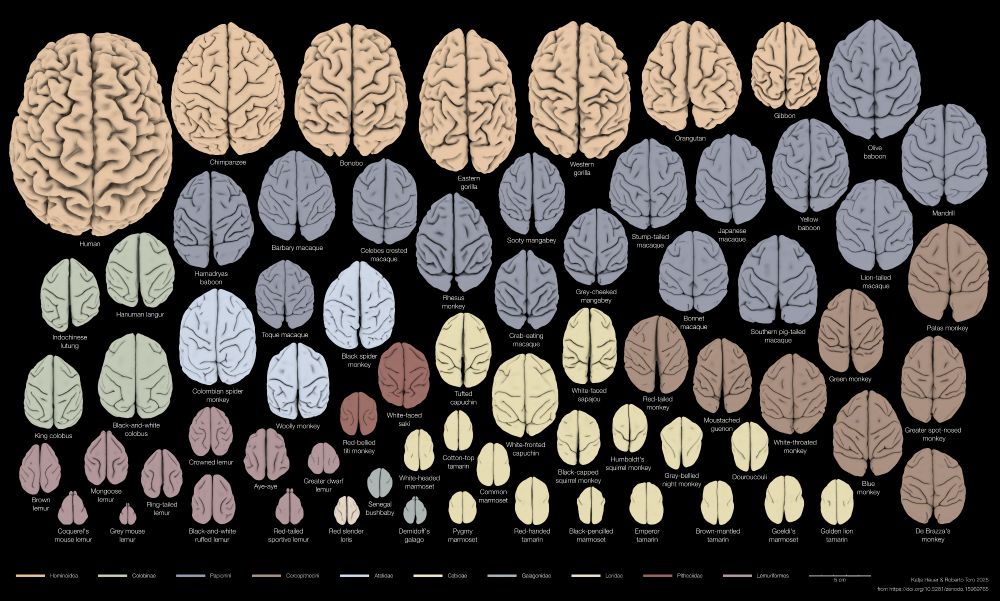
To predict the behaviour of a primate, would you rather base your guess on a closely related species or one with a similar brain shape? We looked at brains & behaviours of 70 species, you’ll be surprised!
🧵Thread on our new preprint with @r3rt0.bsky.social , doi.org/10.1101/2025...
To predict the behaviour of a primate, would you rather base your guess on a closely related species or one with a similar brain shape? We looked at brains & behaviours of 70 species, you’ll be surprised!
🧵Thread on our new preprint with @r3rt0.bsky.social , doi.org/10.1101/2025...
July 27, 2025 at 5:26 PM
1
To predict the behaviour of a primate, would you rather base your guess on a closely related species or one with a similar brain shape? We looked at brains & behaviours of 70 species, you’ll be surprised!
🧵Thread on our new preprint with @r3rt0.bsky.social , doi.org/10.1101/2025...
To predict the behaviour of a primate, would you rather base your guess on a closely related species or one with a similar brain shape? We looked at brains & behaviours of 70 species, you’ll be surprised!
🧵Thread on our new preprint with @r3rt0.bsky.social , doi.org/10.1101/2025...
Reposted by Giulia Baracchini

Biologist folk (especially in evolutionary biology and/or ecology, but it don’t matter):
Can you give me your favorite examples of trade offs in biology? Organism or system don’t matter. Primary literature or reviews preferred.
Can you give me your favorite examples of trade offs in biology? Organism or system don’t matter. Primary literature or reviews preferred.
July 27, 2025 at 12:21 AM
Biologist folk (especially in evolutionary biology and/or ecology, but it don’t matter):
Can you give me your favorite examples of trade offs in biology? Organism or system don’t matter. Primary literature or reviews preferred.
Can you give me your favorite examples of trade offs in biology? Organism or system don’t matter. Primary literature or reviews preferred.
Reposted by Giulia Baracchini
New preprint!
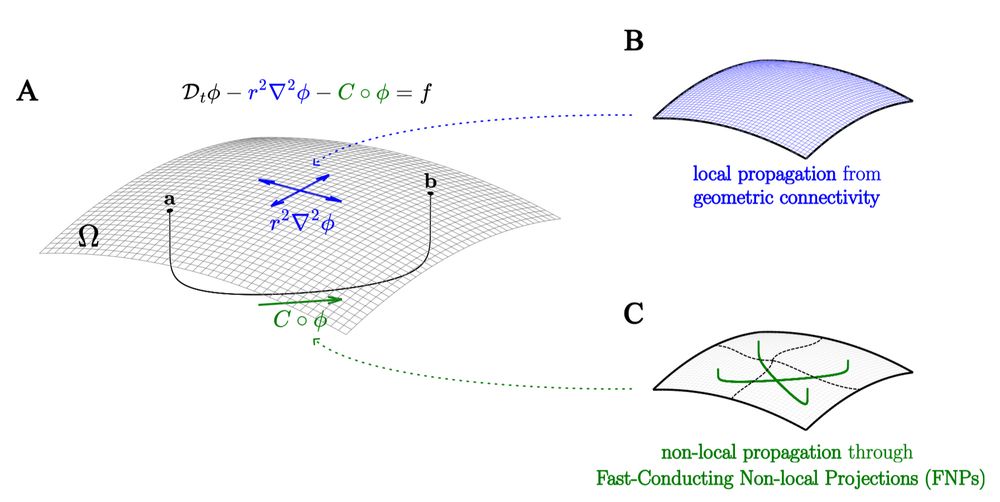
Why are long-range connectomic interactions in the cortex dominant in shaping dynamics in some experiments but apparently negligible in others?
We (w/ R Maran, @elimuller.bsky.social) address this question by studying a new hybrid model of cortical dynamics.
arxiv.org/abs/2506.19800
Why are long-range connectomic interactions in the cortex dominant in shaping dynamics in some experiments but apparently negligible in others?
We (w/ R Maran, @elimuller.bsky.social) address this question by studying a new hybrid model of cortical dynamics.
arxiv.org/abs/2506.19800
June 25, 2025 at 5:03 AM
New preprint!
Why are long-range connectomic interactions in the cortex dominant in shaping dynamics in some experiments but apparently negligible in others?
We (w/ R Maran, @elimuller.bsky.social) address this question by studying a new hybrid model of cortical dynamics.
arxiv.org/abs/2506.19800
Why are long-range connectomic interactions in the cortex dominant in shaping dynamics in some experiments but apparently negligible in others?
We (w/ R Maran, @elimuller.bsky.social) address this question by studying a new hybrid model of cortical dynamics.
arxiv.org/abs/2506.19800
Reposted by Giulia Baracchini

#ohbm2025 Early Career Investigator Award to @macshine.bsky.social - congratulations, super well deserved!

June 24, 2025 at 8:12 AM
#ohbm2025 Early Career Investigator Award to @macshine.bsky.social - congratulations, super well deserved!
The diversity of methods we use to probe the brain (epistemologies) naturally leads to clashes in our theories of how the brain works (ontologies). So how do we reconcile this divide and grow into a more unified neuroscience? Here is our take:
apertureneuro.org/article/1388...
apertureneuro.org/article/1388...
Bridging the epistemological divide in neuroscience to improve ontological clarity | Published in Aperture Neuro
By Giulia Baracchini, Eli Muller & 1 more. This perspective highlights the epistemological divide that arises from the wide variety of different experimental approaches... which in turn lead to ontolo...
apertureneuro.org
June 20, 2025 at 10:27 PM
The diversity of methods we use to probe the brain (epistemologies) naturally leads to clashes in our theories of how the brain works (ontologies). So how do we reconcile this divide and grow into a more unified neuroscience? Here is our take:
apertureneuro.org/article/1388...
apertureneuro.org/article/1388...
Reposted by Giulia Baracchini
1/ I'm excited to share recent results from my first collaboration with the amazing @anayebi.bsky.social
and @leokoz8.bsky.social !
We show how autonomous behavior and whole-brain dynamics emerge in embodied agents with intrinsic motivation driven by world models.
and @leokoz8.bsky.social !
We show how autonomous behavior and whole-brain dynamics emerge in embodied agents with intrinsic motivation driven by world models.
June 5, 2025 at 8:03 PM
1/ I'm excited to share recent results from my first collaboration with the amazing @anayebi.bsky.social
and @leokoz8.bsky.social !
We show how autonomous behavior and whole-brain dynamics emerge in embodied agents with intrinsic motivation driven by world models.
and @leokoz8.bsky.social !
We show how autonomous behavior and whole-brain dynamics emerge in embodied agents with intrinsic motivation driven by world models.
Reposted by Giulia Baracchini
We are seeking a scientific coordinator for my research group at the Max Planck Institute for Human Cognitive and Brain Sciences in Leipzig 😊🧠🌈
Could be ideal for a gap year between MSc and PhD or PhD and postdoc!
Please out more here: recruitingapp-5218.de.umantis.com/Vacancies/43...?
Could be ideal for a gap year between MSc and PhD or PhD and postdoc!
Please out more here: recruitingapp-5218.de.umantis.com/Vacancies/43...?
Scientific Coordinator (m/f/d) Part-time (50%) | Karriereportal Max-Planck-Institut für Kognitions- und Neurowissenschaften
Scientific Coordinator (m/f/d) Part-time (50%) | Karriereportal Max-Planck-Institut für Kognitions- und Neurowissenschaften
recruitingapp-5218.de.umantis.com
June 3, 2025 at 3:10 PM
We are seeking a scientific coordinator for my research group at the Max Planck Institute for Human Cognitive and Brain Sciences in Leipzig 😊🧠🌈
Could be ideal for a gap year between MSc and PhD or PhD and postdoc!
Please out more here: recruitingapp-5218.de.umantis.com/Vacancies/43...?
Could be ideal for a gap year between MSc and PhD or PhD and postdoc!
Please out more here: recruitingapp-5218.de.umantis.com/Vacancies/43...?
Reposted by Giulia Baracchini
New preprint modelling suppression depth in binocular rivalry and continuous flash suppression
with Hugh Wilson, @macshine.bsky.social,
& David Alais
with Hugh Wilson, @macshine.bsky.social,
& David Alais

A Minimal Physiological Model of Perceptual Suppression and Breakthrough in Visual Rivalry https://www.biorxiv.org/content/10.1101/2025.05.28.656716v1
June 2, 2025 at 1:42 AM
New preprint modelling suppression depth in binocular rivalry and continuous flash suppression
with Hugh Wilson, @macshine.bsky.social,
& David Alais
with Hugh Wilson, @macshine.bsky.social,
& David Alais
Reposted by Giulia Baracchini

When I first started working with resting state fMRI as a postdoc, there was a lot of skepticism about what we could learn from it. 20 years later, it's hard to imagine where the field of neuroscience would be without it. Here's a summary 🧠 www.nature.com/articles/s41...

The history and future of resting-state functional magnetic resonance imaging - Nature
This Review provides an overview of the history of resting-state functional MRI research, which has helped to reveal the spatiotemporal organization of the brain, and discusses how it can contribute f...
www.nature.com
May 28, 2025 at 3:52 PM
When I first started working with resting state fMRI as a postdoc, there was a lot of skepticism about what we could learn from it. 20 years later, it's hard to imagine where the field of neuroscience would be without it. Here's a summary 🧠 www.nature.com/articles/s41...
Reposted by Giulia Baracchini
Have recent changes led to uncertainty in your future scientific career?
Wonder it's like in Australia?
Good news!
Monash's is seeking to hire talented EMCRs from other countries.
Come join a wonderful community of brain mappers & modellers!
www.monash.edu/research/eme...
Wonder it's like in Australia?
Good news!
Monash's is seeking to hire talented EMCRs from other countries.
Come join a wonderful community of brain mappers & modellers!
www.monash.edu/research/eme...
EMERGE
www.monash.edu
May 27, 2025 at 10:49 PM
Have recent changes led to uncertainty in your future scientific career?
Wonder it's like in Australia?
Good news!
Monash's is seeking to hire talented EMCRs from other countries.
Come join a wonderful community of brain mappers & modellers!
www.monash.edu/research/eme...
Wonder it's like in Australia?
Good news!
Monash's is seeking to hire talented EMCRs from other countries.
Come join a wonderful community of brain mappers & modellers!
www.monash.edu/research/eme...
Reposted by Giulia Baracchini
Together with @macshine.bsky.social & @elimuller.bsky.social we have a cool interdisciplinary project on compositional cognition, and we’re looking for a PhD student.
More details here www.findaphd.com/phds/project...
DM or email any questions
Please RT or pass on to interested students. Thanks!
More details here www.findaphd.com/phds/project...
DM or email any questions
Please RT or pass on to interested students. Thanks!
May 26, 2025 at 4:10 AM
Together with @macshine.bsky.social & @elimuller.bsky.social we have a cool interdisciplinary project on compositional cognition, and we’re looking for a PhD student.
More details here www.findaphd.com/phds/project...
DM or email any questions
Please RT or pass on to interested students. Thanks!
More details here www.findaphd.com/phds/project...
DM or email any questions
Please RT or pass on to interested students. Thanks!
Reposted by Giulia Baracchini
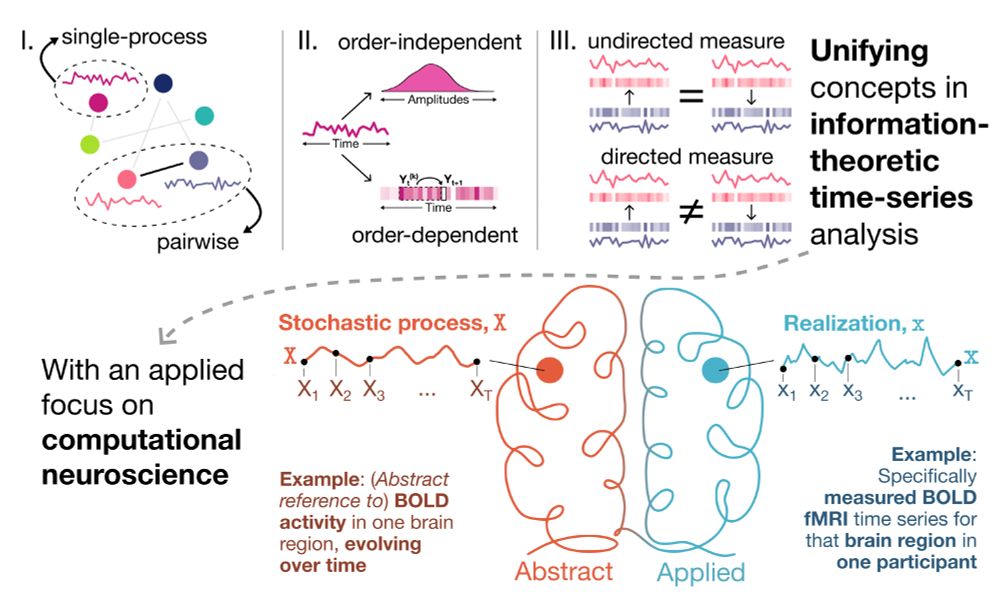
Info theory offers powerful measures for capturing complexity & interaction among elements of a complex system, like the brain! 🧠 Here's our new unified reference for key info-theoretic time series measures ft. 📊 visuals, ➗equations, & 💬descriptions:
arxiv.org/abs/2505.13080
arxiv.org/abs/2505.13080
May 20, 2025 at 3:26 AM
Info theory offers powerful measures for capturing complexity & interaction among elements of a complex system, like the brain! 🧠 Here's our new unified reference for key info-theoretic time series measures ft. 📊 visuals, ➗equations, & 💬descriptions:
arxiv.org/abs/2505.13080
arxiv.org/abs/2505.13080
Reposted by Giulia Baracchini
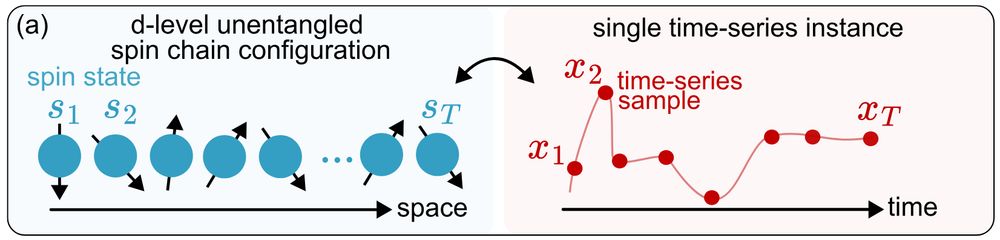
New preprint!: "Using matrix-product states for time-series machine learning".
arxiv.org/abs/2412.15826
Quick summary below 👇
arxiv.org/abs/2412.15826
Quick summary below 👇
May 13, 2025 at 5:15 AM
New preprint!: "Using matrix-product states for time-series machine learning".
arxiv.org/abs/2412.15826
Quick summary below 👇
arxiv.org/abs/2412.15826
Quick summary below 👇
Reposted by Giulia Baracchini

Preprint 🥳
"A unified imaging-histology framework for superficial white matter architecture studies in the human brain"
🧠 SMW key for brain structure-function links
🤔 understudied because of its complexity
💡 SMW mapping for histology & MRI
🌟 OA
📖 lnkd.in/ef8bGGrF
by Youngeun Hwang et al
"A unified imaging-histology framework for superficial white matter architecture studies in the human brain"
🧠 SMW key for brain structure-function links
🤔 understudied because of its complexity
💡 SMW mapping for histology & MRI
🌟 OA
📖 lnkd.in/ef8bGGrF
by Youngeun Hwang et al

May 11, 2025 at 2:24 AM
Preprint 🥳
"A unified imaging-histology framework for superficial white matter architecture studies in the human brain"
🧠 SMW key for brain structure-function links
🤔 understudied because of its complexity
💡 SMW mapping for histology & MRI
🌟 OA
📖 lnkd.in/ef8bGGrF
by Youngeun Hwang et al
"A unified imaging-histology framework for superficial white matter architecture studies in the human brain"
🧠 SMW key for brain structure-function links
🤔 understudied because of its complexity
💡 SMW mapping for histology & MRI
🌟 OA
📖 lnkd.in/ef8bGGrF
by Youngeun Hwang et al
I wish I could carry the enthusiasm for science from this conversation with me in a cup. Fascinating and contagious!

I recently had the great pleasure of interviewing Michael Bruchas about an absolutely banger recent paper from his group that tracked down cells in the brainstem that subtlety and precisely control the output of the locus coeruleus. Check out my interview here. I hope you like it as much as I did!

Far from being a passive neighbor to the locus coeruleus, the pericoeruleus appears to act as a kind of micromanager of arousal, selectively inhibiting different subgroups of locus coeruleus neurons, writes @macshine.bsky.social.
#neuroskyence
www.thetransmitter.org/attention/th...
#neuroskyence
www.thetransmitter.org/attention/th...
May 8, 2025 at 5:34 AM
I wish I could carry the enthusiasm for science from this conversation with me in a cup. Fascinating and contagious!
Reposted by Giulia Baracchini
First post on an exciting new manuscript online today @natneuro.nature.com - in collab with @lucinauddin.bsky.social and Catie Chang. We take a fresh look at the physiological dynamics associated with the global signal 🧠 ...
www.nature.com/articles/s41...
Read here:
rdcu.be/ek01F
www.nature.com/articles/s41...
Read here:
rdcu.be/ek01F
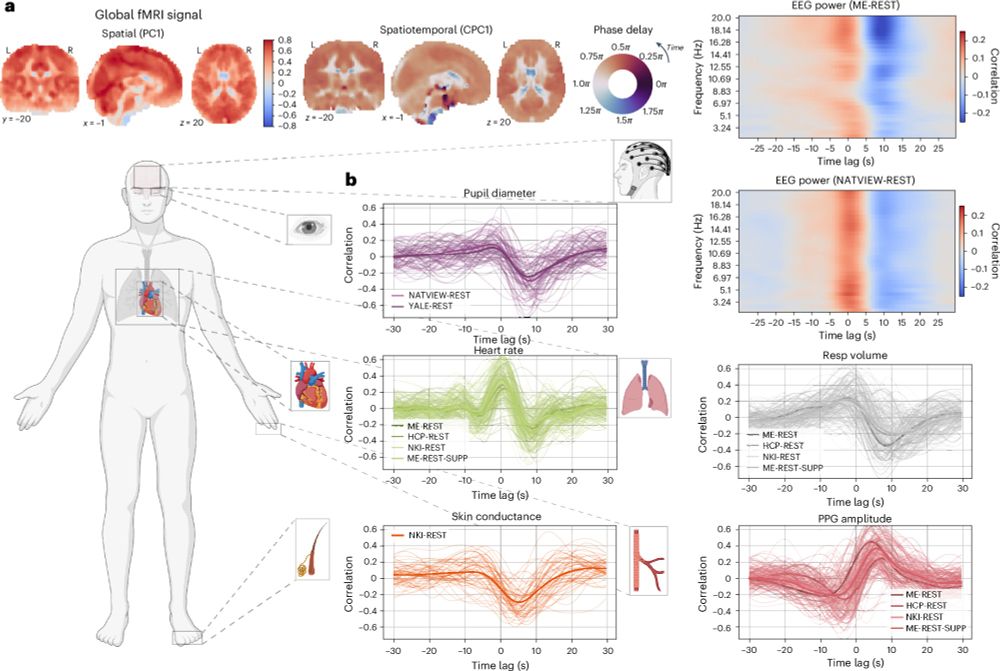
Autonomic physiological coupling of the global fMRI signal
Nature Neuroscience - The brain and body are necessarily connected. Here the authors show that brain blood flow and electrical activity are coupled with systemic physiological changes in the body.
rdcu.be
May 7, 2025 at 1:42 PM
First post on an exciting new manuscript online today @natneuro.nature.com - in collab with @lucinauddin.bsky.social and Catie Chang. We take a fresh look at the physiological dynamics associated with the global signal 🧠 ...
www.nature.com/articles/s41...
Read here:
rdcu.be/ek01F
www.nature.com/articles/s41...
Read here:
rdcu.be/ek01F