



Fernanda de Carvalho-Niebel
@fdecarvalhonie.bsky.social
Happy to share our recent work!
Rhizobial motility preference in root colonization of Medicago truncatula https://www.biorxiv.org/content/10.1101/2025.10.12.681932v1
October 16, 2025 at 12:35 PM
Happy to share our recent work!
Reposted by Fernanda de Carvalho-Niebel

Rhizobial motility preference in root colonization of Medicago truncatula https://www.biorxiv.org/content/10.1101/2025.10.12.681932v1
October 14, 2025 at 6:03 PM
Rhizobial motility preference in root colonization of Medicago truncatula https://www.biorxiv.org/content/10.1101/2025.10.12.681932v1
Reposted by Fernanda de Carvalho-Niebel
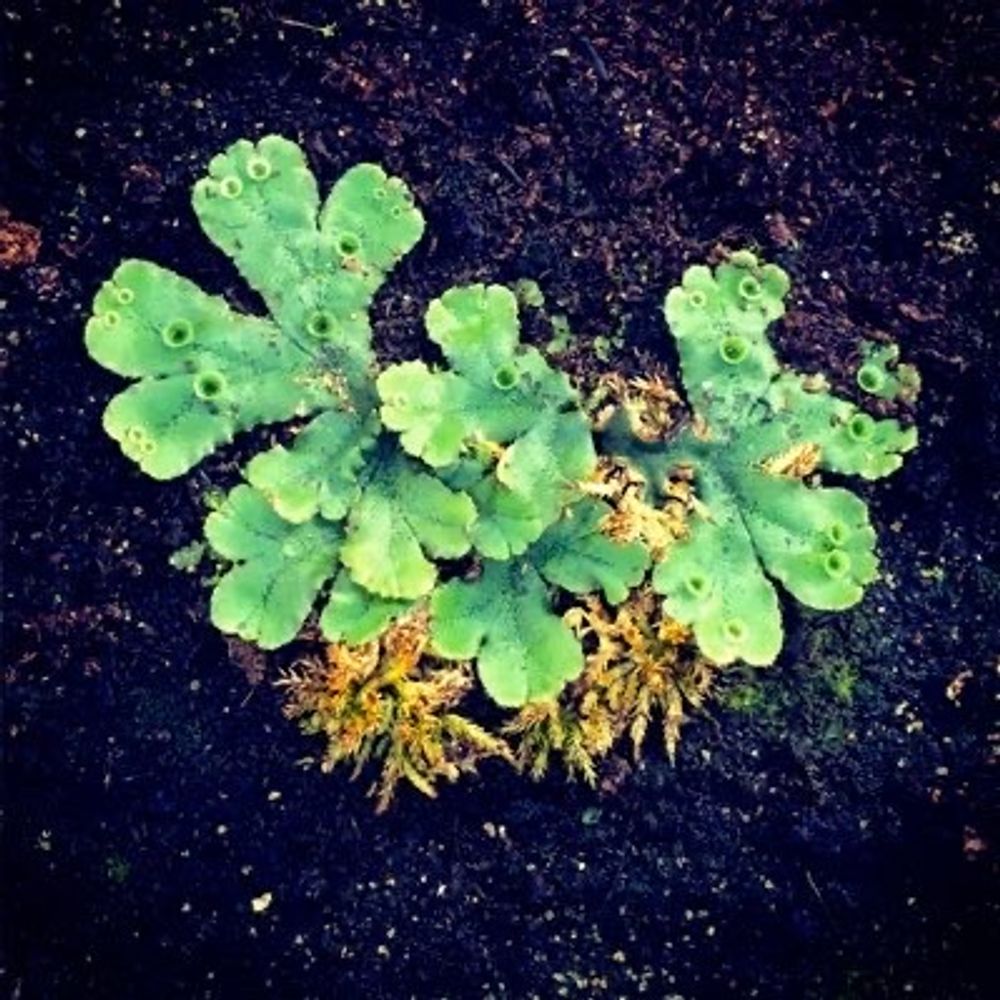
New opportunity to undertake a PhD in my group at the John Innes Centre - if you’re interested in plant immunity and evolution check out the link!

Understanding Host Compatibility in the Marchantia-Phytophthora System (CARELLA_J26DTP) | Doctoral Training Partnership
The fossil record demonstrates that filamentous microbes invaded ancient plant cells with intracellular hyphal structures over 450 million years ago. To this day, a rich diversity of extant land plant...
biodtp.norwichresearchpark.ac.uk
October 12, 2025 at 5:30 PM
New opportunity to undertake a PhD in my group at the John Innes Centre - if you’re interested in plant immunity and evolution check out the link!
Reposted by Fernanda de Carvalho-Niebel

We have a project available for 2026 NRP Doctoral Training Partnership entry (i.e. PhD studentship opportunity!)
How do cells communicate when it's hot?
Don't know? Me either! Come work with us @johninnescentre.bsky.social and figure it out
biodtp.norwichresearchpark.ac.uk/projects/how...
How do cells communicate when it's hot?
Don't know? Me either! Come work with us @johninnescentre.bsky.social and figure it out
biodtp.norwichresearchpark.ac.uk/projects/how...

How do cells communicate when it’s hot? (FAULKNER_J26DTP) | Doctoral Training Partnership
Plant cells are connected to their neighbours via ‘tubes’ called plasmodesmata, creating an interconnected cytoplasm that joins cells within and between tissues and organs.
biodtp.norwichresearchpark.ac.uk
October 12, 2025 at 11:48 AM
We have a project available for 2026 NRP Doctoral Training Partnership entry (i.e. PhD studentship opportunity!)
How do cells communicate when it's hot?
Don't know? Me either! Come work with us @johninnescentre.bsky.social and figure it out
biodtp.norwichresearchpark.ac.uk/projects/how...
How do cells communicate when it's hot?
Don't know? Me either! Come work with us @johninnescentre.bsky.social and figure it out
biodtp.norwichresearchpark.ac.uk/projects/how...
Reposted by Fernanda de Carvalho-Niebel

Post doc position in Extracellular vesicles and cross kingdom communication in the Arbuscular mycorrhizal symbiosis. Final week to apply! my.corehr.com/pls/uoxrecru...
Job Details
my.corehr.com
October 12, 2025 at 3:36 AM
Post doc position in Extracellular vesicles and cross kingdom communication in the Arbuscular mycorrhizal symbiosis. Final week to apply! my.corehr.com/pls/uoxrecru...
Reposted by Fernanda de Carvalho-Niebel

New Article: "Precise deletion, replacement and inversion of large DNA fragments in plants using dual prime editing" rdcu.be/d55WL
...a chromosome editing tech enabling the scarless deletion, replacement and inversion of large DNA fragments, up to the megabase scale. #PlantScience
...a chromosome editing tech enabling the scarless deletion, replacement and inversion of large DNA fragments, up to the megabase scale. #PlantScience

January 13, 2025 at 12:36 PM
New Article: "Precise deletion, replacement and inversion of large DNA fragments in plants using dual prime editing" rdcu.be/d55WL
...a chromosome editing tech enabling the scarless deletion, replacement and inversion of large DNA fragments, up to the megabase scale. #PlantScience
...a chromosome editing tech enabling the scarless deletion, replacement and inversion of large DNA fragments, up to the megabase scale. #PlantScience
Reposted by Fernanda de Carvalho-Niebel

Noncoding RNA controls the expression of a gene implicated in drug- and stress-induced behaviors.
Learn more in a new #SciencePerspective:
Learn more in a new #SciencePerspective:

A neuronal gene that loops the loop
Noncoding RNA controls the expression of a gene implicated in drug- and stress-induced behaviors
scim.ag
December 27, 2024 at 7:56 PM
Noncoding RNA controls the expression of a gene implicated in drug- and stress-induced behaviors.
Learn more in a new #SciencePerspective:
Learn more in a new #SciencePerspective:
Reposted by Fernanda de Carvalho-Niebel

#Communiqué 🗞️Microalgae use light sensors which are codified in their genomes: phytochromes. These photoreceptors enable them to detect changes in the light spectrum in the water column, providing information regarding their vertical position within it. 🌊
👉 www.cnrs.fr/en/press/phy...
👉 www.cnrs.fr/en/press/phy...

December 18, 2024 at 3:22 PM
#Communiqué 🗞️Microalgae use light sensors which are codified in their genomes: phytochromes. These photoreceptors enable them to detect changes in the light spectrum in the water column, providing information regarding their vertical position within it. 🌊
👉 www.cnrs.fr/en/press/phy...
👉 www.cnrs.fr/en/press/phy...
Reposted by Fernanda de Carvalho-Niebel
#Communiqué 🗞️Les diatomées, des microalgues, utilisent des phytochromes codés dans leur génome pour détecter les variations lumineuses dans la colonne d'eau, ce qui leur permet de déterminer leur position verticale. 🌊
👉 www.cnrs.fr/fr/presse/le...
👉 www.cnrs.fr/fr/presse/le...

December 18, 2024 at 3:07 PM
#Communiqué 🗞️Les diatomées, des microalgues, utilisent des phytochromes codés dans leur génome pour détecter les variations lumineuses dans la colonne d'eau, ce qui leur permet de déterminer leur position verticale. 🌊
👉 www.cnrs.fr/fr/presse/le...
👉 www.cnrs.fr/fr/presse/le...
Reposted by Fernanda de Carvalho-Niebel
Interested in doing a PhD on modelling the dynamics of a differentiation wavefront in the Arabidopsis root, in collaboration with @tonnigrubeandersen.bsky.social, at the MPIPZ in Cologne? Just a few weeks left to apply!

December 17, 2024 at 11:36 PM
Interested in doing a PhD on modelling the dynamics of a differentiation wavefront in the Arabidopsis root, in collaboration with @tonnigrubeandersen.bsky.social, at the MPIPZ in Cologne? Just a few weeks left to apply!
Reposted by Fernanda de Carvalho-Niebel
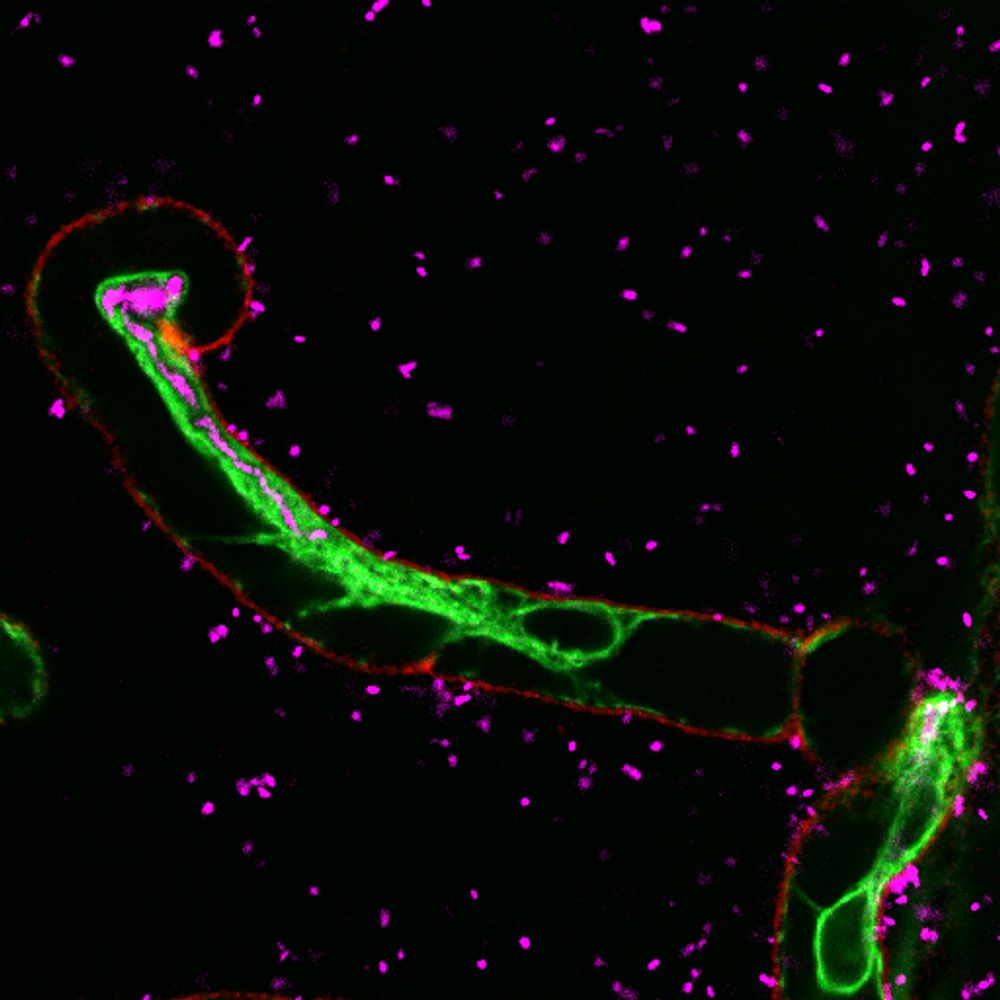
Check out our recent work 'Annexin- and calcium-regulated priming of legume root cells for endosymbiotic infection' in Nature Communications rdcu.be/d2Aye
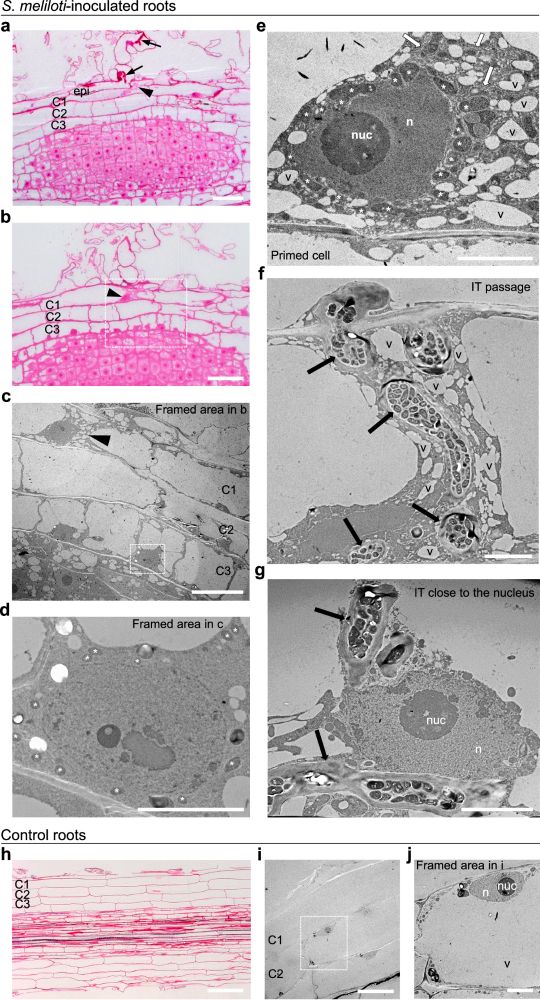
Annexin- and calcium-regulated priming of legume root cells for endosymbiotic infection
Nature Communications - This study describes ultrastructural changes and cell-specific calcium responses that accompany cytoplasmic bridge formation in legume root cells committed to symbiotic...
rdcu.be
December 10, 2024 at 4:44 PM
Check out our recent work 'Annexin- and calcium-regulated priming of legume root cells for endosymbiotic infection' in Nature Communications rdcu.be/d2Aye
Reposted by Fernanda de Carvalho-Niebel

Controlling the genes of a parasite.
https://buff.ly/4g2ujRr
https://buff.ly/4g2ujRr
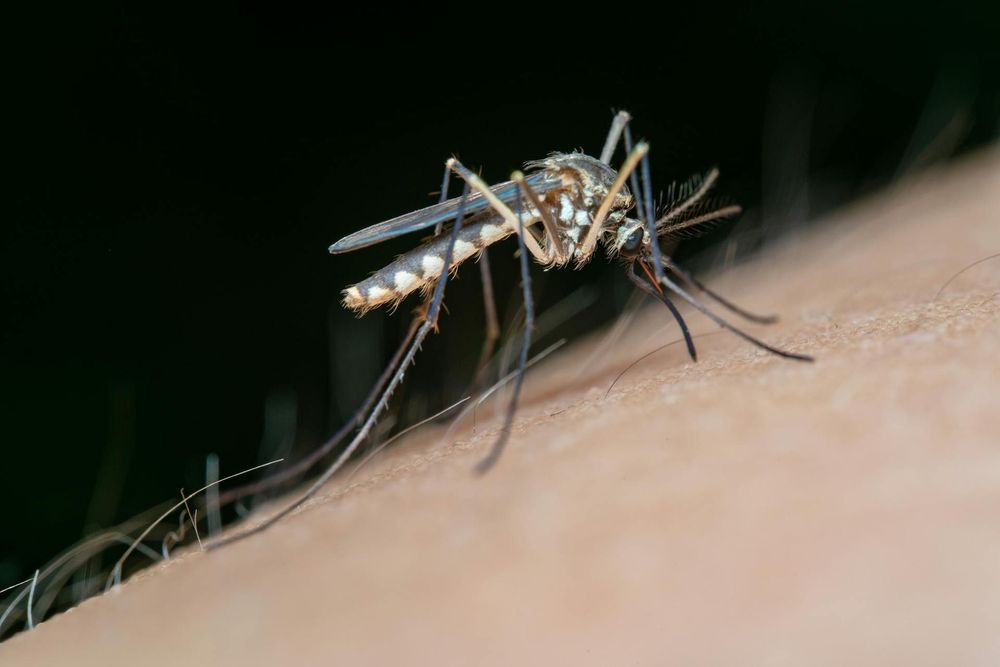
Controlling the genes of a parasite
Plasmodium falciparum, which is responsible for the most fatal forms of malaria, needs a protein called MORC to maintain the structure of its DNA.
buff.ly
December 9, 2024 at 9:21 AM
Controlling the genes of a parasite.
https://buff.ly/4g2ujRr
https://buff.ly/4g2ujRr
Reposted by Fernanda de Carvalho-Niebel

Proud to share our new @plantphys.bsky.social review exploring the anatomical and molecular basis for root adaptations to the environment. Prashanth Ramachandran and Andrea Ramirez detail cell types and pathways that help plants stay resilient in a changing world. academic.oup.com/plphys/advan...

Rooting for survival: how plants tackle a challenging environment through a diversity of root forms and functions
Abstract. The current climate crisis has global impacts and will affect the physiology of plants across every continent. Ensuring resilience of our agricul
academic.oup.com
December 9, 2024 at 7:34 PM
Proud to share our new @plantphys.bsky.social review exploring the anatomical and molecular basis for root adaptations to the environment. Prashanth Ramachandran and Andrea Ramirez detail cell types and pathways that help plants stay resilient in a changing world. academic.oup.com/plphys/advan...