




Clément S. Bellet
@clement-s-bellet.bsky.social
Assistant Professor at Erasmus University, Rotterdam.
Behavioral Economics, Quant Marketing, Inequality, Gender Identity, Emotions.
https://sites.google.com/site/clementbellet/home
Behavioral Economics, Quant Marketing, Inequality, Gender Identity, Emotions.
https://sites.google.com/site/clementbellet/home
We also use a continuous (meaning non-binary 😱) scale of gender representation - DANGER!! - 😅🤗❤️ Science shall prevail still.
February 5, 2025 at 5:21 PM
We also use a continuous (meaning non-binary 😱) scale of gender representation - DANGER!! - 😅🤗❤️ Science shall prevail still.
Inequality doesn’t just impact income; it redefines needs at the bottom of the pyramid.
Our findings highlight the pressing need to address inequality as a nutritional challenge.
Read our full paper here: doi.org/10.1093/jeea...
Our findings highlight the pressing need to address inequality as a nutritional challenge.
Read our full paper here: doi.org/10.1093/jeea...

Does Inequality Affect the Needs of the Poor?*
Abstract. We investigate how inequality affects what is considered most necessary to purchase. Combining detailed consumption surveys in India with an inst
doi.org
January 23, 2025 at 9:47 AM
Inequality doesn’t just impact income; it redefines needs at the bottom of the pyramid.
Our findings highlight the pressing need to address inequality as a nutritional challenge.
Read our full paper here: doi.org/10.1093/jeea...
Our findings highlight the pressing need to address inequality as a nutritional challenge.
Read our full paper here: doi.org/10.1093/jeea...
We also ruled out alternative need-driven explanations like changes in access to food security, gift-giving, or credit markets. The shift in needs due to inequality is the primary driver.
January 23, 2025 at 9:47 AM
We also ruled out alternative need-driven explanations like changes in access to food security, gift-giving, or credit markets. The shift in needs due to inequality is the primary driver.
In some districts, this is like losing the nutritional equivalent of 1.5 portions of cooked rice daily. 🍚Addressing inequality, or accounting for its impact on basic needs in poverty programs could drastically improve nutrition among India's poor.
January 23, 2025 at 9:47 AM
In some districts, this is like losing the nutritional equivalent of 1.5 portions of cooked rice daily. 🍚Addressing inequality, or accounting for its impact on basic needs in poverty programs could drastically improve nutrition among India's poor.
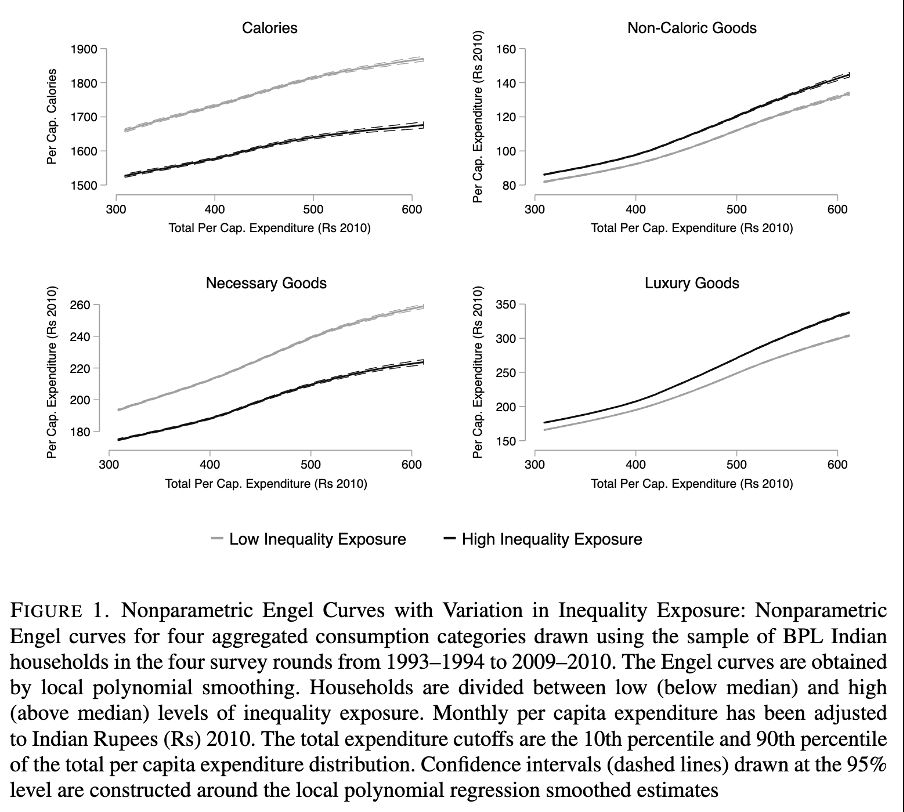
Quantitatively, we find that a 1 standard deviation increase in inequality exposure leads to 186 fewer calories per person per day.
This loss accounts for over 2/3 of the decline in calorie consumption among poor households.
This loss accounts for over 2/3 of the decline in calorie consumption among poor households.

January 23, 2025 at 9:47 AM
Quantitatively, we find that a 1 standard deviation increase in inequality exposure leads to 186 fewer calories per person per day.
This loss accounts for over 2/3 of the decline in calorie consumption among poor households.
This loss accounts for over 2/3 of the decline in calorie consumption among poor households.
The calorie consumption puzzle refers to the paradox that calorie intake among India's poor declined, even as poverty levels and food availability improved.
Our findings show that inequality is driving much of this decline.
Our findings show that inequality is driving much of this decline.
January 23, 2025 at 9:47 AM
The calorie consumption puzzle refers to the paradox that calorie intake among India's poor declined, even as poverty levels and food availability improved.
Our findings show that inequality is driving much of this decline.
Our findings show that inequality is driving much of this decline.
In highly unequal regions, these relative necessities displace essential caloric goods like cereals and vegetables. This explains a large part of the calorie consumption puzzle in India.

January 23, 2025 at 9:47 AM
In highly unequal regions, these relative necessities displace essential caloric goods like cereals and vegetables. This explains a large part of the calorie consumption puzzle in India.
We call goods that become more necessary under inequality relative necessities (their income elasticity falls with inequality).
Interestingly, many of these goods are luxuries in absolute terms—things like dairy, energy, processed foods, and even sweets.
Interestingly, many of these goods are luxuries in absolute terms—things like dairy, energy, processed foods, and even sweets.

January 23, 2025 at 9:47 AM
We call goods that become more necessary under inequality relative necessities (their income elasticity falls with inequality).
Interestingly, many of these goods are luxuries in absolute terms—things like dairy, energy, processed foods, and even sweets.
Interestingly, many of these goods are luxuries in absolute terms—things like dairy, energy, processed foods, and even sweets.
We combine consumption data from India with a shift-share instrumental variable (IV) and a structural model of needs to isolate the effects of inequality from other factors like income and supply constraints.
Our focus: How inequality redefines the hierarchy of needs.
Our focus: How inequality redefines the hierarchy of needs.
January 23, 2025 at 9:47 AM
We combine consumption data from India with a shift-share instrumental variable (IV) and a structural model of needs to isolate the effects of inequality from other factors like income and supply constraints.
Our focus: How inequality redefines the hierarchy of needs.
Our focus: How inequality redefines the hierarchy of needs.
Relative deprivation theory suggests that people feel deprived when they compare themselves to wealthier individuals. This fuels a desire to buy products that signal social inclusion.
For the poor, this shift comes at a nutritional cost. 📉
For the poor, this shift comes at a nutritional cost. 📉
January 23, 2025 at 9:47 AM
Relative deprivation theory suggests that people feel deprived when they compare themselves to wealthier individuals. This fuels a desire to buy products that signal social inclusion.
For the poor, this shift comes at a nutritional cost. 📉
For the poor, this shift comes at a nutritional cost. 📉
We focus on poor households in India and uncover a crucial insight: inequality reduces calorie consumption by shifting spending from necessities (e.g., cereals) to goods linked with the consumption of the rich.
Why does this happen? It's all about relative deprivation. 🏚️🍽️
Why does this happen? It's all about relative deprivation. 🏚️🍽️
January 23, 2025 at 9:47 AM
We focus on poor households in India and uncover a crucial insight: inequality reduces calorie consumption by shifting spending from necessities (e.g., cereals) to goods linked with the consumption of the rich.
Why does this happen? It's all about relative deprivation. 🏚️🍽️
Why does this happen? It's all about relative deprivation. 🏚️🍽️