




Clément S. Bellet
@clement-s-bellet.bsky.social
Assistant Professor at Erasmus University, Rotterdam.
Behavioral Economics, Quant Marketing, Inequality, Gender Identity, Emotions.
https://sites.google.com/site/clementbellet/home
Behavioral Economics, Quant Marketing, Inequality, Gender Identity, Emotions.
https://sites.google.com/site/clementbellet/home
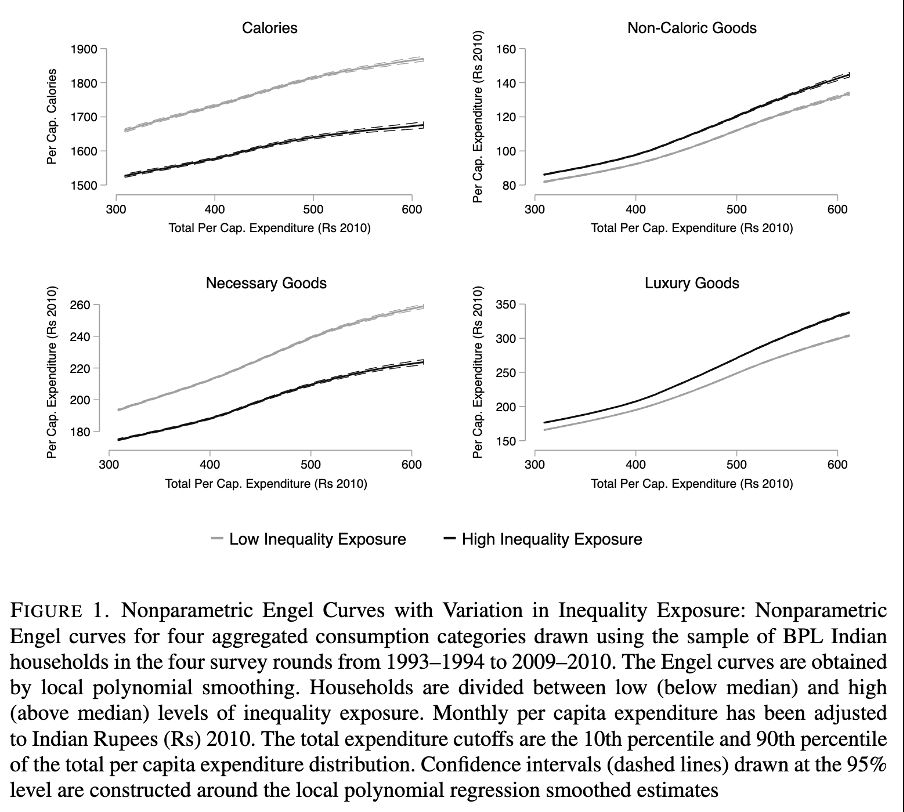
Quantitatively, we find that a 1 standard deviation increase in inequality exposure leads to 186 fewer calories per person per day.
This loss accounts for over 2/3 of the decline in calorie consumption among poor households.
This loss accounts for over 2/3 of the decline in calorie consumption among poor households.

January 23, 2025 at 9:47 AM
Quantitatively, we find that a 1 standard deviation increase in inequality exposure leads to 186 fewer calories per person per day.
This loss accounts for over 2/3 of the decline in calorie consumption among poor households.
This loss accounts for over 2/3 of the decline in calorie consumption among poor households.
In highly unequal regions, these relative necessities displace essential caloric goods like cereals and vegetables. This explains a large part of the calorie consumption puzzle in India.

January 23, 2025 at 9:47 AM
In highly unequal regions, these relative necessities displace essential caloric goods like cereals and vegetables. This explains a large part of the calorie consumption puzzle in India.
We call goods that become more necessary under inequality relative necessities (their income elasticity falls with inequality).
Interestingly, many of these goods are luxuries in absolute terms—things like dairy, energy, processed foods, and even sweets.
Interestingly, many of these goods are luxuries in absolute terms—things like dairy, energy, processed foods, and even sweets.

January 23, 2025 at 9:47 AM
We call goods that become more necessary under inequality relative necessities (their income elasticity falls with inequality).
Interestingly, many of these goods are luxuries in absolute terms—things like dairy, energy, processed foods, and even sweets.
Interestingly, many of these goods are luxuries in absolute terms—things like dairy, energy, processed foods, and even sweets.
We focus on poor households in India and uncover a crucial insight: inequality reduces calorie consumption by shifting spending from necessities (e.g., cereals) to goods linked with the consumption of the rich.
Why does this happen? It's all about relative deprivation. 🏚️🍽️
Why does this happen? It's all about relative deprivation. 🏚️🍽️
January 23, 2025 at 9:47 AM
We focus on poor households in India and uncover a crucial insight: inequality reduces calorie consumption by shifting spending from necessities (e.g., cereals) to goods linked with the consumption of the rich.
Why does this happen? It's all about relative deprivation. 🏚️🍽️
Why does this happen? It's all about relative deprivation. 🏚️🍽️