



Caterina Gratton
@caterinagratton.bsky.social
Associate Professor of Psychology and Neuroscience at the University of Illinois (she/her). Likes thinking about 🧠, networks, and behavior. Twin mom, 🇮🇹🇺🇸, AS Roma fan ⚽️
3) @dianacperez.bsky.social is presenting TUESDAY AM at LPB028
Diana used precision datasets of younger and older adults to individual brain network maps
▶️ she shows that variability increases across the lifespan, suggesting new models for the development of individual differences
Diana used precision datasets of younger and older adults to individual brain network maps
▶️ she shows that variability increases across the lifespan, suggesting new models for the development of individual differences

November 14, 2025 at 3:56 PM
3) @dianacperez.bsky.social is presenting TUESDAY AM at LPB028
Diana used precision datasets of younger and older adults to individual brain network maps
▶️ she shows that variability increases across the lifespan, suggesting new models for the development of individual differences
Diana used precision datasets of younger and older adults to individual brain network maps
▶️ she shows that variability increases across the lifespan, suggesting new models for the development of individual differences
2) @kianzkermani.bsky.social will be presenting on Monday AM at NN10 –
He'll discuss evidence that the DAN-a and DAN-b subnetworks show dissociations in visual vs. auditory WM & attention paradigms
He'll discuss evidence that the DAN-a and DAN-b subnetworks show dissociations in visual vs. auditory WM & attention paradigms

November 14, 2025 at 3:56 PM
2) @kianzkermani.bsky.social will be presenting on Monday AM at NN10 –
He'll discuss evidence that the DAN-a and DAN-b subnetworks show dissociations in visual vs. auditory WM & attention paradigms
He'll discuss evidence that the DAN-a and DAN-b subnetworks show dissociations in visual vs. auditory WM & attention paradigms
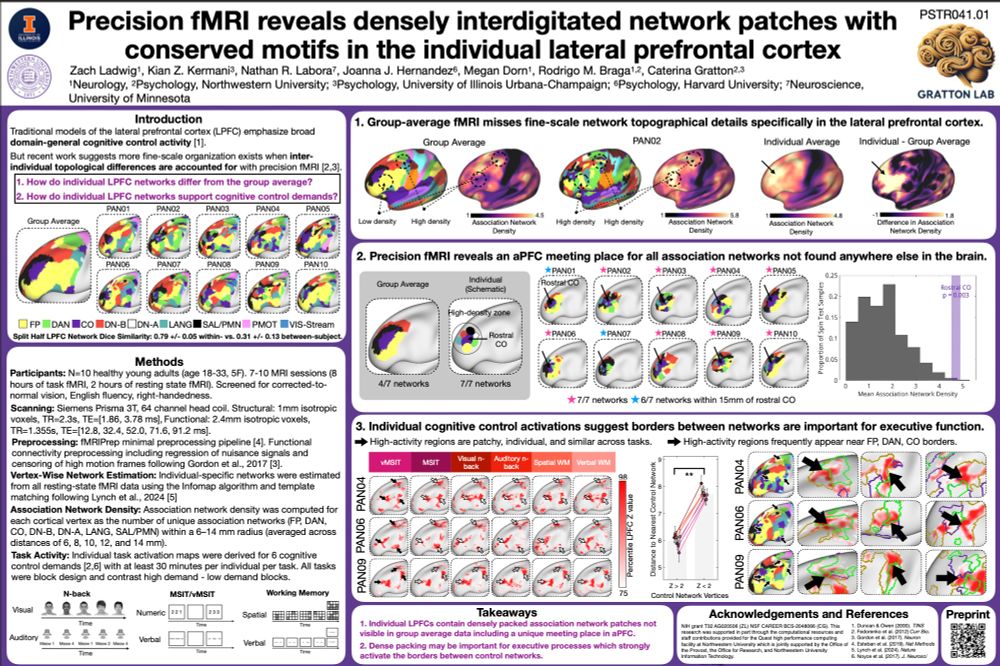
1) @zachladwig.bsky.social will be available on SATURDAY PM at poster CC14
He’ll show his work using precision fMRI to identify new common network motifs in the PFC and investigate how network borders support executive function.
Preprint: www.biorxiv.org/content/10.1...
He’ll show his work using precision fMRI to identify new common network motifs in the PFC and investigate how network borders support executive function.
Preprint: www.biorxiv.org/content/10.1...
November 14, 2025 at 3:56 PM
1) @zachladwig.bsky.social will be available on SATURDAY PM at poster CC14
He’ll show his work using precision fMRI to identify new common network motifs in the PFC and investigate how network borders support executive function.
Preprint: www.biorxiv.org/content/10.1...
He’ll show his work using precision fMRI to identify new common network motifs in the PFC and investigate how network borders support executive function.
Preprint: www.biorxiv.org/content/10.1...
🧵fin
A big 👏 to all driving this field forward (@ndosenbach.bsky.social @evfedorenko.bsky.social @deannajgreene.bsky.social @laurendinicola.bsky.social @gordonneuro.bsky.social @jingnandu.bsky.social ++)!
New work is coming out fast – sorry to anyone we missed –we’d love to see it highlighted 👇
A big 👏 to all driving this field forward (@ndosenbach.bsky.social @evfedorenko.bsky.social @deannajgreene.bsky.social @laurendinicola.bsky.social @gordonneuro.bsky.social @jingnandu.bsky.social ++)!
New work is coming out fast – sorry to anyone we missed –we’d love to see it highlighted 👇
October 16, 2025 at 3:00 PM
🧵fin
A big 👏 to all driving this field forward (@ndosenbach.bsky.social @evfedorenko.bsky.social @deannajgreene.bsky.social @laurendinicola.bsky.social @gordonneuro.bsky.social @jingnandu.bsky.social ++)!
New work is coming out fast – sorry to anyone we missed –we’d love to see it highlighted 👇
A big 👏 to all driving this field forward (@ndosenbach.bsky.social @evfedorenko.bsky.social @deannajgreene.bsky.social @laurendinicola.bsky.social @gordonneuro.bsky.social @jingnandu.bsky.social ++)!
New work is coming out fast – sorry to anyone we missed –we’d love to see it highlighted 👇
🧵8
We focused on fMRI studies of 🧠 networks… but there’s so much more neat idiographic work being done in other neuroimaging & psychology domains! See @mattmattoni.bsky.social's recent review for more thoughts on uniting these perspectives
www.sciencedirect.com/science/arti...
We focused on fMRI studies of 🧠 networks… but there’s so much more neat idiographic work being done in other neuroimaging & psychology domains! See @mattmattoni.bsky.social's recent review for more thoughts on uniting these perspectives
www.sciencedirect.com/science/arti...

Group-to-individual generalizability and individual-level inferences in cognitive neuroscience
Much of cognitive neuroscience research is focused on group-averages and interindividual brain-behavior associations. However, many theories core to t…
www.sciencedirect.com
October 16, 2025 at 3:00 PM
🧵8
We focused on fMRI studies of 🧠 networks… but there’s so much more neat idiographic work being done in other neuroimaging & psychology domains! See @mattmattoni.bsky.social's recent review for more thoughts on uniting these perspectives
www.sciencedirect.com/science/arti...
We focused on fMRI studies of 🧠 networks… but there’s so much more neat idiographic work being done in other neuroimaging & psychology domains! See @mattmattoni.bsky.social's recent review for more thoughts on uniting these perspectives
www.sciencedirect.com/science/arti...
🧵7
We wrap up by reflecting on this exciting – if complex! –world that precision 🧠 imaging has opened for cognitive neuroscience, where we are challenged to chart individual brains to discover what makes them unique and what they share in shaping our minds.
We wrap up by reflecting on this exciting – if complex! –world that precision 🧠 imaging has opened for cognitive neuroscience, where we are challenged to chart individual brains to discover what makes them unique and what they share in shaping our minds.
October 16, 2025 at 3:00 PM
🧵7
We wrap up by reflecting on this exciting – if complex! –world that precision 🧠 imaging has opened for cognitive neuroscience, where we are challenged to chart individual brains to discover what makes them unique and what they share in shaping our minds.
We wrap up by reflecting on this exciting – if complex! –world that precision 🧠 imaging has opened for cognitive neuroscience, where we are challenged to chart individual brains to discover what makes them unique and what they share in shaping our minds.
🧵6
Do brain network differences explain behavior? Sometimes -- but we review evidence suggesting the answer is not that simple. Stochasticity 🎲, redundancy 🧑🧑 and degeneracy 🌀 are probably all important, in addition to simple one-to-one mappings.
Do brain network differences explain behavior? Sometimes -- but we review evidence suggesting the answer is not that simple. Stochasticity 🎲, redundancy 🧑🧑 and degeneracy 🌀 are probably all important, in addition to simple one-to-one mappings.
October 16, 2025 at 3:00 PM
🧵6
Do brain network differences explain behavior? Sometimes -- but we review evidence suggesting the answer is not that simple. Stochasticity 🎲, redundancy 🧑🧑 and degeneracy 🌀 are probably all important, in addition to simple one-to-one mappings.
Do brain network differences explain behavior? Sometimes -- but we review evidence suggesting the answer is not that simple. Stochasticity 🎲, redundancy 🧑🧑 and degeneracy 🌀 are probably all important, in addition to simple one-to-one mappings.
🧵5
Why do we have variability in brain networks in the first place?
We discuss cases of perinatal damage and early life experience to make sense of these findings, as well as possibilities for plasticity in brain networks in adults
Why do we have variability in brain networks in the first place?
We discuss cases of perinatal damage and early life experience to make sense of these findings, as well as possibilities for plasticity in brain networks in adults
a person is making a cake in the shape of a human brain
ALT: a person is making a cake in the shape of a human brain
media.tenor.com
October 16, 2025 at 3:00 PM
🧵5
Why do we have variability in brain networks in the first place?
We discuss cases of perinatal damage and early life experience to make sense of these findings, as well as possibilities for plasticity in brain networks in adults
Why do we have variability in brain networks in the first place?
We discuss cases of perinatal damage and early life experience to make sense of these findings, as well as possibilities for plasticity in brain networks in adults
🧵4
This approach has uncovered key 🧠 network insights into, e.g.:
• distributed & parallel association networks
• prefrontal specialization
• motor map interruptions (from @gordonneuro.bsky.social 👇)
• subcortical–cortical links
• network evolution & development
This approach has uncovered key 🧠 network insights into, e.g.:
• distributed & parallel association networks
• prefrontal specialization
• motor map interruptions (from @gordonneuro.bsky.social 👇)
• subcortical–cortical links
• network evolution & development

October 16, 2025 at 3:00 PM
🧵4
This approach has uncovered key 🧠 network insights into, e.g.:
• distributed & parallel association networks
• prefrontal specialization
• motor map interruptions (from @gordonneuro.bsky.social 👇)
• subcortical–cortical links
• network evolution & development
This approach has uncovered key 🧠 network insights into, e.g.:
• distributed & parallel association networks
• prefrontal specialization
• motor map interruptions (from @gordonneuro.bsky.social 👇)
• subcortical–cortical links
• network evolution & development
🧵3
In the face of these individual differences, how can we find common principles in 🧠 organization across people 👨👨👧?
We map out a strategy using a series of relative ‘zone’-based markers.
In the face of these individual differences, how can we find common principles in 🧠 organization across people 👨👨👧?
We map out a strategy using a series of relative ‘zone’-based markers.

October 16, 2025 at 3:00 PM
🧵3
In the face of these individual differences, how can we find common principles in 🧠 organization across people 👨👨👧?
We map out a strategy using a series of relative ‘zone’-based markers.
In the face of these individual differences, how can we find common principles in 🧠 organization across people 👨👨👧?
We map out a strategy using a series of relative ‘zone’-based markers.
🧵2
This is because brain network features occur in different locations across people 🧑🧔🧑🦱🧑🦰🧓👱♀️
We review recent work highlighting the scope & characteristics of individual variability in brain network organization.
This is because brain network features occur in different locations across people 🧑🧔🧑🦱🧑🦰🧓👱♀️
We review recent work highlighting the scope & characteristics of individual variability in brain network organization.

October 16, 2025 at 3:00 PM
🧵2
This is because brain network features occur in different locations across people 🧑🧔🧑🦱🧑🦰🧓👱♀️
We review recent work highlighting the scope & characteristics of individual variability in brain network organization.
This is because brain network features occur in different locations across people 🧑🧔🧑🦱🧑🦰🧓👱♀️
We review recent work highlighting the scope & characteristics of individual variability in brain network organization.
🧵1
Cognitive neuroscience often averages 🧠 MRI (and other) data across people.
While helpful for broad insights, we argue this hides both 1️⃣ shared principles and 2️⃣ individual differences-- much like averaging fingerprints would lose both unique IDs and common features, like loops and whorls.
Cognitive neuroscience often averages 🧠 MRI (and other) data across people.
While helpful for broad insights, we argue this hides both 1️⃣ shared principles and 2️⃣ individual differences-- much like averaging fingerprints would lose both unique IDs and common features, like loops and whorls.

a red hand with glowing lights on the fingers
ALT: a red hand with glowing lights on the fingers
media.tenor.com
October 16, 2025 at 3:00 PM
🧵1
Cognitive neuroscience often averages 🧠 MRI (and other) data across people.
While helpful for broad insights, we argue this hides both 1️⃣ shared principles and 2️⃣ individual differences-- much like averaging fingerprints would lose both unique IDs and common features, like loops and whorls.
Cognitive neuroscience often averages 🧠 MRI (and other) data across people.
While helpful for broad insights, we argue this hides both 1️⃣ shared principles and 2️⃣ individual differences-- much like averaging fingerprints would lose both unique IDs and common features, like loops and whorls.