



Caterina Gratton
@caterinagratton.bsky.social
Associate Professor of Psychology and Neuroscience at the University of Illinois (she/her). Likes thinking about 🧠, networks, and behavior. Twin mom, 🇮🇹🇺🇸, AS Roma fan ⚽️

3) @dianacperez.bsky.social is presenting TUESDAY AM at LPB028
Diana used precision datasets of younger and older adults to individual brain network maps
▶️ she shows that variability increases across the lifespan, suggesting new models for the development of individual differences
Diana used precision datasets of younger and older adults to individual brain network maps
▶️ she shows that variability increases across the lifespan, suggesting new models for the development of individual differences

November 14, 2025 at 3:56 PM
3) @dianacperez.bsky.social is presenting TUESDAY AM at LPB028
Diana used precision datasets of younger and older adults to individual brain network maps
▶️ she shows that variability increases across the lifespan, suggesting new models for the development of individual differences
Diana used precision datasets of younger and older adults to individual brain network maps
▶️ she shows that variability increases across the lifespan, suggesting new models for the development of individual differences
2) @kianzkermani.bsky.social will be presenting on Monday AM at NN10 –
He'll discuss evidence that the DAN-a and DAN-b subnetworks show dissociations in visual vs. auditory WM & attention paradigms
He'll discuss evidence that the DAN-a and DAN-b subnetworks show dissociations in visual vs. auditory WM & attention paradigms

November 14, 2025 at 3:56 PM
2) @kianzkermani.bsky.social will be presenting on Monday AM at NN10 –
He'll discuss evidence that the DAN-a and DAN-b subnetworks show dissociations in visual vs. auditory WM & attention paradigms
He'll discuss evidence that the DAN-a and DAN-b subnetworks show dissociations in visual vs. auditory WM & attention paradigms
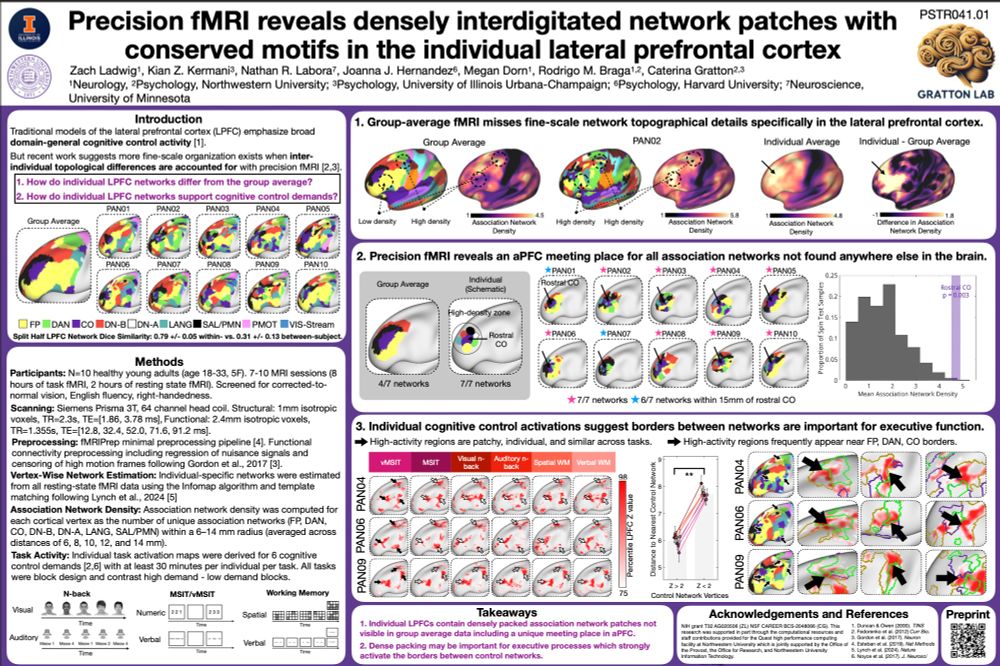
1) @zachladwig.bsky.social will be available on SATURDAY PM at poster CC14
He’ll show his work using precision fMRI to identify new common network motifs in the PFC and investigate how network borders support executive function.
Preprint: www.biorxiv.org/content/10.1...
He’ll show his work using precision fMRI to identify new common network motifs in the PFC and investigate how network borders support executive function.
Preprint: www.biorxiv.org/content/10.1...
November 14, 2025 at 3:56 PM
1) @zachladwig.bsky.social will be available on SATURDAY PM at poster CC14
He’ll show his work using precision fMRI to identify new common network motifs in the PFC and investigate how network borders support executive function.
Preprint: www.biorxiv.org/content/10.1...
He’ll show his work using precision fMRI to identify new common network motifs in the PFC and investigate how network borders support executive function.
Preprint: www.biorxiv.org/content/10.1...
Headed to #SfN25? Come by and see the posters from our lab:
more in 🧵👇
#neuroskyence #SfN2025 @sfn.org @neuronline.sfn.org
more in 🧵👇
#neuroskyence #SfN2025 @sfn.org @neuronline.sfn.org

November 14, 2025 at 3:56 PM
Headed to #SfN25? Come by and see the posters from our lab:
more in 🧵👇
#neuroskyence #SfN2025 @sfn.org @neuronline.sfn.org
more in 🧵👇
#neuroskyence #SfN2025 @sfn.org @neuronline.sfn.org
🧵4
This approach has uncovered key 🧠 network insights into, e.g.:
• distributed & parallel association networks
• prefrontal specialization
• motor map interruptions (from @gordonneuro.bsky.social 👇)
• subcortical–cortical links
• network evolution & development
This approach has uncovered key 🧠 network insights into, e.g.:
• distributed & parallel association networks
• prefrontal specialization
• motor map interruptions (from @gordonneuro.bsky.social 👇)
• subcortical–cortical links
• network evolution & development

October 16, 2025 at 3:00 PM
🧵4
This approach has uncovered key 🧠 network insights into, e.g.:
• distributed & parallel association networks
• prefrontal specialization
• motor map interruptions (from @gordonneuro.bsky.social 👇)
• subcortical–cortical links
• network evolution & development
This approach has uncovered key 🧠 network insights into, e.g.:
• distributed & parallel association networks
• prefrontal specialization
• motor map interruptions (from @gordonneuro.bsky.social 👇)
• subcortical–cortical links
• network evolution & development
🧵3
In the face of these individual differences, how can we find common principles in 🧠 organization across people 👨👨👧?
We map out a strategy using a series of relative ‘zone’-based markers.
In the face of these individual differences, how can we find common principles in 🧠 organization across people 👨👨👧?
We map out a strategy using a series of relative ‘zone’-based markers.

October 16, 2025 at 3:00 PM
🧵3
In the face of these individual differences, how can we find common principles in 🧠 organization across people 👨👨👧?
We map out a strategy using a series of relative ‘zone’-based markers.
In the face of these individual differences, how can we find common principles in 🧠 organization across people 👨👨👧?
We map out a strategy using a series of relative ‘zone’-based markers.
🧵2
This is because brain network features occur in different locations across people 🧑🧔🧑🦱🧑🦰🧓👱♀️
We review recent work highlighting the scope & characteristics of individual variability in brain network organization.
This is because brain network features occur in different locations across people 🧑🧔🧑🦱🧑🦰🧓👱♀️
We review recent work highlighting the scope & characteristics of individual variability in brain network organization.

October 16, 2025 at 3:00 PM
🧵2
This is because brain network features occur in different locations across people 🧑🧔🧑🦱🧑🦰🧓👱♀️
We review recent work highlighting the scope & characteristics of individual variability in brain network organization.
This is because brain network features occur in different locations across people 🧑🧔🧑🦱🧑🦰🧓👱♀️
We review recent work highlighting the scope & characteristics of individual variability in brain network organization.
Ah whoops interrupting the thread to post in a new version of the fig above, since it didn't load in correctly. Trying again here!

August 14, 2025 at 4:08 PM
Ah whoops interrupting the thread to post in a new version of the fig above, since it didn't load in correctly. Trying again here!
(8) - Cognitive control tasks activated a set of regions, but rather than matching a single network, these sat near the borders of individual control networks (FP, DAN, CO).
This echoes recent work by @moatazassem.bsky.social and suggests borders could be sites of cross-network communication
(16/X)
This echoes recent work by @moatazassem.bsky.social and suggests borders could be sites of cross-network communication
(16/X)

August 14, 2025 at 3:16 PM
(8) - Cognitive control tasks activated a set of regions, but rather than matching a single network, these sat near the borders of individual control networks (FP, DAN, CO).
This echoes recent work by @moatazassem.bsky.social and suggests borders could be sites of cross-network communication
(16/X)
This echoes recent work by @moatazassem.bsky.social and suggests borders could be sites of cross-network communication
(16/X)
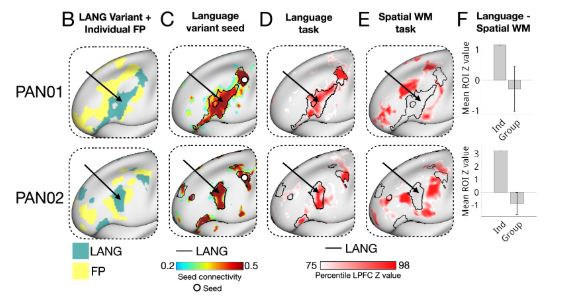
(7) Task activations matched network boundaries even in idiosyncratic locations! Like a piece of the language network in mid-LPFC. These cases provided clear examples of functional interdigitation and how group maps overestimate overlap/blurring of distinct regions
(15/X)
(15/X)
August 14, 2025 at 3:16 PM
(7) Task activations matched network boundaries even in idiosyncratic locations! Like a piece of the language network in mid-LPFC. These cases provided clear examples of functional interdigitation and how group maps overestimate overlap/blurring of distinct regions
(15/X)
(15/X)
(6) These individual-specific activations corresponded better to individual-specific brain networks versus group average estimates.
** Note: this individual advantage was generally true, but was larger in the LPFC than in the rest of the brain!
(14/X)
** Note: this individual advantage was generally true, but was larger in the LPFC than in the rest of the brain!
(14/X)

August 14, 2025 at 3:16 PM
(6) These individual-specific activations corresponded better to individual-specific brain networks versus group average estimates.
** Note: this individual advantage was generally true, but was larger in the LPFC than in the rest of the brain!
(14/X)
** Note: this individual advantage was generally true, but was larger in the LPFC than in the rest of the brain!
(14/X)
In several ways we found that the answer was yes.
(5) Replicating prior work by @rodbraga.bsky.social @laurendinicola.bsky.social @jingnandu.bsky.social we found language, theory of mind, and episodic projection contrasts preferentially engaged LPFC regions of the LANG, DN-A, & DN-B
(13/X)
(5) Replicating prior work by @rodbraga.bsky.social @laurendinicola.bsky.social @jingnandu.bsky.social we found language, theory of mind, and episodic projection contrasts preferentially engaged LPFC regions of the LANG, DN-A, & DN-B
(13/X)

August 14, 2025 at 3:16 PM
In several ways we found that the answer was yes.
(5) Replicating prior work by @rodbraga.bsky.social @laurendinicola.bsky.social @jingnandu.bsky.social we found language, theory of mind, and episodic projection contrasts preferentially engaged LPFC regions of the LANG, DN-A, & DN-B
(13/X)
(5) Replicating prior work by @rodbraga.bsky.social @laurendinicola.bsky.social @jingnandu.bsky.social we found language, theory of mind, and episodic projection contrasts preferentially engaged LPFC regions of the LANG, DN-A, & DN-B
(13/X)
(4) The rostral CO region was a special high-density-zone relative to other regions of the brain (confirmed with spin test). All 7 association networks frequently appeared near this location.
(11/X)
(11/X)

August 14, 2025 at 3:16 PM
(4) The rostral CO region was a special high-density-zone relative to other regions of the brain (confirmed with spin test). All 7 association networks frequently appeared near this location.
(11/X)
(11/X)
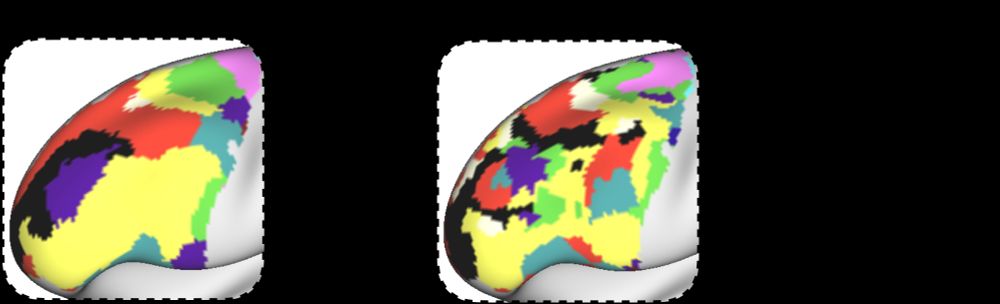
(3) This anterior LPFC fine-scale detail was NOT totally random: a conserved motif - novel anterior regions of the DAN and LANG networks bordering the CO region - was found consistently across individuals.
(10/X)
(10/X)

August 14, 2025 at 3:16 PM
(3) This anterior LPFC fine-scale detail was NOT totally random: a conserved motif - novel anterior regions of the DAN and LANG networks bordering the CO region - was found consistently across individuals.
(10/X)
(10/X)
(2) Networks in individuals were more interdigitated than in the group. While true on average throughout the LPFC, group maps particularly missed fine-scale details in the anterior LPFC.
(8/X)
(8/X)

August 14, 2025 at 3:16 PM
(2) Networks in individuals were more interdigitated than in the group. While true on average throughout the LPFC, group maps particularly missed fine-scale details in the anterior LPFC.
(8/X)
(8/X)
We found (1) FP is over-represented in group-average maps. 9/10 individuals show a distinctly smaller and more fragmented FP network versus the large contiguous FP region seen in the group.
(8/X)
(8/X)

August 14, 2025 at 3:16 PM
We found (1) FP is over-represented in group-average maps. 9/10 individuals show a distinctly smaller and more fragmented FP network versus the large contiguous FP region seen in the group.
(8/X)
(8/X)
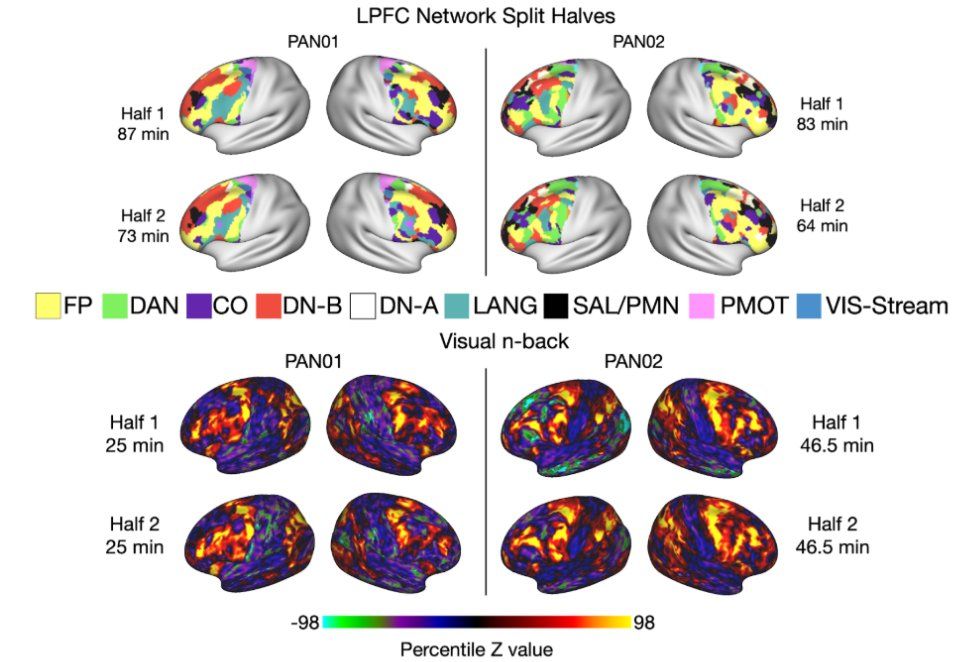
We mapped networks and task activations in each person, showing they are highly reliable with precision mapping methods - even in fine-scale detail.
7/X
7/X
August 14, 2025 at 3:16 PM
We mapped networks and task activations in each person, showing they are highly reliable with precision mapping methods - even in fine-scale detail.
7/X
7/X
Most neuroimaging studies have identified either:
(1) relatively little functional differentiation in the LPFC, supporting the idea that a large chunk of the LPFC may be flexible or
(2) that its function changes in a slow, continuous, gradient-like fashion.
(4/X)
(1) relatively little functional differentiation in the LPFC, supporting the idea that a large chunk of the LPFC may be flexible or
(2) that its function changes in a slow, continuous, gradient-like fashion.
(4/X)

August 14, 2025 at 3:16 PM
Most neuroimaging studies have identified either:
(1) relatively little functional differentiation in the LPFC, supporting the idea that a large chunk of the LPFC may be flexible or
(2) that its function changes in a slow, continuous, gradient-like fashion.
(4/X)
(1) relatively little functional differentiation in the LPFC, supporting the idea that a large chunk of the LPFC may be flexible or
(2) that its function changes in a slow, continuous, gradient-like fashion.
(4/X)
The lateral prefrontal cortex 🧠— which we think of as critical for goal driven behavior + is a target for psychiatric treatments— is fundamentally different in individuals relative to the group averages we’ve often studied.
👇see preprint and thread, led by Zach Ladwig
#neuroskyence #PsychSciSky
👇see preprint and thread, led by Zach Ladwig
#neuroskyence #PsychSciSky
August 14, 2025 at 3:16 PM
The lateral prefrontal cortex 🧠— which we think of as critical for goal driven behavior + is a target for psychiatric treatments— is fundamentally different in individuals relative to the group averages we’ve often studied.
👇see preprint and thread, led by Zach Ladwig
#neuroskyence #PsychSciSky
👇see preprint and thread, led by Zach Ladwig
#neuroskyence #PsychSciSky
Most Midwest thing ever

May 10, 2025 at 4:44 PM
Most Midwest thing ever

[Taking a break from bouts of 🤯 😑😩 to be...]
Happy that our paper is officially out in the latest issue of TICS:
go.illinois.edu/Lee2025_TICS
and highlighted with a beautiful cover art by Ally Dworetsky.
Check 👇 for a quick summary
Happy that our paper is officially out in the latest issue of TICS:
go.illinois.edu/Lee2025_TICS
and highlighted with a beautiful cover art by Ally Dworetsky.
Check 👇 for a quick summary

February 4, 2025 at 8:02 PM
[Taking a break from bouts of 🤯 😑😩 to be...]
Happy that our paper is officially out in the latest issue of TICS:
go.illinois.edu/Lee2025_TICS
and highlighted with a beautiful cover art by Ally Dworetsky.
Check 👇 for a quick summary
Happy that our paper is officially out in the latest issue of TICS:
go.illinois.edu/Lee2025_TICS
and highlighted with a beautiful cover art by Ally Dworetsky.
Check 👇 for a quick summary

Happy Thanksgiving bluesky! I’m thankful for the creative 🦃 🦃s in my household ❤️❤️❤️❤️

November 28, 2024 at 2:51 PM
Happy Thanksgiving bluesky! I’m thankful for the creative 🦃 🦃s in my household ❤️❤️❤️❤️