


C. Haas
@ca-haas.bsky.social
wildlife biologist, faculty member at Virginia Tech
Reposted by C. Haas

The life cycle of #dragonflies. From my forthcoming book "PONDS: An illustrated Guide," Yale University Press, 2026. a.co/d/1dl1IFn
🧪🐡🌿🌎 #scicomm #diagrams #infographics #Graphics #VisualJournalism #DataVisualization #Infographics #VisualStorytelling #VisualCommunication #ponds #lakes #freshwater
🧪🐡🌿🌎 #scicomm #diagrams #infographics #Graphics #VisualJournalism #DataVisualization #Infographics #VisualStorytelling #VisualCommunication #ponds #lakes #freshwater

October 29, 2025 at 12:50 PM
The life cycle of #dragonflies. From my forthcoming book "PONDS: An illustrated Guide," Yale University Press, 2026. a.co/d/1dl1IFn
🧪🐡🌿🌎 #scicomm #diagrams #infographics #Graphics #VisualJournalism #DataVisualization #Infographics #VisualStorytelling #VisualCommunication #ponds #lakes #freshwater
🧪🐡🌿🌎 #scicomm #diagrams #infographics #Graphics #VisualJournalism #DataVisualization #Infographics #VisualStorytelling #VisualCommunication #ponds #lakes #freshwater
Recent publication from our lab group provides a "recipe" for wetland restoration in fire-suppressed longleaf pine flatwoods, resulting in more than doubling the number of ponds with breeding populations of reticulated flatwoods salamanders. 🌏🧪 conbio.onlinelibrary.wiley.com/doi/10.1111/...

Tracking reticulated flatwoods salamander (Ambystoma bishopi) recovery in response to habitat restoration and assisted translocations
Naive (a) and predicted (b) number of occupied sites between 2003 and 2024. Naive occupancy data derived from larval captures, while predicted occupancy estimates are from a dynamic, spatially explic....
conbio.onlinelibrary.wiley.com
October 30, 2025 at 3:45 AM
Recent publication from our lab group provides a "recipe" for wetland restoration in fire-suppressed longleaf pine flatwoods, resulting in more than doubling the number of ponds with breeding populations of reticulated flatwoods salamanders. 🌏🧪 conbio.onlinelibrary.wiley.com/doi/10.1111/...
Reposted by C. Haas

It's not going to "vanish," it's going to be eliminated by the current administration.
🌿🌎
🌿🌎

Bees are collapsing in the U.S. A key to their secrets might vanish.
The top federal lab on native bees is set to close under President Trump’s budget.
www.washingtonpost.com
June 22, 2025 at 4:28 PM
It's not going to "vanish," it's going to be eliminated by the current administration.
🌿🌎
🌿🌎
Reposted by C. Haas

My latest for @instbirdpop.bsky.social ! This was our 2024 winter card illustration - a break from the snow, since the end of the year comes to the tropics too! Featuring a nosa' luta (Zosterops rotensis) chowing down on a caterpillar plucked off a trongkon guåfi (Serianthes nelsonii) 🎨🪶🐡🌏 #birdart

January 7, 2025 at 3:53 PM
My latest for @instbirdpop.bsky.social ! This was our 2024 winter card illustration - a break from the snow, since the end of the year comes to the tropics too! Featuring a nosa' luta (Zosterops rotensis) chowing down on a caterpillar plucked off a trongkon guåfi (Serianthes nelsonii) 🎨🪶🐡🌏 #birdart
It took more than a decade of field work by a large and dedicated crew, and several years of data wrangling by postdocs, graduate students, and research associates, and great support from sponsors and colleagues, but exciting to see it come together! 🧪 🌎 doi.org/10.1643/h202...

Wetland Hydrology, Not Altered Phenology, Challenges Reticulated Flatwoods Salamander (Ambystoma bishopi) Management Under Future Climate Change
Shifts in phenology have been one of the most frequently documented effects of climate change across a wide variety of taxonomic groups. These shifts can alter both species and ecosystem level process...
doi.org
November 27, 2024 at 5:31 AM
It took more than a decade of field work by a large and dedicated crew, and several years of data wrangling by postdocs, graduate students, and research associates, and great support from sponsors and colleagues, but exciting to see it come together! 🧪 🌎 doi.org/10.1643/h202...
Hoping these principles can help guide conservation of amphibians and reptiles even without much baseline data, by applying theory. 🌍 🧪 meridian.allenpress.com/journal-of-h...

Ten Principles From Evolutionary Ecology for the Effective Conservation of Reptiles and Amphibians
ABSTRACT. Reptiles and amphibians are disproportionately threatened among vertebrates but are lagging behind other vertebrate taxa with regards to conservation plans. As the need to triage data-limite...
meridian.allenpress.com
November 27, 2024 at 5:18 AM
Hoping these principles can help guide conservation of amphibians and reptiles even without much baseline data, by applying theory. 🌍 🧪 meridian.allenpress.com/journal-of-h...
Several former students collaborated on this paper modeling turtle habitat and one got the cover photo! Another example of how understanding topographic controls on hydrology can inform conservation of reptiles and amphibians. onlinelibrary.wiley.com/doi/full/10.... 🌏🧪
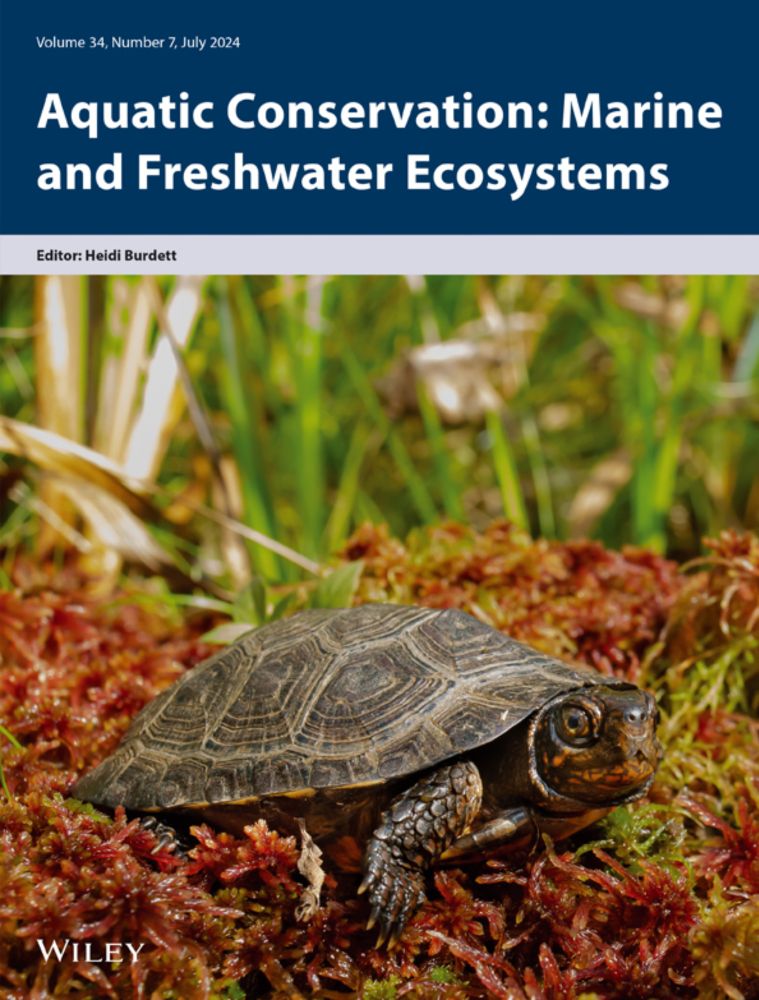
Aquatic Conservation: Marine and Freshwater Ecosystems: Vol 34, No 7
Aquatic Conservation: Marine and Freshwater Ecosystems is an international journal focusing on the conservation of freshwater, brackish or marine habitat.
onlinelibrary.wiley.com
July 12, 2024 at 4:14 PM
Several former students collaborated on this paper modeling turtle habitat and one got the cover photo! Another example of how understanding topographic controls on hydrology can inform conservation of reptiles and amphibians. onlinelibrary.wiley.com/doi/full/10.... 🌏🧪
Modern technology can provide so much information that is useful to conservation of amphibians that breed in ephemeral wetlands. Proud of our recent paper including LiDAR data and automated water level loggers as another contribution in this area. link.springer.com/article/10.1...
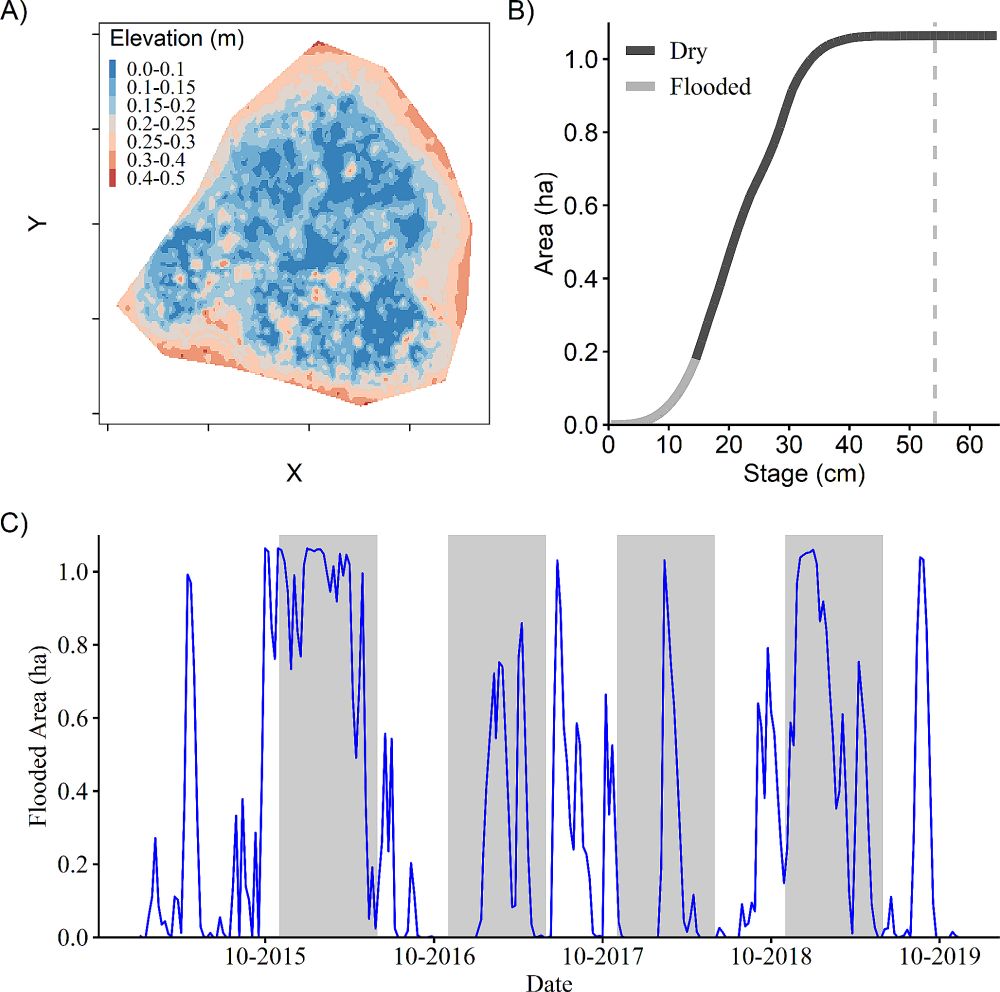
Informing the Conservation of Ephemerally Flooded Wetlands Using Hydrologic Regime and LiDAR-Based Habitat Assessments - Wetlands
Integrated assessments of wetland hydrologic regimes and other environmental factors are key to understanding the ecology of species breeding in ephemerally flooded wetlands, and reproductive success ...
link.springer.com
May 19, 2024 at 5:14 PM
Modern technology can provide so much information that is useful to conservation of amphibians that breed in ephemeral wetlands. Proud of our recent paper including LiDAR data and automated water level loggers as another contribution in this area. link.springer.com/article/10.1...