



Gosia Curyło
@astrogosia.bsky.social
Astrophysics research fellow at Monash, timing pulsars 💫
🇵🇱 🇦🇺
🇵🇱 🇦🇺
Reposted by Gosia Curyło

Hot off the press!
One of my students, Yu Wing (Joshua) Lee, has discovered a new radio transient (along with @manishacaleb.bsky.social).
Read more about "The Stellar Object That’s Too Slow to Shine" in their Conversation article:
theconversation.com/blinking-rad...
#RadioAstronomy
One of my students, Yu Wing (Joshua) Lee, has discovered a new radio transient (along with @manishacaleb.bsky.social).
Read more about "The Stellar Object That’s Too Slow to Shine" in their Conversation article:
theconversation.com/blinking-rad...
#RadioAstronomy

Blinking radio pulses from space hint at a cosmic object that ‘shouldn’t exist’
The slowest ‘cosmic lighthouse’ ever found challenges our understanding of how neutron stars work.
theconversation.com
January 15, 2025 at 7:18 PM
Hot off the press!
One of my students, Yu Wing (Joshua) Lee, has discovered a new radio transient (along with @manishacaleb.bsky.social).
Read more about "The Stellar Object That’s Too Slow to Shine" in their Conversation article:
theconversation.com/blinking-rad...
#RadioAstronomy
One of my students, Yu Wing (Joshua) Lee, has discovered a new radio transient (along with @manishacaleb.bsky.social).
Read more about "The Stellar Object That’s Too Slow to Shine" in their Conversation article:
theconversation.com/blinking-rad...
#RadioAstronomy
Reposted by Gosia Curyło

And you don't need to be an expert to process #JWST images ... you can do it from your own home, for free and it's not that hard.
Here's some guidelines: www.spaceaustralia.com/news/process...
🔭🧪
Here's some guidelines: www.spaceaustralia.com/news/process...
🔭🧪
Process your own JWST images at home | Spaceaustralia
Since its launch, the JWST has not only been giving us an unprecedented new look at the Universe, it’s been leaving global audiences gasping at the beauty that exists across the cosmos. Now, you can a...
www.spaceaustralia.com
December 1, 2024 at 4:14 AM
And you don't need to be an expert to process #JWST images ... you can do it from your own home, for free and it's not that hard.
Here's some guidelines: www.spaceaustralia.com/news/process...
🔭🧪
Here's some guidelines: www.spaceaustralia.com/news/process...
🔭🧪
Reposted by Gosia Curyło

1 in 100 billion!
The double pulsar system, where both pulsar beams point at us, offers astronomers a unique chance to study extreme astrophysics.
@cosmicrami.com chatted with @astromelow.bsky.social on his new paper.
www.spaceaustralia.com/feature/unve...
#SpaceAustralia
🔭📡🧪
📸M. Kramer/MPIfR
The double pulsar system, where both pulsar beams point at us, offers astronomers a unique chance to study extreme astrophysics.
@cosmicrami.com chatted with @astromelow.bsky.social on his new paper.
www.spaceaustralia.com/feature/unve...
#SpaceAustralia
🔭📡🧪
📸M. Kramer/MPIfR

November 26, 2024 at 9:22 PM
1 in 100 billion!
The double pulsar system, where both pulsar beams point at us, offers astronomers a unique chance to study extreme astrophysics.
@cosmicrami.com chatted with @astromelow.bsky.social on his new paper.
www.spaceaustralia.com/feature/unve...
#SpaceAustralia
🔭📡🧪
📸M. Kramer/MPIfR
The double pulsar system, where both pulsar beams point at us, offers astronomers a unique chance to study extreme astrophysics.
@cosmicrami.com chatted with @astromelow.bsky.social on his new paper.
www.spaceaustralia.com/feature/unve...
#SpaceAustralia
🔭📡🧪
📸M. Kramer/MPIfR
Reposted by Gosia Curyło
y'all.
FAST is an incredible instrument. It is a radio dish that is so big, they placed it in a valley - it is 500m in diameter! (Murriyang is just 64m!)
This makes it extremely sensitive at certain frequencies.
And the team just announced 473 NEW pulsars, incl. 137 new Millisecond Pulsars 🔭📡
FAST is an incredible instrument. It is a radio dish that is so big, they placed it in a valley - it is 500m in diameter! (Murriyang is just 64m!)
This makes it extremely sensitive at certain frequencies.
And the team just announced 473 NEW pulsars, incl. 137 new Millisecond Pulsars 🔭📡

The FAST Galactic Plane Pulsar Snapshot survey: VI. The discovery of 473 new pulsars
The Five-hundred-meter Aperture Spherical radio Telescope (FAST) is the most sensitive telescope at the L-band (1.0-1.5GHz) and has been used to carry out the FAST Galactic Plane Pulsar Snapshot (GPPS...
arxiv.org
November 27, 2024 at 3:09 AM
y'all.
FAST is an incredible instrument. It is a radio dish that is so big, they placed it in a valley - it is 500m in diameter! (Murriyang is just 64m!)
This makes it extremely sensitive at certain frequencies.
And the team just announced 473 NEW pulsars, incl. 137 new Millisecond Pulsars 🔭📡
FAST is an incredible instrument. It is a radio dish that is so big, they placed it in a valley - it is 500m in diameter! (Murriyang is just 64m!)
This makes it extremely sensitive at certain frequencies.
And the team just announced 473 NEW pulsars, incl. 137 new Millisecond Pulsars 🔭📡
Reposted by Gosia Curyło

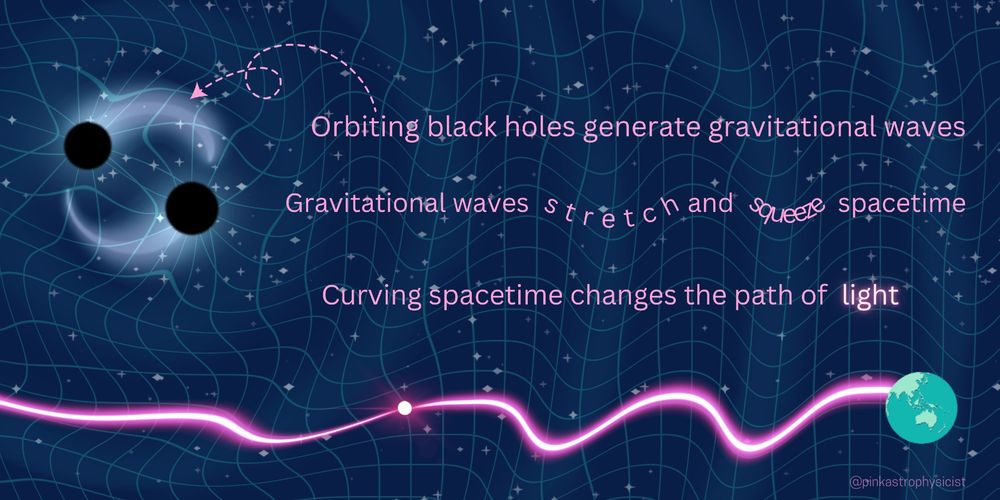
How can pulsars be used to detect gravitational waves? Ripples in spacetime affect the path of light!
I'll be posting some fun infographics in the lead up to my paper release on December 3! Follow along so you're ready for the release 🌟 @ozgrav.bsky.social
I'll be posting some fun infographics in the lead up to my paper release on December 3! Follow along so you're ready for the release 🌟 @ozgrav.bsky.social
November 21, 2024 at 11:57 PM
How can pulsars be used to detect gravitational waves? Ripples in spacetime affect the path of light!
I'll be posting some fun infographics in the lead up to my paper release on December 3! Follow along so you're ready for the release 🌟 @ozgrav.bsky.social
I'll be posting some fun infographics in the lead up to my paper release on December 3! Follow along so you're ready for the release 🌟 @ozgrav.bsky.social