



Anne Briais
@annebriais.bsky.social
Marine geologist and geophysicist. Love oceanographic exploration and seafloor maps. Research scientist @CNRS.bsky Geo-Ocean. Views are my own.
Reposted by Anne Briais

One more Pyrenees stage! And luckily, we have one more Pyrenees clip! How the deepest rocks end up on the highest peaks!
youtu.be/0t4EifLi-zU?...
youtu.be/0t4EifLi-zU?...
GeoTdF 2023 - Stage 5: Earth's mantle
YouTube video by Geo-Sports - The Geology of Sports Events
youtu.be
July 19, 2025 at 7:33 AM
One more Pyrenees stage! And luckily, we have one more Pyrenees clip! How the deepest rocks end up on the highest peaks!
youtu.be/0t4EifLi-zU?...
youtu.be/0t4EifLi-zU?...
Reposted by Anne Briais
Pierre-Yves Raumer @pyraumer.bsky.social is a PhD student at Geo-Ocean in Brest. With a background in computer science, Pierre-Yves develops machine learning techniques to automate and improve the analysis of hydrophone records, teasing apart whale songs, icequakes and earthquakes in record time!
January 5, 2025 at 5:02 PM
Pierre-Yves Raumer @pyraumer.bsky.social is a PhD student at Geo-Ocean in Brest. With a background in computer science, Pierre-Yves develops machine learning techniques to automate and improve the analysis of hydrophone records, teasing apart whale songs, icequakes and earthquakes in record time!
Reposted by Anne Briais
Jean-Arthur Olive @jaodynamics.bsky.social is a CNRS Research Scientist at ENS in Paris, and co-chief scientist on #GEODAMS. J-A uses mechanical models and geophysical observations to understand how the lithosphere deforms at tectonic plate boundaries, with mid-ocean ridges being his clear favorite.
January 5, 2025 at 5:02 PM
Jean-Arthur Olive @jaodynamics.bsky.social is a CNRS Research Scientist at ENS in Paris, and co-chief scientist on #GEODAMS. J-A uses mechanical models and geophysical observations to understand how the lithosphere deforms at tectonic plate boundaries, with mid-ocean ridges being his clear favorite.
Reposted by Anne Briais
Reposted by Anne Briais
Measuring travel time and knowing the speed of sound in water, the echosounder provides depth measurements along swaths, which we combine to create bathymetric maps, revealing underwater landscapes, submarine volcanoes, and ridges.

January 19, 2025 at 12:02 PM
Measuring travel time and knowing the speed of sound in water, the echosounder provides depth measurements along swaths, which we combine to create bathymetric maps, revealing underwater landscapes, submarine volcanoes, and ridges.
Reposted by Anne Briais
Using broadband OBSs, we will also carry out compliance measurements: that's looking at how the oceanic crust responds to changes in water pressure at the seafloor, due to tides and ocean dynamics. This should tell us whether magma is present at depth in the crust.

January 30, 2025 at 9:17 AM
Using broadband OBSs, we will also carry out compliance measurements: that's looking at how the oceanic crust responds to changes in water pressure at the seafloor, due to tides and ocean dynamics. This should tell us whether magma is present at depth in the crust.
Reposted by Anne Briais
This local network will let us locate the events with high precision to characterize how mid-ocean ridge faults slip.

January 30, 2025 at 9:17 AM
This local network will let us locate the events with high precision to characterize how mid-ocean ridge faults slip.
Reposted by Anne Briais
For the last ~10 days, we've been hard at work on and around the Southeast Indian Ridge at 37ºS to recover and redeploy a bunch of geophysical instruments. Let's break it down 👇

January 30, 2025 at 9:17 AM
For the last ~10 days, we've been hard at work on and around the Southeast Indian Ridge at 37ºS to recover and redeploy a bunch of geophysical instruments. Let's break it down 👇
Reposted by Anne Briais
Once comfortably settled in the SOFAR channel, hydrophones record the sound made by earthquakes near and far, and let us relocate them with much better accuracy than distant seismometers on land.
January 30, 2025 at 6:17 PM
Once comfortably settled in the SOFAR channel, hydrophones record the sound made by earthquakes near and far, and let us relocate them with much better accuracy than distant seismometers on land.
Reposted by Anne Briais
They also record whale songs, and even the sound of icebergs grinding against each other! See for example this great explainer video from @noaa.gov : oceanexplorer.noaa.gov/explorations...
NOAA Ocean Explorer: Submarine Ring of Fire 2003: Hydroacoustics Animation
oceanexplorer.noaa.gov
January 30, 2025 at 6:17 PM
They also record whale songs, and even the sound of icebergs grinding against each other! See for example this great explainer video from @noaa.gov : oceanexplorer.noaa.gov/explorations...

Reposted by Anne Briais
But last week we succeeded in recovering and re-deploying 1 beacon from the ridge network, and 1 from the transform network. The first year of data did not disappoint! #ToBeContinued

January 31, 2025 at 4:18 AM
But last week we succeeded in recovering and re-deploying 1 beacon from the ridge network, and 1 from the transform network. The first year of data did not disappoint! #ToBeContinued
Reposted by Anne Briais
Some deployments can take up to 11 hours, as we go through trial-and-error on different target sites with the tripod hanging from the ship on a 2-km long cable.


January 31, 2025 at 4:18 AM
Some deployments can take up to 11 hours, as we go through trial-and-error on different target sites with the tripod hanging from the ship on a 2-km long cable.
Reposted by Anne Briais
The core of the OHA-GEODAMS project is to measure active deformation for 3 years on the Southeast Indian Ridge and the Amsterdam transform fault. To this end, in February 2024, we deployed 15 acoustic beacons that have been pinging each other every few hours ever since.

January 31, 2025 at 4:18 AM
The core of the OHA-GEODAMS project is to measure active deformation for 3 years on the Southeast Indian Ridge and the Amsterdam transform fault. To this end, in February 2024, we deployed 15 acoustic beacons that have been pinging each other every few hours ever since.
Reposted by Anne Briais
We start by deploying the float containing the hydrophone from the back deck, then unroll the ~2 km long mooring...
January 30, 2025 at 6:17 PM
We start by deploying the float containing the hydrophone from the back deck, then unroll the ~2 km long mooring...
Reposted by Anne Briais
We deployed 7 Ocean Bottom Seismometers (OBSs) to record earthquakes and other signals emitted by the Southeast Indian Ridge and the Amsterdam transform fault.

January 30, 2025 at 9:17 AM
We deployed 7 Ocean Bottom Seismometers (OBSs) to record earthquakes and other signals emitted by the Southeast Indian Ridge and the Amsterdam transform fault.
Reposted by Anne Briais

Volume 395 of the Proceedings of the #IODP #Exp395, Reykjanes Mantle Convection and Climate, was published online today, 21 January 2025. Enjoy!
publications.iodp.org/proceedings/...
publications.iodp.org/proceedings/...
Proceedings of the International Ocean Discovery Program Volume 395
Reykjanes Mantle Convection and Climate
publications.iodp.org
January 22, 2025 at 12:18 AM
Volume 395 of the Proceedings of the #IODP #Exp395, Reykjanes Mantle Convection and Climate, was published online today, 21 January 2025. Enjoy!
publications.iodp.org/proceedings/...
publications.iodp.org/proceedings/...
Reposted by Anne Briais
As we make our way to our study area, we map the seafloor under the ship! 🌊 Our multibeam echosounder sends acoustic waves to the ocean floor and records how much time they take to bounce back.

January 19, 2025 at 12:02 PM
As we make our way to our study area, we map the seafloor under the ship! 🌊 Our multibeam echosounder sends acoustic waves to the ocean floor and records how much time they take to bounce back.
Reposted by Anne Briais
We will recover it at the location of our last hydrophone, West of Amsterdam, next week.
January 20, 2025 at 6:16 AM
We will recover it at the location of our last hydrophone, West of Amsterdam, next week.
Reposted by Anne Briais
This glider is equipped with a hydrophone (48kHz) to record the underwater soundscape, and in particular the cetaceans (i.e., blue whales, fin whales, killer whales, sperm whales, etc.). The glider will navigate south and west of Amsterdam, diving down to 1000 m, driven by buoyancy changes.

January 20, 2025 at 6:16 AM
This glider is equipped with a hydrophone (48kHz) to record the underwater soundscape, and in particular the cetaceans (i.e., blue whales, fin whales, killer whales, sperm whales, etc.). The glider will navigate south and west of Amsterdam, diving down to 1000 m, driven by buoyancy changes.
Reposted by Anne Briais
In the meantime, Julie stayed on the Marion Dufresne, to manage communications between the pilot team in Brest and the team on the workboat.
January 20, 2025 at 6:16 AM
In the meantime, Julie stayed on the Marion Dufresne, to manage communications between the pilot team in Brest and the team on the workboat.
Reposted by Anne Briais
In order to prevent the glider from colliding with the Marion Dufresne, it had to be launched at a certain distance. To do so, 3 brave members of our GEODAMS team, Anne, Séverine and Diane, boarded a workboat with 2 LDA crew members.


January 20, 2025 at 6:16 AM
In order to prevent the glider from colliding with the Marion Dufresne, it had to be launched at a certain distance. To do so, 3 brave members of our GEODAMS team, Anne, Séverine and Diane, boarded a workboat with 2 LDA crew members.
Reposted by Anne Briais
A few days ago, we deployed a Sea Explorer glider developed by ALSEAMAR and owned by ENSTA Bretagne at the location of our first hydrophone, southeast of Amsterdam island.

January 20, 2025 at 6:16 AM
A few days ago, we deployed a Sea Explorer glider developed by ALSEAMAR and owned by ENSTA Bretagne at the location of our first hydrophone, southeast of Amsterdam island.
Reposted by Anne Briais
Planning our upcoming deployments like they schedule sketches on Saturday Night Live
(with multiple new versions since that v1 😜) #GEODAMS
(with multiple new versions since that v1 😜) #GEODAMS


January 19, 2025 at 11:47 AM
Planning our upcoming deployments like they schedule sketches on Saturday Night Live
(with multiple new versions since that v1 😜) #GEODAMS
(with multiple new versions since that v1 😜) #GEODAMS
Reposted by Anne Briais
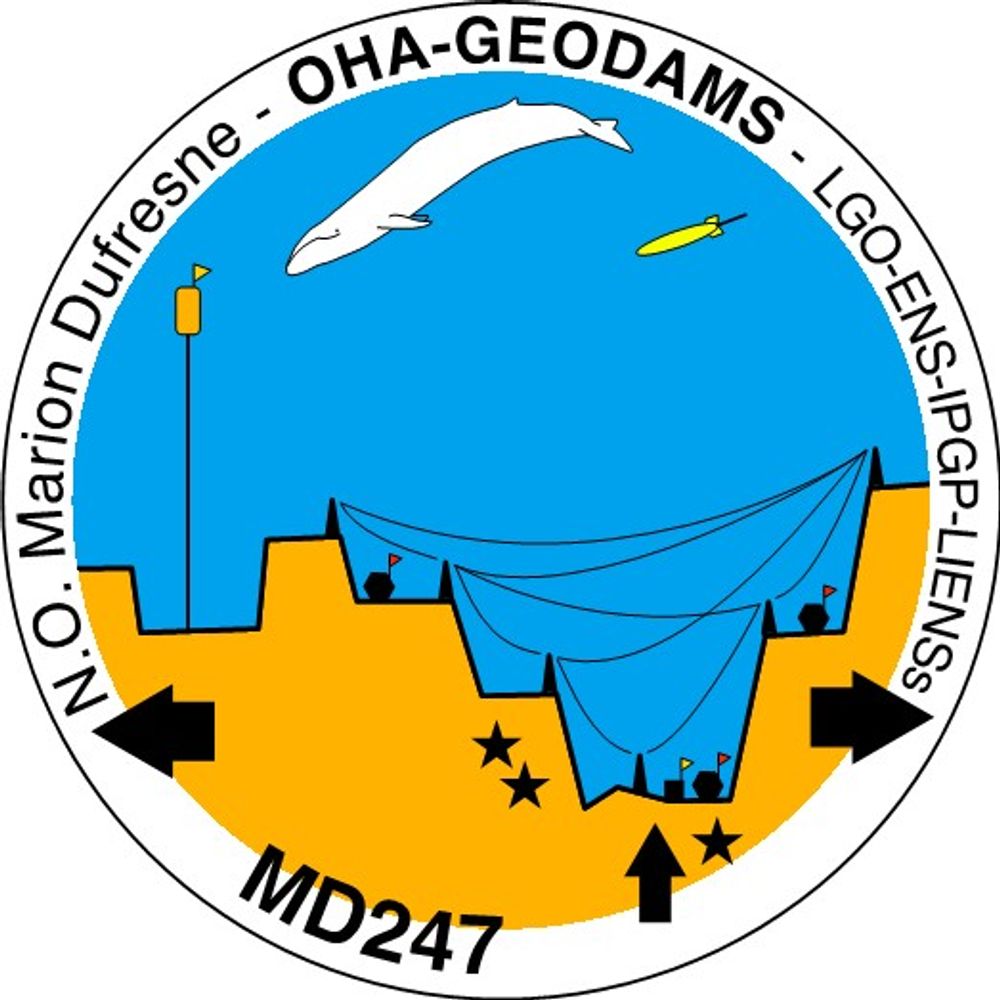
A tradition aboard the Marion Dufresne is to stamp letters to be mailed from the French Southern and Antarctic Lands. The ship captain, chief mechanic, doctor... each have their own stamp, and the science teams make new, custom ones every year!


January 14, 2025 at 1:43 PM
A tradition aboard the Marion Dufresne is to stamp letters to be mailed from the French Southern and Antarctic Lands. The ship captain, chief mechanic, doctor... each have their own stamp, and the science teams make new, custom ones every year!