



Ann-Sophie Kroell
@ann-sophiekroell.bsky.social
PhD Student @ Niopek Lab, Uni Heidelberg
Synthetic Biology, Protein Switches, Protein Engineering, CRISPR
Synthetic Biology, Protein Switches, Protein Engineering, CRISPR
Reposted by Ann-Sophie Kroell

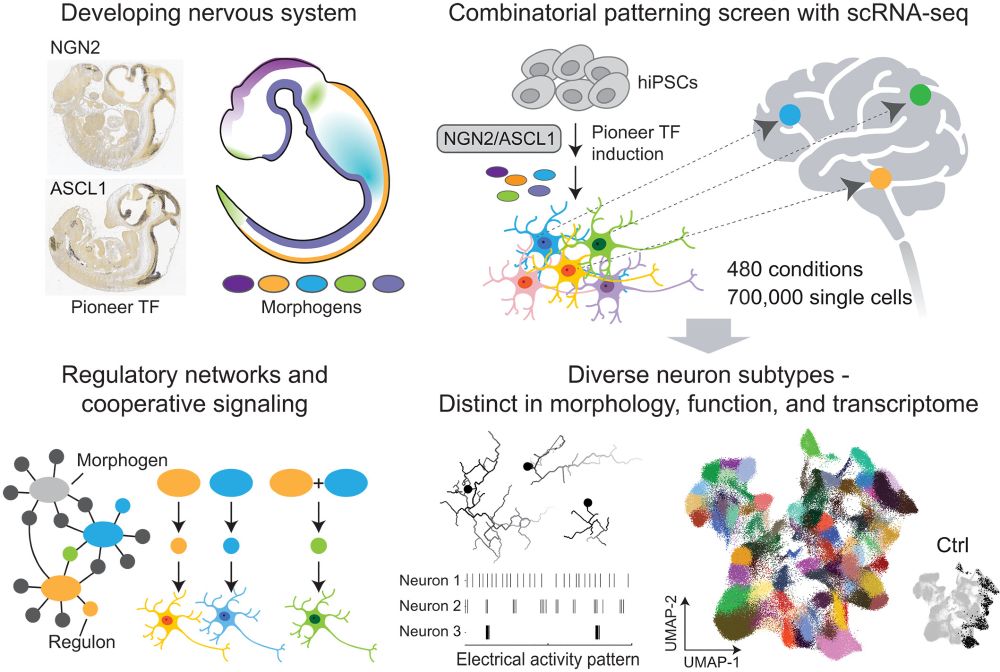
My postdoc work at Treutlein lab and @graycamplab.bsky.social with @jasperjanssens.bsky.social is out in @science.org ! We screen for neuron subtypes using pro-neural TFs + morphogen combinations + scRNA-seq and profiled over 700,000 cells in 480 conditions. www.science.org/doi/10.1126/...
July 12, 2025 at 10:11 PM
My postdoc work at Treutlein lab and @graycamplab.bsky.social with @jasperjanssens.bsky.social is out in @science.org ! We screen for neuron subtypes using pro-neural TFs + morphogen combinations + scRNA-seq and profiled over 700,000 cells in 480 conditions. www.science.org/doi/10.1126/...
Reposted by Ann-Sophie Kroell

Excited to share my main PhD work is finally out! 🥳
We built a phage-assisted evolution platform to evolve allosteric protein switches (POGO-PANCE) and introduce cumulative, targeted mutations/Indels (RAMPhaGE)!
See how we evolved ultra-strong, light-switchable AraC variants 🌚🌞
We built a phage-assisted evolution platform to evolve allosteric protein switches (POGO-PANCE) and introduce cumulative, targeted mutations/Indels (RAMPhaGE)!
See how we evolved ultra-strong, light-switchable AraC variants 🌚🌞

Phage-Assisted Evolution of Allosteric Protein Switches https://www.biorxiv.org/content/10.1101/2025.06.12.659331v1
June 13, 2025 at 9:23 AM
Excited to share my main PhD work is finally out! 🥳
We built a phage-assisted evolution platform to evolve allosteric protein switches (POGO-PANCE) and introduce cumulative, targeted mutations/Indels (RAMPhaGE)!
See how we evolved ultra-strong, light-switchable AraC variants 🌚🌞
We built a phage-assisted evolution platform to evolve allosteric protein switches (POGO-PANCE) and introduce cumulative, targeted mutations/Indels (RAMPhaGE)!
See how we evolved ultra-strong, light-switchable AraC variants 🌚🌞
Reposted by Ann-Sophie Kroell

Check out the new pre-print from our lab on phage-assisted evolution of light-switchable, allosteric proteins. Congrats to first author @neuroscinikolai.bsky.social, co-corresponding author @jmathony.bsky.social and everyone from the @niopeklab.bsky.social involved!
www.biorxiv.org/content/10.1...
www.biorxiv.org/content/10.1...

Phage-Assisted Evolution of Allosteric Protein Switches
Allostery, the transmission of locally induced conformational changes to distant functional sites, is a key mechanism for protein regulation. Artificial allosteric effectors enable remote manipulation...
www.biorxiv.org
June 13, 2025 at 10:13 AM
Check out the new pre-print from our lab on phage-assisted evolution of light-switchable, allosteric proteins. Congrats to first author @neuroscinikolai.bsky.social, co-corresponding author @jmathony.bsky.social and everyone from the @niopeklab.bsky.social involved!
www.biorxiv.org/content/10.1...
www.biorxiv.org/content/10.1...
Reposted by Ann-Sophie Kroell

New paper alert! We introduce the modular allosteric thermo-control of protein activity. Employing the AsLOV2 domain and mutants thereof as thermoreceptors, we engineered diverse hybrid proteins, whose activity can be controlled by small temperature changes (37-40/41 °C).
doi.org/10.1101/2025...
doi.org/10.1101/2025...
doi.org
May 3, 2025 at 11:03 AM
New paper alert! We introduce the modular allosteric thermo-control of protein activity. Employing the AsLOV2 domain and mutants thereof as thermoreceptors, we engineered diverse hybrid proteins, whose activity can be controlled by small temperature changes (37-40/41 °C).
doi.org/10.1101/2025...
doi.org/10.1101/2025...
Reposted by Ann-Sophie Kroell

In @nature.com we describe the use of scalable #proteinengineering & #machinelearning to predict millions of bespoke CRISPR enzymes, offering safer & more efficient genome editing tools 🧬🖥️ @rachelsilverstein9.bsky.social @mgbresearch.bsky.social @harvardmed.bsky.social
www.nature.com/articles/s41...
www.nature.com/articles/s41...
Custom CRISPR—Cas9 PAM variants via scalable engineering and machine learning - Nature
Nature - Custom CRISPR—Cas9 PAM variants via scalable engineering and machine learning
www.nature.com
April 22, 2025 at 8:57 PM
In @nature.com we describe the use of scalable #proteinengineering & #machinelearning to predict millions of bespoke CRISPR enzymes, offering safer & more efficient genome editing tools 🧬🖥️ @rachelsilverstein9.bsky.social @mgbresearch.bsky.social @harvardmed.bsky.social
www.nature.com/articles/s41...
www.nature.com/articles/s41...
Reposted by Ann-Sophie Kroell

We are thrilled to share ProDomino a model for the prediction of domain insertion sites in proteins. Our approach enables the simple and rapid engineering of highly potent switchable proteins, as we exemplify by creating novel inducible variants of Cas9 and Cas12a.
www.biorxiv.org/content/10.1...
www.biorxiv.org/content/10.1...

Rational engineering of allosteric protein switches by in silico prediction of domain insertion sites
Domain insertion engineering is a powerful approach to juxtapose otherwise separate biological functions, resulting in proteins with new-to-nature activities. A prominent example are switchable protei...
www.biorxiv.org
December 5, 2024 at 9:59 AM
We are thrilled to share ProDomino a model for the prediction of domain insertion sites in proteins. Our approach enables the simple and rapid engineering of highly potent switchable proteins, as we exemplify by creating novel inducible variants of Cas9 and Cas12a.
www.biorxiv.org/content/10.1...
www.biorxiv.org/content/10.1...
Reposted by Ann-Sophie Kroell
New pre-print from our group reporting engineered, broad-spectrum anti-CRISPR proteins based on AcrIIA5, a type II inhibitor, and AcrVA1, a type V inhibitor, for opto- and chemogenetic control of CRISPR-Cas9 and -Cas12a:
www.biorxiv.org/content/10.1...
(1/3)
www.biorxiv.org/content/10.1...
(1/3)

A Versatile Anti-CRISPR Platform for Opto- and Chemogenetic Control of CRISPR-Cas9 and Cas12 across a Wide Range of Orthologs
CRISPR-Cas technologies have revolutionized life sciences by enabling programmable genome editing across diverse organisms. Achieving dynamic and precise control over CRISPR-Cas activity with exogenou...
www.biorxiv.org
November 26, 2024 at 11:34 AM
New pre-print from our group reporting engineered, broad-spectrum anti-CRISPR proteins based on AcrIIA5, a type II inhibitor, and AcrVA1, a type V inhibitor, for opto- and chemogenetic control of CRISPR-Cas9 and -Cas12a:
www.biorxiv.org/content/10.1...
(1/3)
www.biorxiv.org/content/10.1...
(1/3)
Reposted by Ann-Sophie Kroell
Now out in Nucleic Acids Research: A deep mutational scanning platform to characterize the fitness landscape of anti-CRISPR proteins: doi.org/10.1093/nar/...
(1/4)
(1/4)

A deep mutational scanning platform to characterize the fitness landscape of anti-CRISPR proteins
Abstract. Deep mutational scanning is a powerful method for exploring the mutational fitness landscape of proteins. Its adaptation to anti-CRISPR proteins,
doi.org
November 26, 2024 at 11:30 AM
Now out in Nucleic Acids Research: A deep mutational scanning platform to characterize the fitness landscape of anti-CRISPR proteins: doi.org/10.1093/nar/...
(1/4)
(1/4)