



Alex N
@alexnguyen1.bsky.social
student interested in science + innovation policy
Reposted by Alex N

New starter pack: I created this one for people interested in research on #science #communication and public #engagement with science. Feel free to follow them, share the list, and suggest additions! #scicomm
go.bsky.app/3qW3UL2
go.bsky.app/3qW3UL2
November 17, 2024 at 7:57 AM
New starter pack: I created this one for people interested in research on #science #communication and public #engagement with science. Feel free to follow them, share the list, and suggest additions! #scicomm
go.bsky.app/3qW3UL2
go.bsky.app/3qW3UL2
Reposted by Alex N
Joining in on the buzz: I started a list with researchers working on trust in science across disciplines! Any suggestions? Self-suggestions more than welcome!! Let’s connect! Please share widely 🤗 #trustinscience #scicomm
go.bsky.app/UXRS1uq
go.bsky.app/UXRS1uq
November 16, 2024 at 8:40 PM
Joining in on the buzz: I started a list with researchers working on trust in science across disciplines! Any suggestions? Self-suggestions more than welcome!! Let’s connect! Please share widely 🤗 #trustinscience #scicomm
go.bsky.app/UXRS1uq
go.bsky.app/UXRS1uq
Reposted by Alex N

New paper just out in Quantitative Science Studies where we find clear evidence that geographical restrictions on ChatGPT usage have largely failed. Interestingly, OpenAI seems to have taken notice, recently ramping up enforcement efforts. w/ @sunmengyi.bsky.social @innovation.bsky.social


April 17, 2025 at 7:16 PM
New paper just out in Quantitative Science Studies where we find clear evidence that geographical restrictions on ChatGPT usage have largely failed. Interestingly, OpenAI seems to have taken notice, recently ramping up enforcement efforts. w/ @sunmengyi.bsky.social @innovation.bsky.social
Reposted by Alex N

With Harvard, U Mass faculty, Princeton, Wesleyan, Rutgers faculty and others leading the way, academics are standing up to this lawless administration. Here is a pack of academics, former academics, and organizations worth following on Bluesky who are in this opposition
go.bsky.app/5hEmcTw
go.bsky.app/5hEmcTw
April 17, 2025 at 8:43 PM
With Harvard, U Mass faculty, Princeton, Wesleyan, Rutgers faculty and others leading the way, academics are standing up to this lawless administration. Here is a pack of academics, former academics, and organizations worth following on Bluesky who are in this opposition
go.bsky.app/5hEmcTw
go.bsky.app/5hEmcTw
Reposted by Alex N
A psychology journal has retracted an article on IQ tests nearly 50 years after publication — and more than 35 years after an investigation found the lead author had fabricated data in several other studies.

More than three decades after misconduct ruling, researcher’s IQ test paper is retracted
A psychology journal has retracted an article on IQ tests nearly 50 years after publication — and more than 35 years after an investigation found the lead author had fabricated data in several othe…
retractionwatch.com
January 21, 2025 at 1:58 AM
A psychology journal has retracted an article on IQ tests nearly 50 years after publication — and more than 35 years after an investigation found the lead author had fabricated data in several other studies.
Reposted by Alex N
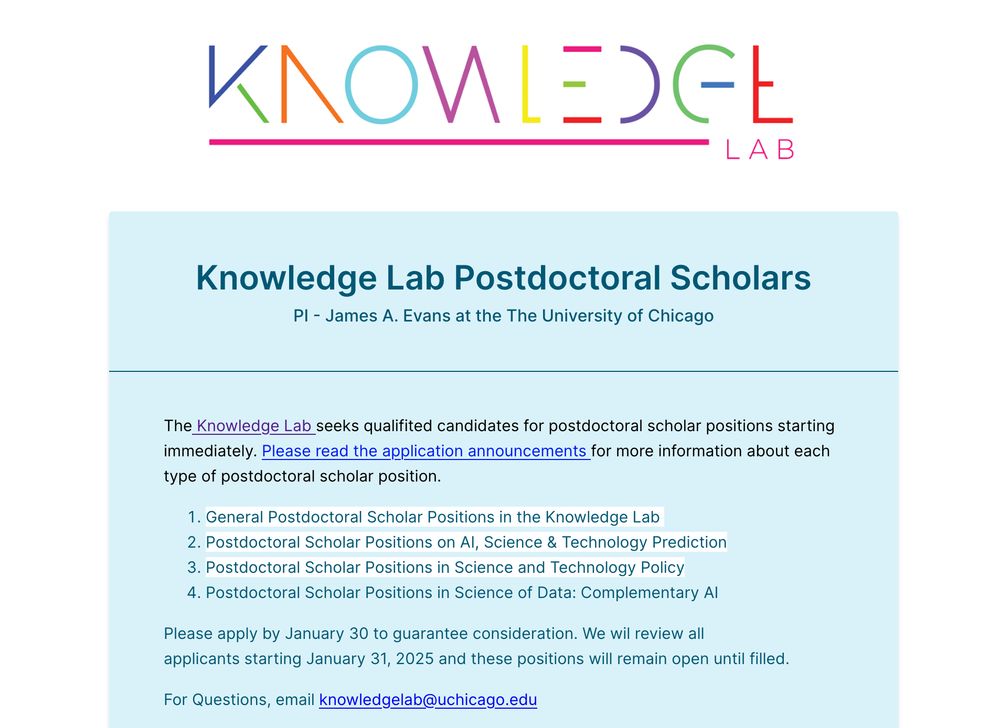
Postdoc opportunities at the Knowledge Lab at U Chicago. Application review begins Jan 31. form.jotform.com/241295631499...
December 22, 2024 at 10:39 PM
Postdoc opportunities at the Knowledge Lab at U Chicago. Application review begins Jan 31. form.jotform.com/241295631499...
Reposted by Alex N

What to do when findings from different studies don't agree? - debug your line of evidence. In this paper @sobla.bsky.social and I examine what that could mean #philsci #metasci www.journals.uchicago.edu/doi/10.1086/...
Persistent evidential discordance | The British Journal for the Philosophy of Science: Vol 0, No ja
www.journals.uchicago.edu
June 5, 2024 at 8:27 AM
What to do when findings from different studies don't agree? - debug your line of evidence. In this paper @sobla.bsky.social and I examine what that could mean #philsci #metasci www.journals.uchicago.edu/doi/10.1086/...
Reposted by Alex N
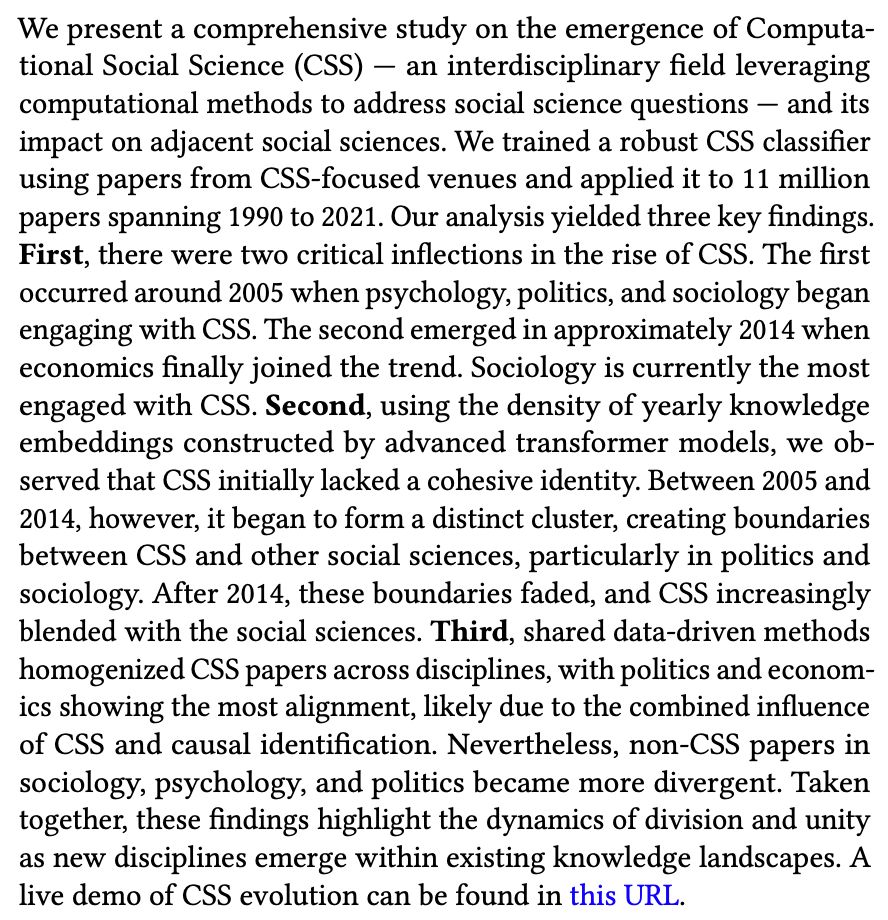
New project with @profjamesevans and my @dsi-uchicago.bsky.social friends on the largest (?) examination (~11 million papers) of how computational social science emerges from -- and shapes -- Econ, Sociology, Psych, and PoliSci. Paper: arxiv.org/abs/2412.08087 A thread: (1/7)
December 12, 2024 at 5:31 PM
New project with @profjamesevans and my @dsi-uchicago.bsky.social friends on the largest (?) examination (~11 million papers) of how computational social science emerges from -- and shapes -- Econ, Sociology, Psych, and PoliSci. Paper: arxiv.org/abs/2412.08087 A thread: (1/7)
Reposted by Alex N

I read the first post in this thread about mirror life, thought “they can’t mean…”, and then clicked the link.
Yep, that’s exactly what they mean. Bioengineering reversed-chirality microbes.
Vaughn’s piece is a necessary if frightening read.
Yep, that’s exactly what they mean. Bioengineering reversed-chirality microbes.
Vaughn’s piece is a necessary if frightening read.

I’m proud to join more than 30 colleagues today in sharing our analysis of potential risks from “mirror life”. We summarize our findings in a @science.org article, and in greater detail in a 300pg technical report:
Article: www.science.org/doi/10.1126/...
Report: purl.stanford.edu/cv716pj4036
Article: www.science.org/doi/10.1126/...
Report: purl.stanford.edu/cv716pj4036
December 12, 2024 at 7:38 PM
I read the first post in this thread about mirror life, thought “they can’t mean…”, and then clicked the link.
Yep, that’s exactly what they mean. Bioengineering reversed-chirality microbes.
Vaughn’s piece is a necessary if frightening read.
Yep, that’s exactly what they mean. Bioengineering reversed-chirality microbes.
Vaughn’s piece is a necessary if frightening read.
Reposted by Alex N

So happy to have this paper placed at NeurIPS 2024. If I may (without humility) say, I think that it is necessary reading for anyone who uses (or intends to use) fairness evaluations for applied ML.

Excited to share our new work on causal sensitivity analysis for fairness metrics at #NeurIPS2024! We've developed a causal sensitivity analysis framework to understand how underlying measurement biases (encoded by DAGs) impact machine learning fairness evaluations. 1 / 5

December 12, 2024 at 9:49 PM
So happy to have this paper placed at NeurIPS 2024. If I may (without humility) say, I think that it is necessary reading for anyone who uses (or intends to use) fairness evaluations for applied ML.