



Alberto Piccoli
@albertopiccoli.bsky.social
PhD student in Chemistry at Université Grenoble Alpes
Really delighted to see our work, titled "Rapid Electrochemical Assessment of Excited-State Quenching Dynamics" now published in ACS Catalysis! @acs.org
We combined CV under irradiation and digital simulation to extract SET rate constants in electrophotocatalytic processes ⚡💡 @unipd.bsky.social
We combined CV under irradiation and digital simulation to extract SET rate constants in electrophotocatalytic processes ⚡💡 @unipd.bsky.social

Rapid Electrochemical Assessment of Excited-State Quenching Dynamics
Recent advancements in electro-photoredox catalysis (e-PRC) and consecutive photoinduced electron transfer (conPET) have pushed the energy limits of conventional photocatalysis. Both methods produce o...
pubs.acs.org
September 26, 2025 at 9:36 AM
Really delighted to see our work, titled "Rapid Electrochemical Assessment of Excited-State Quenching Dynamics" now published in ACS Catalysis! @acs.org
We combined CV under irradiation and digital simulation to extract SET rate constants in electrophotocatalytic processes ⚡💡 @unipd.bsky.social
We combined CV under irradiation and digital simulation to extract SET rate constants in electrophotocatalytic processes ⚡💡 @unipd.bsky.social
Reposted by Alberto Piccoli

Excited organic radicals in photoredox catalysis
Our perspective just published in JACS Au:
pubs.acs.org/doi/10.1021/...
Our perspective just published in JACS Au:
pubs.acs.org/doi/10.1021/...
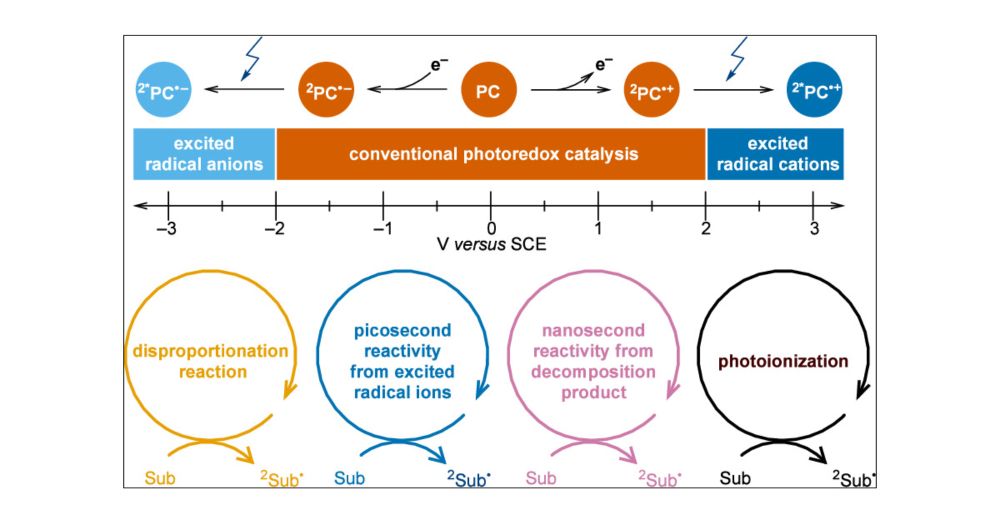
Excited Organic Radicals in Photoredox Catalysis
Many important synthetic-oriented works have proposed excited organic radicals as photoactive species, yet mechanistic studies raised doubts about whether they can truly function as photocatalysts. This skepticism originates from the formation of (photo)redox-active degradation products and the picosecond decay of electronically excited radicals, which is considered too short for diffusion-based photoinduced electron transfer reactions. From this perspective, we analyze important synthetic transformations where organic radicals have been proposed as photocatalysts, comparing their theoretical maximum excited state potentials with the potentials required for the observed photocatalytic reactivity. We summarize mechanistic studies of structurally similar photocatalysts indicating different reaction pathways for some catalytic systems, addressing cases where the proposed radical photocatalysts exceed their theoretical maximum reactivity. Additionally, we perform a kinetic analysis to explain the photoinduced electron transfer observed in excited radicals on subpicosecond time scales. We further rationalize the potential anti-Kasha reactivity from higher excited states with femtosecond lifetimes, highlighting how future photocatalysis advancements could unlock new photochemical pathways.
pubs.acs.org
January 29, 2025 at 5:30 PM
Excited organic radicals in photoredox catalysis
Our perspective just published in JACS Au:
pubs.acs.org/doi/10.1021/...
Our perspective just published in JACS Au:
pubs.acs.org/doi/10.1021/...