




Ana Almeida
@ac-almeida.bsky.social
Postoctoring in🇨🇭@ivanagasic.bsky.social Lab
Cell biologist #Cytoskeleton & #Microscopy enthusiast 🔬🧫
Cell biologist #Cytoskeleton & #Microscopy enthusiast 🔬🧫
(5/5)
Impaired adhesion is driven by changes in tubulin levels and microtubule stability.
Reducing tubulin (T007-1) or mild destabilization (nocodazole) rescues the phenotype, while hyperstabilization (taxol) worsens it.
📌Tubulin homeostasis supports multicellular organization.
Impaired adhesion is driven by changes in tubulin levels and microtubule stability.
Reducing tubulin (T007-1) or mild destabilization (nocodazole) rescues the phenotype, while hyperstabilization (taxol) worsens it.
📌Tubulin homeostasis supports multicellular organization.

July 30, 2025 at 12:20 PM
(5/5)
Impaired adhesion is driven by changes in tubulin levels and microtubule stability.
Reducing tubulin (T007-1) or mild destabilization (nocodazole) rescues the phenotype, while hyperstabilization (taxol) worsens it.
📌Tubulin homeostasis supports multicellular organization.
Impaired adhesion is driven by changes in tubulin levels and microtubule stability.
Reducing tubulin (T007-1) or mild destabilization (nocodazole) rescues the phenotype, while hyperstabilization (taxol) worsens it.
📌Tubulin homeostasis supports multicellular organization.
(4/5)
How?
Loss of autoregulation disrupts localization of adhesion molecules like N-Cadherin, Fibronectin, and Integrin α5: cells round up and lose anchorage.
📌Restoring adhesion (via E-Cadherin over expression or ECM) rescues tissue integrity and viability.
How?
Loss of autoregulation disrupts localization of adhesion molecules like N-Cadherin, Fibronectin, and Integrin α5: cells round up and lose anchorage.
📌Restoring adhesion (via E-Cadherin over expression or ECM) rescues tissue integrity and viability.
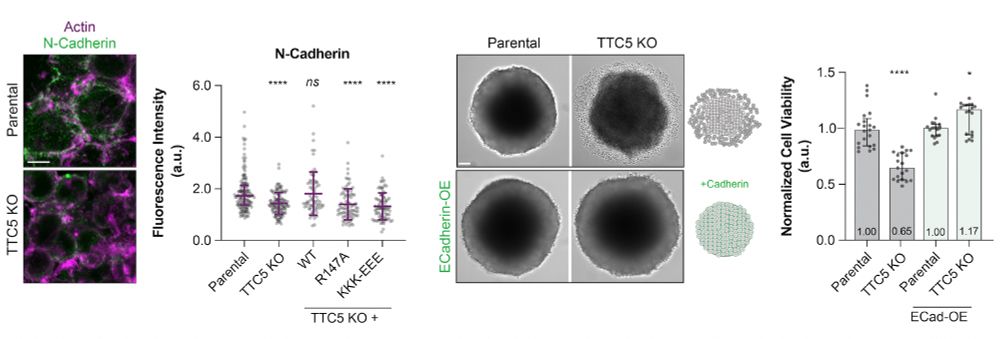
July 30, 2025 at 12:20 PM
(4/5)
How?
Loss of autoregulation disrupts localization of adhesion molecules like N-Cadherin, Fibronectin, and Integrin α5: cells round up and lose anchorage.
📌Restoring adhesion (via E-Cadherin over expression or ECM) rescues tissue integrity and viability.
How?
Loss of autoregulation disrupts localization of adhesion molecules like N-Cadherin, Fibronectin, and Integrin α5: cells round up and lose anchorage.
📌Restoring adhesion (via E-Cadherin over expression or ECM) rescues tissue integrity and viability.
(3/5)
Tubulin autoregulation is essential for spheroid architecture & viability. Without it:
- cells detach (corona forms)
- cell death increases
📌This phenotype isn’t due to cell cycle defects or migration — it reflects impaired cell adhesion.
Tubulin autoregulation is essential for spheroid architecture & viability. Without it:
- cells detach (corona forms)
- cell death increases
📌This phenotype isn’t due to cell cycle defects or migration — it reflects impaired cell adhesion.

July 30, 2025 at 12:20 PM
(3/5)
Tubulin autoregulation is essential for spheroid architecture & viability. Without it:
- cells detach (corona forms)
- cell death increases
📌This phenotype isn’t due to cell cycle defects or migration — it reflects impaired cell adhesion.
Tubulin autoregulation is essential for spheroid architecture & viability. Without it:
- cells detach (corona forms)
- cell death increases
📌This phenotype isn’t due to cell cycle defects or migration — it reflects impaired cell adhesion.
(2/5)
Loss or mutation of TTC5, the key mediator of tubulin autoregulation, increases tubulin mRNA and protein levels in 3D spheroids. This leads to microtubule hyperstability and reorganization of the network.
📌Tubulin levels matter (even in steady state!)
Loss or mutation of TTC5, the key mediator of tubulin autoregulation, increases tubulin mRNA and protein levels in 3D spheroids. This leads to microtubule hyperstability and reorganization of the network.
📌Tubulin levels matter (even in steady state!)

July 30, 2025 at 12:20 PM
(2/5)
Loss or mutation of TTC5, the key mediator of tubulin autoregulation, increases tubulin mRNA and protein levels in 3D spheroids. This leads to microtubule hyperstability and reorganization of the network.
📌Tubulin levels matter (even in steady state!)
Loss or mutation of TTC5, the key mediator of tubulin autoregulation, increases tubulin mRNA and protein levels in 3D spheroids. This leads to microtubule hyperstability and reorganization of the network.
📌Tubulin levels matter (even in steady state!)
(5/5)
Impaired adhesion is driven by changes in tubulin levels and microtubule stability.
Reducing tubulin (T007-1) or mild destabilization (nocodazole) rescues the phenotype, while hyperstabilization (taxol) worsens it.
📌Tubulin homeostasis supports multicellular organization.
Impaired adhesion is driven by changes in tubulin levels and microtubule stability.
Reducing tubulin (T007-1) or mild destabilization (nocodazole) rescues the phenotype, while hyperstabilization (taxol) worsens it.
📌Tubulin homeostasis supports multicellular organization.
July 30, 2025 at 12:16 PM
(5/5)
Impaired adhesion is driven by changes in tubulin levels and microtubule stability.
Reducing tubulin (T007-1) or mild destabilization (nocodazole) rescues the phenotype, while hyperstabilization (taxol) worsens it.
📌Tubulin homeostasis supports multicellular organization.
Impaired adhesion is driven by changes in tubulin levels and microtubule stability.
Reducing tubulin (T007-1) or mild destabilization (nocodazole) rescues the phenotype, while hyperstabilization (taxol) worsens it.
📌Tubulin homeostasis supports multicellular organization.
(4/5)
How?
Loss of autoregulation disrupts localization of adhesion molecules like N-Cadherin, Fibronectin, and Integrin α5: cells round up and lose anchorage.
📌Restoring adhesion (via E-Cadherin over expression or ECM) rescues tissue integrity and viability.
How?
Loss of autoregulation disrupts localization of adhesion molecules like N-Cadherin, Fibronectin, and Integrin α5: cells round up and lose anchorage.
📌Restoring adhesion (via E-Cadherin over expression or ECM) rescues tissue integrity and viability.
July 30, 2025 at 12:16 PM
(4/5)
How?
Loss of autoregulation disrupts localization of adhesion molecules like N-Cadherin, Fibronectin, and Integrin α5: cells round up and lose anchorage.
📌Restoring adhesion (via E-Cadherin over expression or ECM) rescues tissue integrity and viability.
How?
Loss of autoregulation disrupts localization of adhesion molecules like N-Cadherin, Fibronectin, and Integrin α5: cells round up and lose anchorage.
📌Restoring adhesion (via E-Cadherin over expression or ECM) rescues tissue integrity and viability.
(3/5)
Tubulin autoregulation is essential for spheroid architecture & viability. Without it:
- cells detach (corona forms)
- cell death increases
📌This phenotype isn’t due to cell cycle defects or migration — it reflects impaired cell adhesion.
Tubulin autoregulation is essential for spheroid architecture & viability. Without it:
- cells detach (corona forms)
- cell death increases
📌This phenotype isn’t due to cell cycle defects or migration — it reflects impaired cell adhesion.
July 30, 2025 at 12:16 PM
(3/5)
Tubulin autoregulation is essential for spheroid architecture & viability. Without it:
- cells detach (corona forms)
- cell death increases
📌This phenotype isn’t due to cell cycle defects or migration — it reflects impaired cell adhesion.
Tubulin autoregulation is essential for spheroid architecture & viability. Without it:
- cells detach (corona forms)
- cell death increases
📌This phenotype isn’t due to cell cycle defects or migration — it reflects impaired cell adhesion.
2/5)
Loss or mutation of TTC5, the key mediator of tubulin autoregulation, increases tubulin mRNA and protein levels in 3D spheroids. This leads to microtubule hyperstability and reorganization of the network.
📌Tubulin levels matter (even in steady state!)
Loss or mutation of TTC5, the key mediator of tubulin autoregulation, increases tubulin mRNA and protein levels in 3D spheroids. This leads to microtubule hyperstability and reorganization of the network.
📌Tubulin levels matter (even in steady state!)
July 30, 2025 at 12:16 PM
2/5)
Loss or mutation of TTC5, the key mediator of tubulin autoregulation, increases tubulin mRNA and protein levels in 3D spheroids. This leads to microtubule hyperstability and reorganization of the network.
📌Tubulin levels matter (even in steady state!)
Loss or mutation of TTC5, the key mediator of tubulin autoregulation, increases tubulin mRNA and protein levels in 3D spheroids. This leads to microtubule hyperstability and reorganization of the network.
📌Tubulin levels matter (even in steady state!)
EMBO Fellows Meeting 2025 just wrapped up!
4 intense days, 110+ talks, amazing postdocs, mentoring & networking!
Huge thanks to @embo.org & the organizers 👏
Feeling proud to be part of the next gen of scientists ready to push science forward.
Sharing a few highlights 📸
4 intense days, 110+ talks, amazing postdocs, mentoring & networking!
Huge thanks to @embo.org & the organizers 👏
Feeling proud to be part of the next gen of scientists ready to push science forward.
Sharing a few highlights 📸


July 5, 2025 at 9:44 AM
EMBO Fellows Meeting 2025 just wrapped up!
4 intense days, 110+ talks, amazing postdocs, mentoring & networking!
Huge thanks to @embo.org & the organizers 👏
Feeling proud to be part of the next gen of scientists ready to push science forward.
Sharing a few highlights 📸
4 intense days, 110+ talks, amazing postdocs, mentoring & networking!
Huge thanks to @embo.org & the organizers 👏
Feeling proud to be part of the next gen of scientists ready to push science forward.
Sharing a few highlights 📸