



New preprint out on probabilistic control of cell fate in DMD 🔬🎲
Using our insilico framework, we infer dynamic GRN and identify targets to steer differentiation decisions. A nice example of how sys.bio can turn stochasticity into actionable insight.
Preprint 👉 www.biorxiv.org/content/10.1...
Using our insilico framework, we infer dynamic GRN and identify targets to steer differentiation decisions. A nice example of how sys.bio can turn stochasticity into actionable insight.
Preprint 👉 www.biorxiv.org/content/10.1...
www.biorxiv.org
November 20, 2025 at 9:34 AM
New preprint out on probabilistic control of cell fate in DMD 🔬🎲
Using our insilico framework, we infer dynamic GRN and identify targets to steer differentiation decisions. A nice example of how sys.bio can turn stochasticity into actionable insight.
Preprint 👉 www.biorxiv.org/content/10.1...
Using our insilico framework, we infer dynamic GRN and identify targets to steer differentiation decisions. A nice example of how sys.bio can turn stochasticity into actionable insight.
Preprint 👉 www.biorxiv.org/content/10.1...
Reposted by Arnaud Bonnaffoux
🚀 Our new Science paper is out (w/ B DeMeo, D Burkhardt, A Shalek, M Cortes): www.science.org/doi/10.1126/...
We show that active learning + transcriptomic perturbations can guide which exps to run next, boosting phenotypic hit rates >13x. AI not just predicting bio, but designing it. 🔁
We show that active learning + transcriptomic perturbations can guide which exps to run next, boosting phenotypic hit rates >13x. AI not just predicting bio, but designing it. 🔁

October 25, 2025 at 1:24 PM
🚀 Our new Science paper is out (w/ B DeMeo, D Burkhardt, A Shalek, M Cortes): www.science.org/doi/10.1126/...
We show that active learning + transcriptomic perturbations can guide which exps to run next, boosting phenotypic hit rates >13x. AI not just predicting bio, but designing it. 🔁
We show that active learning + transcriptomic perturbations can guide which exps to run next, boosting phenotypic hit rates >13x. AI not just predicting bio, but designing it. 🔁
Reposted by Arnaud Bonnaffoux
'At the Scripps Research Institute, (...) we created the Computational Biology and Bioinformatics (CBB) affinity group, a trainee-led community for the discussion of computational biology/bioinformatics with the goal of facilitating knowledge exchange.'

Catalyzing computational biology research at an academic institute through an interest network
Author summary Scientists have widely adopted computing in their research, and the relative importance of computational methods in biology continues to increase. However, a persistent gap exists betwe...
journals.plos.org
September 21, 2025 at 7:58 AM
'At the Scripps Research Institute, (...) we created the Computational Biology and Bioinformatics (CBB) affinity group, a trainee-led community for the discussion of computational biology/bioinformatics with the goal of facilitating knowledge exchange.'
Reposted by Arnaud Bonnaffoux
RNA velocities provide powerful insights into cell dynamics.
To address current limitations, Jianhua Xing and his lab created GraphVelo, a machine learning framework that extends RNA velocity to multimodal data.
Read the full paper in Nature Communications: tinyurl.com/GraphVelo
To address current limitations, Jianhua Xing and his lab created GraphVelo, a machine learning framework that extends RNA velocity to multimodal data.
Read the full paper in Nature Communications: tinyurl.com/GraphVelo

GraphVelo allows for accurate inference of multimodal velocities and molecular mechanisms for single cells - Nature Communications
RNA velocity offers insight into cell dynamics but faces key limitations across modalities. Here, authors present GraphVelo, a machine learning framework that refines and extends RNA velocity to multi...
tinyurl.com
August 25, 2025 at 6:04 PM
RNA velocities provide powerful insights into cell dynamics.
To address current limitations, Jianhua Xing and his lab created GraphVelo, a machine learning framework that extends RNA velocity to multimodal data.
Read the full paper in Nature Communications: tinyurl.com/GraphVelo
To address current limitations, Jianhua Xing and his lab created GraphVelo, a machine learning framework that extends RNA velocity to multimodal data.
Read the full paper in Nature Communications: tinyurl.com/GraphVelo
Reposted by Arnaud Bonnaffoux
Latest on Waddington Landscapes: Computational methods to fit dynamical landscapes directly to single cell data
Applied to neural tube patterning shows morphogen-signalling landscapes can be linearly interpolated
Connects interpretable landscape models with data
www.biorxiv.org/content/10.1...
Applied to neural tube patterning shows morphogen-signalling landscapes can be linearly interpolated
Connects interpretable landscape models with data
www.biorxiv.org/content/10.1...

Reconstructing Waddington's Landscape from Data
The development of a zygote into a functional organism requires that this single progenitor cell gives rise to numerous distinct cell types. Attempts to exhaustively tabulate the interactions within d...
www.biorxiv.org
August 14, 2025 at 7:53 AM
Latest on Waddington Landscapes: Computational methods to fit dynamical landscapes directly to single cell data
Applied to neural tube patterning shows morphogen-signalling landscapes can be linearly interpolated
Connects interpretable landscape models with data
www.biorxiv.org/content/10.1...
Applied to neural tube patterning shows morphogen-signalling landscapes can be linearly interpolated
Connects interpretable landscape models with data
www.biorxiv.org/content/10.1...
Reposted by Arnaud Bonnaffoux
In the complex world inside our bodies, timing can be everything.
A new study from Steven Smeal and Robin E.C. Lee reveals the timing of molecular signals can change how cells respond to their environment, with implications for cancer treatment and drug discovery.
Read more: rdcu.be/ezTxF
A new study from Steven Smeal and Robin E.C. Lee reveals the timing of molecular signals can change how cells respond to their environment, with implications for cancer treatment and drug discovery.
Read more: rdcu.be/ezTxF

Time-varying stimuli that prolong IKK activation promote nuclear remodeling and mechanistic switching of NF-κB dynamics
Nature Communications - Cells rely on limited numbers of transmembrane receptors to process signals from dynamic microenvironments. Using microfluidics and endogenous reporters, the authors track...
rdcu.be
August 15, 2025 at 4:15 PM
In the complex world inside our bodies, timing can be everything.
A new study from Steven Smeal and Robin E.C. Lee reveals the timing of molecular signals can change how cells respond to their environment, with implications for cancer treatment and drug discovery.
Read more: rdcu.be/ezTxF
A new study from Steven Smeal and Robin E.C. Lee reveals the timing of molecular signals can change how cells respond to their environment, with implications for cancer treatment and drug discovery.
Read more: rdcu.be/ezTxF
Reposted by Arnaud Bonnaffoux
Really excited to share our new @cellpress.bsky.social Cell paper with @fertiglab.bsky.social and colleagues. 1/n
www.cell.com/cell/fulltex...
@jktgfoundation.bsky.social @itcrtraining.bsky.social @smbmathbiology.bsky.social #mathbio #mathonco @mathonco.bsky.social @deniswirtz.bsky.social
www.cell.com/cell/fulltex...
@jktgfoundation.bsky.social @itcrtraining.bsky.social @smbmathbiology.bsky.social #mathbio #mathonco @mathonco.bsky.social @deniswirtz.bsky.social
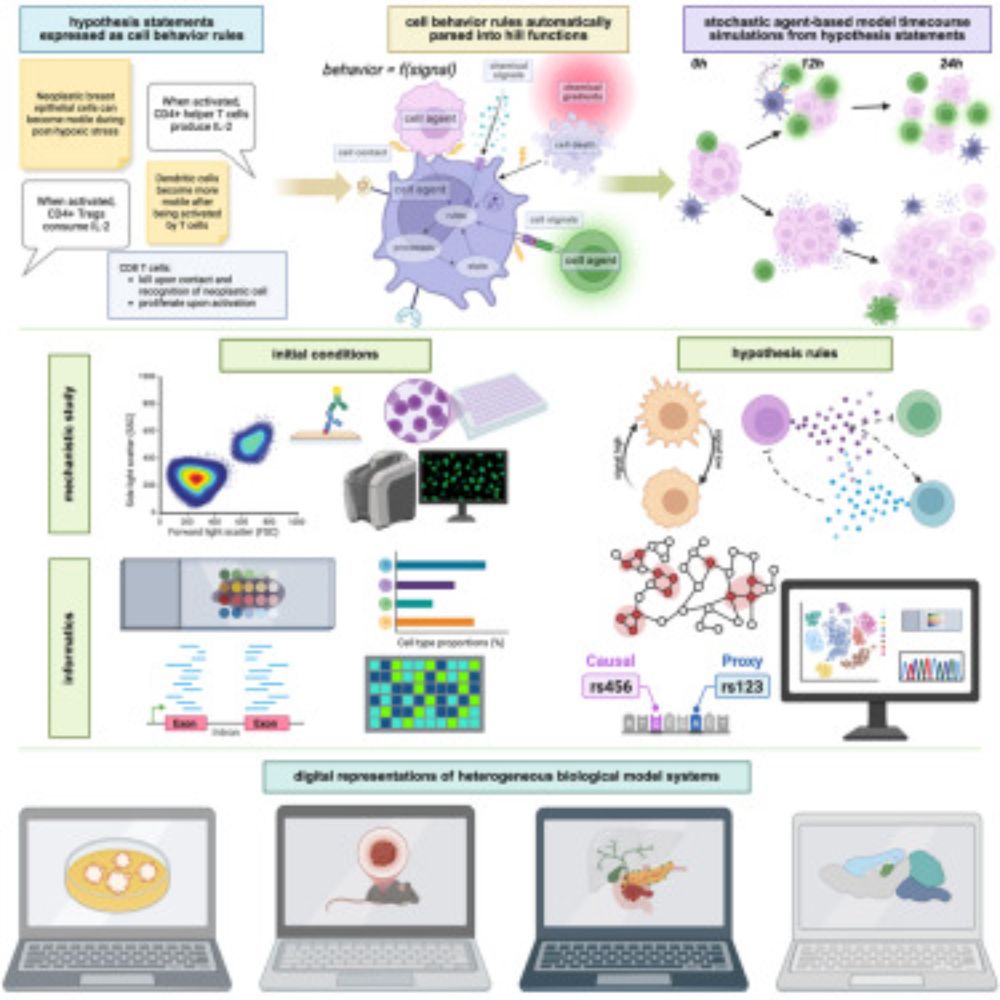
Human interpretable grammar encodes multicellular systems biology models to democratize virtual cell laboratories
We developed a plain text modeling language—a cell behavior hypothesis grammar—to
easily build virtual cell models and connect them to data, helping scientists to unlock
the hidden dynamics of tissues...
www.cell.com
July 28, 2025 at 2:20 PM
Really excited to share our new @cellpress.bsky.social Cell paper with @fertiglab.bsky.social and colleagues. 1/n
www.cell.com/cell/fulltex...
@jktgfoundation.bsky.social @itcrtraining.bsky.social @smbmathbiology.bsky.social #mathbio #mathonco @mathonco.bsky.social @deniswirtz.bsky.social
www.cell.com/cell/fulltex...
@jktgfoundation.bsky.social @itcrtraining.bsky.social @smbmathbiology.bsky.social #mathbio #mathonco @mathonco.bsky.social @deniswirtz.bsky.social
How to build the virtual cell with artificial intelligence: Priorities and opportunities: Cell www.cell.com/cell/fulltex...

How to build the virtual cell with artificial intelligence: Priorities and opportunities
Advances in AI and omics enable the creation of AI virtual cells (AIVCs)—multi-scale,
multimodal neural network models that simulate molecules, cells, and tissues across
diverse states. This vision ou...
www.cell.com
February 28, 2025 at 5:06 PM
How to build the virtual cell with artificial intelligence: Priorities and opportunities: Cell www.cell.com/cell/fulltex...