




Will Harrison
@willjharrison.bsky.social
Vision scientists and horror film enthusiast.
I also lecture at the University of the Sunshine Coast when I'm not at the beach.
I also lecture at the University of the Sunshine Coast when I'm not at the beach.
Reposted by Will Harrison

I tried to take a photo of a grasshopper on my windshield, but now it looks like a gigantic bug destroying the town.

February 10, 2026 at 6:10 AM
I tried to take a photo of a grasshopper on my windshield, but now it looks like a gigantic bug destroying the town.
Anyone want to do a PhD with me at the Sunny Coast? I'm recruiting, and I wanna do some fun psychophysics (but the possibilities for the PhD are very broad). Domestic students only, sadly.
In case y'all happen to know someone:
@nataliepeluso.com
@reubenrideaux.bsky.social
@visnerd.bsky.social
In case y'all happen to know someone:
@nataliepeluso.com
@reubenrideaux.bsky.social
@visnerd.bsky.social
February 10, 2026 at 9:12 PM
Anyone want to do a PhD with me at the Sunny Coast? I'm recruiting, and I wanna do some fun psychophysics (but the possibilities for the PhD are very broad). Domestic students only, sadly.
In case y'all happen to know someone:
@nataliepeluso.com
@reubenrideaux.bsky.social
@visnerd.bsky.social
In case y'all happen to know someone:
@nataliepeluso.com
@reubenrideaux.bsky.social
@visnerd.bsky.social
Reposted by Will Harrison

I made a map of 3.4 million Bluesky users - see if you can find yourself!
bluesky-map.theo.io
I've seen some similar projects, but IMO this seems to better capture some of the fine-grained detail
bluesky-map.theo.io
I've seen some similar projects, but IMO this seems to better capture some of the fine-grained detail

Bluesky Map
Interactive map of 3.4 million Bluesky users, visualised by their follower pattern.
bluesky-map.theo.io
February 8, 2026 at 10:59 PM
I made a map of 3.4 million Bluesky users - see if you can find yourself!
bluesky-map.theo.io
I've seen some similar projects, but IMO this seems to better capture some of the fine-grained detail
bluesky-map.theo.io
I've seen some similar projects, but IMO this seems to better capture some of the fine-grained detail
Matlab nerds, I need help with a coding task that has embarrassingly defeated me.
I want to turn a 3D array (kernel defined in 3 dimensions) into a cube visualisation... HALP
I want to turn a 3D array (kernel defined in 3 dimensions) into a cube visualisation... HALP

February 8, 2026 at 11:30 PM
Matlab nerds, I need help with a coding task that has embarrassingly defeated me.
I want to turn a 3D array (kernel defined in 3 dimensions) into a cube visualisation... HALP
I want to turn a 3D array (kernel defined in 3 dimensions) into a cube visualisation... HALP
Reposted by Will Harrison

New Paper: Pupillary responses are not a reliable index of differences in imagery vividness.
Our search for more reliable metrics of imagery continues...
www.sciencedirect.com/science/arti...
Our search for more reliable metrics of imagery continues...
www.sciencedirect.com/science/arti...

Imagery modulates the pupillary response, but this does not reliably index differences in imagery vividness.
Most people report that they can imagine seeing things in their mind’s eye. But there are large individual differences. A small proportion of people r…
www.sciencedirect.com
February 4, 2026 at 5:20 AM
New Paper: Pupillary responses are not a reliable index of differences in imagery vividness.
Our search for more reliable metrics of imagery continues...
www.sciencedirect.com/science/arti...
Our search for more reliable metrics of imagery continues...
www.sciencedirect.com/science/arti...
Really cool. I wonder if the spatial extent of the sweeps is related to the speed of movement?

Whether the system can be flexibly redirected to prioritize specific locations has been unclear. Using large-scale #Neuropixels recordings in freely behaving rats, we find that both sweeps – and the internal direction signals driving them – are dynamically modulated moment by moment. (4/6)
February 3, 2026 at 8:24 PM
Really cool. I wonder if the spatial extent of the sweeps is related to the speed of movement?
Reposted by Will Harrison


Reposted by Will Harrison

Three days left to submit symposium, workshop, and satellite ideas for EPC-APCV in Auckland in July.
Symposia will run alongside talk sessions during the conference, and workshops/satellites will run on the first day, before the welcome ceremony.
Symposia will run alongside talk sessions during the conference, and workshops/satellites will run on the first day, before the welcome ceremony.
January 27, 2026 at 6:52 PM
Three days left to submit symposium, workshop, and satellite ideas for EPC-APCV in Auckland in July.
Symposia will run alongside talk sessions during the conference, and workshops/satellites will run on the first day, before the welcome ceremony.
Symposia will run alongside talk sessions during the conference, and workshops/satellites will run on the first day, before the welcome ceremony.
Reposted by Will Harrison


Reposted by Will Harrison
The tech that enables Grok to make sexualised images against peoples' will is here to stay and we're just going to have to bring it into the classroom and ensure that all our students are genporn literate as they enter the marketplace.
January 7, 2026 at 6:58 AM
The tech that enables Grok to make sexualised images against peoples' will is here to stay and we're just going to have to bring it into the classroom and ensure that all our students are genporn literate as they enter the marketplace.
Reposted by Will Harrison

Happy to share this new paper from the lab led by Angus Chapman, now out in PLoS Biology! It presents an integrated spatiotemporal normalization model for continuous vision. @afchapman.bsky.social
journals.plos.org/plosbiology/...
journals.plos.org/plosbiology/...

A dynamic spatiotemporal normalization model captures perceptual and neural effects of spatial and temporal context
The effects of spatial and temporal context on sensory systems have mostly been studied independently of each other. This study shows that the modulation of visual perception and neural activity by th...
journals.plos.org
December 18, 2025 at 6:30 PM
Happy to share this new paper from the lab led by Angus Chapman, now out in PLoS Biology! It presents an integrated spatiotemporal normalization model for continuous vision. @afchapman.bsky.social
journals.plos.org/plosbiology/...
journals.plos.org/plosbiology/...
The idea to use a bot (probably) to write about the idea that we could be running out of new ideas is itself a new idea, thereby proving that we are not, in fact, running out of new ideas.

This column on Vox is the biggest pile of steaming AI crap I've seen this year. Human's aren't running out of ideas. Instead, those with power and money don't want to listen to ideas that threaten their power and money.
Ideas are plentiful. Putting those ideas into action is the hard part.
Ideas are plentiful. Putting those ideas into action is the hard part.

We’re running out of good ideas. AI might be how we find new ones.
What if the best use of AI is restarting the world’s idea machine?
www.vox.com
December 14, 2025 at 2:11 AM
The idea to use a bot (probably) to write about the idea that we could be running out of new ideas is itself a new idea, thereby proving that we are not, in fact, running out of new ideas.
Reposted by Will Harrison
There is money just sitting on the table for a university brave enough to grab it.

The first school to market itself as AI free is going to corner the market on people interested in actually learning. And I would not be surprised if rich families and the children of people creating this tech were the first movers.

My employer, Dartmouth College, today boasts it's 1st Ivy "to launch AI at an institutional scale." It is doing this by partnering--"more than a collaboration"--with Anthropic, a company that stole the books of many faculty, me included, which many of us are suing.
December 5, 2025 at 4:20 AM
There is money just sitting on the table for a university brave enough to grab it.
Reposted by Will Harrison

Do you have an open working memory dataset and want it to be findable and reused? You can now add it to the Open WM Data Hub: williamngiam.github.io/OpenWMData! The collection of datasets tagged with useful metadata is steadily growing thanks to a small team of volunteers!

OpenWMData
A collection of publicly available working memory datasets
williamngiam.github.io
December 1, 2025 at 11:28 PM
Do you have an open working memory dataset and want it to be findable and reused? You can now add it to the Open WM Data Hub: williamngiam.github.io/OpenWMData! The collection of datasets tagged with useful metadata is steadily growing thanks to a small team of volunteers!
Reposted by Will Harrison

Thank you to the 2025 IJE cohort who helped improve manuscripts this year via our pre-external review process!
Matthew O'Donohue: scholar.google.com.au/citations?us...
Marcell Székely: scholar.google.com/citations?hl...
Zekun Sun: zekun-sun.github.io
Matthew O'Donohue: scholar.google.com.au/citations?us...
Marcell Székely: scholar.google.com/citations?hl...
Zekun Sun: zekun-sun.github.io


December 3, 2025 at 11:48 PM
Thank you to the 2025 IJE cohort who helped improve manuscripts this year via our pre-external review process!
Matthew O'Donohue: scholar.google.com.au/citations?us...
Marcell Székely: scholar.google.com/citations?hl...
Zekun Sun: zekun-sun.github.io
Matthew O'Donohue: scholar.google.com.au/citations?us...
Marcell Székely: scholar.google.com/citations?hl...
Zekun Sun: zekun-sun.github.io
Reposted by Will Harrison

New pre-print with @drbarner.bsky.social! We ask how children come to understand age. We find that young children use numerical age and facial morphology to identify who’s older, not just size, and point to acquiring a number system as key to developing an understanding of age.
osf.io/gvb46
osf.io/gvb46
OSF
osf.io
December 1, 2025 at 5:04 PM
New pre-print with @drbarner.bsky.social! We ask how children come to understand age. We find that young children use numerical age and facial morphology to identify who’s older, not just size, and point to acquiring a number system as key to developing an understanding of age.
osf.io/gvb46
osf.io/gvb46
Reposted by Will Harrison

My Visual Attention in Crisis paper has finally appeared, along with 30 commentaries and response. I argue that it’s time to rethink attention from the ground up, and suggest key phenomena and possible directions. Requires access, alas. doi.org/10.1017/S014...
Visual Attention in Crisis | Behavioral and Brain Sciences | Cambridge Core
Visual Attention in Crisis - Volume 48
doi.org
November 26, 2025 at 1:23 PM
My Visual Attention in Crisis paper has finally appeared, along with 30 commentaries and response. I argue that it’s time to rethink attention from the ground up, and suggest key phenomena and possible directions. Requires access, alas. doi.org/10.1017/S014...
Reposted by Will Harrison

despite the questionable choice of keynote speaker, i think this is likely going to be a good conference

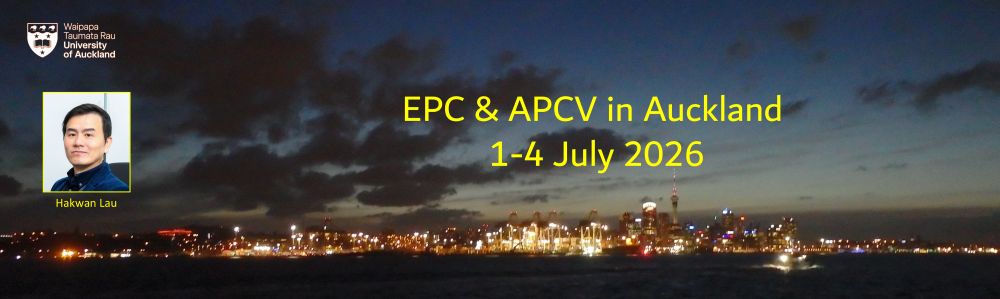
It is our great honour to announce the APCV Keynote at #epc-apcv-2026: Prof. Hakwan Lau from the Institute for Basic Science in Korea!
The call for member-initiated symposia & abstracts is now open: visualneuroscience.auckland.ac.nz/epc-apcv-2026
#psychscisky #visionscience #neuroskyence
The call for member-initiated symposia & abstracts is now open: visualneuroscience.auckland.ac.nz/epc-apcv-2026
#psychscisky #visionscience #neuroskyence
November 25, 2025 at 1:04 AM
despite the questionable choice of keynote speaker, i think this is likely going to be a good conference
Reposted by Will Harrison

See also for instance: irisvanrooijcogsci.com/2025/08/12/a...
AI slop and the destruction of knowledge
Cite as: van Rooij, I. (2025) AI slop and the destruction of knowledge. This week I was looking for info on what cognitive scientists mean when they speak of ‘domain-general’ cognition. I was curio…
irisvanrooijcogsci.com
November 23, 2025 at 4:21 PM
See also for instance: irisvanrooijcogsci.com/2025/08/12/a...
One of the few papers of my own that I enjoy reading is an analysis of a wonderful image database. But I'm a nerd.
Harrison, W. J. (2022). Luminance and Contrast of Images in the THINGS Database: Perception, 51(4), 244–262. doi.org/10.1177/0301...
Harrison, W. J. (2022). Luminance and Contrast of Images in the THINGS Database: Perception, 51(4), 244–262. doi.org/10.1177/0301...

November 21, 2025 at 9:14 AM
One of the few papers of my own that I enjoy reading is an analysis of a wonderful image database. But I'm a nerd.
Harrison, W. J. (2022). Luminance and Contrast of Images in the THINGS Database: Perception, 51(4), 244–262. doi.org/10.1177/0301...
Harrison, W. J. (2022). Luminance and Contrast of Images in the THINGS Database: Perception, 51(4), 244–262. doi.org/10.1177/0301...
Reposted by Will Harrison

Please repost! I am looking for a PhD candidate in the area of Computational Cognitive Neuroscience to start in early 2026.
The position is funded as part of the Excellence Cluster "The Adaptive Mind" at @jlugiessen.bsky.social.
Please apply here until Nov 25:
www.uni-giessen.de/de/ueber-uns...
The position is funded as part of the Excellence Cluster "The Adaptive Mind" at @jlugiessen.bsky.social.
Please apply here until Nov 25:
www.uni-giessen.de/de/ueber-uns...

November 4, 2025 at 1:57 PM
Please repost! I am looking for a PhD candidate in the area of Computational Cognitive Neuroscience to start in early 2026.
The position is funded as part of the Excellence Cluster "The Adaptive Mind" at @jlugiessen.bsky.social.
Please apply here until Nov 25:
www.uni-giessen.de/de/ueber-uns...
The position is funded as part of the Excellence Cluster "The Adaptive Mind" at @jlugiessen.bsky.social.
Please apply here until Nov 25:
www.uni-giessen.de/de/ueber-uns...
Reposted by Will Harrison

This is wild!
Introducing CorText: a framework that fuses brain data directly into a large language model, allowing for interactive neural readout using natural language.
tl;dr: you can now chat with a brain scan 🧠💬
1/n
tl;dr: you can now chat with a brain scan 🧠💬
1/n

November 3, 2025 at 6:12 PM
This is wild!
Reposted by Will Harrison

A reminder that the original Hallowe'en jack o' lanterns date back to 18th century Ireland if not earlier, were based on a shady boozy blacksmith called Stingy Jack who cheated the devil & was trapped between 2 worlds, were carved from turnips and looked like this:


October 31, 2025 at 7:59 AM
A reminder that the original Hallowe'en jack o' lanterns date back to 18th century Ireland if not earlier, were based on a shady boozy blacksmith called Stingy Jack who cheated the devil & was trapped between 2 worlds, were carved from turnips and looked like this:
Great thread and I wanna throw in my two cents too: increasing N does not increase the chance of a false positive per se (theoretically it'll always be alpha).
However, increasing N, particularly with lots of DVs, makes very small confounds more likely to produce a statistically significant result.
However, increasing N, particularly with lots of DVs, makes very small confounds more likely to produce a statistically significant result.
There still seems to be a lot of confusion about significance testing in psych. No, p-values *don’t* become useless at large N. This flawed point also used to be framed as "too much power". But power isn't the problem – it's 1) unbalanced error rates and 2) the (lack of a) SESOI. 1/ >
November 1, 2025 at 12:56 AM
Great thread and I wanna throw in my two cents too: increasing N does not increase the chance of a false positive per se (theoretically it'll always be alpha).
However, increasing N, particularly with lots of DVs, makes very small confounds more likely to produce a statistically significant result.
However, increasing N, particularly with lots of DVs, makes very small confounds more likely to produce a statistically significant result.