



Wilfling Lab
@wilflinglab.bsky.social
Investigating mechanisms of eukaryotic cellular quality control with a focus on autophagy @MPIbp via #cryoET, #teamtomo, #cellbiology and #massspectrometry
Pinned
Wilfling Lab
@wilflinglab.bsky.social
· Jan 20

LLOMe has long been used to study lysosomal damage, yet how it works has remained a mystery.
Using cryo-electron tomography, we show it forms amyloid structures inside lysosomes that mechanically rupture membranes – revealing a new paradigm for lysosomal failure.
🔗 doi.org/10.64898/202...
#CryoET
Using cryo-electron tomography, we show it forms amyloid structures inside lysosomes that mechanically rupture membranes – revealing a new paradigm for lysosomal failure.
🔗 doi.org/10.64898/202...
#CryoET
LLOMe has long been used to study lysosomal damage, yet how it works has remained a mystery.
Using cryo-electron tomography, we show it forms amyloid structures inside lysosomes that mechanically rupture membranes – revealing a new paradigm for lysosomal failure.
🔗 doi.org/10.64898/202...
#CryoET
Using cryo-electron tomography, we show it forms amyloid structures inside lysosomes that mechanically rupture membranes – revealing a new paradigm for lysosomal failure.
🔗 doi.org/10.64898/202...
#CryoET
January 20, 2026 at 10:01 AM
LLOMe has long been used to study lysosomal damage, yet how it works has remained a mystery.
Using cryo-electron tomography, we show it forms amyloid structures inside lysosomes that mechanically rupture membranes – revealing a new paradigm for lysosomal failure.
🔗 doi.org/10.64898/202...
#CryoET
Using cryo-electron tomography, we show it forms amyloid structures inside lysosomes that mechanically rupture membranes – revealing a new paradigm for lysosomal failure.
🔗 doi.org/10.64898/202...
#CryoET
We are excited to share our new preprint which is now available to read on biorXiv: doi.org/10.64898/202... 🎉🎉🎉
January 13, 2026 at 2:39 PM
We are excited to share our new preprint which is now available to read on biorXiv: doi.org/10.64898/202... 🎉🎉🎉
Yes was absolute fun! Like always a fantastic collaboration.
Physical principles have redefined our understanding of autophagy.
In our new @cp-trendsbiochem.bsky.social review, we discuss how phase separation, avidity, and wetting shape autophagy at the molecular level.
Great collaboration with @wilflinglab.bsky.social
www.cell.com/trends/bioch...
In our new @cp-trendsbiochem.bsky.social review, we discuss how phase separation, avidity, and wetting shape autophagy at the molecular level.
Great collaboration with @wilflinglab.bsky.social
www.cell.com/trends/bioch...

Autophagy regulation by phase separation, avidity, and wetting
Autophagy enables cells to selectively degrade a wide range of macromolecules, and
how this process achieves spatial precision within the densely packed cytosol is an
active area of investigation. Rec...
www.cell.com
November 20, 2025 at 10:10 PM
Yes was absolute fun! Like always a fantastic collaboration.
Reposted by Wilfling Lab
🔄 Repost because the previous link was broken! To degrade or not to degrade! We put together an Autophagic Punctum with @wilflinglab.bsky.social on our latest paper, take a look if you're interested!
🔗 www.tandfonline.com/doi/full/10....
🔗 www.tandfonline.com/doi/full/10....
To degrade or not to degrade: how phase separation modulates selective autophagy
Selective macroautophagy/autophagy relies on newly formed double-membrane compartments, known as phagophores, to sequester and recycle diverse cellular components, including organelles, biomolecula...
www.tandfonline.com
March 12, 2025 at 12:31 PM
🔄 Repost because the previous link was broken! To degrade or not to degrade! We put together an Autophagic Punctum with @wilflinglab.bsky.social on our latest paper, take a look if you're interested!
🔗 www.tandfonline.com/doi/full/10....
🔗 www.tandfonline.com/doi/full/10....
Looking forward to this fantastic meeting!

⌛️7 days left for registration: ➡️ www.ubiquitin-wuerzburg-2025.de ⬅️
…and on we go with proteostasis - warm welcome to our autophagy researchers Anja Bremm from @goetheuni.bsky.social and @wilflinglab.bsky.social!
#WUeBI2025 #ubiquitin #autophagy
…and on we go with proteostasis - warm welcome to our autophagy researchers Anja Bremm from @goetheuni.bsky.social and @wilflinglab.bsky.social!
#WUeBI2025 #ubiquitin #autophagy

February 22, 2025 at 7:27 PM
Looking forward to this fantastic meeting!
Reposted by Wilfling Lab
🚨 Paper Alert! We’re starting off the year with our latest publication in @naturecellbiology.bsky.social on the role of phase separation in selective autophagy initiation!
This work was a close and exciting collaboration with
@wilflinglab.bsky.social
🔗 nature.com/articles/s41...
Here's a thread👇
This work was a close and exciting collaboration with
@wilflinglab.bsky.social
🔗 nature.com/articles/s41...
Here's a thread👇

Phase separation of initiation hubs on cargo is a trigger switch for selective autophagy - Nature Cell Biology
Licheva, Pflaum, Babic, Mancilla et al. show that low-affinity cargo–receptor interactions promote autophagy receptor mobility and condensation of the scaffold protein Atg11 to trigger initiation hub ...
nature.com
January 7, 2025 at 10:30 AM
🚨 Paper Alert! We’re starting off the year with our latest publication in @naturecellbiology.bsky.social on the role of phase separation in selective autophagy initiation!
This work was a close and exciting collaboration with
@wilflinglab.bsky.social
🔗 nature.com/articles/s41...
Here's a thread👇
This work was a close and exciting collaboration with
@wilflinglab.bsky.social
🔗 nature.com/articles/s41...
Here's a thread👇
Check out our latest publication in @naturecellbiology.bsky.social on the role of phase separation in selective autophagy initiation! This was done in a fantastic collaboration with
@kraftlabfr.bsky.social
www.nature.com/articles/s41...
Short teaser below 👇👇👇
@kraftlabfr.bsky.social
www.nature.com/articles/s41...
Short teaser below 👇👇👇
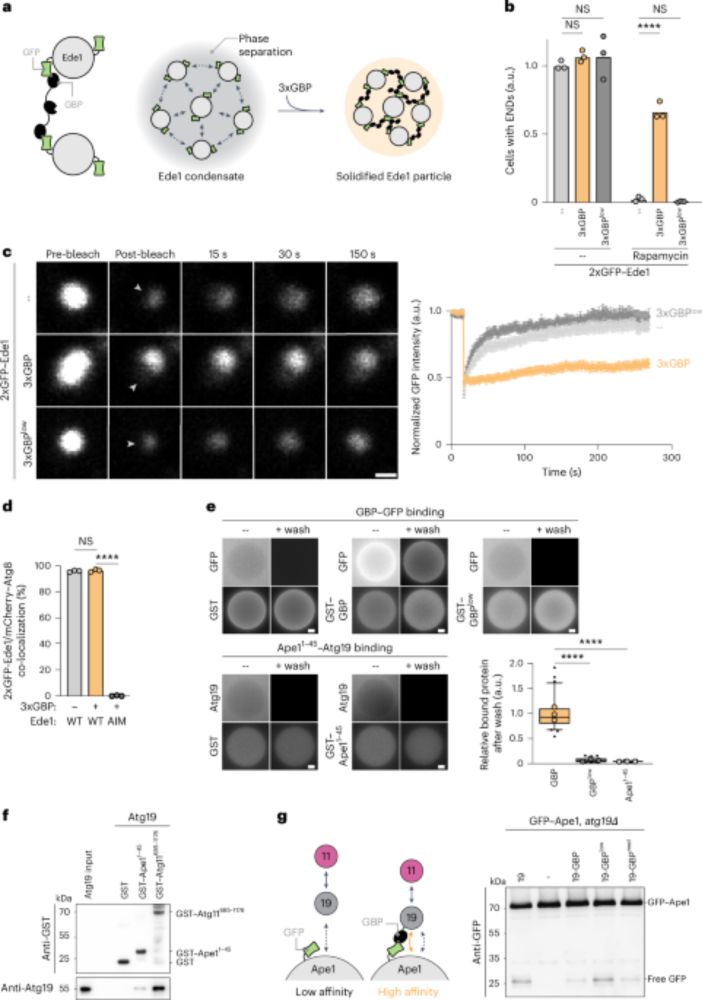
Phase separation of initiation hubs on cargo is a trigger switch for selective autophagy - Nature Cell Biology
Licheva, Pflaum, Babic, Mancilla et al. show that low-affinity cargo–receptor interactions promote autophagy receptor mobility and condensation of the scaffold protein Atg11 to trigger initiation hub ...
www.nature.com
January 8, 2025 at 3:11 PM
Check out our latest publication in @naturecellbiology.bsky.social on the role of phase separation in selective autophagy initiation! This was done in a fantastic collaboration with
@kraftlabfr.bsky.social
www.nature.com/articles/s41...
Short teaser below 👇👇👇
@kraftlabfr.bsky.social
www.nature.com/articles/s41...
Short teaser below 👇👇👇
Great opportunity! We are looking for a PhD student to work on novel sample preparation methods for cryo-electron tomography.
Are you already on track to apply to our #gradschool? 👣 This is a little map of our application process! We hope, you don´t get lost on the way 😊
If you want to start your #phdjourney with IMPRS-CBP #applynow
Don’t miss the chance and apply by February 7th.
👉 imprs-cbp.mpg.de 👈
#imprs_cbp
If you want to start your #phdjourney with IMPRS-CBP #applynow
Don’t miss the chance and apply by February 7th.
👉 imprs-cbp.mpg.de 👈
#imprs_cbp

December 11, 2024 at 10:41 PM
Great opportunity! We are looking for a PhD student to work on novel sample preparation methods for cryo-electron tomography.
Humbled and excited to join the EMBO young investigator community. Congratulations to all and looking forward to meeting you in the future.
www.embo.org/press-releas...
www.embo.org/press-releas...

Twenty-seven scientists become EMBO Young Investigators – Press releases – EMBO
The group leaders join an international network of nearly 800 life scientists and receive financial support
www.embo.org
December 3, 2024 at 8:23 PM
Humbled and excited to join the EMBO young investigator community. Congratulations to all and looking forward to meeting you in the future.
www.embo.org/press-releas...
www.embo.org/press-releas...
