



Liuyang Wang
@wallacewly.bsky.social
Human genetics; Statistical genetics; GWAS; Infectious disease;
@DukeMGM; Father; Husband
@DukeMedSchool
https://scholars.duke.edu/person/liuyang.wang
@DukeMGM; Father; Husband
@DukeMedSchool
https://scholars.duke.edu/person/liuyang.wang
Paired spatial snRNA-seq and scRNA-seq from 4 TB patients are alive at Broad Single Cell Portal, you can look up your genes in seconds :)
You can now explore the mRNA expression of your favorite TB gene of interest in our recently published human pulmonary M.tb granuloma single-cell dataset at the Broad Single Cell PORTAL!
@broadinstitute.org
@wallacewly.bsky.social
singlecell.broadinstitute.org/single_cell/...
@broadinstitute.org
@wallacewly.bsky.social
singlecell.broadinstitute.org/single_cell/...
Paired single-cell and spatial transcriptional profiling reveals a central osteopontin macrophage response mediating tuberculous granuloma formation - Single Cell Portal
Granulomas are classic manifestations of tuberculosis pathogenesis. They result from an ensemble of immune responses to Mycobacterium tuberculosis infection, but the identities, arrangement, cellular interactions, and regulation of the cells that comprise them have thus far been incompletely understood. To better understand the composition of granulomas, we conducted spatial and single-cell RNA sequencing of granulomas in biopsy specimens from patients with tuberculosis. We found that granulomas consist of concentric transcriptional laminae surrounding areas of central necrosis. We identified distinct populations of granuloma-associated stromal cells, fibroblasts, lymphocytes, mast cells, dendritic cells, neutrophils, and macrophages. Furthermore, gene expression among these cell populations differed by location within granulomas. We used inferential analysis to predict dominant granuloma cell-cell interactions, the activity of major signaling pathways, and transcription factor activities. Using spatial deconvolution, we mapped a conserved pattern of cellular organization dominated by macrophages rich in SPP1/osteopontin expression. Trajectory analysis of macrophage subtypes mapped their differentiation and supported the importance of SPP1 to granuloma macrophage polarization. Using the Mycobacterium marinum-zebrafish model, we found that mycobacterial infection induces spp1 expression in macrophages and that spp1 ablation results in granuloma formation defects and reduced survival in adult animals. Cumulatively, we have identified a dominant macrophage granuloma population as well as its central regulatory gene in human samples and confirmed the importance of spp1 to granuloma biology in vivo.
singlecell.broadinstitute.org
September 11, 2025 at 2:33 PM
Paired spatial snRNA-seq and scRNA-seq from 4 TB patients are alive at Broad Single Cell Portal, you can look up your genes in seconds :)
Reposted by Liuyang Wang

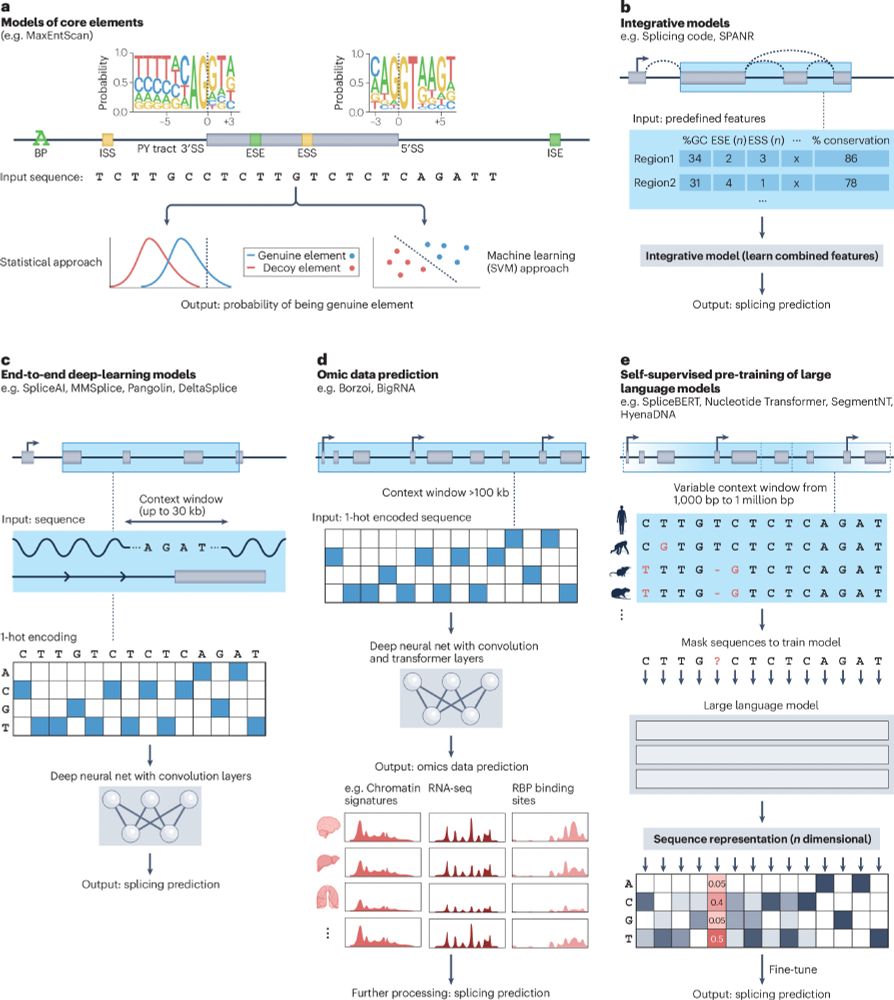
Evolution of splicing model architectures go.nature.com/4eweliE
Figure from our recent Review: From computational models of the splicing code to regulatory mechanisms and therapeutic implications (free to read here: rdcu.be/dVNV4)
Figure from our recent Review: From computational models of the splicing code to regulatory mechanisms and therapeutic implications (free to read here: rdcu.be/dVNV4)
July 2, 2025 at 10:21 AM
Evolution of splicing model architectures go.nature.com/4eweliE
Figure from our recent Review: From computational models of the splicing code to regulatory mechanisms and therapeutic implications (free to read here: rdcu.be/dVNV4)
Figure from our recent Review: From computational models of the splicing code to regulatory mechanisms and therapeutic implications (free to read here: rdcu.be/dVNV4)
Reposted by Liuyang Wang

Proud to present our latest work!
@tobinlab.bsky.social
@wallacewly.bsky.social
@gregorylab.bskyverified.social
Human TB granuloma transcriptional blueprints show they are dominated by SPP1 macrophages. spp1 is essential for granuloma formation in zebrafish.
journals.asm.org/doi/10.1128/...
@tobinlab.bsky.social
@wallacewly.bsky.social
@gregorylab.bskyverified.social
Human TB granuloma transcriptional blueprints show they are dominated by SPP1 macrophages. spp1 is essential for granuloma formation in zebrafish.
journals.asm.org/doi/10.1128/...

Paired single-cell and spatial transcriptional profiling reveals a central osteopontin macrophage response mediating tuberculous granuloma formation | mBio
Tuberculosis is the world’s most deadly single-pathogen infection. Its causative bacterium,
Mycobacterium tuberculosis, sickens over 10 million people annually. Mycobacterial granulomas are the pathol...
journals.asm.org
August 7, 2025 at 7:11 PM
Proud to present our latest work!
@tobinlab.bsky.social
@wallacewly.bsky.social
@gregorylab.bskyverified.social
Human TB granuloma transcriptional blueprints show they are dominated by SPP1 macrophages. spp1 is essential for granuloma formation in zebrafish.
journals.asm.org/doi/10.1128/...
@tobinlab.bsky.social
@wallacewly.bsky.social
@gregorylab.bskyverified.social
Human TB granuloma transcriptional blueprints show they are dominated by SPP1 macrophages. spp1 is essential for granuloma formation in zebrafish.
journals.asm.org/doi/10.1128/...