



@trezieg.bsky.social
Arts Education at the Frontier of Human-Machine Collaboration - Arts Education Partnership share.google/ooQDKvlxM43z...

Arts Education at the Frontier of Human-Machine Collaboration - Arts Education Partnership
As robots become more integrated into our daily lives—from healthcare to hospitality, from classrooms to concert halls—the question is no longer if we will coexist, but how. For arts education […]
share.google
December 29, 2025 at 2:29 AM
Arts Education at the Frontier of Human-Machine Collaboration - Arts Education Partnership share.google/ooQDKvlxM43z...
Reposted

"If we want to protect children, we should be fighting for privacy laws, protecting encryption, and learning from Bluesky's model, where they allow third party algorithmic feeds and moderation tools."

Analysis | ‘Sammy’s Law’ would help parents monitor kids online. It’s gaining steam.
The parents of a teen fentanyl poisoning victim are finding allies in Congress for a bill intended to save others from the same fate.
www.washingtonpost.com
August 26, 2025 at 5:29 PM
"If we want to protect children, we should be fighting for privacy laws, protecting encryption, and learning from Bluesky's model, where they allow third party algorithmic feeds and moderation tools."
Reposted

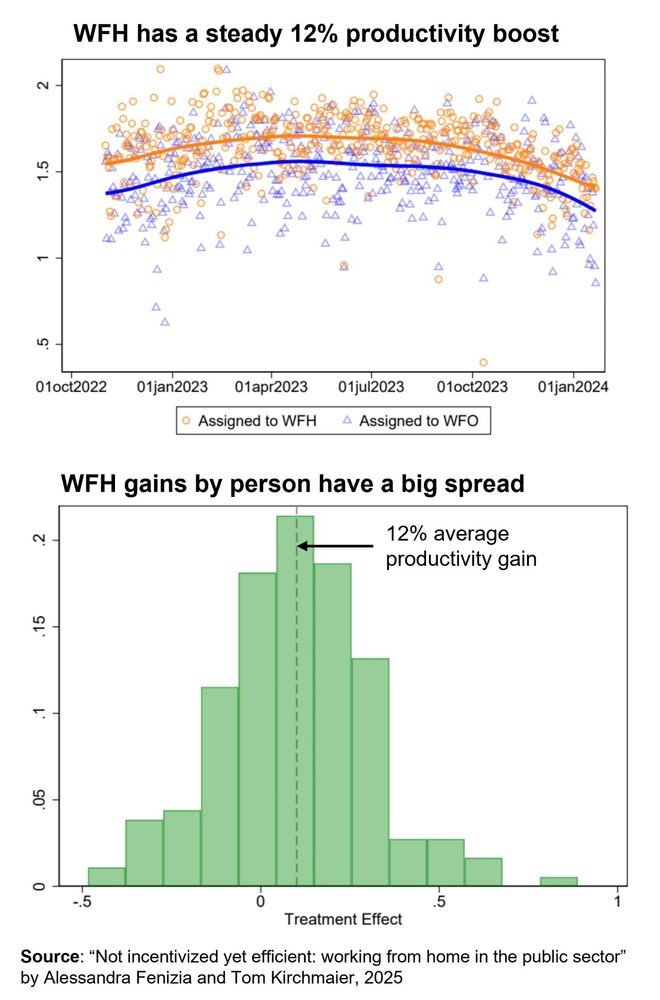
Remote work doesn't thwart productivity. It boosts focus.
Government workers are 12% more productive when randomly assigned to work from home. They're more efficient where it's quiet.
Most people aren't shirking from home. They're escaping distractions and long commutes.
Government workers are 12% more productive when randomly assigned to work from home. They're more efficient where it's quiet.
Most people aren't shirking from home. They're escaping distractions and long commutes.
February 23, 2025 at 4:20 PM
Remote work doesn't thwart productivity. It boosts focus.
Government workers are 12% more productive when randomly assigned to work from home. They're more efficient where it's quiet.
Most people aren't shirking from home. They're escaping distractions and long commutes.
Government workers are 12% more productive when randomly assigned to work from home. They're more efficient where it's quiet.
Most people aren't shirking from home. They're escaping distractions and long commutes.
Reposted

"Overall communication rather than speech should be prioritized. Mainstream communication technologies can support communication for autistic adults & a variety of tools can support communication across contexts."
💯💯💯
Have a LONG rant about a boy who "DiDn'T nEeD" an AAC but *totally* did need it
💯💯💯
Have a LONG rant about a boy who "DiDn'T nEeD" an AAC but *totally* did need it

I mean in my case it is not even a little bit secret but:
Identity-first language is literally why I submitted doi.org/10.1089/aut.... to @autisminadulthood.bsky.social first and not the International Society for Augmentative for Alternative Communication (ISAAC) journal first.
Identity-first language is literally why I submitted doi.org/10.1089/aut.... to @autisminadulthood.bsky.social first and not the International Society for Augmentative for Alternative Communication (ISAAC) journal first.

Augmentative and Alternative Communication for Speaking Autistic Adults: Overview and Recommendations | Autism in Adulthood
In recent years, technologies used for augmentative and alternative communication (AAC) have seen increasing development and availability. As a result, more and more autistic people are using AAC. With the increased use of AAC by autistic people, research on autism and AAC has also increased. However, the vast majority of this research focuses on nonspeaking autistic children. AAC use by autistic adults and by speaking autistic people has received limited academic attention. Speaking autistic adults often use AAC and many have publicly shared information about their strategies and experiences. In this article, we provide an overview of the speech differences autistic adults choose to support through AAC, including varying difficulties with speech depending on environment and content. We also discuss the technologies and strategies adopted by autistic adults, including free or low-cost tools that are not specific to AAC, mobile technologies, and signed languages or gestures. We explore barriers to AAC use, including a lack of awareness of relevant options, misconceptions about who AAC supports are for, and the cost of dedicated AAC applications or devices. We then provide suggestions for autistic adults, people supporting autistic adults, and researchers. Overall communication—rather than speech—should be prioritized. Mainstream communication technologies can support communication for autistic adults and a variety of tools can support communication across contexts. Further research into the use and effectiveness of AAC for autistic adults is needed, as is research on barriers to AAC use.
doi.org
November 25, 2024 at 3:47 PM
"Overall communication rather than speech should be prioritized. Mainstream communication technologies can support communication for autistic adults & a variety of tools can support communication across contexts."
💯💯💯
Have a LONG rant about a boy who "DiDn'T nEeD" an AAC but *totally* did need it
💯💯💯
Have a LONG rant about a boy who "DiDn'T nEeD" an AAC but *totally* did need it
November 16, 2024 at 7:45 PM