




Csaba G. Tóth
@tothgcsaba.bsky.social
Demographer and economist.
population dynamics | mortality | population ageing | fertility | public policy
https://sites.google.com/view/tothgcs
population dynamics | mortality | population ageing | fertility | public policy
https://sites.google.com/view/tothgcs
Pinned
Csaba G. Tóth
@tothgcsaba.bsky.social
· Oct 23

📢My paper is out in Population and Development Review.😀Central and Eastern Europe’s population change isn’t just about fertility, mortality, and migration — the age structure also an important factor.
#demography #ageing #fertility #Hungary #Poland #Romania #migration
doi.org/10.1111/padr...
#demography #ageing #fertility #Hungary #Poland #Romania #migration
doi.org/10.1111/padr...
In most Central and Eastern European (CEE) countries, population decline is driven by low fertility and negative net migration, partly moderated by rising life expectancy and a young initial age structure.
#demography #fertility #migration #Poland #Romania
onlinelibrary.wiley.com/doi/10.1111/...
#demography #fertility #migration #Poland #Romania
onlinelibrary.wiley.com/doi/10.1111/...

January 3, 2026 at 6:29 PM
In most Central and Eastern European (CEE) countries, population decline is driven by low fertility and negative net migration, partly moderated by rising life expectancy and a young initial age structure.
#demography #fertility #migration #Poland #Romania
onlinelibrary.wiley.com/doi/10.1111/...
#demography #fertility #migration #Poland #Romania
onlinelibrary.wiley.com/doi/10.1111/...
Fathers tend to be 3–4 years older than mothers, a gap that has remained stable over the last decade in Hungary. Three decades ago, the average age at childbirth was about 26 for women and 29 for men; today it is roughly 31 and 34.
#demography #fertility #motherhood #Hungary
#demography #fertility #motherhood #Hungary

December 21, 2025 at 8:04 PM
Fathers tend to be 3–4 years older than mothers, a gap that has remained stable over the last decade in Hungary. Three decades ago, the average age at childbirth was about 26 for women and 29 for men; today it is roughly 31 and 34.
#demography #fertility #motherhood #Hungary
#demography #fertility #motherhood #Hungary
An unforgettable moment discussing my research with James J. Heckman, Nobel Prize–winning economist, and Ronald Lee, co-author of the Lee–Carter model, a cornerstone of modern mortality forecasting.
#demography #fertility
youtu.be/KuhbmK98i38?...
#demography #fertility
youtu.be/KuhbmK98i38?...

Modern Fertility Choice: Population Change, Fertility, & Mothers' Employment
YouTube video by hceconomics
youtu.be
December 19, 2025 at 10:36 AM
An unforgettable moment discussing my research with James J. Heckman, Nobel Prize–winning economist, and Ronald Lee, co-author of the Lee–Carter model, a cornerstone of modern mortality forecasting.
#demography #fertility
youtu.be/KuhbmK98i38?...
#demography #fertility
youtu.be/KuhbmK98i38?...
It is a great honor to present my current research on population change at the Mini Conference organized by the Center for the Economics of Human Development at the University of Chicago, under the leadership of Nobel laureate James Heckman @heckmanequation.bsky.social.
#demography
#demography

December 9, 2025 at 9:27 AM
It is a great honor to present my current research on population change at the Mini Conference organized by the Center for the Economics of Human Development at the University of Chicago, under the leadership of Nobel laureate James Heckman @heckmanequation.bsky.social.
#demography
#demography
Births fluctuate, but over five decades fertility in the EU27 was remarkably similar: almost all countries had a total fertility rate between 1.5 and 1.9. Ireland was the exception, at 2.4.
#demography #fertility #EU27 #Ireland #Poland #Germany
#demography #fertility #EU27 #Ireland #Poland #Germany

December 3, 2025 at 7:49 AM
Births fluctuate, but over five decades fertility in the EU27 was remarkably similar: almost all countries had a total fertility rate between 1.5 and 1.9. Ireland was the exception, at 2.4.
#demography #fertility #EU27 #Ireland #Poland #Germany
#demography #fertility #EU27 #Ireland #Poland #Germany
Thrilled to see the population-change decomposition method I developed now applied in the @EBRD Transition Report 2025–26, Brave New World.😃😃
EBRD report: www.ebrd.com/home/news-an...
My publication: onlinelibrary.wiley.com/doi/10.1111/pa…
EBRD report: www.ebrd.com/home/news-an...
My publication: onlinelibrary.wiley.com/doi/10.1111/pa…
https://ebrd.com/home/news-and-…
November 28, 2025 at 2:48 PM
Thrilled to see the population-change decomposition method I developed now applied in the @EBRD Transition Report 2025–26, Brave New World.😃😃
EBRD report: www.ebrd.com/home/news-an...
My publication: onlinelibrary.wiley.com/doi/10.1111/pa…
EBRD report: www.ebrd.com/home/news-an...
My publication: onlinelibrary.wiley.com/doi/10.1111/pa…
Hungary’s fertility rate fell to 1.31 in the first ten months of the year, down from 1.62 four years ago. Combined with a shrinking reproductive-age population, this meant 17 thousand fewer births than in 2021.
#demography #population #Hungary #fertility #maternity
#demography #population #Hungary #fertility #maternity

November 27, 2025 at 2:10 PM
Hungary’s fertility rate fell to 1.31 in the first ten months of the year, down from 1.62 four years ago. Combined with a shrinking reproductive-age population, this meant 17 thousand fewer births than in 2021.
#demography #population #Hungary #fertility #maternity
#demography #population #Hungary #fertility #maternity
Sex ratio at birth hit a new record last year in Hungary.
The number of newborn boys per 100 girls jumped above 107. While boys are the majority at birth, their share gradually declines, by the time people reach their 50s, women become the majority.
#demography #population #fertility #birth
The number of newborn boys per 100 girls jumped above 107. While boys are the majority at birth, their share gradually declines, by the time people reach their 50s, women become the majority.
#demography #population #fertility #birth

November 25, 2025 at 3:31 PM
Sex ratio at birth hit a new record last year in Hungary.
The number of newborn boys per 100 girls jumped above 107. While boys are the majority at birth, their share gradually declines, by the time people reach their 50s, women become the majority.
#demography #population #fertility #birth
The number of newborn boys per 100 girls jumped above 107. While boys are the majority at birth, their share gradually declines, by the time people reach their 50s, women become the majority.
#demography #population #fertility #birth
One in five people eligible to vote in next year’s Hungarian election was too young to vote in 2010. Nearly 2 million people have died since then, leading to a 20% turnover in the voting-age population between 2010 and 2026.
#demography #population #Hungary #Election2026
#demography #population #Hungary #Election2026

November 22, 2025 at 7:54 PM
One in five people eligible to vote in next year’s Hungarian election was too young to vote in 2010. Nearly 2 million people have died since then, leading to a 20% turnover in the voting-age population between 2010 and 2026.
#demography #population #Hungary #Election2026
#demography #population #Hungary #Election2026
The Baltic countries lost a quarter of their population between 1990 and 2020. While net migration was the main driver, below-replacement fertility reduced their populations by about one tenth.
Details: onlinelibrary.wiley.com/doi/10.1111/...
#demography #Population #Estonia #Lithuania #Latvia
Details: onlinelibrary.wiley.com/doi/10.1111/...
#demography #Population #Estonia #Lithuania #Latvia

November 19, 2025 at 2:03 PM
The Baltic countries lost a quarter of their population between 1990 and 2020. While net migration was the main driver, below-replacement fertility reduced their populations by about one tenth.
Details: onlinelibrary.wiley.com/doi/10.1111/...
#demography #Population #Estonia #Lithuania #Latvia
Details: onlinelibrary.wiley.com/doi/10.1111/...
#demography #Population #Estonia #Lithuania #Latvia
The young age profile fully offset population losses from negative migration in Central and Eastern Europe between 1990 and 2020. Population Council just featured my Population and Development Review paper in a short summary!
#demography #migration #Poland
popcouncil.org/insight/driver…
#demography #migration #Poland
popcouncil.org/insight/driver…

November 7, 2025 at 10:19 AM
The young age profile fully offset population losses from negative migration in Central and Eastern Europe between 1990 and 2020. Population Council just featured my Population and Development Review paper in a short summary!
#demography #migration #Poland
popcouncil.org/insight/driver…
#demography #migration #Poland
popcouncil.org/insight/driver…
South Korea’s dramatic fertility decline over the past 25 years has been driven mainly by falling birth rates among women aged 25–29. Since 2012, fertility among those aged 30–34 has also dropped sharply.
#demography #fertility #SouthKorea #population
#demography #fertility #SouthKorea #population

November 5, 2025 at 7:28 PM
South Korea’s dramatic fertility decline over the past 25 years has been driven mainly by falling birth rates among women aged 25–29. Since 2012, fertility among those aged 30–34 has also dropped sharply.
#demography #fertility #SouthKorea #population
#demography #fertility #SouthKorea #population
The age pattern of divorce among men has flattened over the past 25 years. Around the millennium, the risk of divorce fell sharply with age; today in Hungary, it’s nearly the same from 25 to 55. The same pattern holds for women.
#demography #divorce #motherhood #Hungary #marriage
#demography #divorce #motherhood #Hungary #marriage

October 29, 2025 at 9:57 AM
The age pattern of divorce among men has flattened over the past 25 years. Around the millennium, the risk of divorce fell sharply with age; today in Hungary, it’s nearly the same from 25 to 55. The same pattern holds for women.
#demography #divorce #motherhood #Hungary #marriage
#demography #divorce #motherhood #Hungary #marriage
📢My paper is out in Population and Development Review.😀Central and Eastern Europe’s population change isn’t just about fertility, mortality, and migration — the age structure also an important factor.
#demography #ageing #fertility #Hungary #Poland #Romania #migration
doi.org/10.1111/padr...
#demography #ageing #fertility #Hungary #Poland #Romania #migration
doi.org/10.1111/padr...
October 23, 2025 at 8:06 PM
📢My paper is out in Population and Development Review.😀Central and Eastern Europe’s population change isn’t just about fertility, mortality, and migration — the age structure also an important factor.
#demography #ageing #fertility #Hungary #Poland #Romania #migration
doi.org/10.1111/padr...
#demography #ageing #fertility #Hungary #Poland #Romania #migration
doi.org/10.1111/padr...
White and Black Americans are hit harder by the US opioid crisis than Hispanics. In 2023, overdoses claimed 107,000 lives, over 75% tied to opioids. A new study says the surge is mainly supply-driven.
#demography #US #America
link.springer.com/article/10.1...
#demography #US #America
link.springer.com/article/10.1...

September 26, 2025 at 9:42 PM
White and Black Americans are hit harder by the US opioid crisis than Hispanics. In 2023, overdoses claimed 107,000 lives, over 75% tied to opioids. A new study says the surge is mainly supply-driven.
#demography #US #America
link.springer.com/article/10.1...
#demography #US #America
link.springer.com/article/10.1...
Over the last two decades, Romania, Czechia and Slovakia cut their life expectancy gap with the EU27. But Hungary, Poland and Bulgaria remain stuck — showing little convergence.
#demography #lifespan #Poland #Hungary #Romania
#demography #lifespan #Poland #Hungary #Romania

September 14, 2025 at 1:23 PM
Over the last two decades, Romania, Czechia and Slovakia cut their life expectancy gap with the EU27. But Hungary, Poland and Bulgaria remain stuck — showing little convergence.
#demography #lifespan #Poland #Hungary #Romania
#demography #lifespan #Poland #Hungary #Romania
Great honour to present my research at the Annual Conference of the British Society for Population Studies in Swansea — in the session with the undeniably sexy name: Innovations in Formal and Mathematical Demography. 🤓
#Demography #BSPS25
@bspsuk.bsky.social
#Demography #BSPS25
@bspsuk.bsky.social

August 29, 2025 at 12:29 PM
Great honour to present my research at the Annual Conference of the British Society for Population Studies in Swansea — in the session with the undeniably sexy name: Innovations in Formal and Mathematical Demography. 🤓
#Demography #BSPS25
@bspsuk.bsky.social
#Demography #BSPS25
@bspsuk.bsky.social
Fertility boom in Kazakhstan should receive more attention: TFR increased from 1.9 to 3.3 over two decades. This seems to be an example of a reversed fertility transition, with rising progressions to higher-order births and little fertility postponement.
link.springer.com/article/10.1...
#fertility
link.springer.com/article/10.1...
#fertility

August 24, 2025 at 7:01 PM
Fertility boom in Kazakhstan should receive more attention: TFR increased from 1.9 to 3.3 over two decades. This seems to be an example of a reversed fertility transition, with rising progressions to higher-order births and little fertility postponement.
link.springer.com/article/10.1...
#fertility
link.springer.com/article/10.1...
#fertility
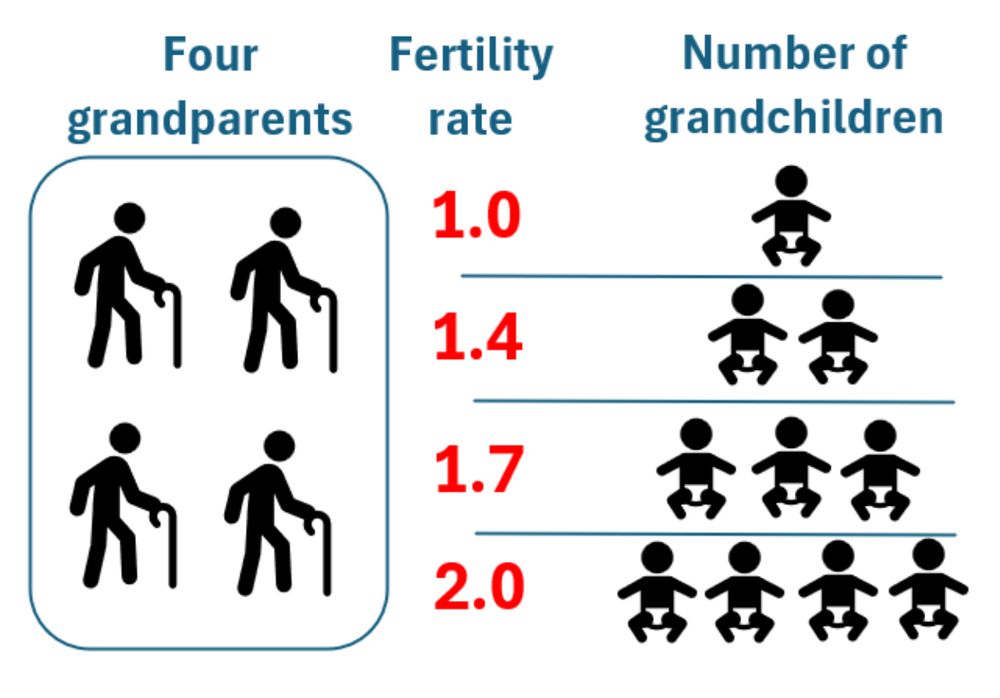
Below-replacement fertility can have very different outcomes. With a TFR of about 1 (as in China or Malta), the third generation is only one-quarter the size of the first. With a TFR of about 1.7 (as in Bulgaria or Romania), it is three-quarters the size.
#demography #fertility #population
#demography #fertility #population
August 12, 2025 at 7:49 AM
Below-replacement fertility can have very different outcomes. With a TFR of about 1 (as in China or Malta), the third generation is only one-quarter the size of the first. With a TFR of about 1.7 (as in Bulgaria or Romania), it is three-quarters the size.
#demography #fertility #population
#demography #fertility #population
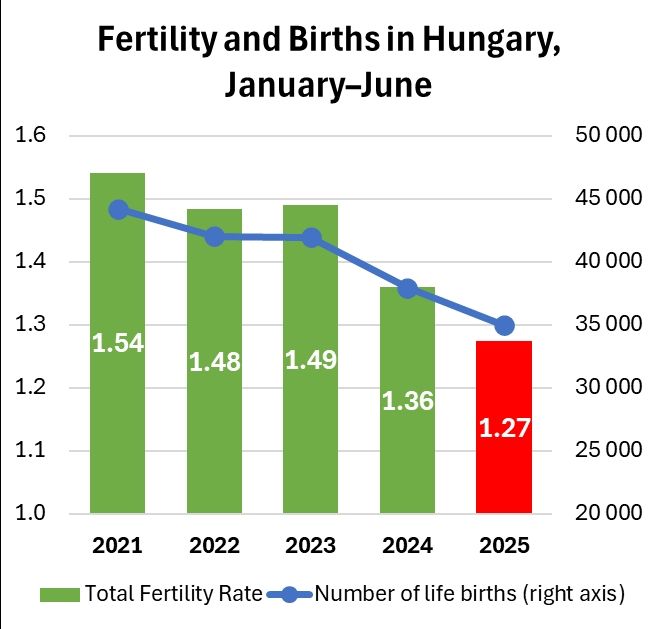
Hungary’s fertility rate fell below 1.3 in the first half of the year. Combined with a shrinking reproductive-age population, this led to 10,000 fewer births compared to 2021.
#demography #population #fertility #Hungary
#demography #population #fertility #Hungary
August 3, 2025 at 9:43 PM
Hungary’s fertility rate fell below 1.3 in the first half of the year. Combined with a shrinking reproductive-age population, this led to 10,000 fewer births compared to 2021.
#demography #population #fertility #Hungary
#demography #population #fertility #Hungary
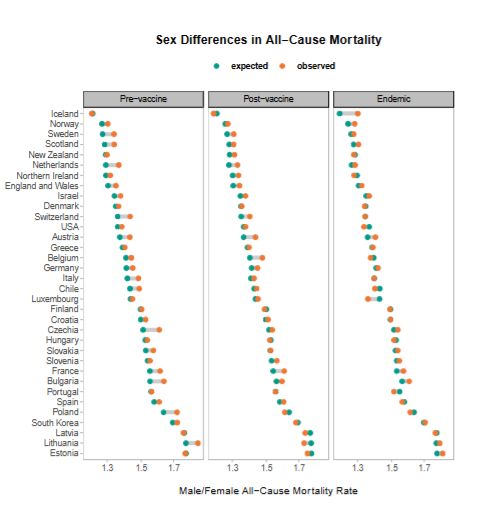
More men died from COVID-19, but since men generally have a higher risk of death at all ages, women weren’t always better off when looking at the increase in mortality. In some cases, their death rates rose even more. Excellent new study just out!
medrxiv.org/content/10.1...
#demography #Population
medrxiv.org/content/10.1...
#demography #Population
July 29, 2025 at 9:01 PM
More men died from COVID-19, but since men generally have a higher risk of death at all ages, women weren’t always better off when looking at the increase in mortality. In some cases, their death rates rose even more. Excellent new study just out!
medrxiv.org/content/10.1...
#demography #Population
medrxiv.org/content/10.1...
#demography #Population
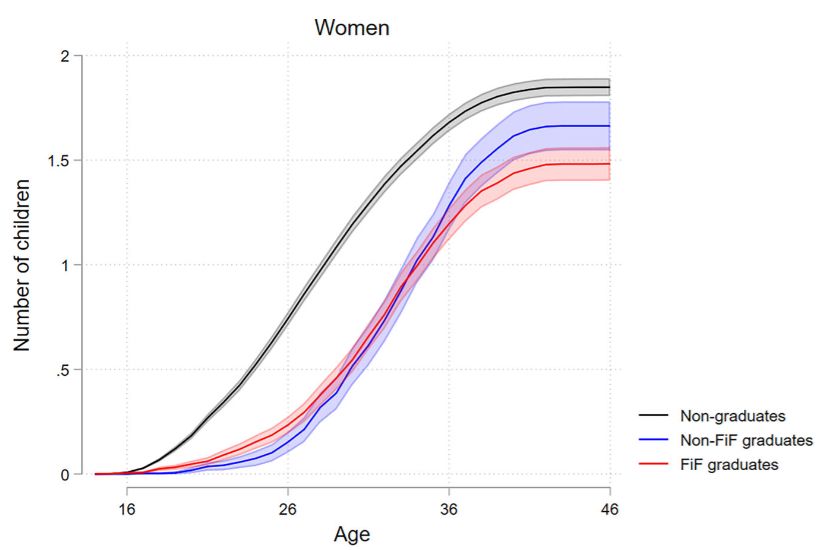
The fertility gap between graduate and non-graduate women becomes statistically insignificant when accounting for first-in-family (FiF) status. FiF graduates have fewer children than both non-FiF graduates and non-graduates.
link.springer.com/article/10.1...
#demography #fertility #population #UK
link.springer.com/article/10.1...
#demography #fertility #population #UK
July 28, 2025 at 1:33 PM
The fertility gap between graduate and non-graduate women becomes statistically insignificant when accounting for first-in-family (FiF) status. FiF graduates have fewer children than both non-FiF graduates and non-graduates.
link.springer.com/article/10.1...
#demography #fertility #population #UK
link.springer.com/article/10.1...
#demography #fertility #population #UK
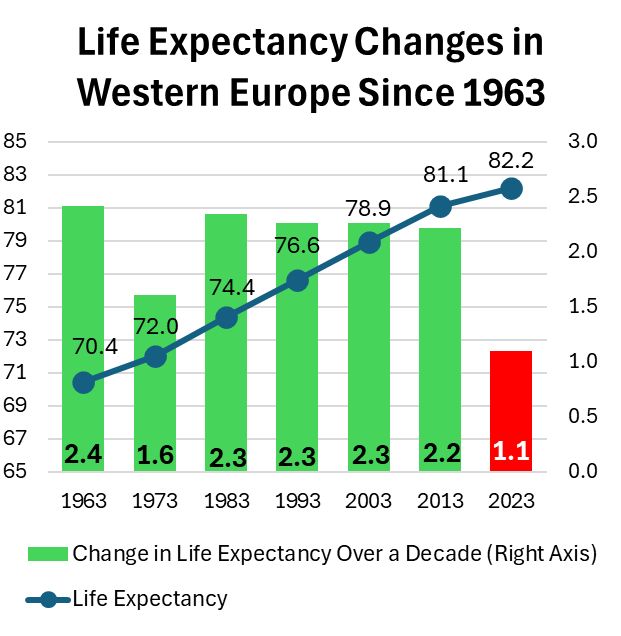
Life expectancy gains have slowed sharply in the past decade in Western Europe. The increase was just 1.1 years, less than half the progress seen in earlier decades.
#demograpy #population #lifepan #Poland #Germany #UK #France #Italy
#demograpy #population #lifepan #Poland #Germany #UK #France #Italy
July 22, 2025 at 8:20 AM
Life expectancy gains have slowed sharply in the past decade in Western Europe. The increase was just 1.1 years, less than half the progress seen in earlier decades.
#demograpy #population #lifepan #Poland #Germany #UK #France #Italy
#demograpy #population #lifepan #Poland #Germany #UK #France #Italy
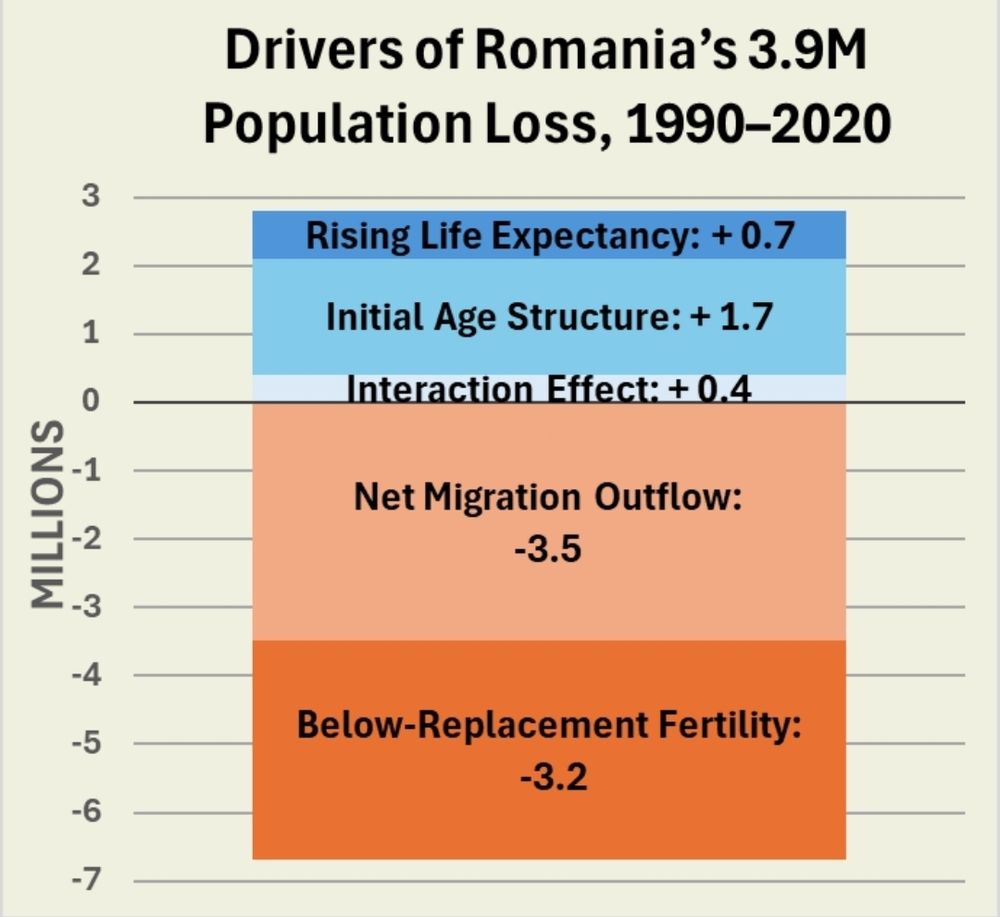
Romania’s population dropped from 23.2M to 19.3M between 1990 and 2020. The decline was driven by net out-migration and low fertility, partly offset by a relatively young age structure and rising life expectancy.
Source:
#demography #population #Romania #Bukarest
osf.io/preprints/so...
Source:
#demography #population #Romania #Bukarest
osf.io/preprints/so...
July 17, 2025 at 12:39 PM
Romania’s population dropped from 23.2M to 19.3M between 1990 and 2020. The decline was driven by net out-migration and low fertility, partly offset by a relatively young age structure and rising life expectancy.
Source:
#demography #population #Romania #Bukarest
osf.io/preprints/so...
Source:
#demography #population #Romania #Bukarest
osf.io/preprints/so...
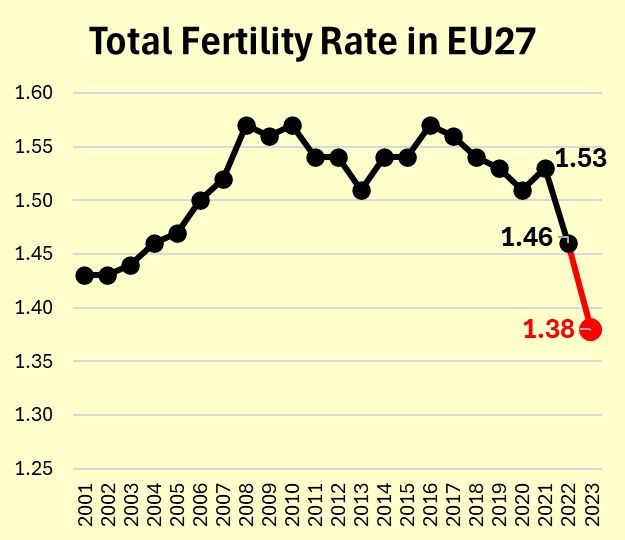
Fertility in the EU27 fell to a historic low below 1.4 in 2023. The TFR of 1.38 marks a 0.15-point drop in just two years.
#demography #fertility #babies #EU #Germany #Poland #Italy #France #Spain
#demography #fertility #babies #EU #Germany #Poland #Italy #France #Spain
May 28, 2025 at 7:51 PM
Fertility in the EU27 fell to a historic low below 1.4 in 2023. The TFR of 1.38 marks a 0.15-point drop in just two years.
#demography #fertility #babies #EU #Germany #Poland #Italy #France #Spain
#demography #fertility #babies #EU #Germany #Poland #Italy #France #Spain