



Solomon742 (Solomon is fine too)
@solomon742.bsky.social
30 He/Him
Just a turbo nerd lizard lover bumbling through life.
Colossal Warhammer and MechWarrior fan.
Big Bi Scalie.
PFP by very tall and talented @rimuru-mayhem.bsky.social
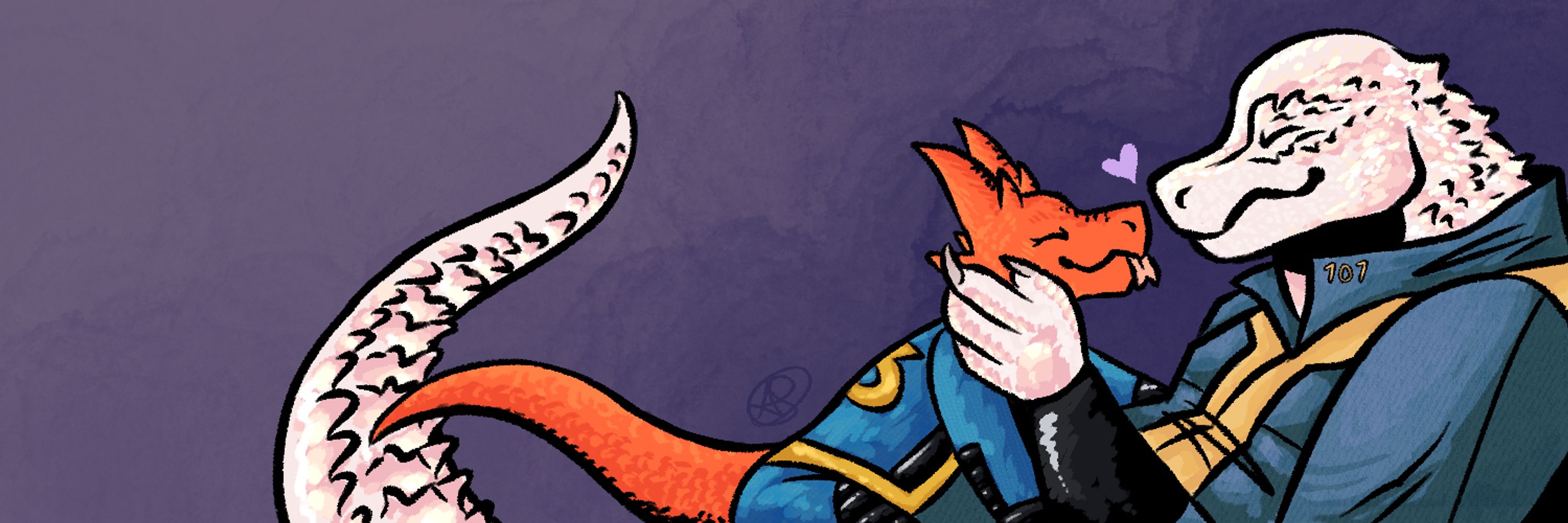
Banner by very smol and skilled @astralabraxas.bsky.social
Just a turbo nerd lizard lover bumbling through life.
Colossal Warhammer and MechWarrior fan.
Big Bi Scalie.
PFP by very tall and talented @rimuru-mayhem.bsky.social
Banner by very smol and skilled @astralabraxas.bsky.social
Pinned
I'm getting followed by lots of "artists" with very few followers, lots of follows, very few if any posts and no links in their bios.
Sorry folks, if you're not bots that makes you look like one. And you'll get mute-blocked real fast.
👏Put links and shit in your bios if you want customers👏
Sorry folks, if you're not bots that makes you look like one. And you'll get mute-blocked real fast.
👏Put links and shit in your bios if you want customers👏
Reposted by Solomon742 (Solomon is fine too)

Reposted by Solomon742 (Solomon is fine too)

Lizard of the day: Desert plated lizard!
These sharp-snouted fellas are endemic to the Namib Desert! They mostly eat plants, but it also forages for beetles and other small arthropods. They're sand-diving lizards, and can move efficiently through sand dunes!
These sharp-snouted fellas are endemic to the Namib Desert! They mostly eat plants, but it also forages for beetles and other small arthropods. They're sand-diving lizards, and can move efficiently through sand dunes!

February 17, 2026 at 3:39 PM
Lizard of the day: Desert plated lizard!
These sharp-snouted fellas are endemic to the Namib Desert! They mostly eat plants, but it also forages for beetles and other small arthropods. They're sand-diving lizards, and can move efficiently through sand dunes!
These sharp-snouted fellas are endemic to the Namib Desert! They mostly eat plants, but it also forages for beetles and other small arthropods. They're sand-diving lizards, and can move efficiently through sand dunes!
Reposted by Solomon742 (Solomon is fine too)

Reposted by Solomon742 (Solomon is fine too)

A drawing of Godzilla 1998 at a fish market, from 2017.

February 17, 2026 at 1:11 AM
A drawing of Godzilla 1998 at a fish market, from 2017.
Reposted by Solomon742 (Solomon is fine too)

Kobold climbs onto sleeping dragon's back while wearing a cowboy hat. Whispers "yeehaw" very quietly.
February 17, 2026 at 6:39 AM
Kobold climbs onto sleeping dragon's back while wearing a cowboy hat. Whispers "yeehaw" very quietly.
Reposted by Solomon742 (Solomon is fine too)

Ranking of the people of Tamriel who are most likely attracted to Flame Atronachs:
1. The Laumont Family (rumors that the Laumont bloodline can trace its ancestry to a Breton/Flame Atronach union)
2. Melyn Drad (Melyn Drad's acknowledged attraction to them, as well as his fire resistance)
1. The Laumont Family (rumors that the Laumont bloodline can trace its ancestry to a Breton/Flame Atronach union)
2. Melyn Drad (Melyn Drad's acknowledged attraction to them, as well as his fire resistance)

February 17, 2026 at 6:46 AM
Ranking of the people of Tamriel who are most likely attracted to Flame Atronachs:
1. The Laumont Family (rumors that the Laumont bloodline can trace its ancestry to a Breton/Flame Atronach union)
2. Melyn Drad (Melyn Drad's acknowledged attraction to them, as well as his fire resistance)
1. The Laumont Family (rumors that the Laumont bloodline can trace its ancestry to a Breton/Flame Atronach union)
2. Melyn Drad (Melyn Drad's acknowledged attraction to them, as well as his fire resistance)
Reposted by Solomon742 (Solomon is fine too)


Reposted by Solomon742 (Solomon is fine too)
Lizard of the day: Satinay Sand Skink!
These fellas are endemic to forests in Fraser Island, Australia! They've got long bodies and short limbs. They're terrestrial and fossorial, meaning that they dig their own burrows!
These fellas are endemic to forests in Fraser Island, Australia! They've got long bodies and short limbs. They're terrestrial and fossorial, meaning that they dig their own burrows!

February 16, 2026 at 5:59 PM
Lizard of the day: Satinay Sand Skink!
These fellas are endemic to forests in Fraser Island, Australia! They've got long bodies and short limbs. They're terrestrial and fossorial, meaning that they dig their own burrows!
These fellas are endemic to forests in Fraser Island, Australia! They've got long bodies and short limbs. They're terrestrial and fossorial, meaning that they dig their own burrows!
Reposted by Solomon742 (Solomon is fine too)

tri banana baby
I lowkey want to do another hydra, but I'm not sure what of yet
I lowkey want to do another hydra, but I'm not sure what of yet

August 28, 2025 at 10:32 PM
tri banana baby
I lowkey want to do another hydra, but I'm not sure what of yet
I lowkey want to do another hydra, but I'm not sure what of yet
Reposted by Solomon742 (Solomon is fine too)
Lizard of the day: Hadramaut sand lizard!
Found throughout the desert plains of the south of the Arabian Peninsula, they mainly prey on ants and other insects, but also have been observed to hunt shrikes too!
Found throughout the desert plains of the south of the Arabian Peninsula, they mainly prey on ants and other insects, but also have been observed to hunt shrikes too!

February 15, 2026 at 1:16 PM
Lizard of the day: Hadramaut sand lizard!
Found throughout the desert plains of the south of the Arabian Peninsula, they mainly prey on ants and other insects, but also have been observed to hunt shrikes too!
Found throughout the desert plains of the south of the Arabian Peninsula, they mainly prey on ants and other insects, but also have been observed to hunt shrikes too!
Reposted by Solomon742 (Solomon is fine too)

So excited about the discovery of the Bloodhound Gang Pac-man model that I've made this #blender #animation which doesn't use it at all and has #Digimon instead!! Best weekend of my life

Here comes Pac-mon...
YouTube video by icesnort
www.youtube.com
February 15, 2026 at 5:12 PM
So excited about the discovery of the Bloodhound Gang Pac-man model that I've made this #blender #animation which doesn't use it at all and has #Digimon instead!! Best weekend of my life
Reposted by Solomon742 (Solomon is fine too)
Lizard of the day: Magombera single-horned chameleon!
I guess their nose counts as the horn? They're a species from Tanzania. They're pretty chonky! They're currently endangered due to their limited range and vulnerability to deforestation.
I guess their nose counts as the horn? They're a species from Tanzania. They're pretty chonky! They're currently endangered due to their limited range and vulnerability to deforestation.

February 14, 2026 at 2:15 PM
Lizard of the day: Magombera single-horned chameleon!
I guess their nose counts as the horn? They're a species from Tanzania. They're pretty chonky! They're currently endangered due to their limited range and vulnerability to deforestation.
I guess their nose counts as the horn? They're a species from Tanzania. They're pretty chonky! They're currently endangered due to their limited range and vulnerability to deforestation.
Reposted by Solomon742 (Solomon is fine too)

Happy Valentine’s Day from your friends at the Independent Fallout Wiki!

February 14, 2026 at 5:48 PM
Happy Valentine’s Day from your friends at the Independent Fallout Wiki!
Reposted by Solomon742 (Solomon is fine too)


Reposted by Solomon742 (Solomon is fine too)
Lizard of the day: Heliolisk!
This Pokémon's design is based on real-life frilled lizards! They can use their frills as a solar panel to collect sunlight and generate electricity. It still pains me that it didn't get a megaevolution in ZA sigh 💔
This Pokémon's design is based on real-life frilled lizards! They can use their frills as a solar panel to collect sunlight and generate electricity. It still pains me that it didn't get a megaevolution in ZA sigh 💔

February 13, 2026 at 12:19 PM
Lizard of the day: Heliolisk!
This Pokémon's design is based on real-life frilled lizards! They can use their frills as a solar panel to collect sunlight and generate electricity. It still pains me that it didn't get a megaevolution in ZA sigh 💔
This Pokémon's design is based on real-life frilled lizards! They can use their frills as a solar panel to collect sunlight and generate electricity. It still pains me that it didn't get a megaevolution in ZA sigh 💔
Reposted by Solomon742 (Solomon is fine too)

do you think they shop at the same vest store?

February 13, 2026 at 5:28 PM
do you think they shop at the same vest store?
Reposted by Solomon742 (Solomon is fine too)

This week's short is looking at the original Saturnine Terminator from 1988 (that wasn't actually a Saturnine until it kinda was).
youtube.com/shorts/AYULY...
youtube.com/shorts/AYULY...

The Original Saturnine #warhammer40k #gamesworkshop #oldhammer
YouTube video by Snipe and Wib
youtube.com
February 13, 2026 at 7:30 PM
This week's short is looking at the original Saturnine Terminator from 1988 (that wasn't actually a Saturnine until it kinda was).
youtube.com/shorts/AYULY...
youtube.com/shorts/AYULY...
Reposted by Solomon742 (Solomon is fine too)

The EU has just voted, by a VERY wide margin, for the full recognition of trans women as women…!

February 12, 2026 at 4:06 PM
The EU has just voted, by a VERY wide margin, for the full recognition of trans women as women…!


Reposted by Solomon742 (Solomon is fine too)
Lizard of the day: Morocco lizard-fingered gecko!
This tiny species can be found in forests, rocky areas and pasturelands in Western Morocco! Unlike similar species, they lack adhesive pads on their paws, having lizard-like fingers instead. They can shed their tails!
This tiny species can be found in forests, rocky areas and pasturelands in Western Morocco! Unlike similar species, they lack adhesive pads on their paws, having lizard-like fingers instead. They can shed their tails!

February 12, 2026 at 5:20 PM
Lizard of the day: Morocco lizard-fingered gecko!
This tiny species can be found in forests, rocky areas and pasturelands in Western Morocco! Unlike similar species, they lack adhesive pads on their paws, having lizard-like fingers instead. They can shed their tails!
This tiny species can be found in forests, rocky areas and pasturelands in Western Morocco! Unlike similar species, they lack adhesive pads on their paws, having lizard-like fingers instead. They can shed their tails!

Reposted by Solomon742 (Solomon is fine too)
Lizard of the day: Panay monitor!
These wrinkly fellas are from the Philippines! They're one of the three monitor species who only eat fruits! They're excellent tree climbers, but are threatened by illegal logging and hunting.
These wrinkly fellas are from the Philippines! They're one of the three monitor species who only eat fruits! They're excellent tree climbers, but are threatened by illegal logging and hunting.

February 11, 2026 at 1:13 PM
Lizard of the day: Panay monitor!
These wrinkly fellas are from the Philippines! They're one of the three monitor species who only eat fruits! They're excellent tree climbers, but are threatened by illegal logging and hunting.
These wrinkly fellas are from the Philippines! They're one of the three monitor species who only eat fruits! They're excellent tree climbers, but are threatened by illegal logging and hunting.
Reposted by Solomon742 (Solomon is fine too)
Did You Know: 3E 399 was an exceptionally good year for Skingrad's winemakers? Gaston Surilie considered that year's perfect conditions to be a once in a lifetime event.

February 11, 2026 at 4:18 PM
Did You Know: 3E 399 was an exceptionally good year for Skingrad's winemakers? Gaston Surilie considered that year's perfect conditions to be a once in a lifetime event.
Reposted by Solomon742 (Solomon is fine too)
Lizard of the day: Blue-mouthed skink!
A monotypic New Caledonian species! They have blue tongues just like the famous blue-tongued skinks! They're arboreal and diurnal. Their natural habitat is endangered due to both mining and deforestation.
A monotypic New Caledonian species! They have blue tongues just like the famous blue-tongued skinks! They're arboreal and diurnal. Their natural habitat is endangered due to both mining and deforestation.

February 10, 2026 at 4:51 PM
Lizard of the day: Blue-mouthed skink!
A monotypic New Caledonian species! They have blue tongues just like the famous blue-tongued skinks! They're arboreal and diurnal. Their natural habitat is endangered due to both mining and deforestation.
A monotypic New Caledonian species! They have blue tongues just like the famous blue-tongued skinks! They're arboreal and diurnal. Their natural habitat is endangered due to both mining and deforestation.