




Simon Bornschier
@simonbornschier.bsky.social
Pinned

New Cambridge Element 'Cleavage Formation in the 21st Century' by Simon Bornschier, @lhaffert.bsky.social, @siljahausermann.bsky.social, Marco Steenberge & @dpzollinger.bsky.social out now!
Read #OpenAccess here: cup.org/3ZLtQ0o
#cambridgeelements #politics
Read #OpenAccess here: cup.org/3ZLtQ0o
#cambridgeelements #politics
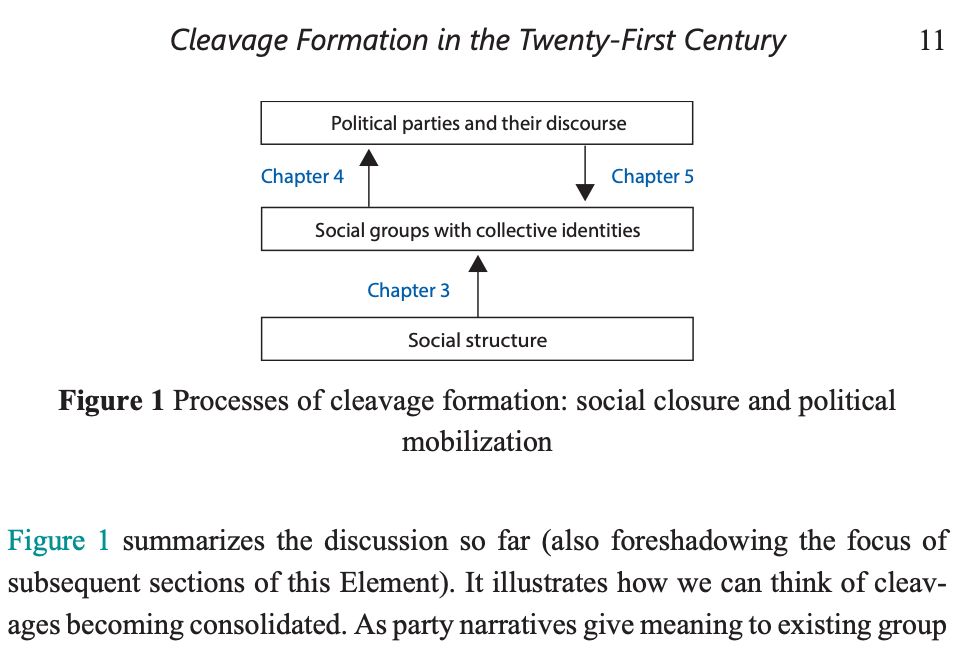
How do voters navigate fragmenting party landscapes with parties behaving in an ever more strategic matter? In this short CUP book, we suggest that group identities mediate the link between social structure and ideological party blocks.
1/8
1/8
Reposted by Simon Bornschier

Share widely with your students in Switzerland 🇨🇭thinking about a PhD @eui-eu.bsky.social
𝗢𝗻𝗹𝗶𝗻𝗲 𝗘𝗨𝗜 𝗣𝗵𝗗 𝗣𝗿𝗲𝗽 𝗧𝗮𝗹𝗸 🇨🇭
21 Nov 2025 | 2:30pm CET
@alissasiara.bsky.social introduces the program & life at EUI, I share my experience, and we answer your questions.
👉 Register: www.eui.eu/events?id=58...
𝗢𝗻𝗹𝗶𝗻𝗲 𝗘𝗨𝗜 𝗣𝗵𝗗 𝗣𝗿𝗲𝗽 𝗧𝗮𝗹𝗸 🇨🇭
21 Nov 2025 | 2:30pm CET
@alissasiara.bsky.social introduces the program & life at EUI, I share my experience, and we answer your questions.
👉 Register: www.eui.eu/events?id=58...
PhD Prep Talk: Switzerland
Meet an EUI Researcher and alumnus from your country!
www.eui.eu
November 5, 2025 at 12:14 PM
Share widely with your students in Switzerland 🇨🇭thinking about a PhD @eui-eu.bsky.social
𝗢𝗻𝗹𝗶𝗻𝗲 𝗘𝗨𝗜 𝗣𝗵𝗗 𝗣𝗿𝗲𝗽 𝗧𝗮𝗹𝗸 🇨🇭
21 Nov 2025 | 2:30pm CET
@alissasiara.bsky.social introduces the program & life at EUI, I share my experience, and we answer your questions.
👉 Register: www.eui.eu/events?id=58...
𝗢𝗻𝗹𝗶𝗻𝗲 𝗘𝗨𝗜 𝗣𝗵𝗗 𝗣𝗿𝗲𝗽 𝗧𝗮𝗹𝗸 🇨🇭
21 Nov 2025 | 2:30pm CET
@alissasiara.bsky.social introduces the program & life at EUI, I share my experience, and we answer your questions.
👉 Register: www.eui.eu/events?id=58...
Reposted by Simon Bornschier

@dpzollinger.bsky.social and I are thrilled "Cleavage Politics in Western Democracies" is out as an SI at @wepsocial.bsky.social!
Its papers explore the foundations of the cleavage pitting new left against radical right parties, and how it compares to the classic cleavages of Lipset & Rokkan:
🧵⬇️
Its papers explore the foundations of the cleavage pitting new left against radical right parties, and how it compares to the classic cleavages of Lipset & Rokkan:
🧵⬇️
October 7, 2025 at 11:28 AM
@dpzollinger.bsky.social and I are thrilled "Cleavage Politics in Western Democracies" is out as an SI at @wepsocial.bsky.social!
Its papers explore the foundations of the cleavage pitting new left against radical right parties, and how it compares to the classic cleavages of Lipset & Rokkan:
🧵⬇️
Its papers explore the foundations of the cleavage pitting new left against radical right parties, and how it compares to the classic cleavages of Lipset & Rokkan:
🧵⬇️
Congratulations!
October 6, 2025 at 3:00 PM
Congratulations!
Looking back to some excellent panels and fruitful discussions with colleagues and friends at #ecprgc25 in vibrant Thessaloniki!

Perceived Group Representation as an Indicator of Cleavage Formation by @simonbornschier.bsky.social in the New Dimensions of Political Cleavages panel organized by @ecprpovb.bsky.social for @ecpr.bsky.social 2025 General Conference.

September 2, 2025 at 4:16 PM
Looking back to some excellent panels and fruitful discussions with colleagues and friends at #ecprgc25 in vibrant Thessaloniki!
Reposted by Simon Bornschier

📄 🚨 New Research on Polarization, Fragmentation, and Democracy in @democratization.bsky.social
Nils-Christian Bormann and I explore the impact of ideological polarization and fragmentation on the democratic systems of interwar Europe: lnkd.in/erjJr9qF
#polarization #democracy #data #history (1/4)
Nils-Christian Bormann and I explore the impact of ideological polarization and fragmentation on the democratic systems of interwar Europe: lnkd.in/erjJr9qF
#polarization #democracy #data #history (1/4)
LinkedIn
This link will take you to a page that’s not on LinkedIn
lnkd.in
August 22, 2025 at 11:59 AM
📄 🚨 New Research on Polarization, Fragmentation, and Democracy in @democratization.bsky.social
Nils-Christian Bormann and I explore the impact of ideological polarization and fragmentation on the democratic systems of interwar Europe: lnkd.in/erjJr9qF
#polarization #democracy #data #history (1/4)
Nils-Christian Bormann and I explore the impact of ideological polarization and fragmentation on the democratic systems of interwar Europe: lnkd.in/erjJr9qF
#polarization #democracy #data #history (1/4)
Reposted by Simon Bornschier

How do parties shape which issues are perceived as part of GAL-TAN?
In my paper presented at the ECPR General Conference in Thessaloniki, I delve into this question, focusing on climate change and LGBTQ rights.
Thank you @ecprpovb.bsky.social for a great section!
1/3
In my paper presented at the ECPR General Conference in Thessaloniki, I delve into this question, focusing on climate change and LGBTQ rights.
Thank you @ecprpovb.bsky.social for a great section!
1/3


August 30, 2025 at 10:35 AM
How do parties shape which issues are perceived as part of GAL-TAN?
In my paper presented at the ECPR General Conference in Thessaloniki, I delve into this question, focusing on climate change and LGBTQ rights.
Thank you @ecprpovb.bsky.social for a great section!
1/3
In my paper presented at the ECPR General Conference in Thessaloniki, I delve into this question, focusing on climate change and LGBTQ rights.
Thank you @ecprpovb.bsky.social for a great section!
1/3
Thank you for organizing!
August 29, 2025 at 1:08 PM
Thank you for organizing!
Join us for the presentation “Perceived Group Representation as an Indicator of Cleavage Formation”, co-authored with @siljahausermann.bsky.social and @dpzollinger.bsky.social in the fantastic POVB @ecprpovb.bsky.social panel “New Dimensions of Political Cleavages”, #ecprgc25, Wednesday 8.30-10.15!
August 26, 2025 at 9:02 AM
Join us for the presentation “Perceived Group Representation as an Indicator of Cleavage Formation”, co-authored with @siljahausermann.bsky.social and @dpzollinger.bsky.social in the fantastic POVB @ecprpovb.bsky.social panel “New Dimensions of Political Cleavages”, #ecprgc25, Wednesday 8.30-10.15!
Reposted by Simon Bornschier

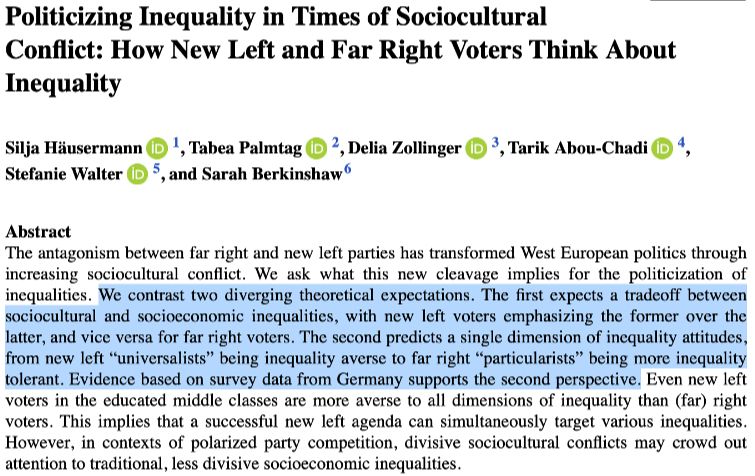
Even in times of sociocultural conflict, a progressive left electorate is more averse to sociocultural *and* socioeconomic inequalities than (far) right voters.
New paper with @siljahausermann.bsky.social Palmtag @tabouchadi.bsky.social @stefwalter.bsky.social Berkinshaw
tinyurl.com/d42wyb79
1/n
New paper with @siljahausermann.bsky.social Palmtag @tabouchadi.bsky.social @stefwalter.bsky.social Berkinshaw
tinyurl.com/d42wyb79
1/n
July 29, 2025 at 12:19 PM
Even in times of sociocultural conflict, a progressive left electorate is more averse to sociocultural *and* socioeconomic inequalities than (far) right voters.
New paper with @siljahausermann.bsky.social Palmtag @tabouchadi.bsky.social @stefwalter.bsky.social Berkinshaw
tinyurl.com/d42wyb79
1/n
New paper with @siljahausermann.bsky.social Palmtag @tabouchadi.bsky.social @stefwalter.bsky.social Berkinshaw
tinyurl.com/d42wyb79
1/n
This study is part of the excellent special issue on ‘Updating Cleavage Theory for the 21st century” that @davidattewell6.bsky.social and @dpzollinger.bsky.social
have edited with @wepsocial.bsky.social
🙏
7/7
have edited with @wepsocial.bsky.social
🙏
7/7
July 8, 2025 at 11:10 AM
This study is part of the excellent special issue on ‘Updating Cleavage Theory for the 21st century” that @davidattewell6.bsky.social and @dpzollinger.bsky.social
have edited with @wepsocial.bsky.social
🙏
7/7
have edited with @wepsocial.bsky.social
🙏
7/7
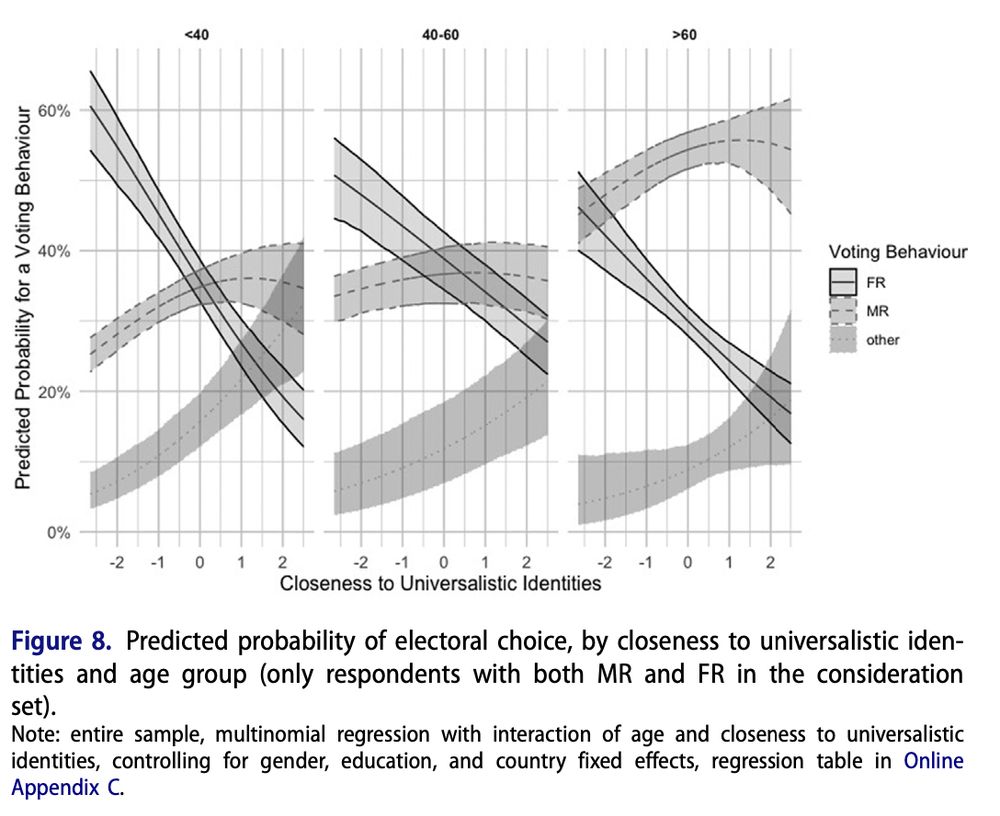
However: Voters in the right field with less particularistic group identities continue to opt for the mainstream right, suggesting that accommodating the far right would likely entail additional losses for mainstream right parties.
6/7
6/7
July 8, 2025 at 11:08 AM
However: Voters in the right field with less particularistic group identities continue to opt for the mainstream right, suggesting that accommodating the far right would likely entail additional losses for mainstream right parties.
6/7
6/7
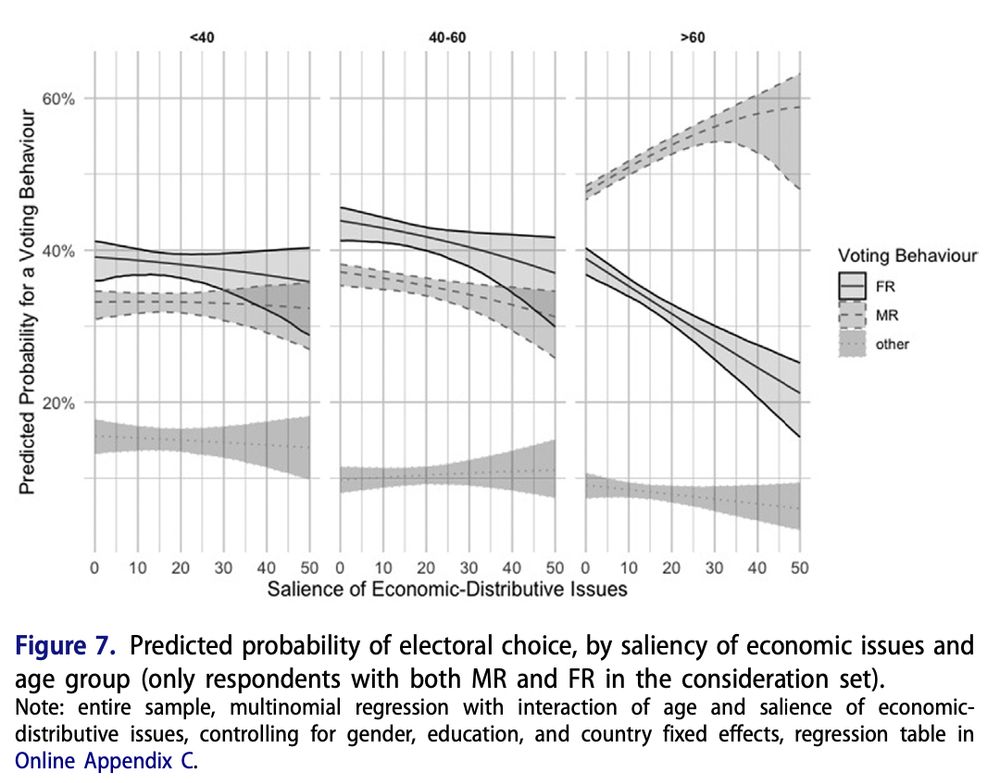
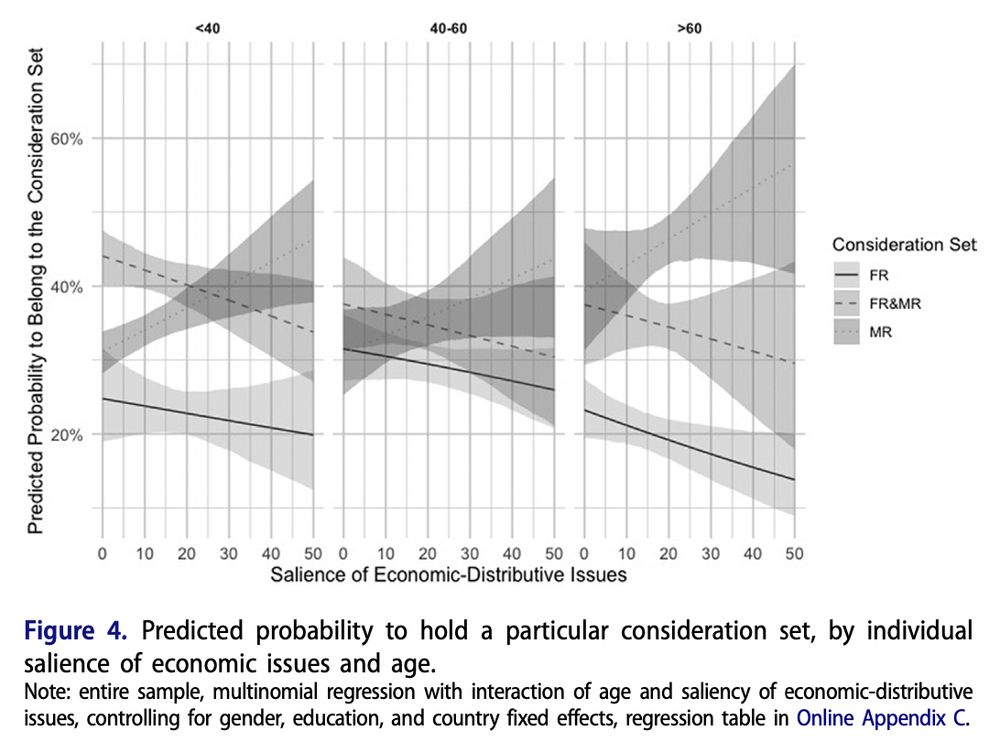
And among those voters who hold BOTH far and mainstream right parties in their consideration set, how salient economic-distributive issues are to them (relative to socio-cultural questions) explains actual choice only among the elderly.
IOW: the segmentation of the right field is eroding.
5/7
IOW: the segmentation of the right field is eroding.
5/7
July 8, 2025 at 11:07 AM
And among those voters who hold BOTH far and mainstream right parties in their consideration set, how salient economic-distributive issues are to them (relative to socio-cultural questions) explains actual choice only among the elderly.
IOW: the segmentation of the right field is eroding.
5/7
IOW: the segmentation of the right field is eroding.
5/7
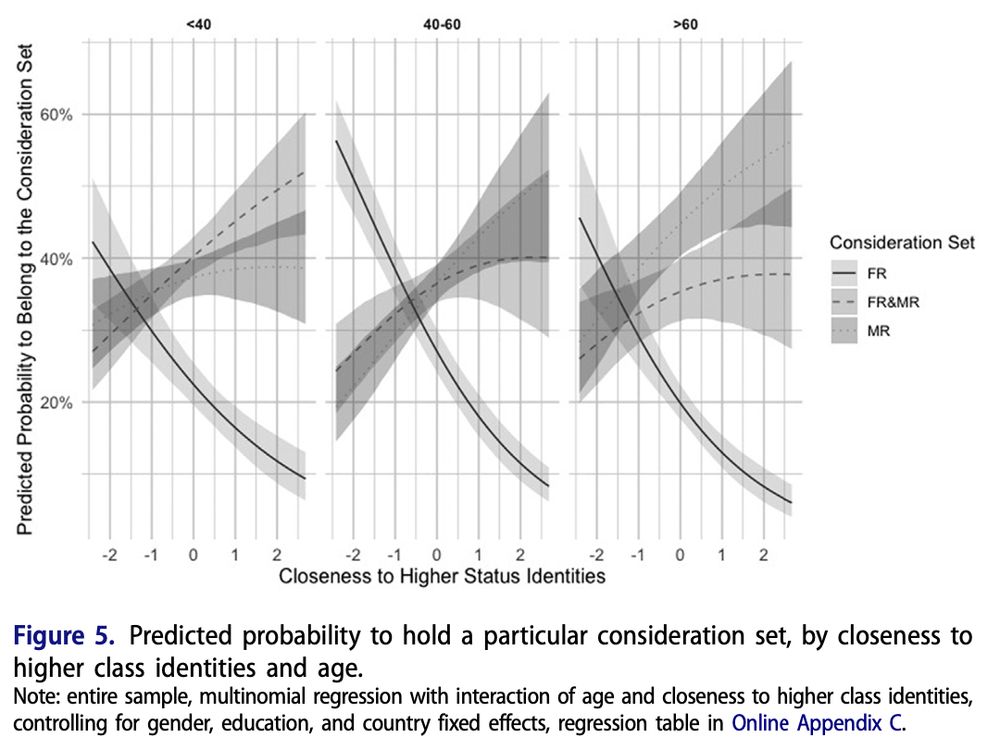
More surprisingly – and reason to worry for these parties – the mainstream right has lost its dominant position even among those younger voters…
• for whom economic-distributive issues are most salient and…
• who hold higher social status identities.
4/7
• for whom economic-distributive issues are most salient and…
• who hold higher social status identities.
4/7
July 8, 2025 at 11:07 AM
More surprisingly – and reason to worry for these parties – the mainstream right has lost its dominant position even among those younger voters…
• for whom economic-distributive issues are most salient and…
• who hold higher social status identities.
4/7
• for whom economic-distributive issues are most salient and…
• who hold higher social status identities.
4/7
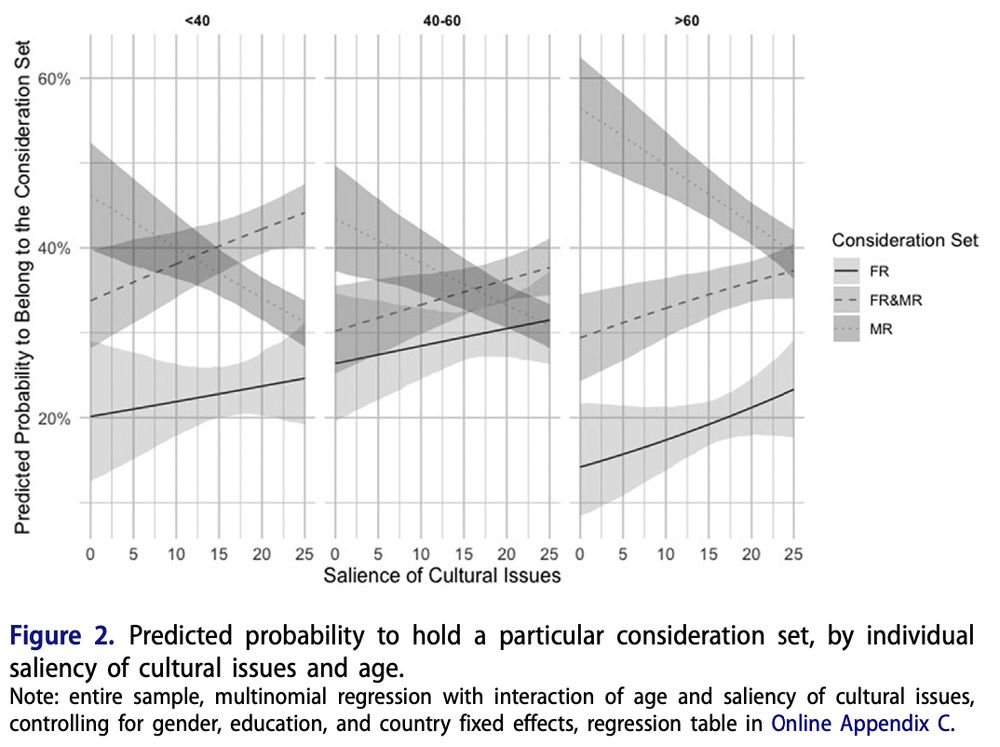
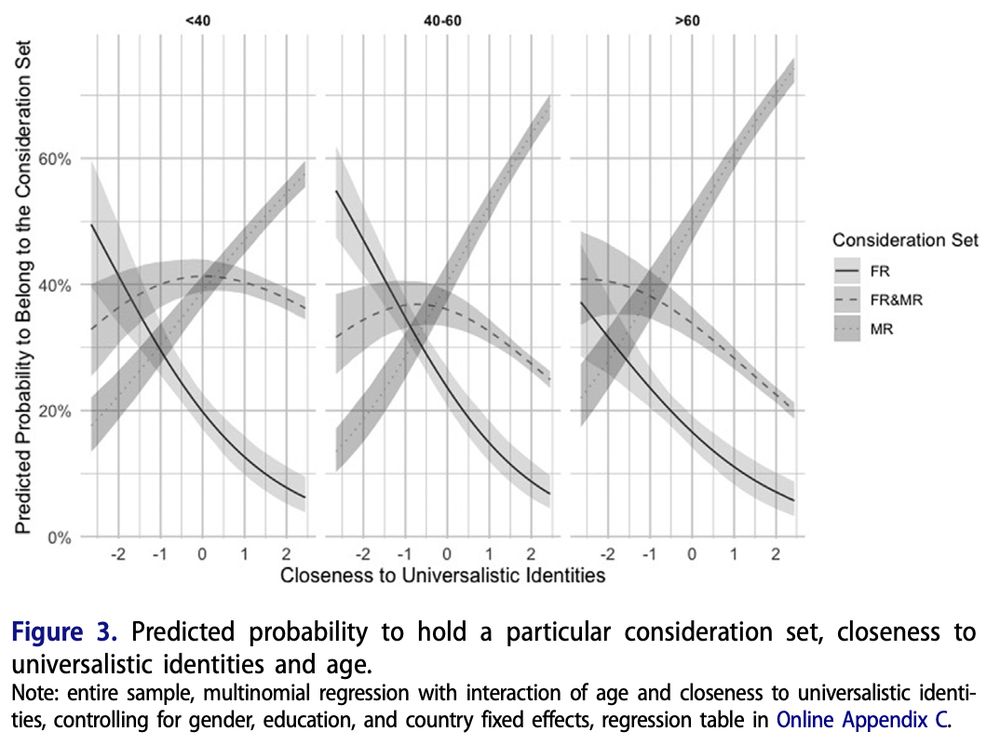
Unsurprisingly,
• the more salient cultural issues are to voters and…
• the more particularistic their identities…
the more likely they are to consider voting for far right parties. This pattern is similar across age groups, but weakest for the elderly.
3/7
• the more salient cultural issues are to voters and…
• the more particularistic their identities…
the more likely they are to consider voting for far right parties. This pattern is similar across age groups, but weakest for the elderly.
3/7

July 8, 2025 at 11:06 AM
Unsurprisingly,
• the more salient cultural issues are to voters and…
• the more particularistic their identities…
the more likely they are to consider voting for far right parties. This pattern is similar across age groups, but weakest for the elderly.
3/7
• the more salient cultural issues are to voters and…
• the more particularistic their identities…
the more likely they are to consider voting for far right parties. This pattern is similar across age groups, but weakest for the elderly.
3/7
What explains whether right-wing voters consider voting for
• only the mainstream right
• only the far right
• or both?
Using original survey data, we study how saliency, attitudes and identities relate to consideration sets and vote choice.
Important finding: the findings vary by age groups.
2/7
• only the mainstream right
• only the far right
• or both?
Using original survey data, we study how saliency, attitudes and identities relate to consideration sets and vote choice.
Important finding: the findings vary by age groups.
2/7
July 8, 2025 at 11:05 AM
What explains whether right-wing voters consider voting for
• only the mainstream right
• only the far right
• or both?
Using original survey data, we study how saliency, attitudes and identities relate to consideration sets and vote choice.
Important finding: the findings vary by age groups.
2/7
• only the mainstream right
• only the far right
• or both?
Using original survey data, we study how saliency, attitudes and identities relate to consideration sets and vote choice.
Important finding: the findings vary by age groups.
2/7
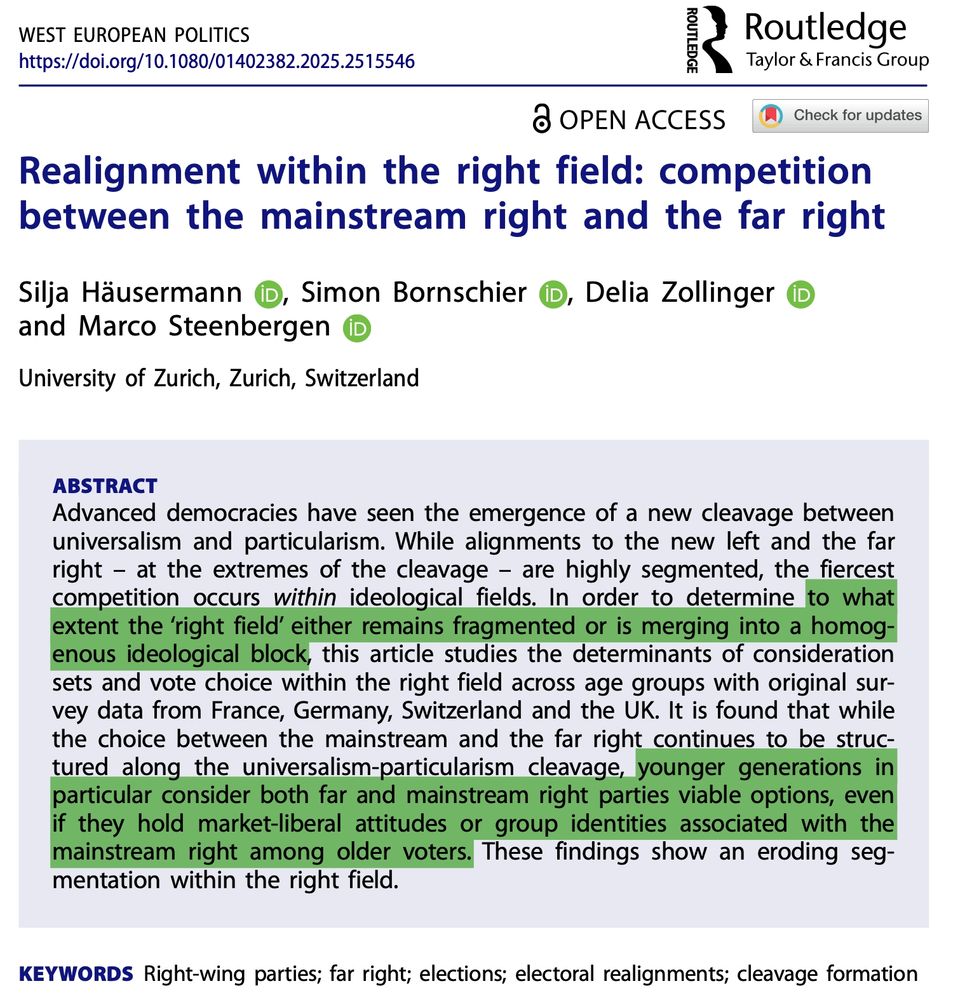
How much competition within the right field?
❗Segmentation is eroding, especially among young voters❗
New article out by @siljahausermann.bsky.social @dpzollinger.bsky.social
@mrsteenbergen.bsky.social and myself
@ipz.bsky.social @wepsocial.bsky.social
tinyurl.com/ycxfx2aj
A short 🧵
1/7
❗Segmentation is eroding, especially among young voters❗
New article out by @siljahausermann.bsky.social @dpzollinger.bsky.social
@mrsteenbergen.bsky.social and myself
@ipz.bsky.social @wepsocial.bsky.social
tinyurl.com/ycxfx2aj
A short 🧵
1/7
July 8, 2025 at 11:04 AM
How much competition within the right field?
❗Segmentation is eroding, especially among young voters❗
New article out by @siljahausermann.bsky.social @dpzollinger.bsky.social
@mrsteenbergen.bsky.social and myself
@ipz.bsky.social @wepsocial.bsky.social
tinyurl.com/ycxfx2aj
A short 🧵
1/7
❗Segmentation is eroding, especially among young voters❗
New article out by @siljahausermann.bsky.social @dpzollinger.bsky.social
@mrsteenbergen.bsky.social and myself
@ipz.bsky.social @wepsocial.bsky.social
tinyurl.com/ycxfx2aj
A short 🧵
1/7
Reposted by Simon Bornschier
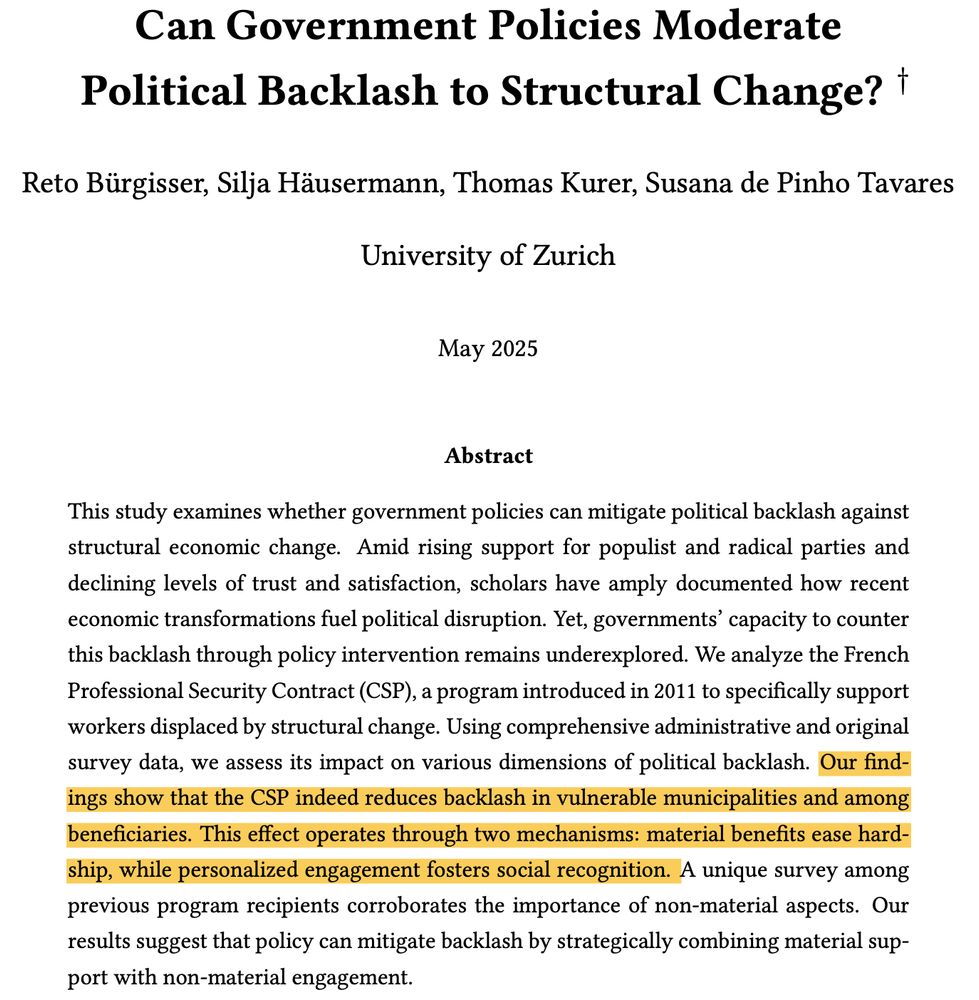
Can government policies moderate political backlash to structural change?
Yes, the effect operates through material benefits and social recognition.
🚨New WP by @retobuergisser.bsky.social, @siljahausermann.bsky.social, @thmskrr.bsky.social and @susanadptavares.bsky.social 🚨
shorturl.at/zFbZE
Yes, the effect operates through material benefits and social recognition.
🚨New WP by @retobuergisser.bsky.social, @siljahausermann.bsky.social, @thmskrr.bsky.social and @susanadptavares.bsky.social 🚨
shorturl.at/zFbZE
June 4, 2025 at 8:01 AM
Can government policies moderate political backlash to structural change?
Yes, the effect operates through material benefits and social recognition.
🚨New WP by @retobuergisser.bsky.social, @siljahausermann.bsky.social, @thmskrr.bsky.social and @susanadptavares.bsky.social 🚨
shorturl.at/zFbZE
Yes, the effect operates through material benefits and social recognition.
🚨New WP by @retobuergisser.bsky.social, @siljahausermann.bsky.social, @thmskrr.bsky.social and @susanadptavares.bsky.social 🚨
shorturl.at/zFbZE
Reposted by Simon Bornschier

New publication in @wepsocial.bsky.social with @retobuergisser.bsky.social, @siljahausermann.bsky.social, and Michael Pinggera. We map the welfare preferences of voters at the poles of the second, GALTAN dimension of political conflict. 🧵

Online first & open access:
"The welfare preferences of socially liberal and socially conservative voters"
by @matthiasenggist.bsky.social @retobuergisser.bsky.social @siljahausermann.bsky.social & Michael Pinggera
doi.org/10.1080/0140...
#Polisky #Academicsky
"The welfare preferences of socially liberal and socially conservative voters"
by @matthiasenggist.bsky.social @retobuergisser.bsky.social @siljahausermann.bsky.social & Michael Pinggera
doi.org/10.1080/0140...
#Polisky #Academicsky


March 4, 2025 at 6:06 PM
New publication in @wepsocial.bsky.social with @retobuergisser.bsky.social, @siljahausermann.bsky.social, and Michael Pinggera. We map the welfare preferences of voters at the poles of the second, GALTAN dimension of political conflict. 🧵
Reposted by Simon Bornschier

Not sure if the world is paying attention—Switzerland is small (though economically powerful). But while other Western leaders sharply criticized VP JD Vance’s speech at the #MSC / in Munich, the current Swiss president largely approved it, interpreting it as „a plea for direct democracy“ polisky

"Das war eine sehr liberale Rede", sagt Bundespräsidentin Karin Keller-Sutter über die Rede von US-Vizepräsident @jdvanceoffical.bsky.social an der Münchner Sicherheitskonferenz: "In einem gewissen Sinne war sie sehr schweizerisch, weil er sagt, man müsse auf die Bevölkerung hören". (1/5)

February 15, 2025 at 5:37 PM
Not sure if the world is paying attention—Switzerland is small (though economically powerful). But while other Western leaders sharply criticized VP JD Vance’s speech at the #MSC / in Munich, the current Swiss president largely approved it, interpreting it as „a plea for direct democracy“ polisky
An excellent analysis by Steven Levitsky & Lucan Way on the prospects for democracy in the US under Trump II, with a lot of comparative insight. A sobering view, yet underlining that polarization may not only be a danger, but paradoxically also a safeguard for liberal democray.

“Worn down by harassment and threats, many of Trump’s critics will be tempted to retreat to the sidelines. Such a retreat would be perilous. When fear, exhaustion, or resignation crowds out citizens’ commitment to democracy, emergent authoritarianism begins to take root.”

The Path to American Authoritarianism
What comes after democratic breakdown.
www.foreignaffairs.com
February 14, 2025 at 5:55 PM
An excellent analysis by Steven Levitsky & Lucan Way on the prospects for democracy in the US under Trump II, with a lot of comparative insight. A sobering view, yet underlining that polarization may not only be a danger, but paradoxically also a safeguard for liberal democray.
Reposted by Simon Bornschier

🚨 Job Alert! 🚨
I’m looking for a postdoc to join my Emmy Noether project on the New Climate Divide! 🌍
🔍 It is a 3-year position with a likely extension for another 3 years & no teaching obligations
📄 Check out the job call: uni-heidelberg.de/md/politik/p...
Thanks for sharing! 🤝
I’m looking for a postdoc to join my Emmy Noether project on the New Climate Divide! 🌍
🔍 It is a 3-year position with a likely extension for another 3 years & no teaching obligations
📄 Check out the job call: uni-heidelberg.de/md/politik/p...
Thanks for sharing! 🤝
uni-heidelberg.de
January 15, 2025 at 12:37 PM
🚨 Job Alert! 🚨
I’m looking for a postdoc to join my Emmy Noether project on the New Climate Divide! 🌍
🔍 It is a 3-year position with a likely extension for another 3 years & no teaching obligations
📄 Check out the job call: uni-heidelberg.de/md/politik/p...
Thanks for sharing! 🤝
I’m looking for a postdoc to join my Emmy Noether project on the New Climate Divide! 🌍
🔍 It is a 3-year position with a likely extension for another 3 years & no teaching obligations
📄 Check out the job call: uni-heidelberg.de/md/politik/p...
Thanks for sharing! 🤝
Reposted by Simon Bornschier

This is also an amazing tool for tracking the social identities parties (try to) tap into! Typical voters are not identified by political profiles but via brands, bands, lifestyles,... Ping
@dpzollinger.bsky.social @simonbornschier.bsky.social @siljahausermann.bsky.social @magneflemmen.bsky.social
@dpzollinger.bsky.social @simonbornschier.bsky.social @siljahausermann.bsky.social @magneflemmen.bsky.social


February 14, 2025 at 8:33 AM
This is also an amazing tool for tracking the social identities parties (try to) tap into! Typical voters are not identified by political profiles but via brands, bands, lifestyles,... Ping
@dpzollinger.bsky.social @simonbornschier.bsky.social @siljahausermann.bsky.social @magneflemmen.bsky.social
@dpzollinger.bsky.social @simonbornschier.bsky.social @siljahausermann.bsky.social @magneflemmen.bsky.social
We @dpzollinger.bsky.social @mrsteenbergen.bsky.social @siljahausermann.bsky.social @lhaffert.bsky.social @simonbornschier.bsky.social are happy to see this come out.
A warm thank you to all those who provided feedback!
The book is #OpenAccess at cup.org/3ZLtQ0o
8/8
A warm thank you to all those who provided feedback!
The book is #OpenAccess at cup.org/3ZLtQ0o
8/8
Cleavage Formation in the 21st Century
Cambridge Core - European Studies - Cleavage Formation in the 21st Century
cup.org
February 7, 2025 at 9:07 AM
We @dpzollinger.bsky.social @mrsteenbergen.bsky.social @siljahausermann.bsky.social @lhaffert.bsky.social @simonbornschier.bsky.social are happy to see this come out.
A warm thank you to all those who provided feedback!
The book is #OpenAccess at cup.org/3ZLtQ0o
8/8
A warm thank you to all those who provided feedback!
The book is #OpenAccess at cup.org/3ZLtQ0o
8/8
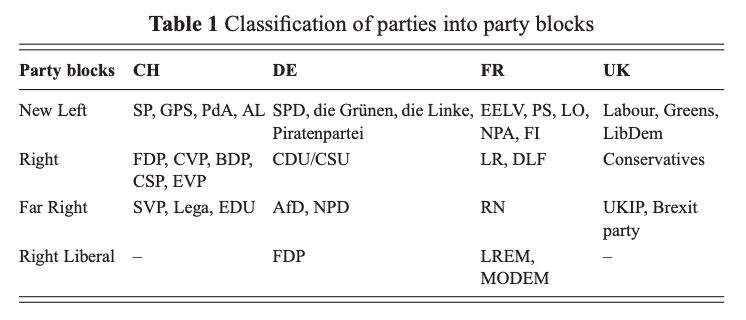
Party systems have undoubtedly become more volatile and fragmented. Seeing the underlying stability in political behavior and the similarities across countries it produces requires focusing on voter alignments to ideological blocks, rather than individual parties.
7/8
7/8
February 7, 2025 at 9:06 AM
Party systems have undoubtedly become more volatile and fragmented. Seeing the underlying stability in political behavior and the similarities across countries it produces requires focusing on voter alignments to ideological blocks, rather than individual parties.
7/8
7/8
But when parties talk about issues related to the universalism-particularism cleavage (for example, gender equality, LGBTQI+ rights, immigration, or the EU), they speak to group identities that are widely shared in certain social structural groups.
6/8
6/8
February 7, 2025 at 9:05 AM
But when parties talk about issues related to the universalism-particularism cleavage (for example, gender equality, LGBTQI+ rights, immigration, or the EU), they speak to group identities that are widely shared in certain social structural groups.
6/8
6/8