



Pooja Swali
@poojaswali.bsky.social
Pathogen evolution, Ancient DNA & Scicomm 🧬💀🦠
Postdoc at @ugiatucl.bsky.social van Dorp Group UCL
Previously @crick.ac.uk 👩🏽🔬👩🏽💻
Postdoc at @ugiatucl.bsky.social van Dorp Group UCL
Previously @crick.ac.uk 👩🏽🔬👩🏽💻
Reposted by Pooja Swali

Henrik Salje from the University of Cambridge joined us to give a fantastic seminar on the genetic and antigenic diversity of dengue virus.

February 3, 2026 at 4:39 PM
Henrik Salje from the University of Cambridge joined us to give a fantastic seminar on the genetic and antigenic diversity of dengue virus.
Reposted by Pooja Swali
We sequenced #ancientRNA from an 18th-Century human lung and recovered a rhinovirus genome. Take a look at our preprint. Feedback welcome.

Excited to share our work on #AncientRNA from alcohol-preserved lungs, recovering the oldest human RNA virus genome (an 18th-century rhinovirus). Our study shows that viral RNA remnants persist in centuries-old tissue, opening new ways to study virus evolution and historical disease #Paleovirology🫁🦠
www.biorxiv.org
January 31, 2026 at 2:08 AM
We sequenced #ancientRNA from an 18th-Century human lung and recovered a rhinovirus genome. Take a look at our preprint. Feedback welcome.
Reposted by Pooja Swali
Today we welcomed Dr Verity Hill @viralverity.bsky.social to present her work on disease control in the genomics age. She gave examples of her work on mosquito-borne viruses, such as dengue, to illustrate how we can use virus genomes to better control and understand virus evolution and transmission.

January 27, 2026 at 5:05 PM
Today we welcomed Dr Verity Hill @viralverity.bsky.social to present her work on disease control in the genomics age. She gave examples of her work on mosquito-borne viruses, such as dengue, to illustrate how we can use virus genomes to better control and understand virus evolution and transmission.
Reposted by Pooja Swali
See UGI's Dr Marina Escalera Zamudio (Rosetrees Fellow) and Dr Cenk Celik (Research Fellow) @cenkcelik.bsky.social presenting at the Norwich Science Festival @niscifest.bsky.social session on "Reimagining Health with Big Data".
norwichsciencefestival.co.uk/whats-on/rei...
#NISF26
norwichsciencefestival.co.uk/whats-on/rei...
#NISF26

Reimagining Health with Big Data | Norwich Science Festival
Dr Marina Escalera Zamudio and Dr Cenk Celik will share the ways in which big data and AI are transforming medicine.
norwichsciencefestival.co.uk
January 22, 2026 at 12:34 PM
See UGI's Dr Marina Escalera Zamudio (Rosetrees Fellow) and Dr Cenk Celik (Research Fellow) @cenkcelik.bsky.social presenting at the Norwich Science Festival @niscifest.bsky.social session on "Reimagining Health with Big Data".
norwichsciencefestival.co.uk/whats-on/rei...
#NISF26
norwichsciencefestival.co.uk/whats-on/rei...
#NISF26
Reposted by Pooja Swali

www.science.org/doi/10.1126/... It's finally out! Meriam Guellil expertly led this project from the first HHV6 detection to the final paper. We found both human herpesviruses 6A and 6B in ancient remains going back 2500 years.
January 2, 2026 at 7:53 PM
www.science.org/doi/10.1126/... It's finally out! Meriam Guellil expertly led this project from the first HHV6 detection to the final paper. We found both human herpesviruses 6A and 6B in ancient remains going back 2500 years.
Reposted by Pooja Swali

1/ In a recent @britishacademy.bsky.social video @rebeccasear.bsky.social from @brunelpsy.bsky.social takes a clear-eyed look at the 21st‑century rise of eugenics - an ideology that should have been left behind, yet is now re‑emerging in a number of troubling ways ⚠️🧬 🧪
Watch the full talk here 🎥👇
Watch the full talk here 🎥👇

The 21st Century Resurgence of Eugenics
YouTube video by The British Academy
www.youtube.com
December 15, 2025 at 1:48 PM
1/ In a recent @britishacademy.bsky.social video @rebeccasear.bsky.social from @brunelpsy.bsky.social takes a clear-eyed look at the 21st‑century rise of eugenics - an ideology that should have been left behind, yet is now re‑emerging in a number of troubling ways ⚠️🧬 🧪
Watch the full talk here 🎥👇
Watch the full talk here 🎥👇
Reposted by Pooja Swali
Great talk from @ugiatucl.bsky.social post-doc @cenkcelik.bsky.social presenting his work developing new approaches to explore the spatial patterns of cancer evolution.
Preprint 👉 www.biorxiv.org/content/10.1...
Thanks for giving our last seminar of the year!
Preprint 👉 www.biorxiv.org/content/10.1...
Thanks for giving our last seminar of the year!

December 9, 2025 at 9:47 PM
Great talk from @ugiatucl.bsky.social post-doc @cenkcelik.bsky.social presenting his work developing new approaches to explore the spatial patterns of cancer evolution.
Preprint 👉 www.biorxiv.org/content/10.1...
Thanks for giving our last seminar of the year!
Preprint 👉 www.biorxiv.org/content/10.1...
Thanks for giving our last seminar of the year!
Reposted by Pooja Swali
Lovely is the right adjective. Writing this was so enjoyable in the company of @acstone.bsky.social @blevinske.bsky.social and Verena Schuenemann. Hope you enjoy.

Lovely to work with @blevinske.bsky.social, @paleogenomics.bsky.social & Verena Schuenemann on " Ancient DNA insights into diverse pathogens and their hosts"! Read it at rdcu.be/eSVPN

Ancient DNA insights into diverse pathogens and their hosts
Nature Reviews Genetics - Ancient DNA techniques are being applied to study increasingly diverse pathogens of the past. The authors review the latest insights into pathogen–host coevolution,...
rdcu.be
December 3, 2025 at 7:42 PM
Lovely is the right adjective. Writing this was so enjoyable in the company of @acstone.bsky.social @blevinske.bsky.social and Verena Schuenemann. Hope you enjoy.
Reposted by Pooja Swali

We’re recruiting a PhD student as part of the AI-Intervene DTP to join FlightPath, an exciting project combining viral genomics, bird migration data, and AI-powered phylodynamics to forecast how avian influenza evolves and spreads.
Project Details 🦠🧬🦅🦆🌎: tinyurl.com/2v4xaxmx.
Project Details 🦠🧬🦅🦆🌎: tinyurl.com/2v4xaxmx.

FlightPath: Predicting Avian Influenza Evolution through AI-Powered Phylodynamics and Bird Migration Modelling at University of Reading on FindAPhD.com
PhD Project - FlightPath: Predicting Avian Influenza Evolution through AI-Powered Phylodynamics and Bird Migration Modelling at University of Reading, listed on FindAPhD.com
www.findaphd.com
December 4, 2025 at 11:45 AM
We’re recruiting a PhD student as part of the AI-Intervene DTP to join FlightPath, an exciting project combining viral genomics, bird migration data, and AI-powered phylodynamics to forecast how avian influenza evolves and spreads.
Project Details 🦠🧬🦅🦆🌎: tinyurl.com/2v4xaxmx.
Project Details 🦠🧬🦅🦆🌎: tinyurl.com/2v4xaxmx.
Reposted by Pooja Swali

🚨 PNAS Special Feature 2 🐕
We used ancient DNA and dietary isotopes to show that landscape modification and the introduction of European dogs impacted dingo populations across Australia.
🔗 Full paper here: www.pnas.org/doi/10.1073/...
We used ancient DNA and dietary isotopes to show that landscape modification and the introduction of European dogs impacted dingo populations across Australia.
🔗 Full paper here: www.pnas.org/doi/10.1073/...

November 24, 2025 at 9:22 PM
🚨 PNAS Special Feature 2 🐕
We used ancient DNA and dietary isotopes to show that landscape modification and the introduction of European dogs impacted dingo populations across Australia.
🔗 Full paper here: www.pnas.org/doi/10.1073/...
We used ancient DNA and dietary isotopes to show that landscape modification and the introduction of European dogs impacted dingo populations across Australia.
🔗 Full paper here: www.pnas.org/doi/10.1073/...
Reposted by Pooja Swali

Despite my insomnia, I'm very happy to share our preprint: a multi-disciplinary assessment of a sheep mass mortality event from ~18th century France. We report the first ancient sheeppox virus (think smallpox) and the Taenia hydatigena (nasty roundworm) genomes.
#aDNA
#aDNA

Evidence of sheeppox in 17th-19th century France: a multi-disciplinary investigation of a sheep mass mortality assemblage
Epizootic outbreaks posed major threats to food security, economic stability, and animal welfare in past communities. While these events and their impacts are well documented in historical records, ve...
www.biorxiv.org
November 26, 2025 at 6:33 AM
Despite my insomnia, I'm very happy to share our preprint: a multi-disciplinary assessment of a sheep mass mortality event from ~18th century France. We report the first ancient sheeppox virus (think smallpox) and the Taenia hydatigena (nasty roundworm) genomes.
#aDNA
#aDNA
Reposted by Pooja Swali

UK science and technology is suffering from a lack of investment, a hostile immigration system, and fragile university finances, reports @cathleenogrady.bsky.social 🧪 #scipolicy
www.science.org/content/arti...
www.science.org/content/arti...

U.K. science sector is ‘bleeding to death,’ lawmakers say in report
House of Lords committee urges government to stem exodus of science and technology companies
www.science.org
November 10, 2025 at 10:08 PM
UK science and technology is suffering from a lack of investment, a hostile immigration system, and fragile university finances, reports @cathleenogrady.bsky.social 🧪 #scipolicy
www.science.org/content/arti...
www.science.org/content/arti...
Reposted by Pooja Swali

Our manuscript on bovine deep-time paleogenomics at Denisova Cave and in the broader mid-latitude Asia is online! doi.org/10.1093/gbe/... 🦬🦴🧬
Main findings in the 🧵 below ⬇️
@cpgsthlm.bsky.social @genomebiolevol.bsky.social #aDNA
Main findings in the 🧵 below ⬇️
@cpgsthlm.bsky.social @genomebiolevol.bsky.social #aDNA
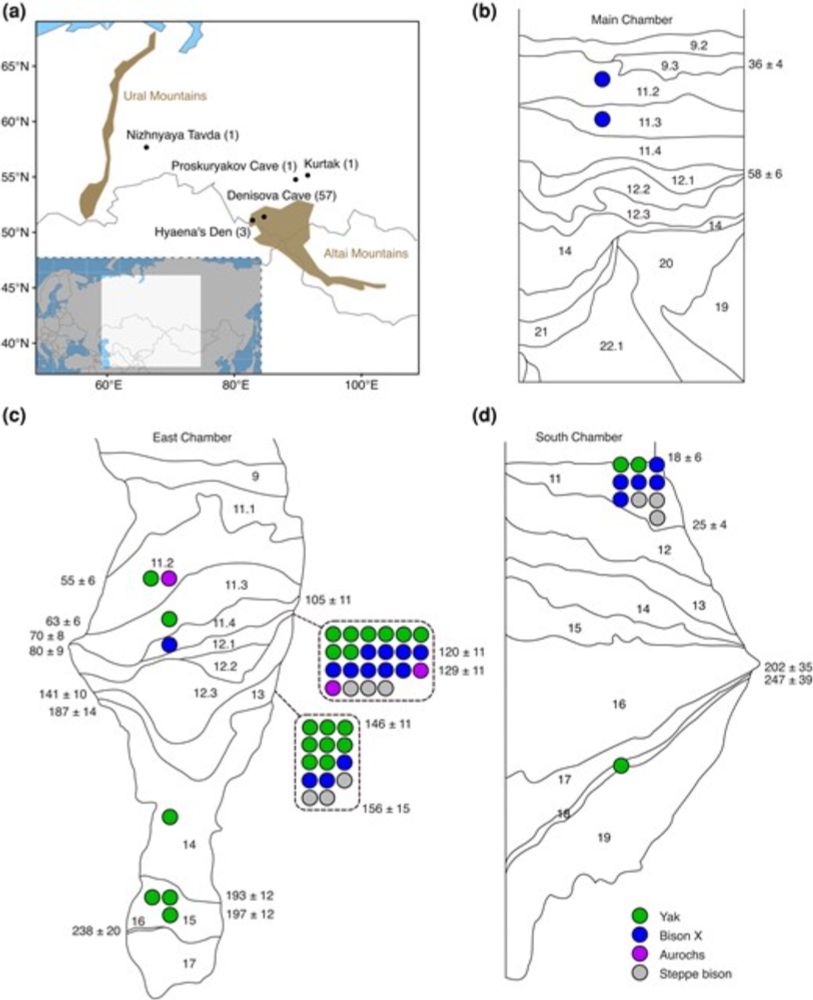
Paleogenomics Reveals a Loss of Bovine Lineages in Mid-latitude Asia Over the Last 200,000 Years
Abstract. Bovines have a complex yet poorly understood evolutionary history that is characterized by admixture and diversity loss during the Late Pleistoce
doi.org
November 20, 2025 at 9:52 AM
Our manuscript on bovine deep-time paleogenomics at Denisova Cave and in the broader mid-latitude Asia is online! doi.org/10.1093/gbe/... 🦬🦴🧬
Main findings in the 🧵 below ⬇️
@cpgsthlm.bsky.social @genomebiolevol.bsky.social #aDNA
Main findings in the 🧵 below ⬇️
@cpgsthlm.bsky.social @genomebiolevol.bsky.social #aDNA
Reposted by Pooja Swali

a life changing opportunity made possible by the Nobel Prize funds awarded to John Sulston -- the @sangerinstitute.bsky.social runs the Sanger Prize scheme, open to an undergrad from any LMIC to spend 3 months here learning all about genomics. more details here www.sanger.ac.uk/about/study/...
November 20, 2025 at 5:39 PM
a life changing opportunity made possible by the Nobel Prize funds awarded to John Sulston -- the @sangerinstitute.bsky.social runs the Sanger Prize scheme, open to an undergrad from any LMIC to spend 3 months here learning all about genomics. more details here www.sanger.ac.uk/about/study/...
Reposted by Pooja Swali
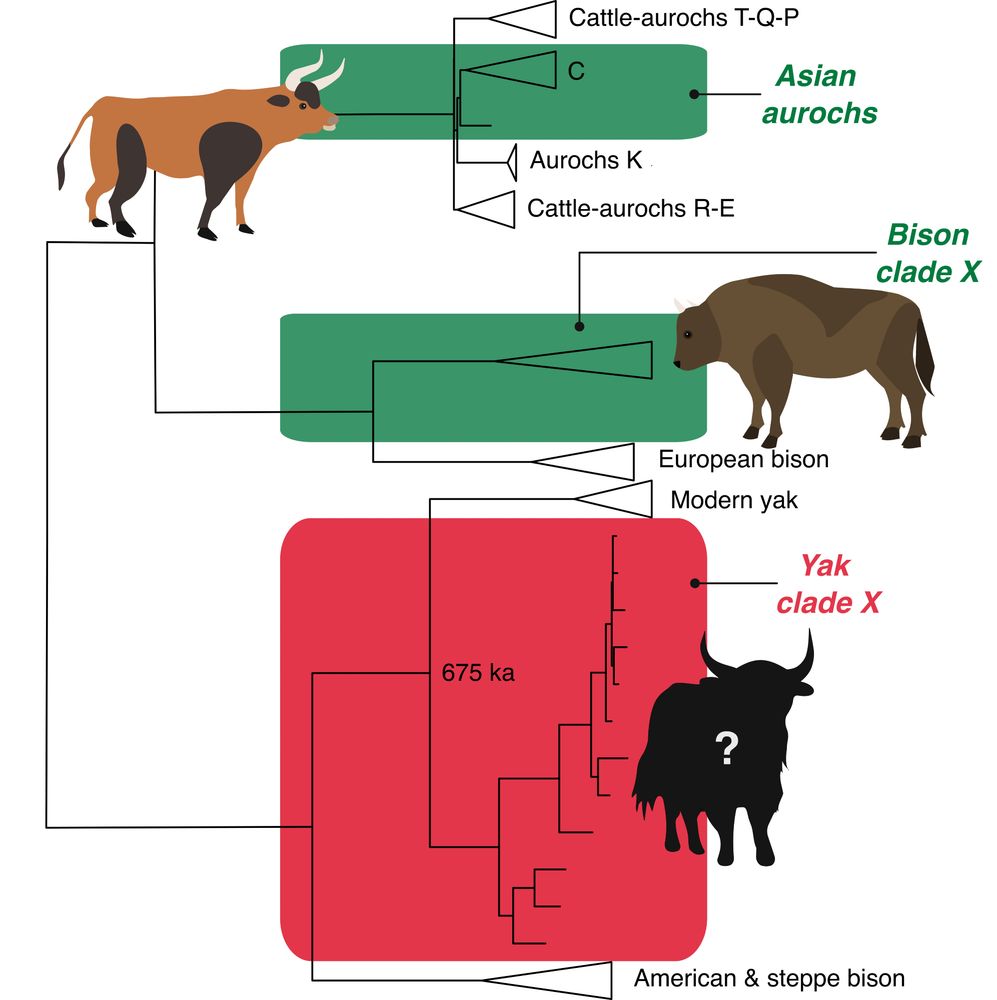
Briefly, we identified three extinct mitochondrial bovine lineages in mid-latitude Asia: aurochs basal to haplogroup C, bison clade X, and a previously unknown yak-like clade X sister to all known yak diversity.
This yak X mitochondrial lineage diverged around 675,000 years ago from modern yak!
This yak X mitochondrial lineage diverged around 675,000 years ago from modern yak!
November 20, 2025 at 9:52 AM
Briefly, we identified three extinct mitochondrial bovine lineages in mid-latitude Asia: aurochs basal to haplogroup C, bison clade X, and a previously unknown yak-like clade X sister to all known yak diversity.
This yak X mitochondrial lineage diverged around 675,000 years ago from modern yak!
This yak X mitochondrial lineage diverged around 675,000 years ago from modern yak!
Reposted by Pooja Swali
What an incredible resource for those starting out in ancient DNA! Thanks once again @oskolkov.bsky.social for being our first #AaRCademy speaker


November 18, 2025 at 8:44 AM
What an incredible resource for those starting out in ancient DNA! Thanks once again @oskolkov.bsky.social for being our first #AaRCademy speaker
Reposted by Pooja Swali

New online! Insights into infectious diseases through ancient pathogen genomics

Insights into infectious diseases through ancient pathogen genomics
Nature Reviews Microbiology, Published online: 17 November 2025; doi:10.1038/s41579-025-01259-7In this Review, Kocher, Krause and Spyrou explore how ancient pathogen genomics is providing new perspectives on the history and evolution of infectious agents. They show how ancient DNA has revealed the aetiology and unfolding of historic outbreaks, pathogen evolutionary timescales, patterns of dissemination and functional evolution, and discuss existing limitations and perspectives of the field.
www.nature.com
November 17, 2025 at 9:24 PM
New online! Insights into infectious diseases through ancient pathogen genomics
Reposted by Pooja Swali

A PhD project on historical genomics in the declining red squirrel in Britain is available in my group, through the @aries-dtp.bsky.social. Use historical genomes to track the effects of decline and genetic rescue in this charismatic species. aries-dtp.ac.uk/studentships...

Historical genomics of the declining red squirrel in Britain | Aries
Dr Anders Bergström, School of Biological Sciences, University of East Anglia Professor Cock van Oosterhout, School of Environmental Sciences, University of East Anglia Dr Selina Brace…
aries-dtp.ac.uk
November 17, 2025 at 1:12 PM
A PhD project on historical genomics in the declining red squirrel in Britain is available in my group, through the @aries-dtp.bsky.social. Use historical genomes to track the effects of decline and genetic rescue in this charismatic species. aries-dtp.ac.uk/studentships...
Reposted by Pooja Swali
Applications are now open for the NERC TREES DLA 2026 PhD cohort. If you’re interested in conducting high-impact research in environmental science via an advertised or self-proposed project please take a look: www.trees-dla.ac.uk/news/applica.... #PhDprogramme #PhD #genomics #evolution
Applications Now Open! | TREES DLA
TREES Overview & Research ThemesTREES supports doctoral research across a broad range of themes. Applicants should align with at least one of these areas:
www.trees-dla.ac.uk
October 21, 2025 at 8:22 AM
Applications are now open for the NERC TREES DLA 2026 PhD cohort. If you’re interested in conducting high-impact research in environmental science via an advertised or self-proposed project please take a look: www.trees-dla.ac.uk/news/applica.... #PhDprogramme #PhD #genomics #evolution
Reposted by Pooja Swali
Wonderful and engaging talk by
@lucyvandorp.bsky.social
who was invited to speak on the drivers of pathogen evolution using ancient DNA at the Ancient Genomes: Perspectives on Human Biology and Medicine meeting
@gensocuk.bsky.social
🧬🦠
@lucyvandorp.bsky.social
who was invited to speak on the drivers of pathogen evolution using ancient DNA at the Ancient Genomes: Perspectives on Human Biology and Medicine meeting
@gensocuk.bsky.social
🧬🦠

November 17, 2025 at 9:54 AM
Wonderful and engaging talk by
@lucyvandorp.bsky.social
who was invited to speak on the drivers of pathogen evolution using ancient DNA at the Ancient Genomes: Perspectives on Human Biology and Medicine meeting
@gensocuk.bsky.social
🧬🦠
@lucyvandorp.bsky.social
who was invited to speak on the drivers of pathogen evolution using ancient DNA at the Ancient Genomes: Perspectives on Human Biology and Medicine meeting
@gensocuk.bsky.social
🧬🦠
Reposted by Pooja Swali
Great to have Priya Moorjani visit UGI and give a talk on inferring Neanderthal ancestry in ancient individuals, and to share a bit about her work on Indian genetics, including insights into the evolution of lactase persistence.

November 12, 2025 at 5:00 PM
Great to have Priya Moorjani visit UGI and give a talk on inferring Neanderthal ancestry in ancient individuals, and to share a bit about her work on Indian genetics, including insights into the evolution of lactase persistence.
Reposted by Pooja Swali
How does life evolve to adapt to modern cities?
Out now in Science, my PhD work with @lindymcbr.bsky.social uncovers the ancient origin of the “London Underground mosquito” – one of the most iconic examples of urban adaptation.
🧵(1/n)
@science.org
www.science.org/doi/10.1126/science.ady4515
Out now in Science, my PhD work with @lindymcbr.bsky.social uncovers the ancient origin of the “London Underground mosquito” – one of the most iconic examples of urban adaptation.
🧵(1/n)
@science.org
www.science.org/doi/10.1126/science.ady4515

Ancient origin of an urban underground mosquito
Understanding how life is adapting to urban environments represents an important challenge in evolutionary biology. In this work, we investigate a widely cited example of urban adaptation, Culex pipie...
www.science.org
October 25, 2025 at 4:46 AM
How does life evolve to adapt to modern cities?
Out now in Science, my PhD work with @lindymcbr.bsky.social uncovers the ancient origin of the “London Underground mosquito” – one of the most iconic examples of urban adaptation.
🧵(1/n)
@science.org
www.science.org/doi/10.1126/science.ady4515
Out now in Science, my PhD work with @lindymcbr.bsky.social uncovers the ancient origin of the “London Underground mosquito” – one of the most iconic examples of urban adaptation.
🧵(1/n)
@science.org
www.science.org/doi/10.1126/science.ady4515
Reposted by Pooja Swali
Great to have Dr Hrushikesh Loya give a fantastic talk on his tool Ghostbusters: A Genome-Wide Genealogical Approach to Uncovering Hidden Admixture Events in Human Evolution 👻

October 28, 2025 at 5:25 PM
Great to have Dr Hrushikesh Loya give a fantastic talk on his tool Ghostbusters: A Genome-Wide Genealogical Approach to Uncovering Hidden Admixture Events in Human Evolution 👻
Reposted by Pooja Swali
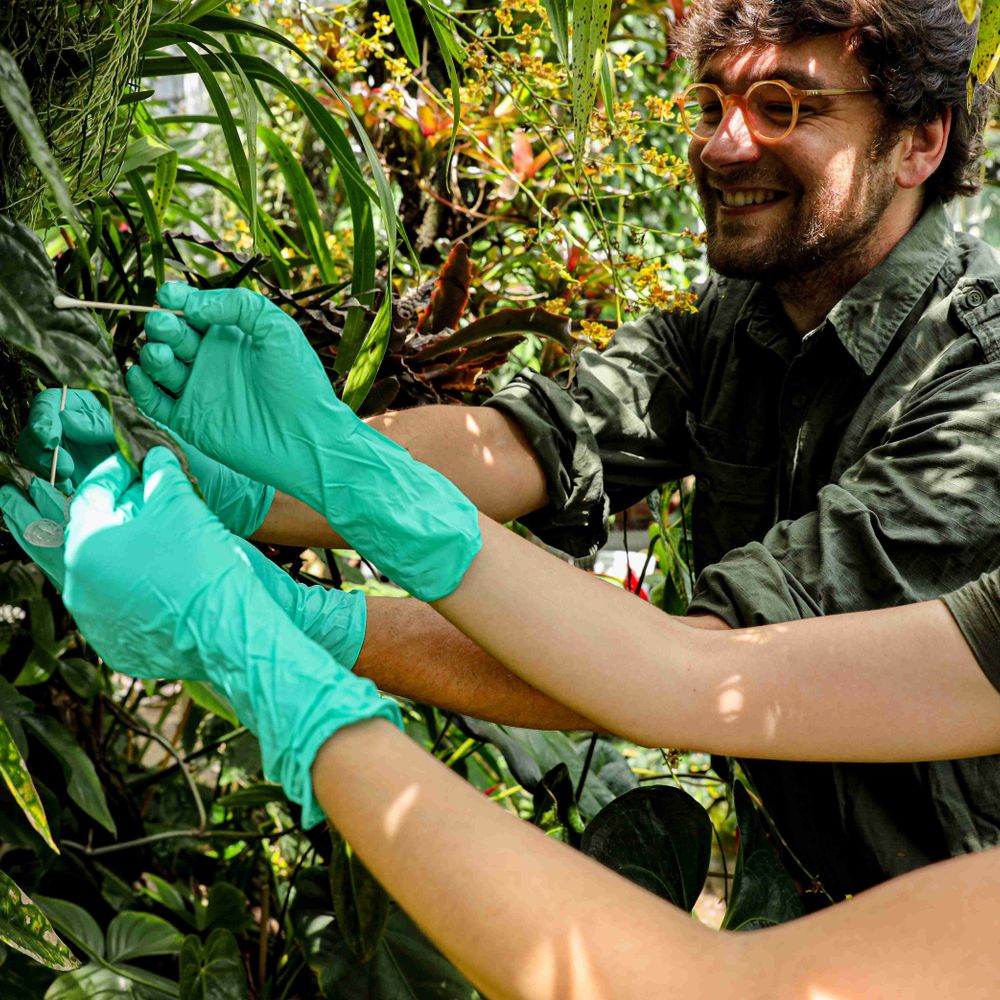
Fantastic reporting by @kakape.bsky.social on @scs22.bsky.social's work in the Arctic looking for sequenceable ancient RNA viruses. Amazing pictures (including this gem), and as always great story telling and commentary on the topic. Excited to see what they find. www.science.org/content/arti...

October 16, 2025 at 7:59 PM
Fantastic reporting by @kakape.bsky.social on @scs22.bsky.social's work in the Arctic looking for sequenceable ancient RNA viruses. Amazing pictures (including this gem), and as always great story telling and commentary on the topic. Excited to see what they find. www.science.org/content/arti...
Reposted by Pooja Swali
Thrilled to share our preprint where we propose that S. enterica Paratyphi C entered Mexico via European conquest and then diversified locally. More evidence is needed to assert whether or not it caused Cocoliztli (a major contact-period epidemic). Comments welcome!
www.biorxiv.org/content/10.1...
www.biorxiv.org/content/10.1...

Ancient genomic insights into Salmonella enterica Paratyphi C in Central Mexico
Salmonella enterica is a widespread pathogen of major global health relevance, with over 2,500 serovars classified into non-typhoidal and typhoidal groups. Within the typhoidal group, S. enterica Para...
www.biorxiv.org
October 14, 2025 at 9:59 PM
Thrilled to share our preprint where we propose that S. enterica Paratyphi C entered Mexico via European conquest and then diversified locally. More evidence is needed to assert whether or not it caused Cocoliztli (a major contact-period epidemic). Comments welcome!
www.biorxiv.org/content/10.1...
www.biorxiv.org/content/10.1...