


COSMO Lab
@labcosmo.bsky.social
Computational Science and Modelling of materials and molecules at the atomic-scale, with machine learning.
Pinned
COSMO Lab
@labcosmo.bsky.social
· Nov 28

PET-MAD as a lightweight universal interatomic potential for advanced materials modeling - Nature Communications
PET-MAD is a fast and lightweight universal machine-learning potential, trained on a small but diverse dataset, that delivers near-quantum accuracy in atomistic simulations for both organic and inorga...
www.nature.com
📢 PET-MAD is here! 📢 It has been for a while for those who read the #arXiv, but now you get it preciously 💸 typeset by @natcomms.nature.com Take home: unconstrained architecture + good train set choices give you fast, accurate and stable universal MLIP that just works™️ www.nature.com/articles/s41...
Many #machinelearning potentials are built (or understood) in terms of "atomic cluster expansions" that link directly to a body-ordered energy decomposition that can be computed explicitly with a sequence of electronic structure calculations. But what kind of expansion do they learn in practice? A🧵

February 14, 2026 at 9:36 PM
Many #machinelearning potentials are built (or understood) in terms of "atomic cluster expansions" that link directly to a body-ordered energy decomposition that can be computed explicitly with a sequence of electronic structure calculations. But what kind of expansion do they learn in practice? A🧵
Hot off the press on hashtag @aip.bsky.social #JCP, an introduction to the metatensor ecosystem. High-quality 🧑🚀 tools for atomistic hashtag#machinelearning - read on pubs.aip.org/aip/jcp/arti... and check it out at metatensor.org 🧑🍳 📖 recipes here atomistic-cookbook.org/software/met...

metatensor and metatomic: Foundational libraries for interoperable atomistic machine learning
Incorporation of machine learning (ML) techniques into atomic-scale modeling has proven to be an extremely effective strategy to improve the accuracy and reduce
pubs.aip.org
February 13, 2026 at 6:56 PM
Hot off the press on hashtag @aip.bsky.social #JCP, an introduction to the metatensor ecosystem. High-quality 🧑🚀 tools for atomistic hashtag#machinelearning - read on pubs.aip.org/aip/jcp/arti... and check it out at metatensor.org 🧑🍳 📖 recipes here atomistic-cookbook.org/software/met...
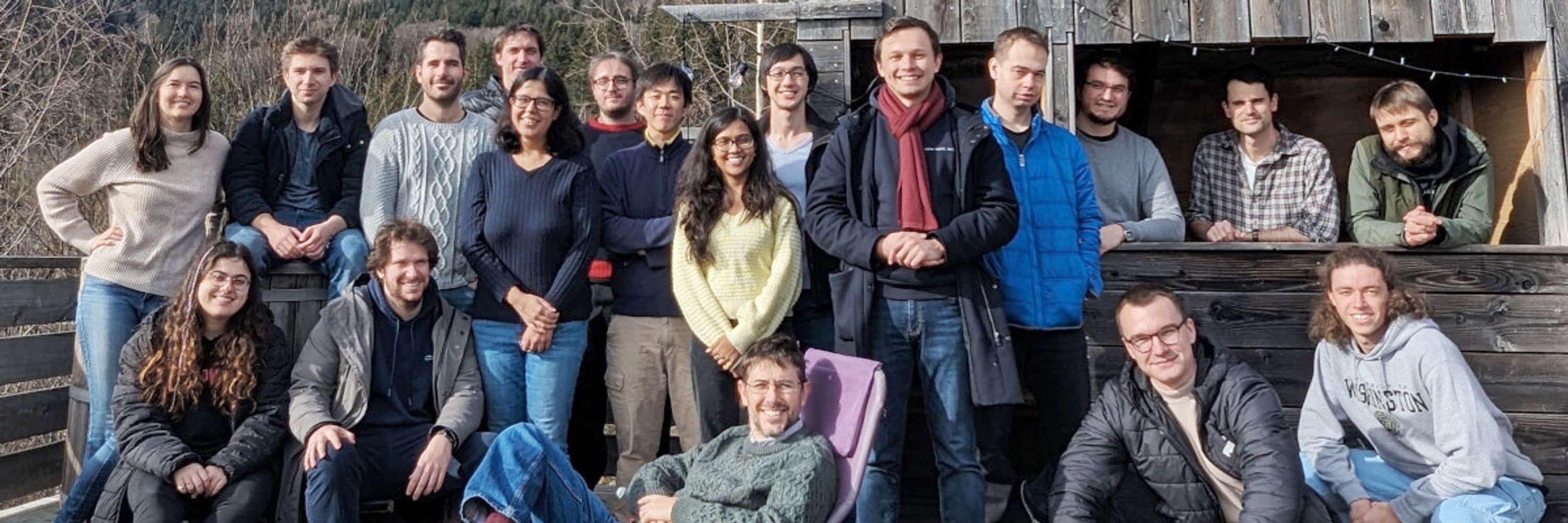
It is a stormy day, but the COSMO retreat is going strong!

February 12, 2026 at 11:16 AM
It is a stormy day, but the COSMO retreat is going strong!
🧑🚀 Filippo, Arslan and Paolo doing some PET talk with our friends at the @epfl-ai-center.bsky.social ai.epfl.ch/a-new-refere...

A New Reference Model for Machine-Learning–Driven Materials Discovery - EPFL AI Center
Researchers at EPFL’s Laboratory of Computational Science and Modeling (COSMO) have reached a significant milestone in material science, reaching the top position on Matbench Discovery, the leading be...
ai.epfl.ch
February 9, 2026 at 11:13 AM
🧑🚀 Filippo, Arslan and Paolo doing some PET talk with our friends at the @epfl-ai-center.bsky.social ai.epfl.ch/a-new-refere...
If you want to learn about materials modeling, from DFT to MD, well marinated in a spicy ML sauce, don't miss out the @ictp.bsky.social / @nccr-marvel.bsky.social college. Details and application instructions here indico.ictp.it/event/11146/. See you in Miramare!

February 8, 2026 at 7:46 AM
If you want to learn about materials modeling, from DFT to MD, well marinated in a spicy ML sauce, don't miss out the @ictp.bsky.social / @nccr-marvel.bsky.social college. Details and application instructions here indico.ictp.it/event/11146/. See you in Miramare!
PET continues its victory round of benchmarks and challenges 🥇🥉. And this one has a (bit far-fetched) end goal that would also make it useful! Congrats to Filippo and Cesare (and @marceldotsci.bsky.social who got a honorable mention and will also try further his LOREM model)🚀 dtu.dk/english/news...
International AI competition aims to speed up the development of materials for the green transition
The Pioneer Center CAPeX at DTU has announced the winners of the first phase (Stage 1) an international competition in partnership with the Novo Nordisk Foundation, and the Danish Centre for AI Innovation (DCAI), on using machine learning models to predict synthesis recipes for novel nanoparticles.
dtu.dk
February 6, 2026 at 12:53 PM
PET continues its victory round of benchmarks and challenges 🥇🥉. And this one has a (bit far-fetched) end goal that would also make it useful! Congrats to Filippo and Cesare (and @marceldotsci.bsky.social who got a honorable mention and will also try further his LOREM model)🚀 dtu.dk/english/news...
Congratulations to 🧑🚀 Sergey Pozdnyakov who very deservedly won the @materials-epfl.bsky.social doctoral distinction award. A good time to go check on his papers, if you haven't read them already!

February 3, 2026 at 3:43 PM
Congratulations to 🧑🚀 Sergey Pozdnyakov who very deservedly won the @materials-epfl.bsky.social doctoral distinction award. A good time to go check on his papers, if you haven't read them already!
Release candidate 3 of chemiscope 1.0 is out, with class and range based highlighting of points. Try it, break it, report it on github.com/lab-cosmo/ch...

February 1, 2026 at 11:59 AM
Release candidate 3 of chemiscope 1.0 is out, with class and range based highlighting of points. Try it, break it, report it on github.com/lab-cosmo/ch...
Fantastic news from the @snf-fns.ch, who despite the budget cuts managed to fund six new NCCRs. Looking forward to doing some cool simulations to advance separation science! actu.epfl.ch/news/a-new-n...

A new national research programme recognizes EPFL's expertise
The Swiss Confederation launches six new National Centres of Competence in Research (NCCRs). The NCCR “Separations”, which aims to accelerate research in separation sciences - the quest for chemical a...
actu.epfl.ch
January 30, 2026 at 9:59 AM
Fantastic news from the @snf-fns.ch, who despite the budget cuts managed to fund six new NCCRs. Looking forward to doing some cool simulations to advance separation science! actu.epfl.ch/news/a-new-n...
If you got curious by the PET-OAM results a week ago, you can learn more reading up arxiv.org/abs/2601.16195. Including some general considerations on how to train and use safely an unconstrained ML potential.

January 23, 2026 at 7:02 AM
If you got curious by the PET-OAM results a week ago, you can learn more reading up arxiv.org/abs/2601.16195. Including some general considerations on how to train and use safely an unconstrained ML potential.
Not going to make a big deal out of a benchmark table, but PET just got the top spot on matbench-discovery.materialsproject.org. And don't be fooled by the huge parameters count, it's faster and can handle larger structures than eSEN-30M 🚀. Kudos to 🧑🚀 Filippo, Arslan and Paolo!

January 14, 2026 at 6:32 AM
Not going to make a big deal out of a benchmark table, but PET just got the top spot on matbench-discovery.materialsproject.org. And don't be fooled by the huge parameters count, it's faster and can handle larger structures than eSEN-30M 🚀. Kudos to 🧑🚀 Filippo, Arslan and Paolo!
📢 chemiscope.org 1.0.0rc1 just dropped on pypi! We are making (a few) breaking changes to the interfaces, fixing a ton of bugs and introducing some exciting features (you can finally load datasets with > 100k points!). We'd be grateful if you test, break and report 🐛 github.com/lab-cosmo/ch...


January 5, 2026 at 2:42 PM
📢 chemiscope.org 1.0.0rc1 just dropped on pypi! We are making (a few) breaking changes to the interfaces, fixing a ton of bugs and introducing some exciting features (you can finally load datasets with > 100k points!). We'd be grateful if you test, break and report 🐛 github.com/lab-cosmo/ch...
Hope y'all are getting a great start of 2026. Here we're taking some time to add the 2025 winter card to the archives www.epfl.ch/labs/cosmo/i... 🎅=🧑🚀

January 3, 2026 at 9:17 AM
Hope y'all are getting a great start of 2026. Here we're taking some time to add the 2025 winter card to the archives www.epfl.ch/labs/cosmo/i... 🎅=🧑🚀
📢 New chemiscope.org release just landed! To make it even easier to integrate ⚗️🔭 into your workflow, we added a @streamlit.bsky.social component, so you can run analyses and show you atomistic data in a web app by just writing a few lines of python! try it, break it, report it!

December 17, 2025 at 9:21 PM
📢 New chemiscope.org release just landed! To make it even easier to integrate ⚗️🔭 into your workflow, we added a @streamlit.bsky.social component, so you can run analyses and show you atomistic data in a web app by just writing a few lines of python! try it, break it, report it!
Congrats to 🧑🚀 Sergey Pozdnyakov who received a distinction (best 8% of theses at @materials-epfl.bsky.social) for his PhD thesis "Advancing understanding and practical performance of machine learning interatomic potentials". Поїхали 🚀! infoscience.epfl.ch/entities/pub...

December 10, 2025 at 12:50 PM
Congrats to 🧑🚀 Sergey Pozdnyakov who received a distinction (best 8% of theses at @materials-epfl.bsky.social) for his PhD thesis "Advancing understanding and practical performance of machine learning interatomic potentials". Поїхали 🚀! infoscience.epfl.ch/entities/pub...
No day goes by without a new universal #ML potential. But how different they really are? Sanggyu and Sofiia tried to give a quantitative answer by comparing the reconstruction errors between their latent-space features. If you are curious, check out the #preprint arxiv.org/html/2512.05...

December 9, 2025 at 7:16 AM
No day goes by without a new universal #ML potential. But how different they really are? Sanggyu and Sofiia tried to give a quantitative answer by comparing the reconstruction errors between their latent-space features. If you are curious, check out the #preprint arxiv.org/html/2512.05...
📢 PET-MAD is here! 📢 It has been for a while for those who read the #arXiv, but now you get it preciously 💸 typeset by @natcomms.nature.com Take home: unconstrained architecture + good train set choices give you fast, accurate and stable universal MLIP that just works™️ www.nature.com/articles/s41...
PET-MAD as a lightweight universal interatomic potential for advanced materials modeling - Nature Communications
PET-MAD is a fast and lightweight universal machine-learning potential, trained on a small but diverse dataset, that delivers near-quantum accuracy in atomistic simulations for both organic and inorga...
www.nature.com
November 28, 2025 at 8:36 AM
📢 PET-MAD is here! 📢 It has been for a while for those who read the #arXiv, but now you get it preciously 💸 typeset by @natcomms.nature.com Take home: unconstrained architecture + good train set choices give you fast, accurate and stable universal MLIP that just works™️ www.nature.com/articles/s41...
📢 Let us (re)introduce to you our Massive Atomic Diversity dataset for universal MLIPs. MAD includes molecules, clusters, surfaces and plenty of bulk configs, we cover a lot of ground with fewer than 100k structures, using highly consistent DFT settings. Read more 📑 www.nature.com/articles/s41...

Massive Atomic Diversity: a compact universal dataset for atomistic machine learning - Scientific Data
Scientific Data - Massive Atomic Diversity: a compact universal dataset for atomistic machine learning
www.nature.com
November 23, 2025 at 8:06 PM
📢 Let us (re)introduce to you our Massive Atomic Diversity dataset for universal MLIPs. MAD includes molecules, clusters, surfaces and plenty of bulk configs, we cover a lot of ground with fewer than 100k structures, using highly consistent DFT settings. Read more 📑 www.nature.com/articles/s41...
Reposted by COSMO Lab

In this blog post, Filippo Bigi, Marcel Langer (@labcosmo.bsky.social) and @micheleceriotti.bsky.social write about the need to balance speed and physical laws when using ML for atomic-scale simulations
aihub.org/2025/10/10/m...
aihub.org/2025/10/10/m...

Machine learning for atomic-scale simulations: balancing speed and physical laws - ΑΙhub
aihub.org
October 15, 2025 at 3:04 PM
In this blog post, Filippo Bigi, Marcel Langer (@labcosmo.bsky.social) and @micheleceriotti.bsky.social write about the need to balance speed and physical laws when using ML for atomic-scale simulations
aihub.org/2025/10/10/m...
aihub.org/2025/10/10/m...
A primer for non conservative (& rotationally unconstrained) MLIPs, and how to use them safely. Thanks @aihub.org for the space! aihub.org/2025/10/10/m...

Machine learning for atomic-scale simulations: balancing speed and physical laws - ΑΙhub
aihub.org
October 10, 2025 at 10:31 AM
A primer for non conservative (& rotationally unconstrained) MLIPs, and how to use them safely. Thanks @aihub.org for the space! aihub.org/2025/10/10/m...
Reposted by COSMO Lab

Looks like @ox.ac.uk forbids their researchers to do any kind of literature search, though it seems that thankfully they can still submit to the arxiv arxiv.org/abs/2510.00027 🤷

Learning Inter-Atomic Potentials without Explicit Equivariance
Accurate and scalable machine-learned inter-atomic potentials (MLIPs) are essential for molecular simulations ranging from drug discovery to new material design. Current state-of-the-art models enforc...
arxiv.org
October 5, 2025 at 6:19 PM
Looks like @ox.ac.uk forbids their researchers to do any kind of literature search, though it seems that thankfully they can still submit to the arxiv arxiv.org/abs/2510.00027 🤷
📝 We have been told (& been telling) that ML potentials are linked quite directly to the expansion of the atomic energy into pairs, triples, and so on. But is this actually true 🤔? Go read the latest from the 🧑🚀 team (w/QM help from Joonho's team at Harvard) to find out more arxiv.org/html/2509.14...
Resolving the Body-Order Paradox of Machine Learning Interatomic Potentials
arxiv.org
September 23, 2025 at 7:26 AM
📝 We have been told (& been telling) that ML potentials are linked quite directly to the expansion of the atomic energy into pairs, triples, and so on. But is this actually true 🤔? Go read the latest from the 🧑🚀 team (w/QM help from Joonho's team at Harvard) to find out more arxiv.org/html/2509.14...
Bragging time - ⚡ FlashMD⚡ was accepted as a spotlight paper at #NeurIPS25. if you still haven't checked it out, it's already on the #arxiv arxiv.org/abs/2505.19350, the code is at flashmd.org and the 🧑🍳📖 is here atomistic-cookbook.org/examples/fla.... Congrats to Filippo, Sanggyu and Augustinus!

GitHub - lab-cosmo/flashmd: A universal ML model to predict molecular dynamics trajectories with long time steps
A universal ML model to predict molecular dynamics trajectories with long time steps - lab-cosmo/flashmd
flashmd.org
September 19, 2025 at 12:53 PM
Bragging time - ⚡ FlashMD⚡ was accepted as a spotlight paper at #NeurIPS25. if you still haven't checked it out, it's already on the #arxiv arxiv.org/abs/2505.19350, the code is at flashmd.org and the 🧑🍳📖 is here atomistic-cookbook.org/examples/fla.... Congrats to Filippo, Sanggyu and Augustinus!
Reposted by COSMO Lab

Michele Parrinello giving the ICTP Colloquium (he speaks about catalysis) as part of the conference celebrating his 80th birthday. Amazing creativity throughout a long career!

September 10, 2025 at 2:42 PM
Michele Parrinello giving the ICTP Colloquium (he speaks about catalysis) as part of the conference celebrating his 80th birthday. Amazing creativity throughout a long career!
Reposted by COSMO Lab

I'm very pleased to say my first preprint, with @graemeday.bsky.social and @micheleceriotti.bsky.social is now online!
This is the main work of my PhD, adapting a similarity kernel to be more suited for exploring molecular CSP landscapes
#compchemsky #chemsky #compchem
doi.org/10.26434/che...
This is the main work of my PhD, adapting a similarity kernel to be more suited for exploring molecular CSP landscapes
#compchemsky #chemsky #compchem
doi.org/10.26434/che...

An Adapted Similarity Kernel and Generalised Convex Hull for Molecular Crystal Structure Prediction
We adapted an existing approach to identifying stabilisable crystal structures from prediction sets - the Generalised Convex Hull (GCH) - to improve its application to molecular crystal structures. Th...
doi.org
September 3, 2025 at 9:54 AM
I'm very pleased to say my first preprint, with @graemeday.bsky.social and @micheleceriotti.bsky.social is now online!
This is the main work of my PhD, adapting a similarity kernel to be more suited for exploring molecular CSP landscapes
#compchemsky #chemsky #compchem
doi.org/10.26434/che...
This is the main work of my PhD, adapting a similarity kernel to be more suited for exploring molecular CSP landscapes
#compchemsky #chemsky #compchem
doi.org/10.26434/che...