



Keisuke Suzuki
@ksks.bsky.social
Associat Professor at Center for Human Nature, Artificial Intelligence and Neuroscience (CHAIN), at Hokkaido University, working on Artificial Life/Virtual Reality/Embodied Self/Sense of Presence/Altered States/Computational Phenomenology

Reposted by Keisuke Suzuki

This idea was first empirically validated in Suzuki (@ksks.bsky.social) et al. (2017) with the Hallucination Machine:
panoramic DeepDream videos presented in VR reliably induced altered states with similarities to psilocybin experiences.
www.nature.com/articles/s41...
panoramic DeepDream videos presented in VR reliably induced altered states with similarities to psilocybin experiences.
www.nature.com/articles/s41...

A Deep-Dream Virtual Reality Platform for Studying Altered Perceptual Phenomenology - Scientific Reports
Scientific Reports - A Deep-Dream Virtual Reality Platform for Studying Altered Perceptual Phenomenology
www.nature.com
January 16, 2026 at 2:58 PM
This idea was first empirically validated in Suzuki (@ksks.bsky.social) et al. (2017) with the Hallucination Machine:
panoramic DeepDream videos presented in VR reliably induced altered states with similarities to psilocybin experiences.
www.nature.com/articles/s41...
panoramic DeepDream videos presented in VR reliably induced altered states with similarities to psilocybin experiences.
www.nature.com/articles/s41...
@naotsuchiya.bsky.social CHAINのクラウドファンディングです。土谷さんも応援してください!https://readyfor.jp/projects/chain2025

「人間とは何か?」を学際的に問い直すーCHAIN異分野融合教育支援 - クラウドファンディング READYFOR
人文社会科学・脳科学・AIを融合する北海道大学CHAIN。学際的教育を通じて「人間とは何か」を探究し次世代人材を育成します。 - クラウドファンディング READYFOR
readyfor.jp
November 25, 2025 at 6:24 AM
@naotsuchiya.bsky.social CHAINのクラウドファンディングです。土谷さんも応援してください!https://readyfor.jp/projects/chain2025
New preprint with super @manuelbaltieri.bsky.social !
Mathematical approaches to the study of agents
osf.io/preprints/ps...
Mathematical approaches to the study of agents
osf.io/preprints/ps...
OSF
osf.io
November 21, 2025 at 12:44 PM
New preprint with super @manuelbaltieri.bsky.social !
Mathematical approaches to the study of agents
osf.io/preprints/ps...
Mathematical approaches to the study of agents
osf.io/preprints/ps...
Reposted by Keisuke Suzuki

New paper! Investigating the role of sensorimotor spatial dependencies in shaping conscious access to virtual 3D objects, w/ Paweł Moytka, DavidSchwartzman, me, and @ksks.bsky.social. Link below. www.sciencedirect.com/science/arti...

September 16, 2025 at 9:53 AM
New paper! Investigating the role of sensorimotor spatial dependencies in shaping conscious access to virtual 3D objects, w/ Paweł Moytka, DavidSchwartzman, me, and @ksks.bsky.social. Link below. www.sciencedirect.com/science/arti...
In short, the beautiful complexity of our perception might be born from a delicate dance on the edge of chaos. This suggests our brain's "variability" isn't a bug, but a core feature of how we make sense of the world. 💡
Read the full paper here: doi.org/10.1016/j.ne...
7/7
Read the full paper here: doi.org/10.1016/j.ne...
7/7
Redirecting
doi.org
July 16, 2025 at 10:30 PM
In short, the beautiful complexity of our perception might be born from a delicate dance on the edge of chaos. This suggests our brain's "variability" isn't a bug, but a core feature of how we make sense of the world. 💡
Read the full paper here: doi.org/10.1016/j.ne...
7/7
Read the full paper here: doi.org/10.1016/j.ne...
7/7
This chaos-based model explains why illusions work and perception fluctuates—all without adding external noise. It even predicts how visual blur increases variability by making the network itself more chaotic.
6/7
6/7
July 16, 2025 at 10:30 PM
This chaos-based model explains why illusions work and perception fluctuates—all without adding external noise. It even predicts how visual blur increases variability by making the network itself more chaotic.
6/7
6/7
😵💫 But when your senses conflict (like seeing a touch on a rubber hand while feeling it on your hidden hand), the network is pushed into a more chaotic state. This internal chaos creates the fluctuations we experience, making our perception unstable.
5/7
5/7
July 16, 2025 at 10:30 PM
😵💫 But when your senses conflict (like seeing a touch on a rubber hand while feeling it on your hidden hand), the network is pushed into a more chaotic state. This internal chaos creates the fluctuations we experience, making our perception unstable.
5/7
5/7
Here’s the core concept:
✅ When your senses agree (e.g., you see a touch exactly where you feel it), our model shows the brain network "calms down" and becomes stable. You get a clear, unified perception.
4/7
✅ When your senses agree (e.g., you see a touch exactly where you feel it), our model shows the brain network "calms down" and becomes stable. You get a clear, unified perception.
4/7
July 16, 2025 at 10:30 PM
Here’s the core concept:
✅ When your senses agree (e.g., you see a touch exactly where you feel it), our model shows the brain network "calms down" and becomes stable. You get a clear, unified perception.
4/7
✅ When your senses agree (e.g., you see a touch exactly where you feel it), our model shows the brain network "calms down" and becomes stable. You get a clear, unified perception.
4/7
Our new paper in Neural Networks suggests our brains operate on the "edge of chaos." This isn't random noise, but a highly sensitive sweet spot between order and unpredictability, creating a rich state that's perfect for complex perception. ✨
3/7
3/7
July 16, 2025 at 10:30 PM
Our new paper in Neural Networks suggests our brains operate on the "edge of chaos." This isn't random noise, but a highly sensitive sweet spot between order and unpredictability, creating a rich state that's perfect for complex perception. ✨
3/7
3/7
Scientists have been puzzled: even when we see and feel the exact same thing multiple times, our perception can fluctuate wildly. Why do we sometimes feel an illusion strongly, and other times not at all? Is it just random noise? Or is something deeper going on? 🤯
2/7
2/7
July 16, 2025 at 10:30 PM
Scientists have been puzzled: even when we see and feel the exact same thing multiple times, our perception can fluctuate wildly. Why do we sometimes feel an illusion strongly, and other times not at all? Is it just random noise? Or is something deeper going on? 🤯
2/7
2/7
Ever wonder why a ventriloquist's dummy seems to talk, or why a rubber hand can feel like your own? 🤔 Our brains perform an amazing trick, merging what we see, hear, and feel into a single reality. But this process isn't always stable.
A new theory on why. 🧵
1/7
A new theory on why. 🧵
1/7
July 16, 2025 at 10:30 PM
Ever wonder why a ventriloquist's dummy seems to talk, or why a rubber hand can feel like your own? 🤔 Our brains perform an amazing trick, merging what we see, hear, and feel into a single reality. But this process isn't always stable.
A new theory on why. 🧵
1/7
A new theory on why. 🧵
1/7
7/7 And there's more! We've also created and released a program to easily administer the PCS-J in online or lab experiments, handling instruction presentation (audio/text) and response recording! 💻 Researchers, please feel free to use it! 🔗 github.com/ksk-S/PhenoC... #OpenScience

GitHub - ksk-S/PhenoControl-JP
Contribute to ksk-S/PhenoControl-JP development by creating an account on GitHub.
github.com
May 30, 2025 at 12:49 PM
7/7 And there's more! We've also created and released a program to easily administer the PCS-J in online or lab experiments, handling instruction presentation (audio/text) and response recording! 💻 Researchers, please feel free to use it! 🔗 github.com/ksk-S/PhenoC... #OpenScience
6/7 These findings suggest that the PCS-J indeed correlates with related psychological traits (positive schizotypy – indicating convergent validity) and does not correlate with less related traits (negative schizotypy – indicating discriminant validity), supporting the scale's validity.
May 30, 2025 at 12:49 PM
6/7 These findings suggest that the PCS-J indeed correlates with related psychological traits (positive schizotypy – indicating convergent validity) and does not correlate with less related traits (negative schizotypy – indicating discriminant validity), supporting the scale's validity.
5/7 We also examined the construct validity of the PCS-J (i.e., does it accurately measure what it's intended to measure?). Scores correlated with SPQ-B "positive schizotypy" (cognitive-perceptual), but NOT "negative schizotypy" (interpersonal). A new finding not in the original PCS! 🙌
May 30, 2025 at 12:49 PM
5/7 We also examined the construct validity of the PCS-J (i.e., does it accurately measure what it's intended to measure?). Scores correlated with SPQ-B "positive schizotypy" (cognitive-perceptual), but NOT "negative schizotypy" (interpersonal). A new finding not in the original PCS! 🙌
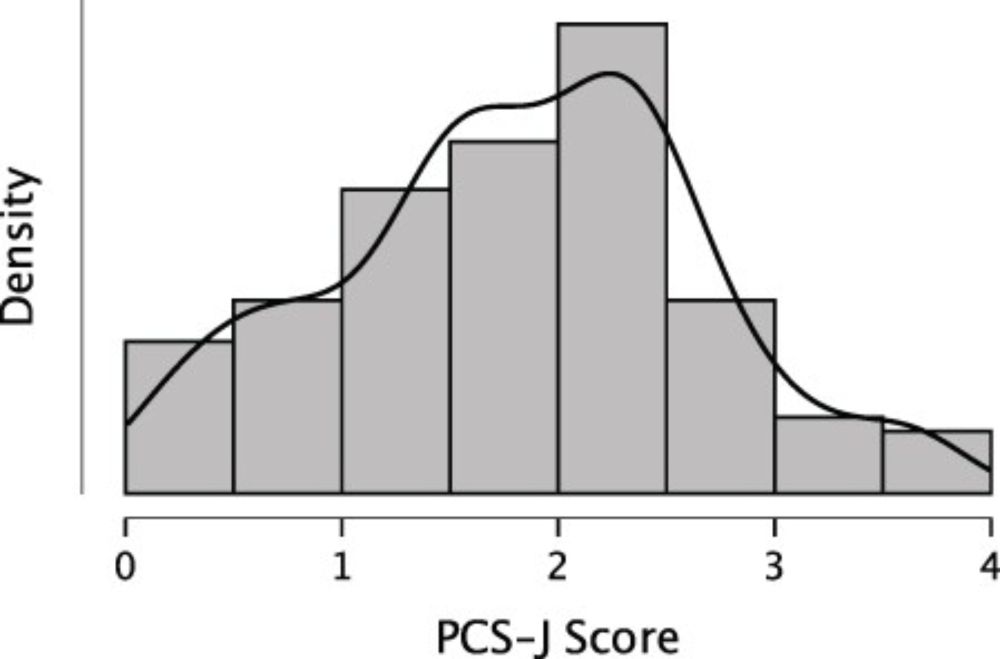
4/7 We have now developed the Japanese version of the PCS, the "PCS-J"! ✨ In a pre-registered online study, we confirmed both test-retest reliability (consistency of results over time) and internal consistency (consistency of items within the scale) were good (even higher than original!).
May 30, 2025 at 12:49 PM
4/7 We have now developed the Japanese version of the PCS, the "PCS-J"! ✨ In a pre-registered online study, we confirmed both test-retest reliability (consistency of results over time) and internal consistency (consistency of items within the scale) were good (even higher than original!).
3/7 To objectively measure the degree of this "Phenomenological Control," Lush et al. (2021) developed the self-report "Phenomenological Control Scale (PCS)." This scale was specifically designed to measure an individual's PC ability without using the term "hypnosis". doi.org/10.1525/coll...
The Phenomenological Control Scale: Measuring the Capacity for Creating Illusory Nonvolition, Hallucination and Delusion
Phenomenological control is the ability to generate experiences to meet expectancies. There are stable trait differences in this ability, as shown by responses to imaginative suggestions of, for examp...
doi.org
May 30, 2025 at 12:49 PM
3/7 To objectively measure the degree of this "Phenomenological Control," Lush et al. (2021) developed the self-report "Phenomenological Control Scale (PCS)." This scale was specifically designed to measure an individual's PC ability without using the term "hypnosis". doi.org/10.1525/coll...
2/7 Crucially, the term "Phenomenological Control" was proposed by Lush et al. to capture this ability more directly and neutrally, avoiding the specific theoretical implications and common misconceptions associated with "hypnosis" (e.g., needing a special trance state).
May 30, 2025 at 12:49 PM
2/7 Crucially, the term "Phenomenological Control" was proposed by Lush et al. to capture this ability more directly and neutrally, avoiding the specific theoretical implications and common misconceptions associated with "hypnosis" (e.g., needing a special trance state).
1/7 First, what is "Phenomenological Control" (PC)? 🤔 It's a broad concept referring to the ability to alter subjective sensations or experiences (e.g., hearing a sound that isn't there) in response to suggestions, whether intentional or not. Think experiences in hypnosis or imaginative suggestion.
May 30, 2025 at 12:49 PM
1/7 First, what is "Phenomenological Control" (PC)? 🤔 It's a broad concept referring to the ability to alter subjective sensations or experiences (e.g., hearing a sound that isn't there) in response to suggestions, whether intentional or not. Think experiences in hypnosis or imaginative suggestion.
Imaizumi, S., & Suzuki, K. (2025). DOI: doi.org/10.1093/nc/n... (Explaining in this thread 👇) #Psychology #PhenomenologicalControl
The Japanese version of the Phenomenological Control Scale
Abstract. People vary in their capacity for phenomenological control, which enables them to align their perceptual experiences with their intentions and go
doi.org
May 30, 2025 at 12:49 PM
Imaizumi, S., & Suzuki, K. (2025). DOI: doi.org/10.1093/nc/n... (Explaining in this thread 👇) #Psychology #PhenomenologicalControl
🎉 Paper Published! 🎉 Our paper, "The Japanese version of the Phenomenological Control Scale," has been published in Neuroscience of Consciousness! If you're interested in individual differences in phenomenological control, please check it out!
May 30, 2025 at 12:49 PM
🎉 Paper Published! 🎉 Our paper, "The Japanese version of the Phenomenological Control Scale," has been published in Neuroscience of Consciousness! If you're interested in individual differences in phenomenological control, please check it out!
7/7 そして!PCS-Jをオンライン実験や実験室実験で手軽に実施できるよう、教示の提示(音声・テキスト対応)から回答記録までを行えるプログラムも作成し、公開しました!💻 研究者の皆さん、ぜひご活用ください! 🔗 github.com/ksk-S/PhenoC... #認知科学 #オープンサイエンス
GitHub - ksk-S/PhenoControl-JP
Contribute to ksk-S/PhenoControl-JP development by creating an account on GitHub.
github.com
May 30, 2025 at 12:40 PM
7/7 そして!PCS-Jをオンライン実験や実験室実験で手軽に実施できるよう、教示の提示(音声・テキスト対応)から回答記録までを行えるプログラムも作成し、公開しました!💻 研究者の皆さん、ぜひご活用ください! 🔗 github.com/ksk-S/PhenoC... #認知科学 #オープンサイエンス
6/7 この結果は、PCS-Jが関連する心理的特徴(陽性因子)とは確かに相関し(収束的妥当性)、関連の薄い特徴(陰性因子)とは相関しない(弁別的妥当性)ことを示唆しており、尺度の妥当性を支持するものです。
May 30, 2025 at 12:40 PM
6/7 この結果は、PCS-Jが関連する心理的特徴(陽性因子)とは確かに相関し(収束的妥当性)、関連の薄い特徴(陰性因子)とは相関しない(弁別的妥当性)ことを示唆しており、尺度の妥当性を支持するものです。
5/7 さらに、PCS-Jが測定したい概念をきちんと捉えているか(構成概念妥当性)も検討しました。 その結果、PCS-Jの得点は、統合失調型パーソナリティ傾向(SPQ-B)の「陽性因子(認知・知覚)」と関連し、「陰性因子(対人関係)」とは関連しないことが明らかに。これはオリジナル版では未検証の、私たちの新たな知見です!🙌
May 30, 2025 at 12:40 PM
5/7 さらに、PCS-Jが測定したい概念をきちんと捉えているか(構成概念妥当性)も検討しました。 その結果、PCS-Jの得点は、統合失調型パーソナリティ傾向(SPQ-B)の「陽性因子(認知・知覚)」と関連し、「陰性因子(対人関係)」とは関連しないことが明らかに。これはオリジナル版では未検証の、私たちの新たな知見です!🙌
4/7 今回、私たちはこのPCSの日本語版「PCS-J」を開発しました!✨ 事前登録したオンライン調査で信頼性を検証した結果、テストと再テストでの結果の一致度(再検査信頼性)も、質問項目の一貫性(内的整合性)も良好でした。特に内的整合性はオリジナル版よりも高い値を示しています。
May 30, 2025 at 12:40 PM
4/7 今回、私たちはこのPCSの日本語版「PCS-J」を開発しました!✨ 事前登録したオンライン調査で信頼性を検証した結果、テストと再テストでの結果の一致度(再検査信頼性)も、質問項目の一貫性(内的整合性)も良好でした。特に内的整合性はオリジナル版よりも高い値を示しています。