


Kentaro K. Shimizu
@kkshimizu1.bsky.social
Director and Professor of the Department of Evolutionary Biology and Environmental Studies, University of Zurich🇨🇭, https://www.ieu.uzh.ch/en/staff/member/shimizu_kentaro.html
plant polyploidy, fieldwork, language evolution 英語と日本語で主に研究について
plant polyploidy, fieldwork, language evolution 英語と日本語で主に研究について
Our new publication from the 10+ Wheat Genome Project in Cell Reports! The combined effect of #polyploidy and expression on selection will inform the target of future #wheat breeding to mitigate the effect of deleterious variants. By a former PhD Gwyn and a postdoc Moeko
www.cell.com/cell-reports...
www.cell.com/cell-reports...

Purifying selection on deleterious variants affected by the combination of subgenomes and gene expression in bread wheat
Halstead-Nussloch et al. quantify genome-wide purifying selection on deleterious variants
using high-quality annotation of 10 genomes of bread wheat. Strong purifying selection
is observed in the cate...
www.cell.com
January 26, 2026 at 4:04 PM
Our new publication from the 10+ Wheat Genome Project in Cell Reports! The combined effect of #polyploidy and expression on selection will inform the target of future #wheat breeding to mitigate the effect of deleterious variants. By a former PhD Gwyn and a postdoc Moeko
www.cell.com/cell-reports...
www.cell.com/cell-reports...
Our new publication on HOBIT, a software tool for polyploid gene expression analysis. Compared with our previous method HomeoRoq (2014), HOBIT enables direct and higher-quality analysis of complex allohexaploid species such as bread wheat.

HOBIT: LRT to detect homeolog expression shifts in allopolyploids
Sun et al.
nph.onlinelibrary.wiley.com/doi/10.1111/...
Sun et al.
nph.onlinelibrary.wiley.com/doi/10.1111/...

October 28, 2025 at 7:32 PM
Our new publication on HOBIT, a software tool for polyploid gene expression analysis. Compared with our previous method HomeoRoq (2014), HOBIT enables direct and higher-quality analysis of complex allohexaploid species such as bread wheat.
Press release in English about the new paper in Nature Communications thanks to the Earlham Institute doi.org/10.1038/s414...
October 6, 2025 at 11:40 AM
Press release in English about the new paper in Nature Communications thanks to the Earlham Institute doi.org/10.1038/s414...
Interviewed by Nikkei Science (Japanese edition of Scientific American). The photo shows a Swiss Alps village where a new species, Cardamine insueta, formed in the past 150 years via hybridization and genome duplication. The article also covers wheat and Arabidopsis kamchatica.

「新種誕生の現場」
150年前の森林開拓をきっかけに新種が誕生した現場がスイスの山あいにあります。私たちの足元では都市化が進化の原動力になっています。
植物はどのように環境の変化に適応し,多様化してきたのでしょうか。
目の前で起きている進化から迫ります。
別冊日経サイエンス278『シン・進化論 生物の型破りな戦略』
www.nikkei-science.com/sci_book/bes...
150年前の森林開拓をきっかけに新種が誕生した現場がスイスの山あいにあります。私たちの足元では都市化が進化の原動力になっています。
植物はどのように環境の変化に適応し,多様化してきたのでしょうか。
目の前で起きている進化から迫ります。
別冊日経サイエンス278『シン・進化論 生物の型破りな戦略』
www.nikkei-science.com/sci_book/bes...

September 3, 2025 at 6:56 AM
Interviewed by Nikkei Science (Japanese edition of Scientific American). The photo shows a Swiss Alps village where a new species, Cardamine insueta, formed in the past 150 years via hybridization and genome duplication. The article also covers wheat and Arabidopsis kamchatica.
Excited to be featured in Nature Digest’s “Japanese Author” series! They wrote about some of my work in Nature and sister journals. #genome #evolution #wheat #linguistics #polyploidy #biodiversity #Darwin
Article (Japanese): doi.org/10.1038/ndig...
Article (Japanese): doi.org/10.1038/ndig...

現在進行中の進化を野外で研究する
学生時代、山で出合った植物、ミヤマハタザオ。シロイヌナズナに似ているが形態も分布も違う。この植物を使えば、現在進行中の進化を検証できるのではないか。そうひらめいた清水健太郎(現・チューリヒ大学教授)は、分子生物学を野外の植物の研究に適用し、進化ゲノム学を推し進めてきた。
doi.org
September 1, 2025 at 10:51 AM
Excited to be featured in Nature Digest’s “Japanese Author” series! They wrote about some of my work in Nature and sister journals. #genome #evolution #wheat #linguistics #polyploidy #biodiversity #Darwin
Article (Japanese): doi.org/10.1038/ndig...
Article (Japanese): doi.org/10.1038/ndig...
Reposted by Kentaro K. Shimizu

📰When populations meet, they exchange genes, but also language features. According to a new study by NCCR researchers, contact between human populations increases the resemblance between their languages to similar extents all over the world, but differently.
evolvinglanguage.ch/capturing-la...
evolvinglanguage.ch/capturing-la...

Capturing language change through the genes - NCCR Evolving Language
When populations meet, they typically exchange genes. Their languages meet too, and such encounters can change languages. But how much do languages actually change through contact, and do these change...
evolvinglanguage.ch
August 29, 2025 at 7:45 PM
📰When populations meet, they exchange genes, but also language features. According to a new study by NCCR researchers, contact between human populations increases the resemblance between their languages to similar extents all over the world, but differently.
evolvinglanguage.ch/capturing-la...
evolvinglanguage.ch/capturing-la...
New paper out in Science Advances!
We studied language & genetic evolution using the GeLaTo database—focusing on burrowing and schismogenesis.
Link: doi.org/10.1126/scia...
Special thanks to @chiarabarbieri.bsky.social @annagraff.bsky.social @balthasarbickel.bsky.social @nccrlanguage.bsky.social
We studied language & genetic evolution using the GeLaTo database—focusing on burrowing and schismogenesis.
Link: doi.org/10.1126/scia...
Special thanks to @chiarabarbieri.bsky.social @annagraff.bsky.social @balthasarbickel.bsky.social @nccrlanguage.bsky.social
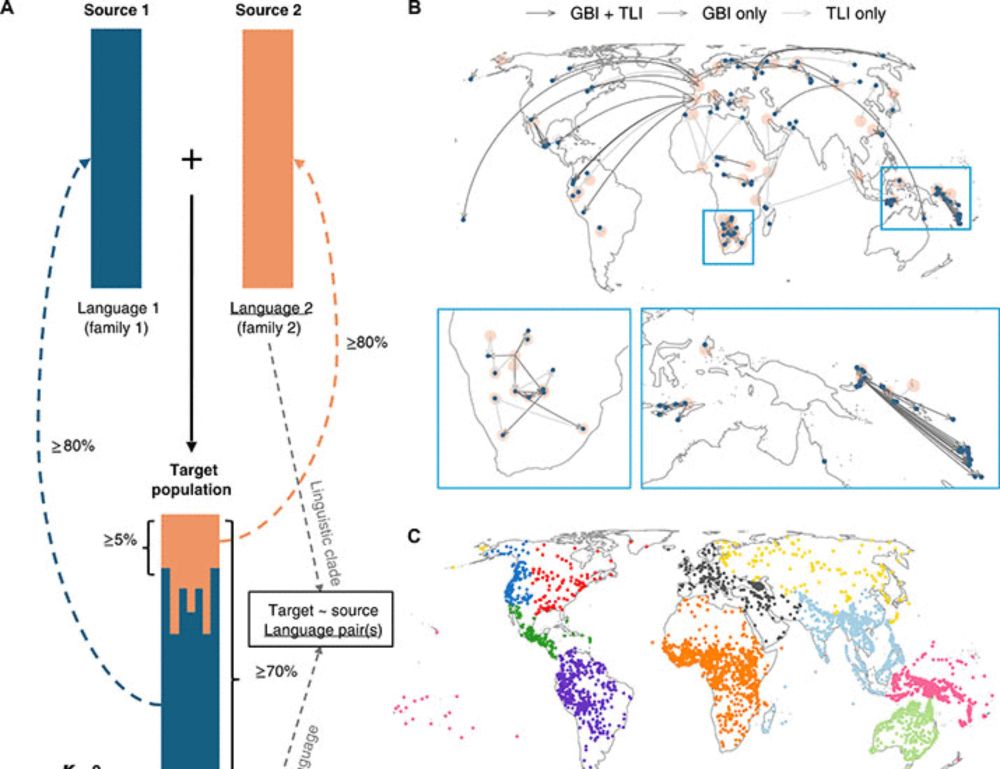
Patterns of genetic admixture reveal similar rates of borrowing across diverse scenarios of language contact
Human population contact leads to consistently similar rates of linguistic borrowing, but effects vary across linguistic features.
www.science.org
August 29, 2025 at 7:20 PM
New paper out in Science Advances!
We studied language & genetic evolution using the GeLaTo database—focusing on burrowing and schismogenesis.
Link: doi.org/10.1126/scia...
Special thanks to @chiarabarbieri.bsky.social @annagraff.bsky.social @balthasarbickel.bsky.social @nccrlanguage.bsky.social
We studied language & genetic evolution using the GeLaTo database—focusing on burrowing and schismogenesis.
Link: doi.org/10.1126/scia...
Special thanks to @chiarabarbieri.bsky.social @annagraff.bsky.social @balthasarbickel.bsky.social @nccrlanguage.bsky.social
Our new preprint introduces HOBIT, a bioinformatics tool for allopolyploid RNA-seq. It’s directly applicable to allohexaploid species like bread wheat and outperforms our previous method, HomeoRoq, in 2014.
Software: github.com/bitdessin/he... by Jianqiang
Preprint: www.biorxiv.org/content/10.1...
Software: github.com/bitdessin/he... by Jianqiang
Preprint: www.biorxiv.org/content/10.1...

A moderated statistical test for detecting shifts in homeolog expression ratios in allopolyploids
Allopolyploids arise through hybridization between related species, carrying multiple sets of chromosomes from distinct progenitor, referred to as subgenomes. Within allopolyploids, duplicated genes a...
www.biorxiv.org
July 10, 2025 at 6:48 PM
Our new preprint introduces HOBIT, a bioinformatics tool for allopolyploid RNA-seq. It’s directly applicable to allohexaploid species like bread wheat and outperforms our previous method, HomeoRoq, in 2014.
Software: github.com/bitdessin/he... by Jianqiang
Preprint: www.biorxiv.org/content/10.1...
Software: github.com/bitdessin/he... by Jianqiang
Preprint: www.biorxiv.org/content/10.1...
Reposted by Kentaro K. Shimizu
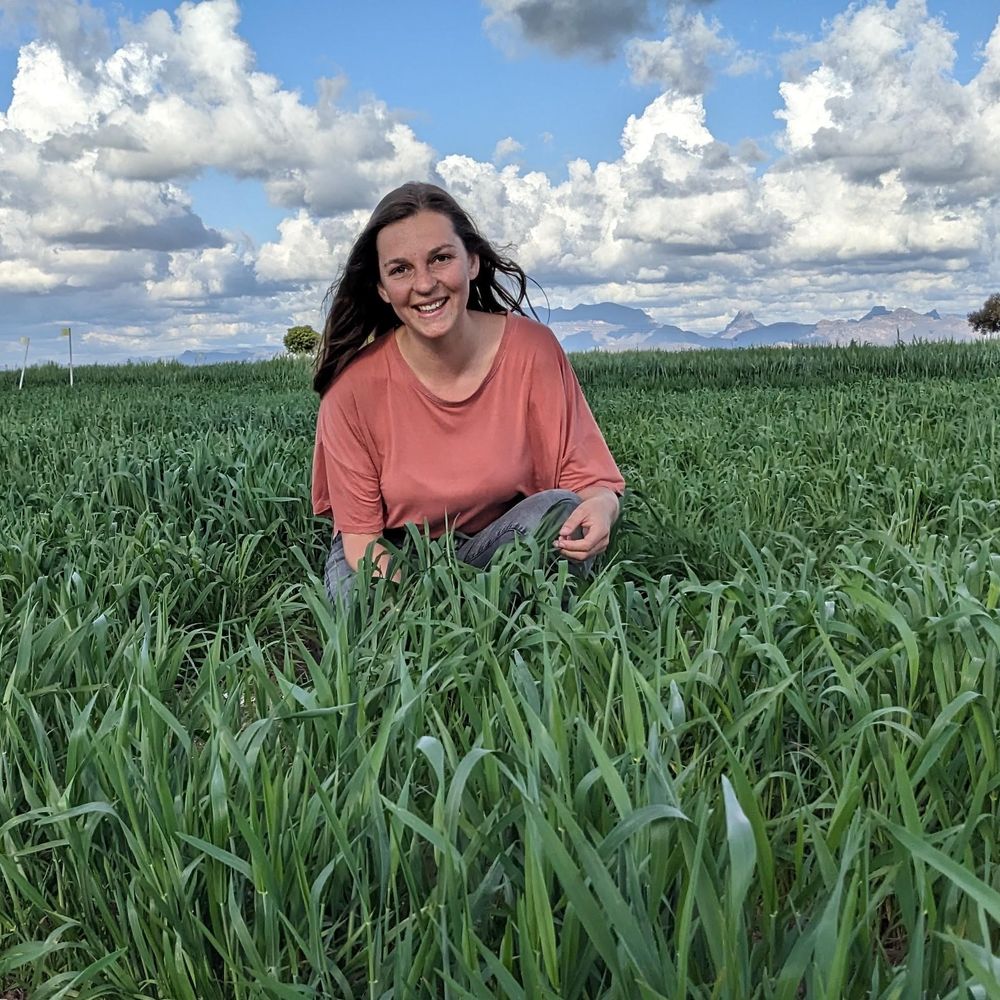
My first thesis chapter is out 🎉!
doi.org/10.1007/s001...
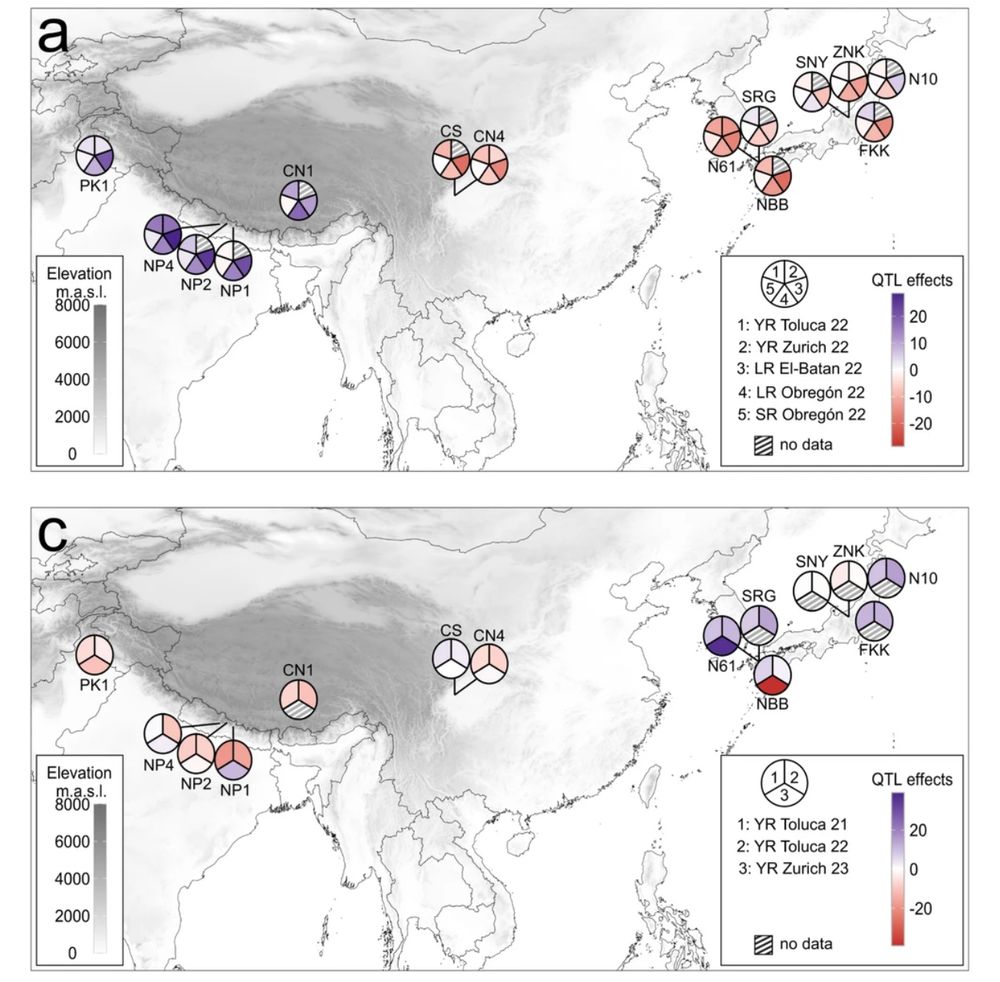
We discovered two potentially novel yellow rust resistance loci in a new Asian wheat NAM population and gained insights into their distribution.
Time to celebrate with my first publication cake🍰!
@kkshimizu1.bsky.social @cimmyt.bsky.social
doi.org/10.1007/s001...
We discovered two potentially novel yellow rust resistance loci in a new Asian wheat NAM population and gained insights into their distribution.
Time to celebrate with my first publication cake🍰!
@kkshimizu1.bsky.social @cimmyt.bsky.social

June 5, 2025 at 9:14 AM
My first thesis chapter is out 🎉!
doi.org/10.1007/s001...
We discovered two potentially novel yellow rust resistance loci in a new Asian wheat NAM population and gained insights into their distribution.
Time to celebrate with my first publication cake🍰!
@kkshimizu1.bsky.social @cimmyt.bsky.social
doi.org/10.1007/s001...
We discovered two potentially novel yellow rust resistance loci in a new Asian wheat NAM population and gained insights into their distribution.
Time to celebrate with my first publication cake🍰!
@kkshimizu1.bsky.social @cimmyt.bsky.social
Press release: Preserving #biodiversity within the crop species wheat is valuable for food security. Thanks to collaborators, particularly the partnership with Kyoto University, my alma mater.
doi.org/10.1007/s001... @kajung.bsky.social
www.news.uzh.ch/en/articles/... in English and in German
doi.org/10.1007/s001... @kajung.bsky.social
www.news.uzh.ch/en/articles/... in English and in German
Fungal Resistance in Wheat: Preserving Biodiversity for Food Security
www.news.uzh.ch
June 5, 2025 at 6:10 AM
Press release: Preserving #biodiversity within the crop species wheat is valuable for food security. Thanks to collaborators, particularly the partnership with Kyoto University, my alma mater.
doi.org/10.1007/s001... @kajung.bsky.social
www.news.uzh.ch/en/articles/... in English and in German
doi.org/10.1007/s001... @kajung.bsky.social
www.news.uzh.ch/en/articles/... in English and in German
New publication on #wheat disease resistance by my group member Kathi Jung (PhD in Science and Policy)! Using the genome assembly of the Japanese cultivar Norin 61, she identified yellow rust resistance loci in landraces from the Himalayan region.
doi.org/10.1007/s001...
@kajung.bsky.social
doi.org/10.1007/s001...
@kajung.bsky.social
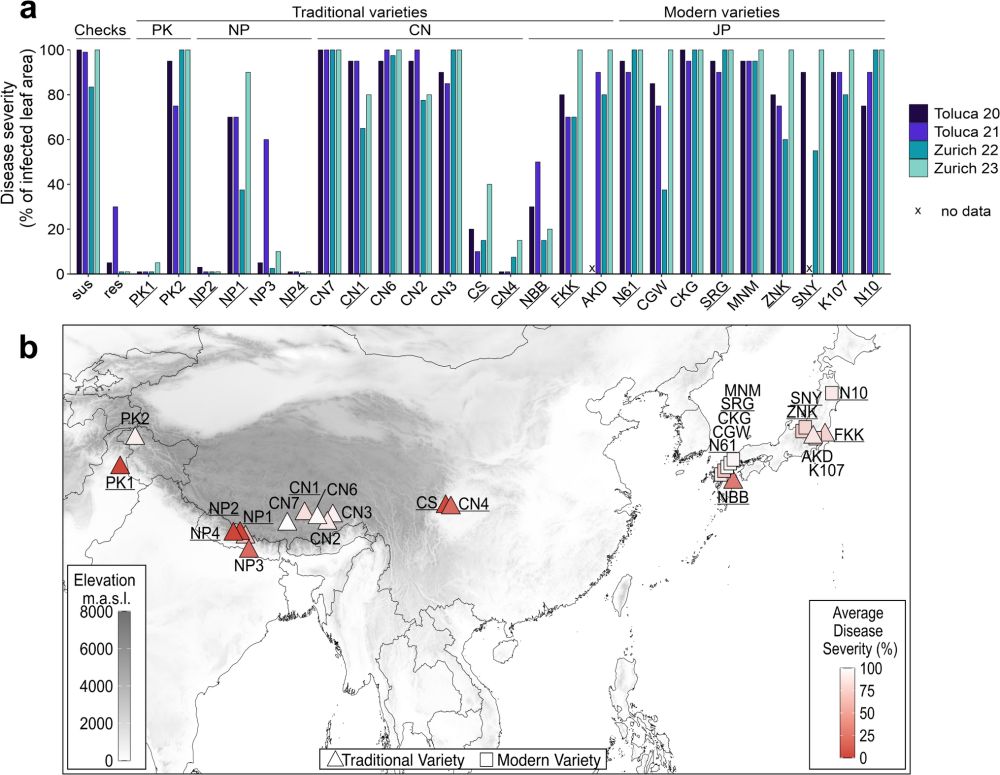
Unveiling yellow rust resistance in the near-Himalayan region: insights from a nested association mapping study - Theoretical and Applied Genetics
Key message This study identified two potentially novel yellow rust resistance loci in traditional Asian wheat varieties and gives insights into the distribution of resistances in high disease-pressur...
doi.org
June 5, 2025 at 6:07 AM
New publication on #wheat disease resistance by my group member Kathi Jung (PhD in Science and Policy)! Using the genome assembly of the Japanese cultivar Norin 61, she identified yellow rust resistance loci in landraces from the Himalayan region.
doi.org/10.1007/s001...
@kajung.bsky.social
doi.org/10.1007/s001...
@kajung.bsky.social
A fundamental and groundbreaking study by Jordi Bascompte, a colleague from our department:
The emergence of eukaryotes as an evolutionary algorithmic phase transition | PNAS www.pnas.org/doi/10.1073/...
The emergence of eukaryotes as an evolutionary algorithmic phase transition | PNAS www.pnas.org/doi/10.1073/...
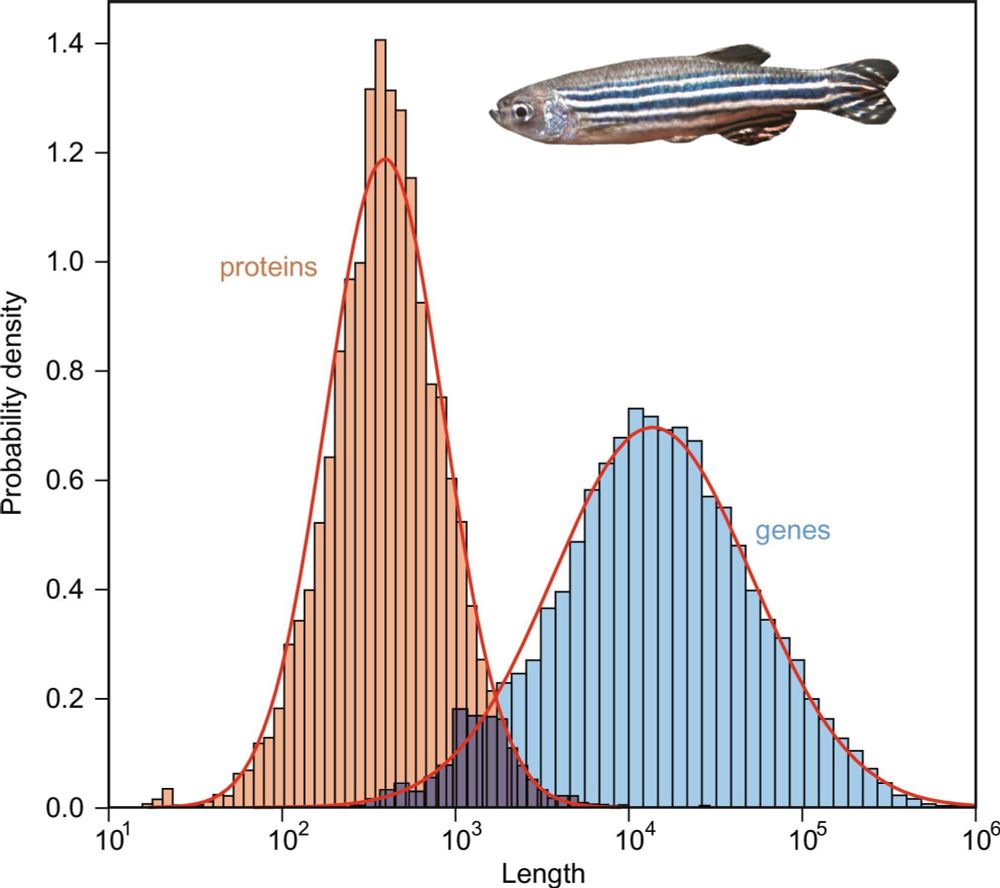
The emergence of eukaryotes as an evolutionary algorithmic phase transition | PNAS
The origin of eukaryotes represents one of the most significant events in evolution
since it allowed the posterior emergence of multicellular organ...
www.pnas.org
March 29, 2025 at 9:52 AM
A fundamental and groundbreaking study by Jordi Bascompte, a colleague from our department:
The emergence of eukaryotes as an evolutionary algorithmic phase transition | PNAS www.pnas.org/doi/10.1073/...
The emergence of eukaryotes as an evolutionary algorithmic phase transition | PNAS www.pnas.org/doi/10.1073/...
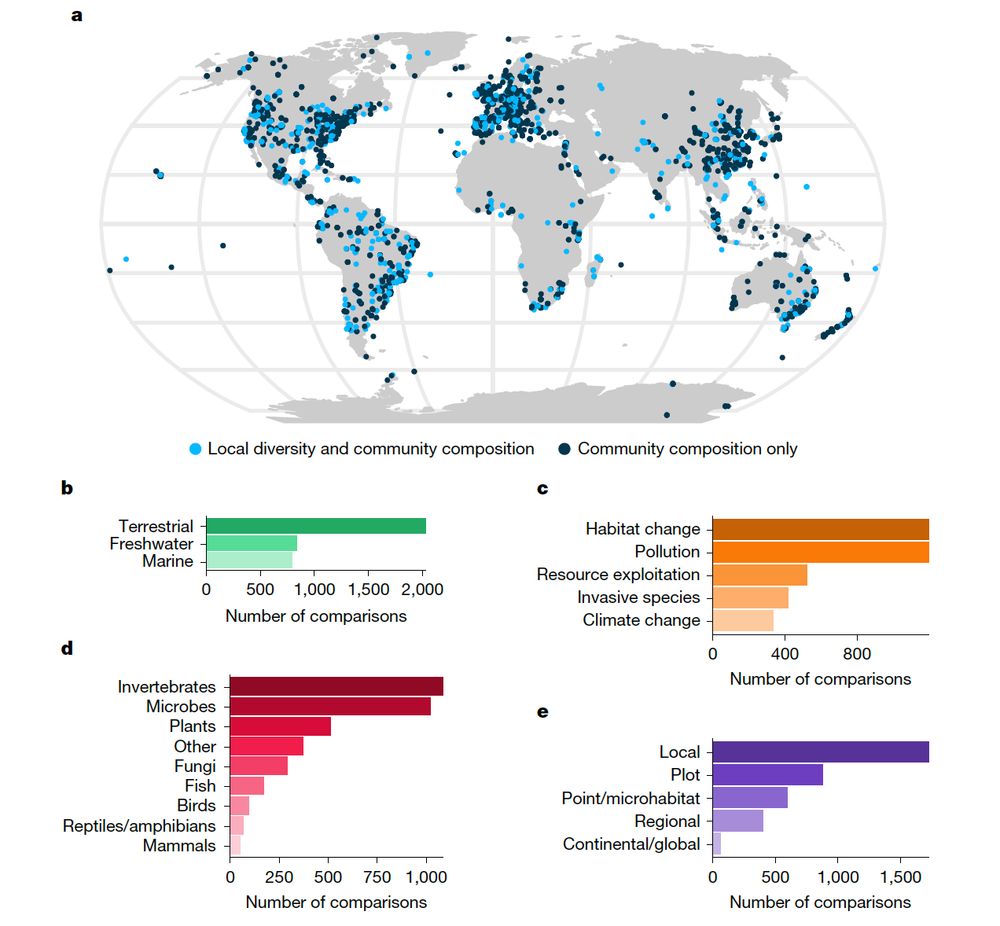
A major milestone on global biodiversity by our colleague, the Florian Altermatt group — just published in Nature.
Our study ‘The #global #human impact on #biodiversity’ is out in @nature.com: www.nature.com/articles/s41...
🌍🌐🐟🌿🪲
Unprecedented synthesis of >2000 studies led by @francoiskeck.bsky.social shows humans are not only shrinking species numbers—but reshaping entire communities across the planet.
🧵1/5
🌍🌐🐟🌿🪲
Unprecedented synthesis of >2000 studies led by @francoiskeck.bsky.social shows humans are not only shrinking species numbers—but reshaping entire communities across the planet.
🧵1/5
March 27, 2025 at 1:13 PM
A major milestone on global biodiversity by our colleague, the Florian Altermatt group — just published in Nature.
Reposted by Kentaro K. Shimizu

I am so happy to see this review online finally! A lot of work, but a lot of fun too! Thank you to all the co-authors! @gretabocedi.bsky.social @trinebilde.bsky.social @jevbio.bsky.social
academic.oup.com/jeb/advance-...
academic.oup.com/jeb/advance-...
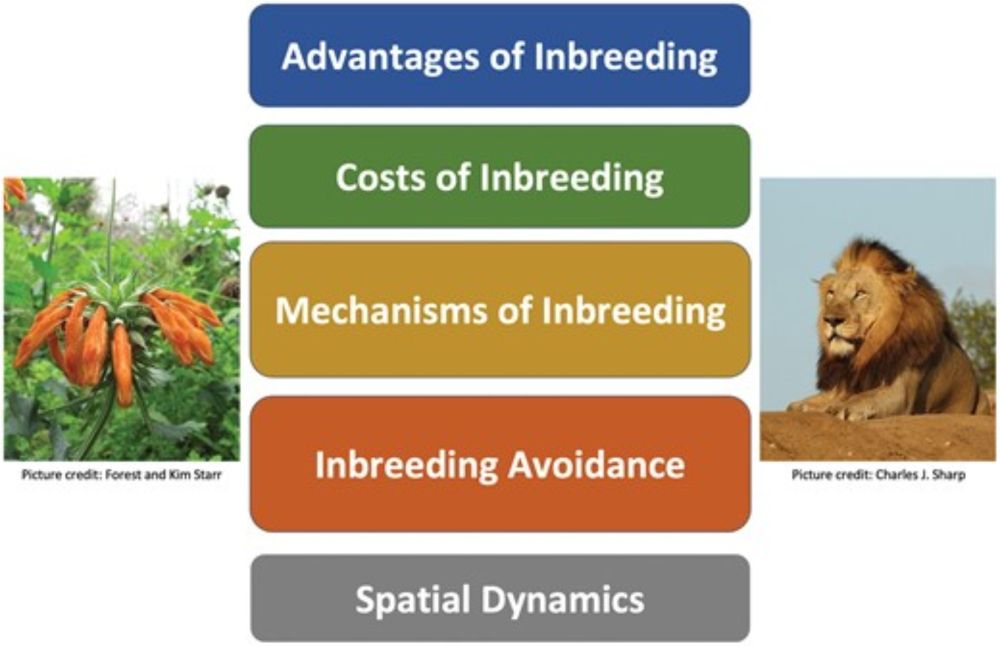
Perspectives on mating–system evolution: comparing concepts in plants and animals
Abstract. The study of mating systems, defined as the distribution of who mates with whom and how often in a sexually reproducing population, forms a core
academic.oup.com
March 1, 2025 at 7:50 AM
I am so happy to see this review online finally! A lot of work, but a lot of fun too! Thank you to all the co-authors! @gretabocedi.bsky.social @trinebilde.bsky.social @jevbio.bsky.social
academic.oup.com/jeb/advance-...
academic.oup.com/jeb/advance-...
Congratulations to Kathi on successfully defending her PhD! 🎉🎓 As the tradition, her PhD hat made by the lab members showcases her fascinating research on Asian wheat cultivars. Well done, Kathi! 🌾👏

February 27, 2025 at 7:52 PM
Congratulations to Kathi on successfully defending her PhD! 🎉🎓 As the tradition, her PhD hat made by the lab members showcases her fascinating research on Asian wheat cultivars. Well done, Kathi! 🌾👏
Reposted by Kentaro K. Shimizu

Our review of recently evolved allopolyploid plants is out. It was very nice writing this paper with great colleagues! We dedicate this paper to the memory of Richard Abbott who contributed so much to this and many other topics in plant evolution. doi.org/10.1111/nph....

Natural neopolyploids: a stimulus for novel research
Recently formed allopolyploid species offer unprecedented insights into the early stages of polyploid evolution. This review examines seven well-studied neopolyploids (we use ‘neopolyploid’ to refer ...
doi.org
February 15, 2025 at 7:07 AM
Our review of recently evolved allopolyploid plants is out. It was very nice writing this paper with great colleagues! We dedicate this paper to the memory of Richard Abbott who contributed so much to this and many other topics in plant evolution. doi.org/10.1111/nph....
A new review, published on Valentine's Day! We explore the future of the study of contemporary polyploid speciation such as Cardamine insueta in Switzerland, building on discussions from the Polyploidy 2023 conference led by Doug & Pam Soltis, Patrick @nicrodemo.bsky.social doi.org/10.1111/nph.20437

Natural neopolyploids: a stimulus for novel research
Recently formed allopolyploid species offer unprecedented insights into the early stages of polyploid evolution. This review examines seven well-studied neopolyploids (we use ‘neopolyploid’ to refer ...
doi.org
February 15, 2025 at 7:32 PM
A new review, published on Valentine's Day! We explore the future of the study of contemporary polyploid speciation such as Cardamine insueta in Switzerland, building on discussions from the Polyploidy 2023 conference led by Doug & Pam Soltis, Patrick @nicrodemo.bsky.social doi.org/10.1111/nph.20437
A new paper online! Improved GO annotation of the bread wheat genome will be useful, thanks to the first author Yasuyuki and the last author Atsushi. The homeolog expression was studied using 25 Asian cultivars including Norin 61. @plantcellphysiol.bsky.social doi.org/10.1093/pcp/...

Subgenome-informed statistical modeling of transcriptomes in 25 common wheat accessions reveals cis- and trans- regulation architectures
ABSTRACT. Common wheat is allohexaploid, where it is difficult to obtain homoeolog-distinguished transcriptome data. Lasy-Seq, a type of 3ʹ RNA-seq, is a t
doi.org
January 26, 2025 at 8:27 PM
A new paper online! Improved GO annotation of the bread wheat genome will be useful, thanks to the first author Yasuyuki and the last author Atsushi. The homeolog expression was studied using 25 Asian cultivars including Norin 61. @plantcellphysiol.bsky.social doi.org/10.1093/pcp/...
Reposted by Kentaro K. Shimizu
The Shimizu group seeks a Postdoctoral Researcher in population genomics at the University of Zurich to study genetic and language evolution. Applications are open now. More info: https://jobs.uzh.ch/job-vacancies/postdoc-in-population-genomics/40227b73-2360-4e79-8924-844e5f5ed4c0 #postdoc

UZH: Postdoc in population genomics
The NCCR Evolving Language invites applications for a Postdoctoral Researcher in population genomics to study the demography of humans and domesticated crop species related to language evolution at the Department of Evolutionary Biology and Environmental Studies, University of Zurich.
jobs.uzh.ch
January 10, 2025 at 4:33 PM
The Shimizu group seeks a Postdoctoral Researcher in population genomics at the University of Zurich to study genetic and language evolution. Applications are open now. More info: https://jobs.uzh.ch/job-vacancies/postdoc-in-population-genomics/40227b73-2360-4e79-8924-844e5f5ed4c0 #postdoc
Excited to be an invited speaker at the CSH Asia 'Plant Reproductive Development and Genomics' conference on Awaji Island, Japan, May 18-22, 2025! 🌸 Awaji Island is home to beautiful botanical gardens, a legacy of the Flower Expo 2000. More details: www.csh-asia.org?content/2653

January 9, 2025 at 7:43 PM
Excited to be an invited speaker at the CSH Asia 'Plant Reproductive Development and Genomics' conference on Awaji Island, Japan, May 18-22, 2025! 🌸 Awaji Island is home to beautiful botanical gardens, a legacy of the Flower Expo 2000. More details: www.csh-asia.org?content/2653
A new open postdoc position in population genomics! Reposting appreciated. Demography of human beings and crop plants. Attached is a group picture during a lab retreat in Lichtenstein. Job description:
jobs.uzh.ch/job-vacancie...
@nccrlanguage.bsky.social
jobs.uzh.ch/job-vacancie...
@nccrlanguage.bsky.social

January 1, 2025 at 4:58 PM
A new open postdoc position in population genomics! Reposting appreciated. Demography of human beings and crop plants. Attached is a group picture during a lab retreat in Lichtenstein. Job description:
jobs.uzh.ch/job-vacancie...
@nccrlanguage.bsky.social
jobs.uzh.ch/job-vacancie...
@nccrlanguage.bsky.social