



Kaçar Lab at UW-Madison
@kacarlab.bsky.social
Past, Present and Future of Life
Here and Elsewhere
PI: Betül Kaçar
Account managed by lab members.
Latest paper: https://www.nature.com/articles/s41467-025-67423-y
✨
kacarlab.org
Here and Elsewhere
PI: Betül Kaçar
Account managed by lab members.
Latest paper: https://www.nature.com/articles/s41467-025-67423-y
✨
kacarlab.org
Pinned

Resurrected nitrogenases recapitulate canonical N-isotope biosignatures over two billion years - Nature Communications
The study shows that nitrogenase enzymes have maintained stable isotope signatures over billions of years, revealing how ancient microbes shaped Earth’s nitrogen cycle and offering a new experimental ...
www.nature.com
Our new paper, out today! We resurrected ancient nitrogenases first used by life on Earth 3 billion years ago. We combined synthetic biology and geology & validated their chemical #biosignature in rocks that helps reveal ancient life on Earth!(and beyond!)
Link: www.nature.com/articles/s41...
Link: www.nature.com/articles/s41...
Reposted by Kaçar Lab at UW-Madison
Latest work! 🧬
We uncover how evolution of translation initiation factor 2 (IF2) extensions links translation to bacterial stress response. We map 7 structural architectures & show how terminal extensions are enriched in intrinsic disorder & phase-separation features.
Link: doi.org/10.64898/202...
We uncover how evolution of translation initiation factor 2 (IF2) extensions links translation to bacterial stress response. We map 7 structural architectures & show how terminal extensions are enriched in intrinsic disorder & phase-separation features.
Link: doi.org/10.64898/202...

February 11, 2026 at 6:18 PM
Latest work! 🧬
We uncover how evolution of translation initiation factor 2 (IF2) extensions links translation to bacterial stress response. We map 7 structural architectures & show how terminal extensions are enriched in intrinsic disorder & phase-separation features.
Link: doi.org/10.64898/202...
We uncover how evolution of translation initiation factor 2 (IF2) extensions links translation to bacterial stress response. We map 7 structural architectures & show how terminal extensions are enriched in intrinsic disorder & phase-separation features.
Link: doi.org/10.64898/202...
Latest work! 🧬
We uncover how evolution of translation initiation factor 2 (IF2) extensions links translation to bacterial stress response. We map 7 structural architectures & show how terminal extensions are enriched in intrinsic disorder & phase-separation features.
Link: doi.org/10.64898/202...
We uncover how evolution of translation initiation factor 2 (IF2) extensions links translation to bacterial stress response. We map 7 structural architectures & show how terminal extensions are enriched in intrinsic disorder & phase-separation features.
Link: doi.org/10.64898/202...
February 11, 2026 at 6:18 PM
Latest work! 🧬
We uncover how evolution of translation initiation factor 2 (IF2) extensions links translation to bacterial stress response. We map 7 structural architectures & show how terminal extensions are enriched in intrinsic disorder & phase-separation features.
Link: doi.org/10.64898/202...
We uncover how evolution of translation initiation factor 2 (IF2) extensions links translation to bacterial stress response. We map 7 structural architectures & show how terminal extensions are enriched in intrinsic disorder & phase-separation features.
Link: doi.org/10.64898/202...
Reposted by Kaçar Lab at UW-Madison

Fabulous work! 👏
Our new paper, out today! We resurrected ancient nitrogenases first used by life on Earth 3 billion years ago. We combined synthetic biology and geology & validated their chemical #biosignature in rocks that helps reveal ancient life on Earth!(and beyond!)
Link: www.nature.com/articles/s41...
Link: www.nature.com/articles/s41...
Resurrected nitrogenases recapitulate canonical N-isotope biosignatures over two billion years - Nature Communications
The study shows that nitrogenase enzymes have maintained stable isotope signatures over billions of years, revealing how ancient microbes shaped Earth’s nitrogen cycle and offering a new experimental ...
www.nature.com
February 10, 2026 at 4:33 AM
Fabulous work! 👏
Reposted by Kaçar Lab at UW-Madison

Me pregunto qué pensaría Susumu Ohno de que los eventos más antiguos que podemos rastrear mediante métodos filogenéticos sean procesos de duplicación génica.

February 7, 2026 at 2:45 AM
Me pregunto qué pensaría Susumu Ohno de que los eventos más antiguos que podemos rastrear mediante métodos filogenéticos sean procesos de duplicación génica.
Reposted by Kaçar Lab at UW-Madison

a daring approach: looking at LUCA's ancestors, i.e. pre-darwinian evolution. but not surprising it's coming from @kacarlab.bsky.social 👏
glad to see Iwabe et al. (1989) among the references (blew my mind when it came out >30 y ago)
glad to see Iwabe et al. (1989) among the references (blew my mind when it came out >30 y ago)

February 6, 2026 at 10:42 PM
a daring approach: looking at LUCA's ancestors, i.e. pre-darwinian evolution. but not surprising it's coming from @kacarlab.bsky.social 👏
glad to see Iwabe et al. (1989) among the references (blew my mind when it came out >30 y ago)
glad to see Iwabe et al. (1989) among the references (blew my mind when it came out >30 y ago)
Reposted by Kaçar Lab at UW-Madison
What happened before the last universal common ancestor? Pre-LUCA evolution is hard to study. In our new Cell Genomics Perspective we spotlight how paralogous proteins open a window onto the deepest chapters of evolution. 🧬🌍
Out today!
--> www.cell.com/cell-genomic... @cellpress.bsky.social
Out today!
--> www.cell.com/cell-genomic... @cellpress.bsky.social

Universal paralogs provide a window into evolution before the last universal common ancestor
Universal paralog protein families form due to gene duplications that occurred prior
to the last universal common ancestor of life. This perspective describes how these
protein families offer valuable...
www.cell.com
February 6, 2026 at 4:39 PM
What happened before the last universal common ancestor? Pre-LUCA evolution is hard to study. In our new Cell Genomics Perspective we spotlight how paralogous proteins open a window onto the deepest chapters of evolution. 🧬🌍
Out today!
--> www.cell.com/cell-genomic... @cellpress.bsky.social
Out today!
--> www.cell.com/cell-genomic... @cellpress.bsky.social
Reposted by Kaçar Lab at UW-Madison

Bookmarking, #bookmark
What happened before the last universal common ancestor? Pre-LUCA evolution is hard to study. In our new Cell Genomics Perspective we spotlight how paralogous proteins open a window onto the deepest chapters of evolution. 🧬🌍
Out today!
--> www.cell.com/cell-genomic... @cellpress.bsky.social
Out today!
--> www.cell.com/cell-genomic... @cellpress.bsky.social
Universal paralogs provide a window into evolution before the last universal common ancestor
Universal paralog protein families form due to gene duplications that occurred prior
to the last universal common ancestor of life. This perspective describes how these
protein families offer valuable...
www.cell.com
February 6, 2026 at 5:21 PM
Bookmarking, #bookmark
Reposted by Kaçar Lab at UW-Madison

Very nice work!!
What happened before the last universal common ancestor? Pre-LUCA evolution is hard to study. In our new Cell Genomics Perspective we spotlight how paralogous proteins open a window onto the deepest chapters of evolution. 🧬🌍
Out today!
--> www.cell.com/cell-genomic... @cellpress.bsky.social
Out today!
--> www.cell.com/cell-genomic... @cellpress.bsky.social
Universal paralogs provide a window into evolution before the last universal common ancestor
Universal paralog protein families form due to gene duplications that occurred prior
to the last universal common ancestor of life. This perspective describes how these
protein families offer valuable...
www.cell.com
February 6, 2026 at 4:42 PM
Very nice work!!
New collaborative paper! ⚡
Hannah Feinsibler et al. show that synthetic FeS, FeNiS, and NiS compounds catalyze H+ and nitrate reduction under hydrothermal-vent–like conditions, supporting mineral precursors to enzymes like hydrogenases and nitrogenases! #astrobiology
chemrxiv.org/doi/full/10....
Hannah Feinsibler et al. show that synthetic FeS, FeNiS, and NiS compounds catalyze H+ and nitrate reduction under hydrothermal-vent–like conditions, supporting mineral precursors to enzymes like hydrogenases and nitrogenases! #astrobiology
chemrxiv.org/doi/full/10....
Nitrate and Proton Reduction Catalyzed by Iron-and Nickel-Sulfides under Conditions Simulating Hydrothermal Vents | ChemRxiv
The reduction of small molecules, such as protons (H +), nitrate (NO3-), and nitrite (NO2-) to dihydrogen (H2) and ammonium (NH4 +) are essential reactions for life. Extant enzymes such as hydrogenase, nitrogenase, nitrate reductase, and nitrite reductase ...
chemrxiv.org
February 6, 2026 at 4:49 PM
New collaborative paper! ⚡
Hannah Feinsibler et al. show that synthetic FeS, FeNiS, and NiS compounds catalyze H+ and nitrate reduction under hydrothermal-vent–like conditions, supporting mineral precursors to enzymes like hydrogenases and nitrogenases! #astrobiology
chemrxiv.org/doi/full/10....
Hannah Feinsibler et al. show that synthetic FeS, FeNiS, and NiS compounds catalyze H+ and nitrate reduction under hydrothermal-vent–like conditions, supporting mineral precursors to enzymes like hydrogenases and nitrogenases! #astrobiology
chemrxiv.org/doi/full/10....
New paper! Why are some Nitrogen fixing microbes more complex?
@msobol.bsky.social et al. find that microbes with more N2-fixation genes have larger, more versatile genomes, showing how changing environments shaped this key metabolism!
> academic.oup.com/ismecommun/a... @isme-microbes.bsky.social
@msobol.bsky.social et al. find that microbes with more N2-fixation genes have larger, more versatile genomes, showing how changing environments shaped this key metabolism!
> academic.oup.com/ismecommun/a... @isme-microbes.bsky.social

Ecological constraints and evolutionary trade-offs shape nitrogen fixation across habitats
Abstract. From its earliest beginnings, life’s expansion into new habitats has been profoundly shaped by its reciprocal interactions with Earth’s changing
academic.oup.com
February 6, 2026 at 4:44 PM
New paper! Why are some Nitrogen fixing microbes more complex?
@msobol.bsky.social et al. find that microbes with more N2-fixation genes have larger, more versatile genomes, showing how changing environments shaped this key metabolism!
> academic.oup.com/ismecommun/a... @isme-microbes.bsky.social
@msobol.bsky.social et al. find that microbes with more N2-fixation genes have larger, more versatile genomes, showing how changing environments shaped this key metabolism!
> academic.oup.com/ismecommun/a... @isme-microbes.bsky.social
What happened before the last universal common ancestor? Pre-LUCA evolution is hard to study. In our new Cell Genomics Perspective we spotlight how paralogous proteins open a window onto the deepest chapters of evolution. 🧬🌍
Out today!
--> www.cell.com/cell-genomic... @cellpress.bsky.social
Out today!
--> www.cell.com/cell-genomic... @cellpress.bsky.social
Universal paralogs provide a window into evolution before the last universal common ancestor
Universal paralog protein families form due to gene duplications that occurred prior
to the last universal common ancestor of life. This perspective describes how these
protein families offer valuable...
www.cell.com
February 6, 2026 at 4:39 PM
What happened before the last universal common ancestor? Pre-LUCA evolution is hard to study. In our new Cell Genomics Perspective we spotlight how paralogous proteins open a window onto the deepest chapters of evolution. 🧬🌍
Out today!
--> www.cell.com/cell-genomic... @cellpress.bsky.social
Out today!
--> www.cell.com/cell-genomic... @cellpress.bsky.social
Reposted by Kaçar Lab at UW-Madison

Resurrected Nitrogenases Recapitulate Canonical N-isotope Biosignatures Over Two Billion Years
astrobiology.com/2025/11/resu... #astrobiology #genomics #evolution #biosignatures
astrobiology.com/2025/11/resu... #astrobiology #genomics #evolution #biosignatures
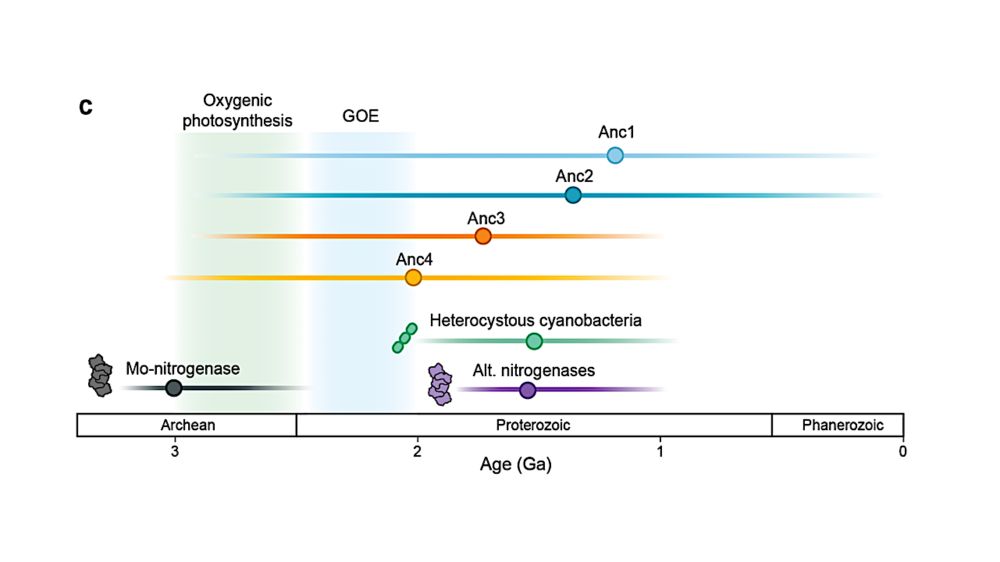
Resurrected Nitrogenases Recapitulate Canonical N-isotope Biosignatures Over Two Billion Years - Astrobiology
Nitrogen isotope fractionation (ε15N) in sedimentary rocks has provided evidence for biological nitrogen fixation, and thus primary productivity, on the early Earth.
astrobiology.com
November 12, 2025 at 7:49 PM
Resurrected Nitrogenases Recapitulate Canonical N-isotope Biosignatures Over Two Billion Years
astrobiology.com/2025/11/resu... #astrobiology #genomics #evolution #biosignatures
astrobiology.com/2025/11/resu... #astrobiology #genomics #evolution #biosignatures
Reposted by Kaçar Lab at UW-Madison
Our new paper, out today! We resurrected ancient nitrogenases first used by life on Earth 3 billion years ago. We combined synthetic biology and geology & validated their chemical #biosignature in rocks that helps reveal ancient life on Earth!(and beyond!)
Link: www.nature.com/articles/s41...
Link: www.nature.com/articles/s41...
Resurrected nitrogenases recapitulate canonical N-isotope biosignatures over two billion years - Nature Communications
The study shows that nitrogenase enzymes have maintained stable isotope signatures over billions of years, revealing how ancient microbes shaped Earth’s nitrogen cycle and offering a new experimental ...
www.nature.com
January 30, 2026 at 9:12 PM
Our new paper, out today! We resurrected ancient nitrogenases first used by life on Earth 3 billion years ago. We combined synthetic biology and geology & validated their chemical #biosignature in rocks that helps reveal ancient life on Earth!(and beyond!)
Link: www.nature.com/articles/s41...
Link: www.nature.com/articles/s41...
Our latest paper on ancient microbes and nitrogen is featured on the NASA website today! 🚀🔬Way to go, @hollyrucker.bsky.social!
Resurrecting Ancient Enzymes in NASA’s Search for Life Beyond Earth
www.nasa.gov
Paper link: www.nature.com/articles/s41... #astrobiology @uwmadscience.bsky.social
Resurrecting Ancient Enzymes in NASA’s Search for Life Beyond Earth
www.nasa.gov
Paper link: www.nature.com/articles/s41... #astrobiology @uwmadscience.bsky.social

NASA
NASA.gov brings you the latest news, images and videos from America's space agency, pioneering the future in space exploration, scientific discovery and aeronautics research.
www.nasa.gov
February 2, 2026 at 4:02 PM
Our latest paper on ancient microbes and nitrogen is featured on the NASA website today! 🚀🔬Way to go, @hollyrucker.bsky.social!
Resurrecting Ancient Enzymes in NASA’s Search for Life Beyond Earth
www.nasa.gov
Paper link: www.nature.com/articles/s41... #astrobiology @uwmadscience.bsky.social
Resurrecting Ancient Enzymes in NASA’s Search for Life Beyond Earth
www.nasa.gov
Paper link: www.nature.com/articles/s41... #astrobiology @uwmadscience.bsky.social
Reposted by Kaçar Lab at UW-Madison

I wonder if some of the Archean fossils I've found were using these molecules?
Our new paper, out today! We resurrected ancient nitrogenases first used by life on Earth 3 billion years ago. We combined synthetic biology and geology & validated their chemical #biosignature in rocks that helps reveal ancient life on Earth!(and beyond!)
Link: www.nature.com/articles/s41...
Link: www.nature.com/articles/s41...
Resurrected nitrogenases recapitulate canonical N-isotope biosignatures over two billion years - Nature Communications
The study shows that nitrogenase enzymes have maintained stable isotope signatures over billions of years, revealing how ancient microbes shaped Earth’s nitrogen cycle and offering a new experimental ...
www.nature.com
February 1, 2026 at 4:46 PM
I wonder if some of the Archean fossils I've found were using these molecules?
Reposted by Kaçar Lab at UW-Madison

Resurrected nitrogenases recapitulate canonical N-isotope biosignatures over two billion years www.nature.com/articles/s41... #jcampubs

Resurrected nitrogenases recapitulate canonical N-isotope biosignatures over two billion years - Nature Communications
The study shows that nitrogenase enzymes have maintained stable isotope signatures over billions of years, revealing how ancient microbes shaped Earth’s nitrogen cycle and offering a new experimental ...
www.nature.com
January 22, 2026 at 1:57 PM
Resurrected nitrogenases recapitulate canonical N-isotope biosignatures over two billion years www.nature.com/articles/s41... #jcampubs
Reposted by Kaçar Lab at UW-Madison

Resurrected nitrogenases recapitulate canonical N-isotope biosignatures over two billion years
#nitrogen #evolution
@natcomms.nature.com
www.nature.com/articles/s41...
#nitrogen #evolution
@natcomms.nature.com
www.nature.com/articles/s41...

Resurrected nitrogenases recapitulate canonical N-isotope biosignatures over two billion years - Nature Communications
The study shows that nitrogenase enzymes have maintained stable isotope signatures over billions of years, revealing how ancient microbes shaped Earth’s nitrogen cycle and offering a new experimental ...
www.nature.com
January 25, 2026 at 6:12 PM
Resurrected nitrogenases recapitulate canonical N-isotope biosignatures over two billion years
#nitrogen #evolution
@natcomms.nature.com
www.nature.com/articles/s41...
#nitrogen #evolution
@natcomms.nature.com
www.nature.com/articles/s41...
Reposted by Kaçar Lab at UW-Madison
Another great paper from @kacarlab.bsky.social at @uwbact.bsky.social suggesting that the molybdenum-dependent nitrogenase has been largely invariant for a long time -> Resurrected nitrogenases recapitulate canonical N-isotope biosignatures over two billion years

Resurrected nitrogenases recapitulate canonical N-isotope biosignatures over two billion years
Nitrogen isotope fractionation (ε15N) in sedimentary rocks has provided evidence for biological nitrogen fixation, and thus primary productivity, on the early Earth. However, the extent to which molecular evolution has influenced the isotopic signatures of nitrogenase, the enzyme that catalyzes the conversion of atmospheric nitrogen (N₂) to bioavailable ammonia, remains unresolved. Here, we reconstruct and experimentally characterize a library of synthetic ancestral nitrogenase genes, spanning over 2 billion years of evolutionary history. We assess the resulting ε¹⁵N values under controlled laboratory conditions. All engineered strains exhibit ε15N values within a narrow range comparable to that of modern microbes, suggesting that molybdenum (Mo)-dependent nitrogenase has been largely invariant throughout evolutionary time since the origins of this pathway. The results of this study support the early origin of molybdenum nitrogenase and the resilience of nitrogen-isotope biosignatures in ancient rocks, while also demonstrating their potential as powerful tools in the search for life beyond Earth.
sco.lt
January 31, 2026 at 5:36 PM
Another great paper from @kacarlab.bsky.social at @uwbact.bsky.social suggesting that the molybdenum-dependent nitrogenase has been largely invariant for a long time -> Resurrected nitrogenases recapitulate canonical N-isotope biosignatures over two billion years
Our new paper, out today! We resurrected ancient nitrogenases first used by life on Earth 3 billion years ago. We combined synthetic biology and geology & validated their chemical #biosignature in rocks that helps reveal ancient life on Earth!(and beyond!)
Link: www.nature.com/articles/s41...
Link: www.nature.com/articles/s41...
Resurrected nitrogenases recapitulate canonical N-isotope biosignatures over two billion years - Nature Communications
The study shows that nitrogenase enzymes have maintained stable isotope signatures over billions of years, revealing how ancient microbes shaped Earth’s nitrogen cycle and offering a new experimental ...
www.nature.com
January 30, 2026 at 9:12 PM
Our new paper, out today! We resurrected ancient nitrogenases first used by life on Earth 3 billion years ago. We combined synthetic biology and geology & validated their chemical #biosignature in rocks that helps reveal ancient life on Earth!(and beyond!)
Link: www.nature.com/articles/s41...
Link: www.nature.com/articles/s41...
Reposted by Kaçar Lab at UW-Madison

Happy to share that a fantastic article about my latest research was just published on NASA’s website! Very grateful to have such a spotlight on my PhD research and recent Nature Communications paper.

Resurrecting Ancient Enzymes in NASA's Search for Life Beyond Earth - NASA Science
NASA-supported scientists have resurrected an enzyme first used by organisms on Earth 3.2-billion years ago and, in the process, have validated a chemical
science.nasa.gov
January 30, 2026 at 6:28 PM
Happy to share that a fantastic article about my latest research was just published on NASA’s website! Very grateful to have such a spotlight on my PhD research and recent Nature Communications paper.
Reposted by Kaçar Lab at UW-Madison

fully agree, roland. this "experimental archeology" approach by @kacarlab.bsky.social is thrilling and a reasonable surrogate for cases when fossils are missing (we had this point recently, right?). I loved to write about their EF-Tu story for STC >

Of Terms in Biology: "Synonymous Substitution", part 1|2
by Christoph — We are occasionally warned not to compare apples with pears (sorry, English speakers, not with oranges this time). Sure, both are pome fruits, and both plants belong to t…
smallthingsconsidered.blog
January 29, 2026 at 9:08 PM
fully agree, roland. this "experimental archeology" approach by @kacarlab.bsky.social is thrilling and a reasonable surrogate for cases when fossils are missing (we had this point recently, right?). I loved to write about their EF-Tu story for STC >
Reposted by Kaçar Lab at UW-Madison

Pioneering work by the @kacarlab.bsky.social Ancestral state reconstruction, expression of ancient nitrogenases, measuring their isotope fractionation, reinterpretations of geobiological record. Super cool :)
The study shows that nitrogenase enzymes have maintained stable isotope signatures over billions of years, revealing how ancient #microbes shaped Earth’s #nitrogen cycle and offering a new experimental framework for probing early life.
www.nature.com/articles/s41...
www.nature.com/articles/s41...

Resurrected nitrogenases recapitulate canonical N-isotope biosignatures over two billion years - Nature Communications
The study shows that nitrogenase enzymes have maintained stable isotope signatures over billions of years, revealing how ancient microbes shaped Earth’s nitrogen cycle and offering a new experimental ...
www.nature.com
January 29, 2026 at 2:16 PM
Pioneering work by the @kacarlab.bsky.social Ancestral state reconstruction, expression of ancient nitrogenases, measuring their isotope fractionation, reinterpretations of geobiological record. Super cool :)
Reposted by Kaçar Lab at UW-Madison

Super cool! I'd love to include viruses in this work.
The study shows that nitrogenase enzymes have maintained stable isotope signatures over billions of years, revealing how ancient #microbes shaped Earth’s #nitrogen cycle and offering a new experimental framework for probing early life.
www.nature.com/articles/s41...
www.nature.com/articles/s41...
Resurrected nitrogenases recapitulate canonical N-isotope biosignatures over two billion years - Nature Communications
The study shows that nitrogenase enzymes have maintained stable isotope signatures over billions of years, revealing how ancient microbes shaped Earth’s nitrogen cycle and offering a new experimental ...
www.nature.com
January 28, 2026 at 1:00 AM
Super cool! I'd love to include viruses in this work.
Reposted by Kaçar Lab at UW-Madison

The study shows that nitrogenase enzymes have maintained stable isotope signatures over billions of years, revealing how ancient #microbes shaped Earth’s #nitrogen cycle and offering a new experimental framework for probing early life.
www.nature.com/articles/s41...
www.nature.com/articles/s41...
Resurrected nitrogenases recapitulate canonical N-isotope biosignatures over two billion years - Nature Communications
The study shows that nitrogenase enzymes have maintained stable isotope signatures over billions of years, revealing how ancient microbes shaped Earth’s nitrogen cycle and offering a new experimental ...
www.nature.com
January 27, 2026 at 7:18 PM
The study shows that nitrogenase enzymes have maintained stable isotope signatures over billions of years, revealing how ancient #microbes shaped Earth’s #nitrogen cycle and offering a new experimental framework for probing early life.
www.nature.com/articles/s41...
www.nature.com/articles/s41...
Reposted by Kaçar Lab at UW-Madison
A very cool little announcement I saw on my Google Scholar page today!

January 19, 2026 at 7:18 PM
A very cool little announcement I saw on my Google Scholar page today!