


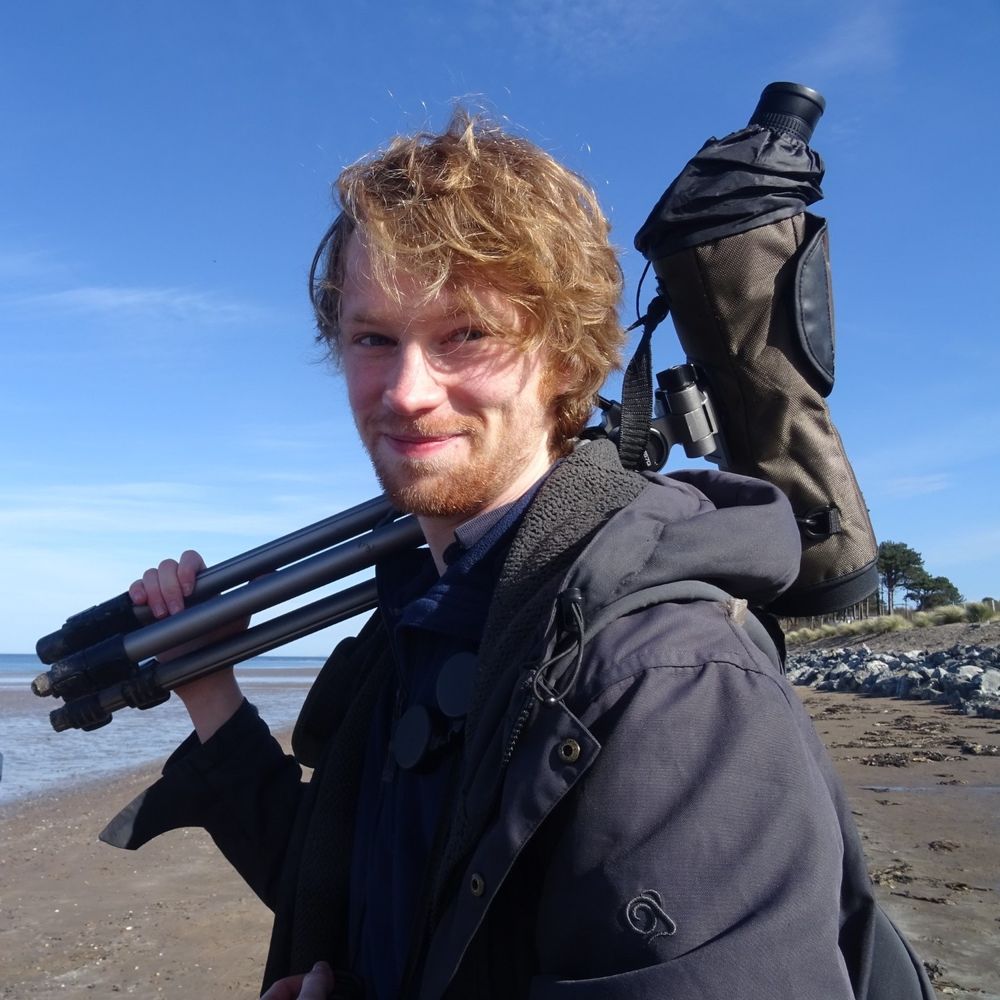
Joe Parham
@joeparham19.bsky.social
PhD student in Buzz Baum's lab at the MRC-LMB, interested in mechanisms of DNA segregation and cell division. Also birding from time to time.
First patch foray of 2026 at Fen Drayton. Nice stumble upon this Red-breasted Merg, which I believe is the first for some years. Two drake Smew visible from the reserve on St Ives gravel pits. Merlin, Goosander and lots of expected wildfowl the supporting cast. #PWC2026 @cambsbirdclub.bsky.social

January 10, 2026 at 4:54 PM
First patch foray of 2026 at Fen Drayton. Nice stumble upon this Red-breasted Merg, which I believe is the first for some years. Two drake Smew visible from the reserve on St Ives gravel pits. Merlin, Goosander and lots of expected wildfowl the supporting cast. #PWC2026 @cambsbirdclub.bsky.social
Reposted by Joe Parham
I’m excited to announce that I will be starting my research group on computational enzyme design at the Generative Biology Institute, Oxford, UK (@eitoxford.bsky.social)! PhD applications are open, deadline is Jan 8th (www.chem.ox.ac.uk/genbio-dtp). Email kiarash.jamali@eit.org with any questions!

GenBio DTP
Optional supporting text
www.chem.ox.ac.uk
December 9, 2025 at 2:54 PM
I’m excited to announce that I will be starting my research group on computational enzyme design at the Generative Biology Institute, Oxford, UK (@eitoxford.bsky.social)! PhD applications are open, deadline is Jan 8th (www.chem.ox.ac.uk/genbio-dtp). Email kiarash.jamali@eit.org with any questions!
Reposted by Joe Parham
New preprint from the lab!!🎉
We show that Asgard archaea ESCRT-III proteins can trigger membrane fission and reveal its molecular mechanism, offering clues to how these cells may have built internal compartments. But do these organisms even have these compartments?
www.biorxiv.org/content/10.1...
We show that Asgard archaea ESCRT-III proteins can trigger membrane fission and reveal its molecular mechanism, offering clues to how these cells may have built internal compartments. But do these organisms even have these compartments?
www.biorxiv.org/content/10.1...

Molecular basis for cellular compartmentalization by an ancient membrane fission mechanism
The emergence of cell compartmentalization depends on membrane fission to create the endomembrane compartments. In eukaryotes, membrane fission is commonly executed by ESCRT-III, a protein complex con...
www.biorxiv.org
December 1, 2025 at 9:09 AM
New preprint from the lab!!🎉
We show that Asgard archaea ESCRT-III proteins can trigger membrane fission and reveal its molecular mechanism, offering clues to how these cells may have built internal compartments. But do these organisms even have these compartments?
www.biorxiv.org/content/10.1...
We show that Asgard archaea ESCRT-III proteins can trigger membrane fission and reveal its molecular mechanism, offering clues to how these cells may have built internal compartments. But do these organisms even have these compartments?
www.biorxiv.org/content/10.1...
While admiring this diorama in the Roman baths museum (in Bath..) I noticed this small tribute to the Life of Brian- a figure (under supervision) vandalising the walls with red writing!

November 10, 2025 at 1:45 PM
While admiring this diorama in the Roman baths museum (in Bath..) I noticed this small tribute to the Life of Brian- a figure (under supervision) vandalising the walls with red writing!
Reposted by Joe Parham
An Asgard archaeon with internal membrane compartments
Brilliant study led by @fmacleod.bsky.social and Andriko von Kügelgen. Tight collaboration with @buzzbaum.bsky.social and lab. Congrats to all authors!
www.biorxiv.org/content/10.1...
Brilliant study led by @fmacleod.bsky.social and Andriko von Kügelgen. Tight collaboration with @buzzbaum.bsky.social and lab. Congrats to all authors!
www.biorxiv.org/content/10.1...

November 7, 2025 at 10:44 AM
An Asgard archaeon with internal membrane compartments
Brilliant study led by @fmacleod.bsky.social and Andriko von Kügelgen. Tight collaboration with @buzzbaum.bsky.social and lab. Congrats to all authors!
www.biorxiv.org/content/10.1...
Brilliant study led by @fmacleod.bsky.social and Andriko von Kügelgen. Tight collaboration with @buzzbaum.bsky.social and lab. Congrats to all authors!
www.biorxiv.org/content/10.1...
Reposted by Joe Parham

How common cuckoos adapt to multiple hosts | Science www.science.org/doi/10.1126/...

How common cuckoos adapt to multiple hosts
Genomic data reveal the complexity of egg mimicry evolution in cuckoos
www.science.org
November 2, 2025 at 5:21 AM
How common cuckoos adapt to multiple hosts | Science www.science.org/doi/10.1126/...
131 species for the week by public transport in north Norfolk. Self-found GGS and Richard’s Pipit the highlights. Best of rest: Hume’s, many YBW, Glossy Ibis, L Yellowlegs. Classic coastal autumn vismig with many Crossbill, Brambling, thrushes etc. Curlew and Purple Sands, Little Stint.


October 20, 2025 at 4:20 PM
131 species for the week by public transport in north Norfolk. Self-found GGS and Richard’s Pipit the highlights. Best of rest: Hume’s, many YBW, Glossy Ibis, L Yellowlegs. Classic coastal autumn vismig with many Crossbill, Brambling, thrushes etc. Curlew and Purple Sands, Little Stint.
Just having tea in Cley visitor centre and a Great Grey Shrikes flies past the window! Managed to get a few people on it, appears to have gone down in a hedgerow east of visitor centre. Best bird I’ve found while mid-cup of tea @birdguides.bsky.social
October 20, 2025 at 1:23 PM
Just having tea in Cley visitor centre and a Great Grey Shrikes flies past the window! Managed to get a few people on it, appears to have gone down in a hedgerow east of visitor centre. Best bird I’ve found while mid-cup of tea @birdguides.bsky.social
Come and join our lab @mrclmb.bsky.social for your PhD! A wonderful environment to explore our archaeal origins with supportive and collaborative colleagues and the chance to investigate big evolutionary and cell biology questions.
LMB PhD studentship available in the Baum lab to use informatics to infer cell structure from genomic data in collaboration with the brilliant Tom Williams. If you write to me and I don’t reply - try again - the spam filter is hungry…
October 2, 2025 at 10:08 AM
Come and join our lab @mrclmb.bsky.social for your PhD! A wonderful environment to explore our archaeal origins with supportive and collaborative colleagues and the chance to investigate big evolutionary and cell biology questions.
Reposted by Joe Parham
We are excited to share our preprint describing how Sulfolobus cells coordinate DNA segregation with cell division! In eukaryotes this type of regulation involves checkpoints and CDK-cyclins. But how does this work in archaea? This is the question we ask in our paper: www.biorxiv.org/content/10.1...

Temporal and spatial coordination of DNA segregation and cell division in an archaeon.
Cells must coordinate DNA segregation with cytokinesis to ensure that each daughter cell inherits a complete genome. Here, we explore how DNA segregation and division are mechanistically coupled in ar...
www.biorxiv.org
May 29, 2025 at 3:36 PM
We are excited to share our preprint describing how Sulfolobus cells coordinate DNA segregation with cell division! In eukaryotes this type of regulation involves checkpoints and CDK-cyclins. But how does this work in archaea? This is the question we ask in our paper: www.biorxiv.org/content/10.1...
We are excited to share our preprint describing how Sulfolobus cells coordinate DNA segregation with cell division! In eukaryotes this type of regulation involves checkpoints and CDK-cyclins. But how does this work in archaea? This is the question we ask in our paper: www.biorxiv.org/content/10.1...
Temporal and spatial coordination of DNA segregation and cell division in an archaeon.
Cells must coordinate DNA segregation with cytokinesis to ensure that each daughter cell inherits a complete genome. Here, we explore how DNA segregation and division are mechanistically coupled in ar...
www.biorxiv.org
May 29, 2025 at 3:36 PM
We are excited to share our preprint describing how Sulfolobus cells coordinate DNA segregation with cell division! In eukaryotes this type of regulation involves checkpoints and CDK-cyclins. But how does this work in archaea? This is the question we ask in our paper: www.biorxiv.org/content/10.1...
Reposted by Joe Parham

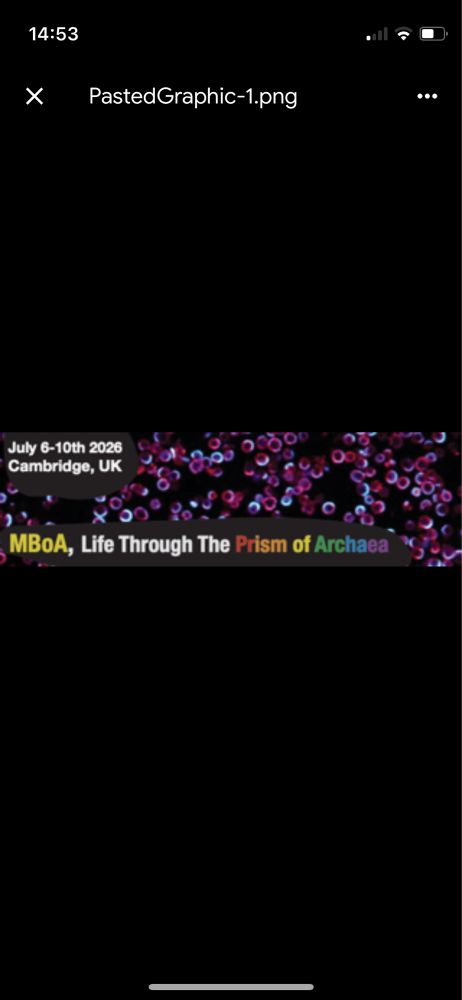
Excited to announce the Molecular Biology of Archaea (MBoA) 2026!
Join us in Cambridge, UK, from 6–10 July 2026 for the only international meeting dedicated to Archaea.
Join us in Cambridge, UK, from 6–10 July 2026 for the only international meeting dedicated to Archaea.
April 18, 2025 at 1:56 PM
Excited to announce the Molecular Biology of Archaea (MBoA) 2026!
Join us in Cambridge, UK, from 6–10 July 2026 for the only international meeting dedicated to Archaea.
Join us in Cambridge, UK, from 6–10 July 2026 for the only international meeting dedicated to Archaea.
Reposted by Joe Parham
Happy to share our paper’s final version on the evolution, structure, and membrane binding / remodeling of Asgard ESCRT-III proteins! And my first 🦋 post! www.science.org/doi/10.1126/...
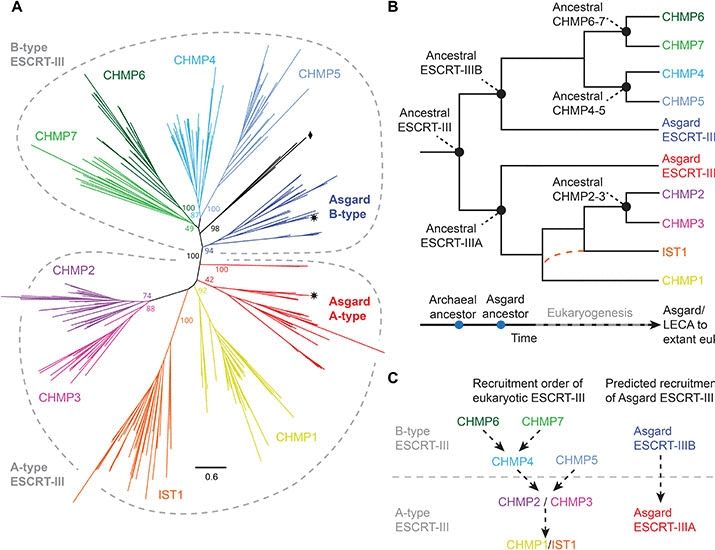
Asgard archaea reveal the conserved principles of ESCRT-III membrane remodeling
Asgard archaea have two ESCRT-III subunits with the conserved traits that drive stepwise membrane remodeling in eukaryotes.
www.science.org
February 8, 2025 at 5:27 AM
Happy to share our paper’s final version on the evolution, structure, and membrane binding / remodeling of Asgard ESCRT-III proteins! And my first 🦋 post! www.science.org/doi/10.1126/...
Reposted by Joe Parham
Our latest work on how the surface layer assists cell division in Sulfolobus is now out! Don't forget to like, comment and subscribe!

The mechanics of a continuous self-assembling surface-layer aids cell division in an archaeon
The surface layer or “S-layer” is a planar lattice of glycosylated proteins that coats a wide range of archaea and bacteria instead of a classical cell wall or capsular polysaccharides, insulating the...
www.biorxiv.org
February 7, 2025 at 2:31 PM
Our latest work on how the surface layer assists cell division in Sulfolobus is now out! Don't forget to like, comment and subscribe!
My good friend Arjun and I found a stunning male Bluethroat this afternoon at Grantchester meadows in Cambridge. Spring patch birding at its absolute best!
November 19, 2024 at 9:41 PM
My good friend Arjun and I found a stunning male Bluethroat this afternoon at Grantchester meadows in Cambridge. Spring patch birding at its absolute best!
Waxwings on the LMB list, flock of 30+ past a few mins ago.

November 19, 2024 at 9:41 PM
Waxwings on the LMB list, flock of 30+ past a few mins ago.
