



Jens Eisert
@jenseisert.bsky.social
Scientist, professor of quantum physics at Freie Universität Berlin and affiliated with Helmholtz Center Berlin and the Fraunhofer Heinrich Hertz Institute. ERC Fellow.
It has been a great pleasure—and both fun and insightful—to speak with Dr. Thomas Ramge about the future of quantum technologies, broader aspects of science and technology, and what makes science so exciting in the first place.
m.youtube.com/watch?si=mh2...
m.youtube.com/watch?si=mh2...

January 17, 2026 at 3:10 PM
It has been a great pleasure—and both fun and insightful—to speak with Dr. Thomas Ramge about the future of quantum technologies, broader aspects of science and technology, and what makes science so exciting in the first place.
m.youtube.com/watch?si=mh2...
m.youtube.com/watch?si=mh2...
This is the most technological paper I have been involved in for a while. It presents a below-threshold error reduction in single photons through photon #distillation.
scirate.com/arxiv/2601.0...
scirate.com/arxiv/2601.0...


January 12, 2026 at 6:52 PM
This is the most technological paper I have been involved in for a while. It presents a below-threshold error reduction in single photons through photon #distillation.
scirate.com/arxiv/2601.0...
scirate.com/arxiv/2601.0...
Variational optimization of projected entangled-pair states on the triangular lattice.
journals.aps.org/prb/abstract...
The “meta-message” is that the use of tools such as #automaticdifferentiation, and the co-design of the ansatz class and the physical system can improve #tensornetwork methods.
journals.aps.org/prb/abstract...
The “meta-message” is that the use of tools such as #automaticdifferentiation, and the co-design of the ansatz class and the physical system can improve #tensornetwork methods.

January 11, 2026 at 11:58 AM
Variational optimization of projected entangled-pair states on the triangular lattice.
journals.aps.org/prb/abstract...
The “meta-message” is that the use of tools such as #automaticdifferentiation, and the co-design of the ansatz class and the physical system can improve #tensornetwork methods.
journals.aps.org/prb/abstract...
The “meta-message” is that the use of tools such as #automaticdifferentiation, and the co-design of the ansatz class and the physical system can improve #tensornetwork methods.
To what extent can noisy quantum circuits be classically simulated? And at what point is this no longer true, so that one can hope for a quantum advantage? This is a compelling research question. Here, we suggest frames to do so, extending known Monte Carlo methods.
scirate.com/arxiv/2601.0...
scirate.com/arxiv/2601.0...

January 9, 2026 at 10:29 AM
To what extent can noisy quantum circuits be classically simulated? And at what point is this no longer true, so that one can hope for a quantum advantage? This is a compelling research question. Here, we suggest frames to do so, extending known Monte Carlo methods.
scirate.com/arxiv/2601.0...
scirate.com/arxiv/2601.0...
Do Bose-Hubbard type systems have a speed of sound for particle propagation?
scirate.com/arxiv/2601.001…
Yes. This work proves a strikingly simple bound of this kind for particle propagation for generalized Bose–Hubbard models defined on general lattices.
scirate.com/arxiv/2601.001…
Yes. This work proves a strikingly simple bound of this kind for particle propagation for generalized Bose–Hubbard models defined on general lattices.

January 5, 2026 at 4:27 AM
Do Bose-Hubbard type systems have a speed of sound for particle propagation?
scirate.com/arxiv/2601.001…
Yes. This work proves a strikingly simple bound of this kind for particle propagation for generalized Bose–Hubbard models defined on general lattices.
scirate.com/arxiv/2601.001…
Yes. This work proves a strikingly simple bound of this kind for particle propagation for generalized Bose–Hubbard models defined on general lattices.
We suggest a shift in emphasis—namely, putting it on the representability of #functions—when thinking about quantum models aimed at achieving a quantum advantage for machine learning tasks.
scirate.com/arxiv/2512.1...
scirate.com/arxiv/2512.1...

December 18, 2025 at 10:45 AM
We suggest a shift in emphasis—namely, putting it on the representability of #functions—when thinking about quantum models aimed at achieving a quantum advantage for machine learning tasks.
scirate.com/arxiv/2512.1...
scirate.com/arxiv/2512.1...
How can we classically simulate large-scale open quantum systems—effectively dequantizing them? I am delighted to see the results of this wonderfully fruitful collaboration published in @natureportfolio.nature.com Communications.
www.nature.com/articles/s41...
www.nature.com/articles/s41...

December 10, 2025 at 4:38 PM
How can we classically simulate large-scale open quantum systems—effectively dequantizing them? I am delighted to see the results of this wonderfully fruitful collaboration published in @natureportfolio.nature.com Communications.
www.nature.com/articles/s41...
www.nature.com/articles/s41...
Reposted by Jens Eisert

Recent analysis shows that quantum-state tomography faces significant challenges in accurately reconstructing continuous-variable quantum states, highlighting key limitations for quantum technologies. doi.org/hbdw67

Quantifying unknown quantum states: Study explores effectiveness of existing methods
Reliably quantifying and characterizing the quantum states of various systems is highly advantageous for both quantum physics research and the development of quantum technologies.
phys.org
December 8, 2025 at 5:50 PM
Recent analysis shows that quantum-state tomography faces significant challenges in accurately reconstructing continuous-variable quantum states, highlighting key limitations for quantum technologies. doi.org/hbdw67
This is a publication I am extremely happy about. It is a bit rebellious, and yet it touches upon an old and important question: How can we learn an unknown continuous quantum state from data?
www.nature.com/articles/s41...
We prove that quantum state tomography is a lot harder than anticipated.
www.nature.com/articles/s41...
We prove that quantum state tomography is a lot harder than anticipated.

November 29, 2025 at 4:35 PM
This is a publication I am extremely happy about. It is a bit rebellious, and yet it touches upon an old and important question: How can we learn an unknown continuous quantum state from data?
www.nature.com/articles/s41...
We prove that quantum state tomography is a lot harder than anticipated.
www.nature.com/articles/s41...
We prove that quantum state tomography is a lot harder than anticipated.
Reposted by Jens Eisert
The results of the evaluation of the submissions to #QIP2026 are out. I am very happy to see eight accepted submissions from our team so far.
arxiv.org/abs/2504.12263
arxiv.org/abs/2505.15770
arxiv.org/abs/2502.12284
arxiv.org/abs/2510.07305
arxiv.org/abs/2503.15751
arxiv.org/abs/2510.05531
and …
arxiv.org/abs/2504.12263
arxiv.org/abs/2505.15770
arxiv.org/abs/2502.12284
arxiv.org/abs/2510.07305
arxiv.org/abs/2503.15751
arxiv.org/abs/2510.05531
and …

November 9, 2025 at 2:54 PM
The results of the evaluation of the submissions to #QIP2026 are out. I am very happy to see eight accepted submissions from our team so far.
arxiv.org/abs/2504.12263
arxiv.org/abs/2505.15770
arxiv.org/abs/2502.12284
arxiv.org/abs/2510.07305
arxiv.org/abs/2503.15751
arxiv.org/abs/2510.05531
and …
arxiv.org/abs/2504.12263
arxiv.org/abs/2505.15770
arxiv.org/abs/2502.12284
arxiv.org/abs/2510.07305
arxiv.org/abs/2503.15751
arxiv.org/abs/2510.05531
and …
Reposted by Jens Eisert


Reposted by Jens Eisert

Congratulations to Kiana Salehi, Perimeter PhD student who was awarded the Blue Apple Award for her talk, Influence of observer’s inclination and spacetime structure on photon ring observables.
Learn more: indico.global/event/14302/...
Learn more: indico.global/event/14302/...

November 10, 2025 at 6:20 PM
Congratulations to Kiana Salehi, Perimeter PhD student who was awarded the Blue Apple Award for her talk, Influence of observer’s inclination and spacetime structure on photon ring observables.
Learn more: indico.global/event/14302/...
Learn more: indico.global/event/14302/...
Reposted by Jens Eisert
Wow. Stunning indeed.
Today, a friend involved in the Esna restoration project has shared with me his latest stunning photos of the restored ceiling and columns of the Temple of Khnum in Esna, Upper #Egypt. During a multi-year restoration project, the dirt and soot that had obscured the ...🧵1/3
📷 D. v. Recklinghausen
🏺
📷 D. v. Recklinghausen
🏺

November 7, 2025 at 9:09 AM
Wow. Stunning indeed.
The results of the evaluation of the submissions to #QIP2026 are out. I am very happy to see eight accepted submissions from our team so far.
arxiv.org/abs/2504.12263
arxiv.org/abs/2505.15770
arxiv.org/abs/2502.12284
arxiv.org/abs/2510.07305
arxiv.org/abs/2503.15751
arxiv.org/abs/2510.05531
and …
arxiv.org/abs/2504.12263
arxiv.org/abs/2505.15770
arxiv.org/abs/2502.12284
arxiv.org/abs/2510.07305
arxiv.org/abs/2503.15751
arxiv.org/abs/2510.05531
and …
November 9, 2025 at 2:54 PM
The results of the evaluation of the submissions to #QIP2026 are out. I am very happy to see eight accepted submissions from our team so far.
arxiv.org/abs/2504.12263
arxiv.org/abs/2505.15770
arxiv.org/abs/2502.12284
arxiv.org/abs/2510.07305
arxiv.org/abs/2503.15751
arxiv.org/abs/2510.05531
and …
arxiv.org/abs/2504.12263
arxiv.org/abs/2505.15770
arxiv.org/abs/2502.12284
arxiv.org/abs/2510.07305
arxiv.org/abs/2503.15751
arxiv.org/abs/2510.05531
and …
Over the recent weeks and months, John Preskill and I sat down to think about where we are in quantum computing. While the noisy intermediate-scale quantum (#NISQ) era is just unfolding as we speak, the time seems right to look ahead to the next steps to come.
scirate.com/arxiv/2510.1...
scirate.com/arxiv/2510.1...

October 24, 2025 at 8:29 AM
Over the recent weeks and months, John Preskill and I sat down to think about where we are in quantum computing. While the noisy intermediate-scale quantum (#NISQ) era is just unfolding as we speak, the time seems right to look ahead to the next steps to come.
scirate.com/arxiv/2510.1...
scirate.com/arxiv/2510.1...
This is a manuscript I am particularly happy with. It concerns topics I have been working on for my PhD, entanglement theory, going back to the work of Bennett et al. Yet it still has a fresh flavour, relating the subject to modern developments in quantum computing.
www.nature.com/articles/s41...
www.nature.com/articles/s41...

October 22, 2025 at 11:58 AM
This is a manuscript I am particularly happy with. It concerns topics I have been working on for my PhD, entanglement theory, going back to the work of Bennett et al. Yet it still has a fresh flavour, relating the subject to modern developments in quantum computing.
www.nature.com/articles/s41...
www.nature.com/articles/s41...
In the shadow of the Hadamard test: Using the garbage state for good and further modifications
journals.aps.org/prl/abstract...
I am excited to see this improvement of the primitive of the Hadamard test in #quantumalgorithms in press in the PRL. We combine the unused output with shadow estimation.
journals.aps.org/prl/abstract...
I am excited to see this improvement of the primitive of the Hadamard test in #quantumalgorithms in press in the PRL. We combine the unused output with shadow estimation.

October 13, 2025 at 10:18 AM
In the shadow of the Hadamard test: Using the garbage state for good and further modifications
journals.aps.org/prl/abstract...
I am excited to see this improvement of the primitive of the Hadamard test in #quantumalgorithms in press in the PRL. We combine the unused output with shadow estimation.
journals.aps.org/prl/abstract...
I am excited to see this improvement of the primitive of the Hadamard test in #quantumalgorithms in press in the PRL. We combine the unused output with shadow estimation.
Stability of digital and analog quantum simulations under noise
scirate.com/arxiv/2510.084…
How can one fairly compare the robustness of digital and analog quantum simulations? Immanuel Bloch, for we made an attempt to bring light into the question from a rigorous perspective.
scirate.com/arxiv/2510.084…
How can one fairly compare the robustness of digital and analog quantum simulations? Immanuel Bloch, for we made an attempt to bring light into the question from a rigorous perspective.

October 10, 2025 at 7:00 AM
Stability of digital and analog quantum simulations under noise
scirate.com/arxiv/2510.084…
How can one fairly compare the robustness of digital and analog quantum simulations? Immanuel Bloch, for we made an attempt to bring light into the question from a rigorous perspective.
scirate.com/arxiv/2510.084…
How can one fairly compare the robustness of digital and analog quantum simulations? Immanuel Bloch, for we made an attempt to bring light into the question from a rigorous perspective.
How hard is it to verify a classical shadow?
We look at the problem of establishing classical shadows from the perspective of computational complexity.
scirate.com/arxiv/2510.0...
We look at the problem of establishing classical shadows from the perspective of computational complexity.
scirate.com/arxiv/2510.0...

October 10, 2025 at 6:58 AM
How hard is it to verify a classical shadow?
We look at the problem of establishing classical shadows from the perspective of computational complexity.
scirate.com/arxiv/2510.0...
We look at the problem of establishing classical shadows from the perspective of computational complexity.
scirate.com/arxiv/2510.0...
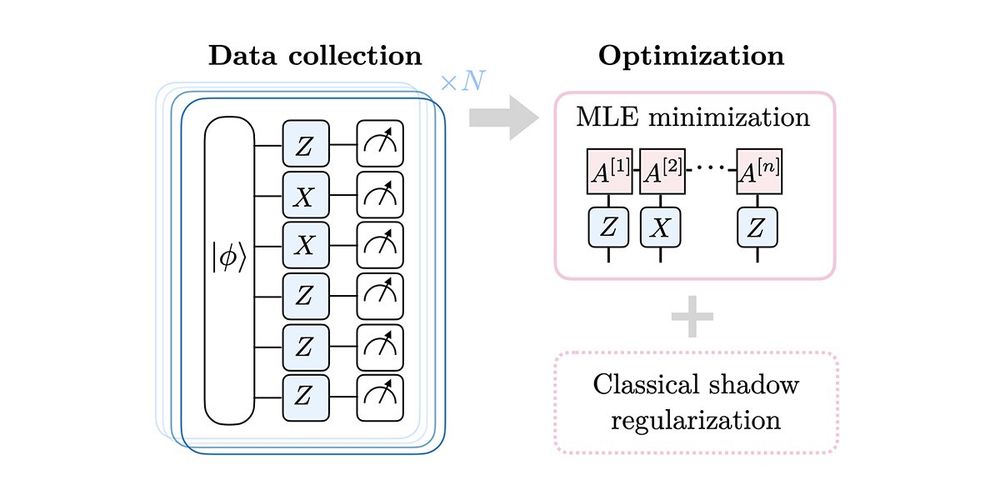
A data-driven heuristic method using tensor-network ansatze is shown to perform high-fidelity tomography of topological states.
go.aps.org/4nVFFKy
go.aps.org/4nVFFKy
October 3, 2025 at 4:46 PM
A data-driven heuristic method using tensor-network ansatze is shown to perform high-fidelity tomography of topological states.
go.aps.org/4nVFFKy
go.aps.org/4nVFFKy
Computational relative entropy
We take steps towards a computationally efficient quantum information theory.
scirate.com/arxiv/2509.2...
We take steps towards a computationally efficient quantum information theory.
scirate.com/arxiv/2509.2...

September 26, 2025 at 3:41 PM
Computational relative entropy
We take steps towards a computationally efficient quantum information theory.
scirate.com/arxiv/2509.2...
We take steps towards a computationally efficient quantum information theory.
scirate.com/arxiv/2509.2...

September 18, 2025 at 5:48 PM
Optimal trace distance bounds for free-fermionic states: Testing and improved tomography
journals.aps.org/prxquantum/a...
How can one optimally learn Gaussian fermionic states? A new trace distance bound is the key.
Thanks to Lennart Bittel, @Antonio_ and Lorenzo Leone for this collaboration.
journals.aps.org/prxquantum/a...
How can one optimally learn Gaussian fermionic states? A new trace distance bound is the key.
Thanks to Lennart Bittel, @Antonio_ and Lorenzo Leone for this collaboration.

September 3, 2025 at 6:38 PM
Optimal trace distance bounds for free-fermionic states: Testing and improved tomography
journals.aps.org/prxquantum/a...
How can one optimally learn Gaussian fermionic states? A new trace distance bound is the key.
Thanks to Lennart Bittel, @Antonio_ and Lorenzo Leone for this collaboration.
journals.aps.org/prxquantum/a...
How can one optimally learn Gaussian fermionic states? A new trace distance bound is the key.
Thanks to Lennart Bittel, @Antonio_ and Lorenzo Leone for this collaboration.
Localized statistics decoding for quantum low-density parity-check codes
www.nature.com/articles/s41...
A highly efficient and highly parallelizable decoder for qLDPC codes, overcoming a bottleneck in the field. Warm thanks to the team for the collaboration.
www.nature.com/articles/s41...
A highly efficient and highly parallelizable decoder for qLDPC codes, overcoming a bottleneck in the field. Warm thanks to the team for the collaboration.

Localized statistics decoding for quantum low-density parity-check codes - Nature Communications
Quantum low-density parity-check (QLDPC) codes offer lower overhead than topological quantum error-correcting codes, but decoding remains a key challenge for scalable fault-tolerant quantum computing....
www.nature.com
September 3, 2025 at 11:51 AM
Localized statistics decoding for quantum low-density parity-check codes
www.nature.com/articles/s41...
A highly efficient and highly parallelizable decoder for qLDPC codes, overcoming a bottleneck in the field. Warm thanks to the team for the collaboration.
www.nature.com/articles/s41...
A highly efficient and highly parallelizable decoder for qLDPC codes, overcoming a bottleneck in the field. Warm thanks to the team for the collaboration.