



Ioan Smart
@ioansmart.bsky.social
Lecturer at Abertay University. Interested in behavioural and sensory ecology. Currently exploring virtual reality as a tool for examining camouflage.
Had a great first day at #ASABWinter2025! Many fascinating talks and intriguing posters. If you didn’t manage to swing by and see me and have any questions about the recent research I’ve been doing, please get in contact!

December 15, 2025 at 10:35 PM
Had a great first day at #ASABWinter2025! Many fascinating talks and intriguing posters. If you didn’t manage to swing by and see me and have any questions about the recent research I’ve been doing, please get in contact!

Reposted by Ioan Smart
Larger frogs are better mimics but are more risk-averse in a nontoxic poison frog
#Aposematism #WarningSignals #Ampibian
doi.org/10.1093/behe...
#Aposematism #WarningSignals #Ampibian
doi.org/10.1093/behe...

December 3, 2025 at 1:29 PM
Larger frogs are better mimics but are more risk-averse in a nontoxic poison frog
#Aposematism #WarningSignals #Ampibian
doi.org/10.1093/behe...
#Aposematism #WarningSignals #Ampibian
doi.org/10.1093/behe...
Reposted by Ioan Smart

Very happy to see our opinion article out in @cp-trendsecolevo.bsky.social today. 🥳 We ask whether sexual signals can influence the evolutionary trajectory of naturally selected adaptations, such as protective colouration, for better or for worse 🧐 1/n
doi.org/10.1016/j.tr...
doi.org/10.1016/j.tr...

November 29, 2025 at 2:07 PM
Very happy to see our opinion article out in @cp-trendsecolevo.bsky.social today. 🥳 We ask whether sexual signals can influence the evolutionary trajectory of naturally selected adaptations, such as protective colouration, for better or for worse 🧐 1/n
doi.org/10.1016/j.tr...
doi.org/10.1016/j.tr...
Reposted by Ioan Smart
We hope everyone is getting excited for #ASABWinter2025 !
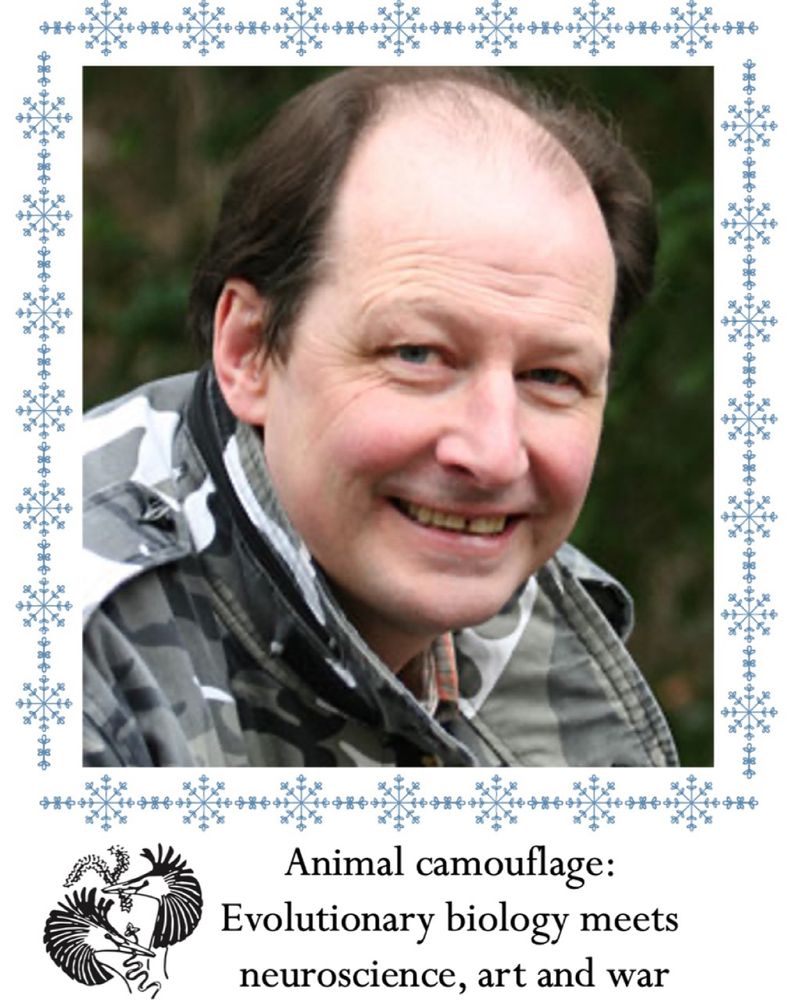
To kick off the conference on Dec 15, we will be having a public lecture by Prof. Innes Cuthill about an interdisciplinary approach to the study of camouflage. So make sure you’re not late ⏰
To kick off the conference on Dec 15, we will be having a public lecture by Prof. Innes Cuthill about an interdisciplinary approach to the study of camouflage. So make sure you’re not late ⏰
November 26, 2025 at 8:08 PM
We hope everyone is getting excited for #ASABWinter2025 !
To kick off the conference on Dec 15, we will be having a public lecture by Prof. Innes Cuthill about an interdisciplinary approach to the study of camouflage. So make sure you’re not late ⏰
To kick off the conference on Dec 15, we will be having a public lecture by Prof. Innes Cuthill about an interdisciplinary approach to the study of camouflage. So make sure you’re not late ⏰
Reposted by Ioan Smart

Do you work (/want to work) with caterpillars? Or sensory systems? Or BOTH?! Well good golly do we have the paper for you! We explain the senses that caterpillars have, what they use them for, and how anthropogenic sensory pollution might be messing it all up 🐛 doi.org/10.1007/s003...

The sensory ecology of caterpillars - Journal of Comparative Physiology A
Caterpillars (larval Lepidoptera) are one of the most ecologically and evolutionarily significant taxa on Earth. As both feeders and food, they shape the dynamics of enumerate ecosystems on land. Key ...
doi.org
November 10, 2025 at 3:24 PM
Do you work (/want to work) with caterpillars? Or sensory systems? Or BOTH?! Well good golly do we have the paper for you! We explain the senses that caterpillars have, what they use them for, and how anthropogenic sensory pollution might be messing it all up 🐛 doi.org/10.1007/s003...
Reposted by Ioan Smart
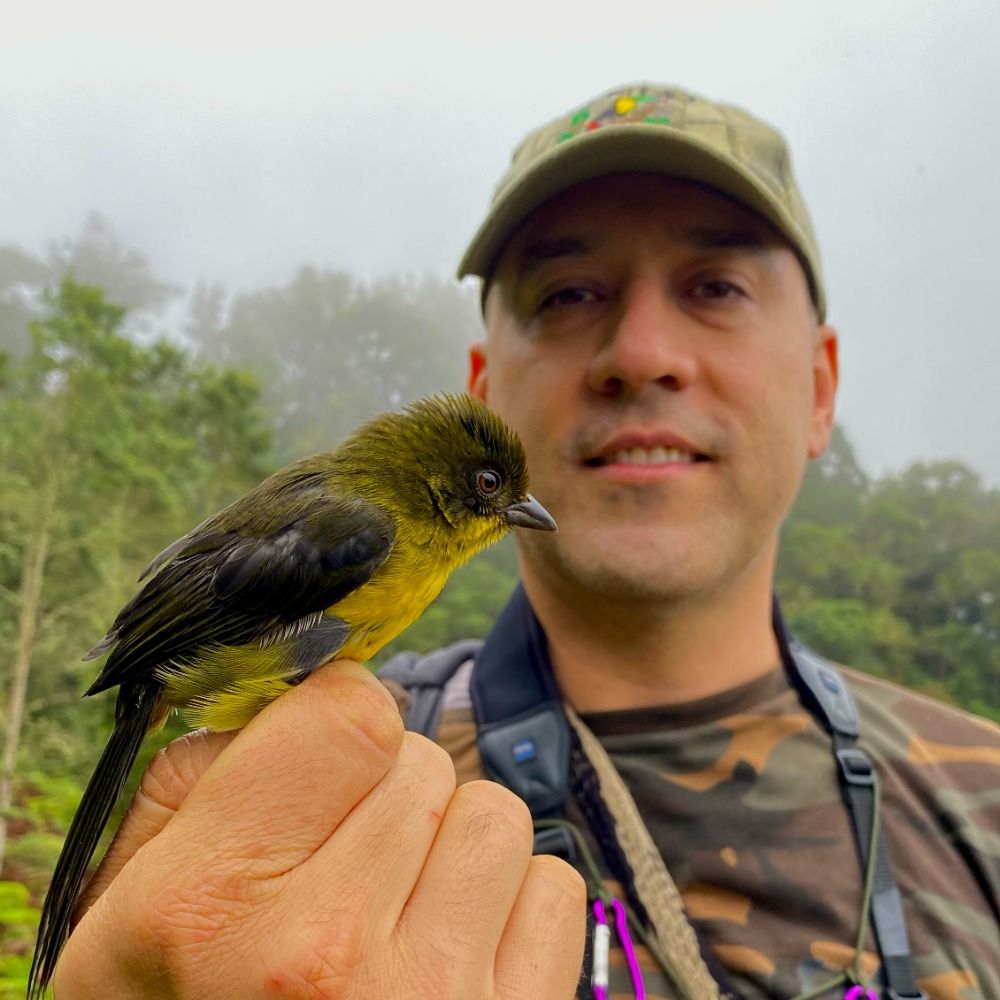
Evaluating the roles of signaling and camouflage in the evolution of iris color in Tyranni passerines. Evolution
doi.org/10.1093/evol...
doi.org/10.1093/evol...

Evaluating the roles of signaling and camouflage in the evolution of iris color in Tyranni passerines
Abstract. Iris color is a conspicuous and diverse trait across animals, but its evolutionary drivers are poorly understood. In over 1000 species of Tyranni
doi.org
November 10, 2025 at 4:39 PM
Evaluating the roles of signaling and camouflage in the evolution of iris color in Tyranni passerines. Evolution
doi.org/10.1093/evol...
doi.org/10.1093/evol...
Reposted by Ioan Smart

BehaveAI is live!
Our biologically inspired video analysis tool sees motion as colour. Track animals or objects, classify their behaviour, and handle complex natural scenes with ease.
Semi-supervised annotation, no GPUs required, user-friendly, free & open source.
Pre-print tinyurl.com/BehaveAI
Our biologically inspired video analysis tool sees motion as colour. Track animals or objects, classify their behaviour, and handle complex natural scenes with ease.
Semi-supervised annotation, no GPUs required, user-friendly, free & open source.
Pre-print tinyurl.com/BehaveAI
November 6, 2025 at 10:09 AM
BehaveAI is live!
Our biologically inspired video analysis tool sees motion as colour. Track animals or objects, classify their behaviour, and handle complex natural scenes with ease.
Semi-supervised annotation, no GPUs required, user-friendly, free & open source.
Pre-print tinyurl.com/BehaveAI
Our biologically inspired video analysis tool sees motion as colour. Track animals or objects, classify their behaviour, and handle complex natural scenes with ease.
Semi-supervised annotation, no GPUs required, user-friendly, free & open source.
Pre-print tinyurl.com/BehaveAI
Reposted by Ioan Smart
Leaf? 🍃 Or katydid? 🦗
Our new
@plosbiology.org paper sheds light on how these incredible mimics evolved their disguises, and what this reveals about how complex adaptations arise. We find that coordinated evolution between traits might be the answer… plos.io/4oUE741 1/n
Our new
@plosbiology.org paper sheds light on how these incredible mimics evolved their disguises, and what this reveals about how complex adaptations arise. We find that coordinated evolution between traits might be the answer… plos.io/4oUE741 1/n

Functional and evolutionary synergy of trait components can explain the existence of leaf masquerade in katydids
The evolution of complex adaptations often involves synergistic changes in multiple traits that lack standalone function. This study shows that leaf masquerade in katydids evolved through concurrent m...
plos.io
November 4, 2025 at 2:02 PM
Leaf? 🍃 Or katydid? 🦗
Our new
@plosbiology.org paper sheds light on how these incredible mimics evolved their disguises, and what this reveals about how complex adaptations arise. We find that coordinated evolution between traits might be the answer… plos.io/4oUE741 1/n
Our new
@plosbiology.org paper sheds light on how these incredible mimics evolved their disguises, and what this reveals about how complex adaptations arise. We find that coordinated evolution between traits might be the answer… plos.io/4oUE741 1/n
Reposted by Ioan Smart

#ISBE2026 Call for Abstracts is now open! Submit your abstract by 15 December 2025 on www.isbe2026.com
@behavecol.bsky.social
@behavecol.bsky.social

September 30, 2025 at 7:12 PM
#ISBE2026 Call for Abstracts is now open! Submit your abstract by 15 December 2025 on www.isbe2026.com
@behavecol.bsky.social
@behavecol.bsky.social
Reposted by Ioan Smart

Interested in vocal #communication? How animals provide referential #information about danger? Then see our 🌟NEW🌟 paper by brilliant ANU #PhD student Chun-Chieh Liao out today in @asab.org Animal Behaviour. 🎉👏
#birds #choughs #fieldwork #ECR
With Rob Magrath and Rob Heinsohn
doi.org/10.1016/j.an...
#birds #choughs #fieldwork #ECR
With Rob Magrath and Rob Heinsohn
doi.org/10.1016/j.an...

September 25, 2025 at 7:39 AM
Interested in vocal #communication? How animals provide referential #information about danger? Then see our 🌟NEW🌟 paper by brilliant ANU #PhD student Chun-Chieh Liao out today in @asab.org Animal Behaviour. 🎉👏
#birds #choughs #fieldwork #ECR
With Rob Magrath and Rob Heinsohn
doi.org/10.1016/j.an...
#birds #choughs #fieldwork #ECR
With Rob Magrath and Rob Heinsohn
doi.org/10.1016/j.an...
Reposted by Ioan Smart

📢🦋 Our paper ‘Global selection on insect antipredator coloration’ is out and featured on the cover of @science.org
We ran a huge experiment to find out how ecological context favours camouflage and warning colouration as antipredator strategies. 1/6
www.science.org/doi/10.1126/...
We ran a huge experiment to find out how ecological context favours camouflage and warning colouration as antipredator strategies. 1/6
www.science.org/doi/10.1126/...

September 25, 2025 at 6:26 PM
📢🦋 Our paper ‘Global selection on insect antipredator coloration’ is out and featured on the cover of @science.org
We ran a huge experiment to find out how ecological context favours camouflage and warning colouration as antipredator strategies. 1/6
www.science.org/doi/10.1126/...
We ran a huge experiment to find out how ecological context favours camouflage and warning colouration as antipredator strategies. 1/6
www.science.org/doi/10.1126/...
Reposted by Ioan Smart
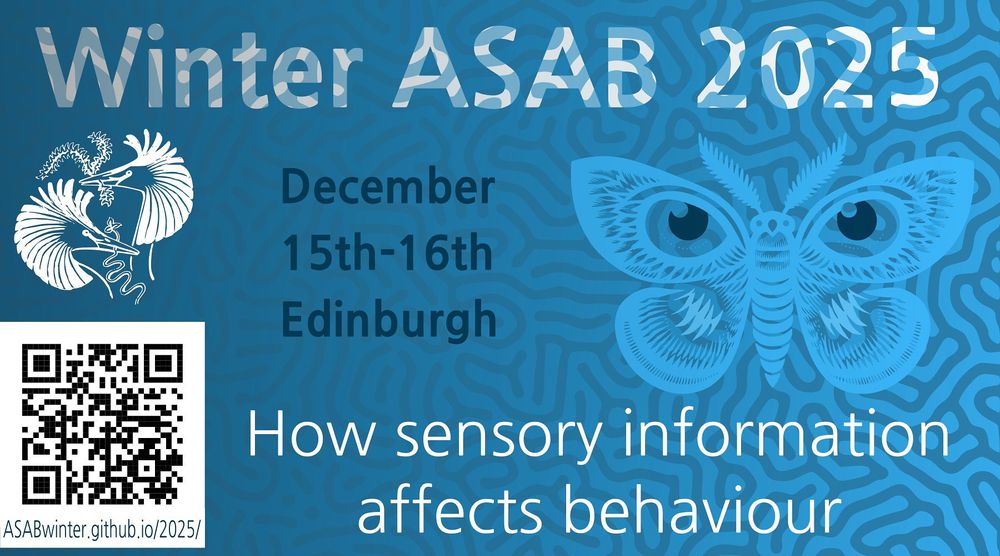
ICYMI : #ASABWinter2025 will take place from December 15-16, once again in lovely Edinburgh!
Registration is now open 🎉 Abstract submission deadline for posters and talks is August 29 🏃♀️🏃🏃♂️
More information here: asabwinter.github.io/2025/
Registration is now open 🎉 Abstract submission deadline for posters and talks is August 29 🏃♀️🏃🏃♂️
More information here: asabwinter.github.io/2025/
August 29, 2025 at 2:00 PM
Reposted by Ioan Smart

🚨Our new paper is out NOW in @jexpbiol.bsky.social 👀 Here we show that cuttlefish use visual contrast cues to inform their 3D camouflage, but these contrast cues can derive from true background features as well as exposure to dynamic lighting patterns. 🦑🔆
🔗 doi.org/10.1242/jeb....
🔗 doi.org/10.1242/jeb....

August 15, 2025 at 1:45 PM
🚨Our new paper is out NOW in @jexpbiol.bsky.social 👀 Here we show that cuttlefish use visual contrast cues to inform their 3D camouflage, but these contrast cues can derive from true background features as well as exposure to dynamic lighting patterns. 🦑🔆
🔗 doi.org/10.1242/jeb....
🔗 doi.org/10.1242/jeb....
Reposted by Ioan Smart
ICYMI : #ASABWinter2025 will take place from December 15-16, once again in lovely Edinburgh!
Registration is now open 🎉 Abstract submission deadline for posters and talks is August 29 🏃♀️🏃🏃♂️
More information here: asabwinter.github.io/2025/
Registration is now open 🎉 Abstract submission deadline for posters and talks is August 29 🏃♀️🏃🏃♂️
More information here: asabwinter.github.io/2025/
August 5, 2025 at 5:40 PM
ICYMI : #ASABWinter2025 will take place from December 15-16, once again in lovely Edinburgh!
Registration is now open 🎉 Abstract submission deadline for posters and talks is August 29 🏃♀️🏃🏃♂️
More information here: asabwinter.github.io/2025/
Registration is now open 🎉 Abstract submission deadline for posters and talks is August 29 🏃♀️🏃🏃♂️
More information here: asabwinter.github.io/2025/
Reposted by Ioan Smart
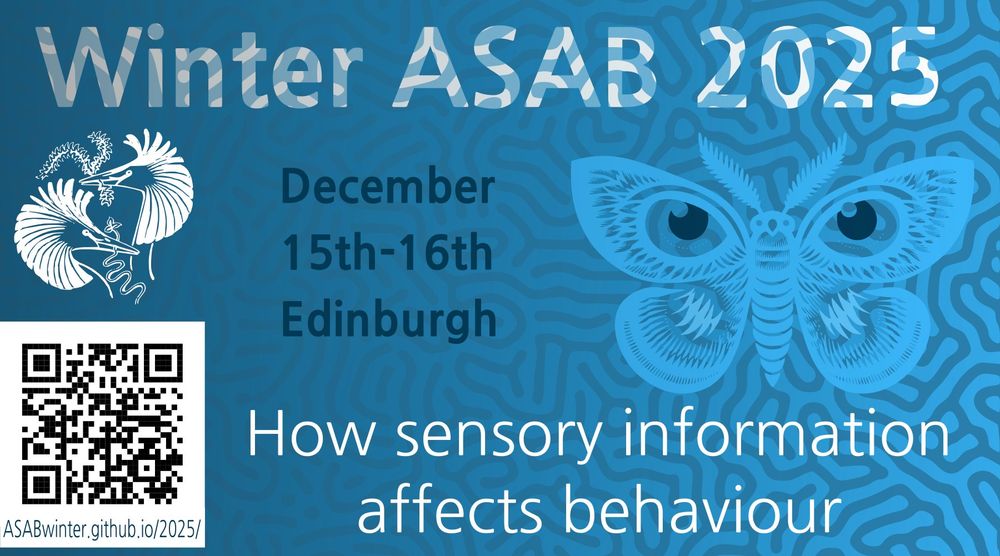
Winter ASAB @asab.org on *Sensory Ecology* register and submit your abstracts now (abstract deadline just a month away)!
I'm organising the conference this year with @lauraakelley.bsky.social and Innes Cuthill
Register & get more info here: asabwinter.github.io/2025/
I'm organising the conference this year with @lauraakelley.bsky.social and Innes Cuthill
Register & get more info here: asabwinter.github.io/2025/
July 29, 2025 at 3:24 PM
Winter ASAB @asab.org on *Sensory Ecology* register and submit your abstracts now (abstract deadline just a month away)!
I'm organising the conference this year with @lauraakelley.bsky.social and Innes Cuthill
Register & get more info here: asabwinter.github.io/2025/
I'm organising the conference this year with @lauraakelley.bsky.social and Innes Cuthill
Register & get more info here: asabwinter.github.io/2025/
Reposted by Ioan Smart
Why do treehoppers look so weird?! Our latest paper, out this week in @pnas.org, suggests a perhaps unexpected reason - static electricity ⚡ We show that treehoppers can detect the electrostatic cues of predators and that their crazy shapes may boost their electrosensitivity! doi.org/10.1073/pnas...
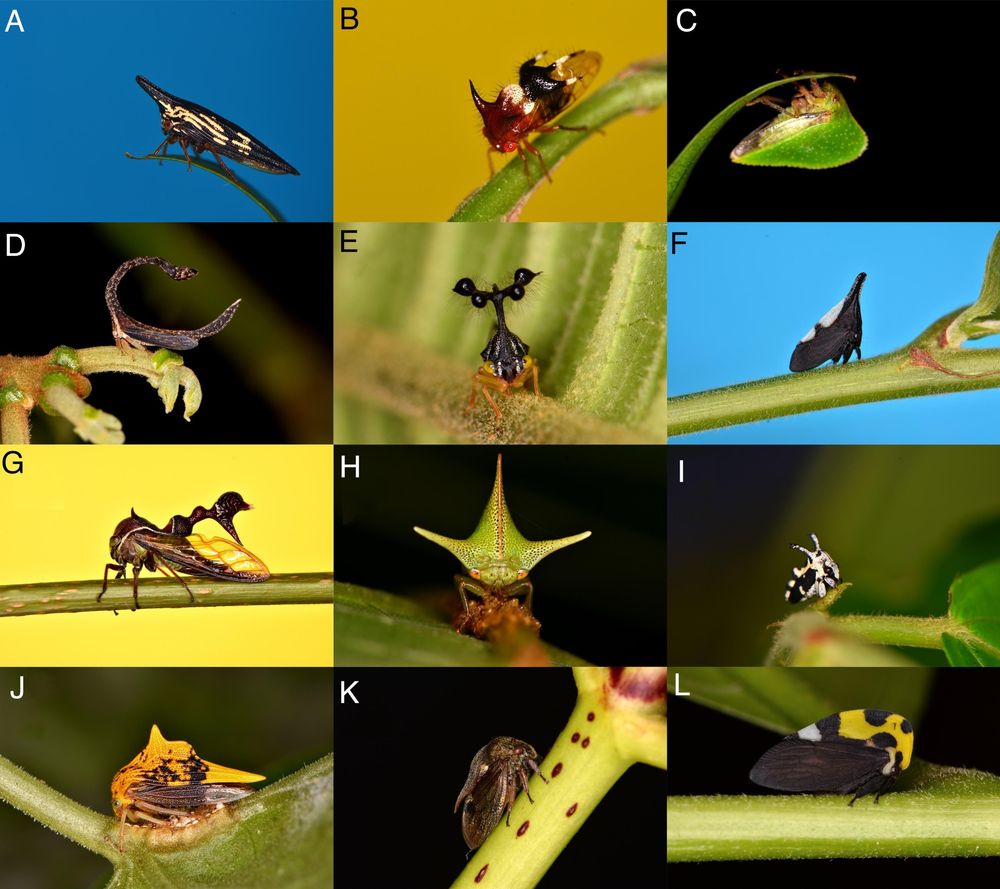
Electroreception in treehoppers: How extreme morphologies can increase electrical sensitivity | PNAS
The link between form and function of an organism’s morphology is usually apparent
or intuitive. However, some clades of organisms show remarkable ...
doi.org
July 24, 2025 at 11:44 AM
Why do treehoppers look so weird?! Our latest paper, out this week in @pnas.org, suggests a perhaps unexpected reason - static electricity ⚡ We show that treehoppers can detect the electrostatic cues of predators and that their crazy shapes may boost their electrosensitivity! doi.org/10.1073/pnas...
Reposted by Ioan Smart

🔴New #trumpetfish content!🔴 This species is colour #polymorphic so we dove (pun intended) into how the relative abundance and saliency of each morph influences the #behaviour of their prey. Find out more via the link below! 🎺🐠
🔗 tinyurl.com/39vn5skp #behavioralecology
🔗 tinyurl.com/39vn5skp #behavioralecology

Antagonistic effects of predator color morph abundance and saliency on prey anti-predator responses
Predators can have different color morphs, but whether morph abundance or saliency is more influential in shaping antipredator behavior in prey remains unc
tinyurl.com
July 23, 2025 at 2:11 PM
🔴New #trumpetfish content!🔴 This species is colour #polymorphic so we dove (pun intended) into how the relative abundance and saliency of each morph influences the #behaviour of their prey. Find out more via the link below! 🎺🐠
🔗 tinyurl.com/39vn5skp #behavioralecology
🔗 tinyurl.com/39vn5skp #behavioralecology
Reposted by Ioan Smart
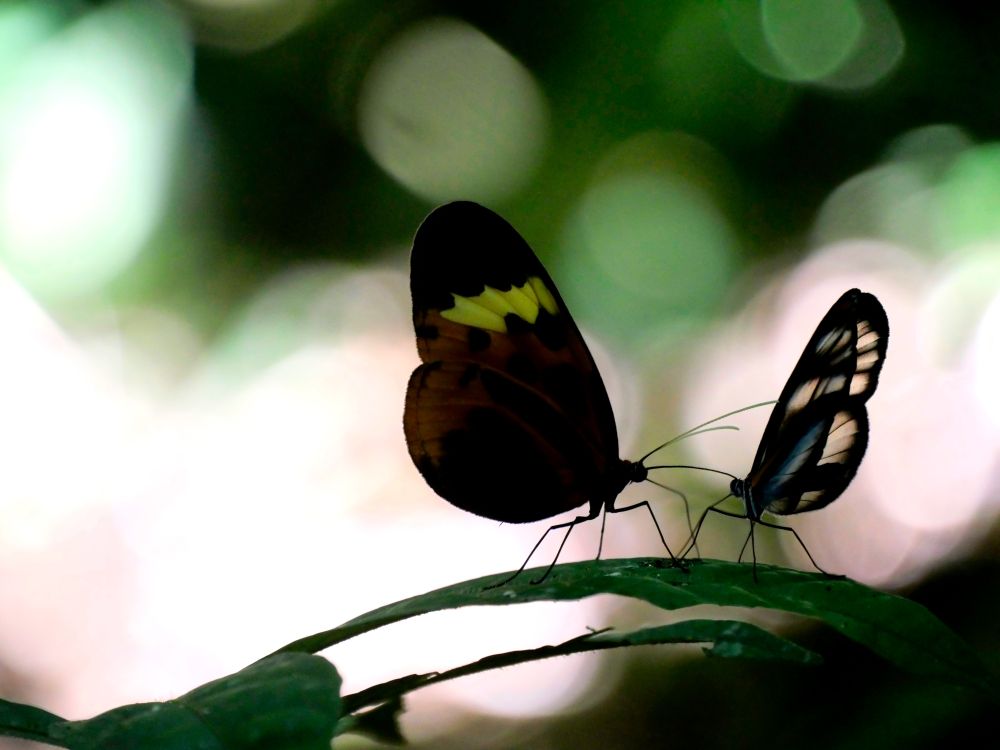
So very excited for the magnum opus of my #PhD to finally be out in @pnas.org. 🎉🎉 We demosntrate that mutualistic co-mimicking tropical butterflies not only converge in light microhabitat but, as a consequence, have also converged in visual system morphology! 1/n😀
www.pnas.org/doi/abs/10.1...
www.pnas.org/doi/abs/10.1...
July 16, 2025 at 9:29 AM
So very excited for the magnum opus of my #PhD to finally be out in @pnas.org. 🎉🎉 We demosntrate that mutualistic co-mimicking tropical butterflies not only converge in light microhabitat but, as a consequence, have also converged in visual system morphology! 1/n😀
www.pnas.org/doi/abs/10.1...
www.pnas.org/doi/abs/10.1...
Reposted by Ioan Smart
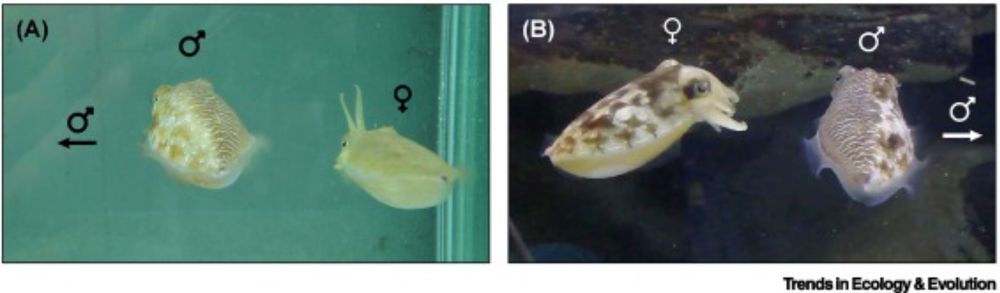
🚨 New paper alert! 👀 In our new opinion piece in TREE @cp-trendsecolevo.bsky.social, we propose #cephalopods as model systems to investigate the link between tactical #deception and #cognition in animals 🐙🦑🪄✨🧠
Read the paper here:
🔗 www.cell.com/trends/ecolo...
Read the paper here:
🔗 www.cell.com/trends/ecolo...
Tactical deception in cephalopods: a new framework for understanding cognition
Many animals rely on deception, including signalling misinformation, to gain advantages
over others. While many deceptive strategies rely on deterministic patterns or conditioning,
some taxa can flexi...
www.cell.com
May 27, 2025 at 10:42 AM
🚨 New paper alert! 👀 In our new opinion piece in TREE @cp-trendsecolevo.bsky.social, we propose #cephalopods as model systems to investigate the link between tactical #deception and #cognition in animals 🐙🦑🪄✨🧠
Read the paper here:
🔗 www.cell.com/trends/ecolo...
Read the paper here:
🔗 www.cell.com/trends/ecolo...
Reposted by Ioan Smart

Was great to be involved in such an interesting paper, now published in @ecol-evol.bsky.social!
dx.doi.org/10.1002/ece3...
dx.doi.org/10.1002/ece3...

The Adaptive Significance of Tail‐Flagging: A Test in European Rabbits (Oryctolagus cuniculus)
European rabbits use their white tails to warn others of danger and ward off predators, revealing the dual function of a single animal signalling behaviour. Using both field observations and phylogen....
dx.doi.org
June 23, 2025 at 3:06 PM
Was great to be involved in such an interesting paper, now published in @ecol-evol.bsky.social!
dx.doi.org/10.1002/ece3...
dx.doi.org/10.1002/ece3...
Reposted by Ioan Smart

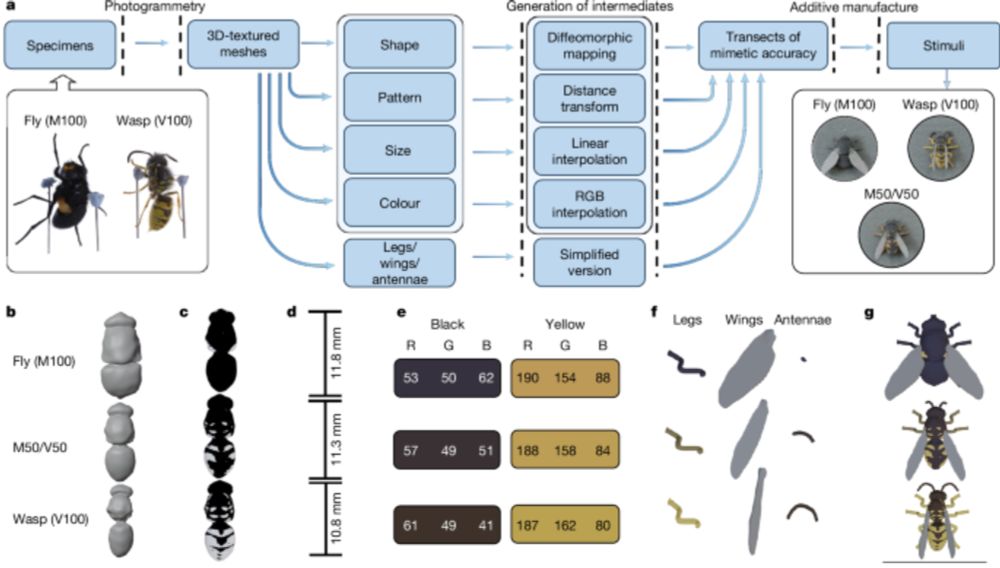
Why do imperfect mimics (such as many hoverflies) exist? We created 3D printed replicas of flies, wasps and our own custom intermediates and then "asked" various predators what they thought of our 3D stimuli. Read all about it here: www.nature.com/articles/s41...
Mapping the adaptive landscape of Batesian mimicry using 3D-printed stimuli - Nature
Birds have an excellent ability to learn to discriminate harmless insects from those that they mimic on the basis of subtle differences in appearance.
www.nature.com
July 2, 2025 at 6:32 PM
Why do imperfect mimics (such as many hoverflies) exist? We created 3D printed replicas of flies, wasps and our own custom intermediates and then "asked" various predators what they thought of our 3D stimuli. Read all about it here: www.nature.com/articles/s41...
Reposted by Ioan Smart
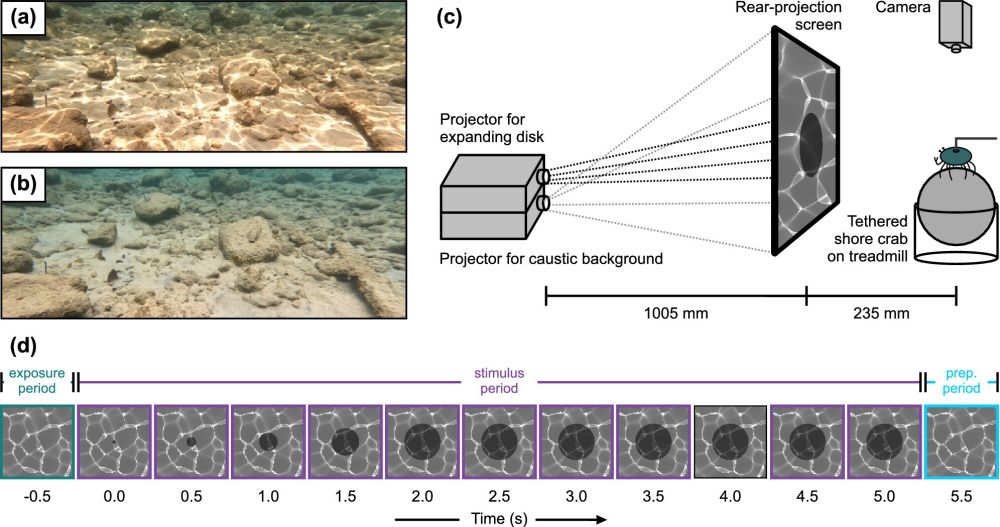
🚨Our new paper is out NOW in @ecol-evol.bsky.social 👀 Here we show that prior exposure to dynamic illumination can have a persisting effect on the visual perception of 🦀, reducing their ability to detect predators even after the dynamic illumination has ended.
onlinelibrary.wiley.com/doi/10.1002/...
onlinelibrary.wiley.com/doi/10.1002/...
Motion After‐Effects Induced by Dynamic Illumination in Crab Vision
While in humans, background motion can disrupt the detection of visual cues even after the moving background component has ceased, it remains unknown whether natural forms of background motion might ...
onlinelibrary.wiley.com
May 12, 2025 at 9:59 AM
🚨Our new paper is out NOW in @ecol-evol.bsky.social 👀 Here we show that prior exposure to dynamic illumination can have a persisting effect on the visual perception of 🦀, reducing their ability to detect predators even after the dynamic illumination has ended.
onlinelibrary.wiley.com/doi/10.1002/...
onlinelibrary.wiley.com/doi/10.1002/...
Reposted by Ioan Smart

The flexibility of social learning and its conservation implications in mammals & beyond.
New paper, led by Josh Arbon with fab collaborators Neil Jordan & @neeltjeboogert.bsky.social.
doi.org/10.1098/rstb.2024.0136
@uniexecec.bsky.social @bristolbiosci.bsky.social @royalsocietypublishing.org
New paper, led by Josh Arbon with fab collaborators Neil Jordan & @neeltjeboogert.bsky.social.
doi.org/10.1098/rstb.2024.0136
@uniexecec.bsky.social @bristolbiosci.bsky.social @royalsocietypublishing.org
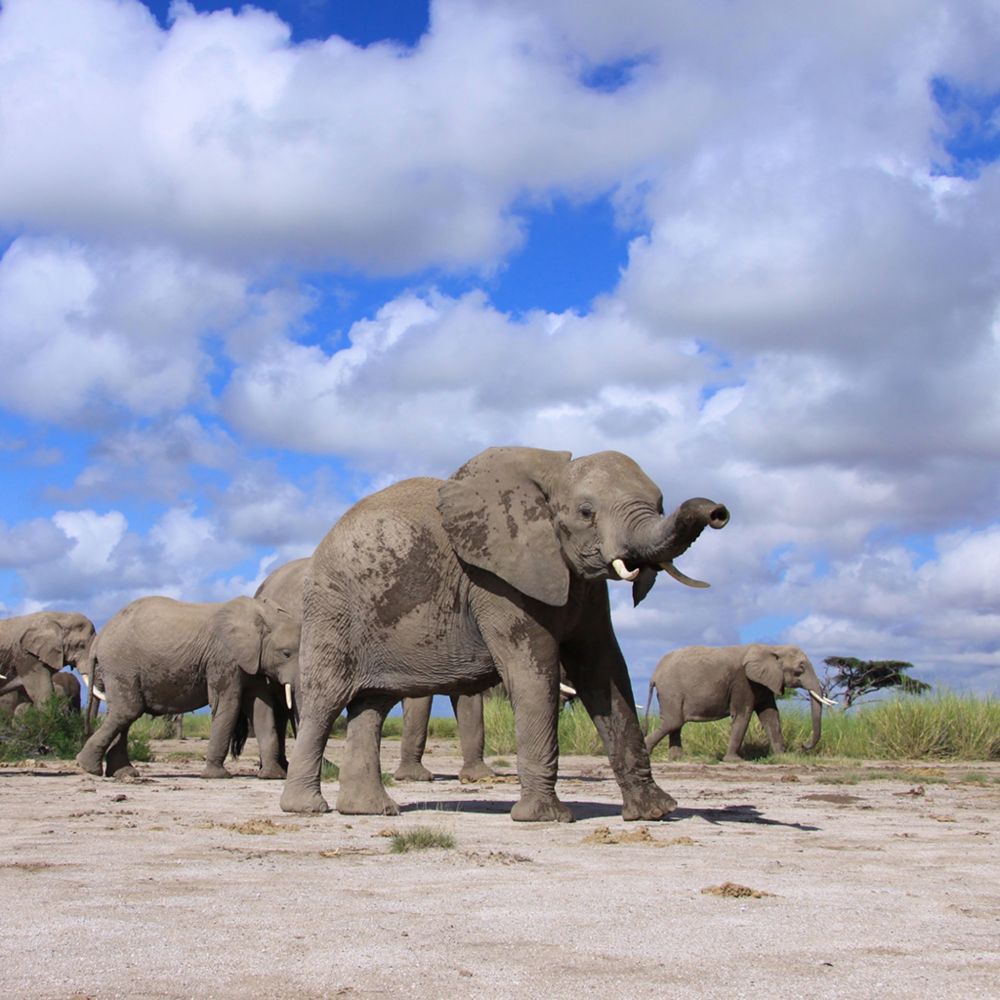
The flexibility of social learning and its conservation implications in mammals and beyond | Philosophical Transactions of the Royal Society B: Biological Sciences
Conservation strategies seek to ensure that populations persist and are resilient to environmental change. As learning from others can shape the development of skills that help animals survive, reproduce and respond to changing conditions, understanding ...
doi.org
May 2, 2025 at 7:41 AM
The flexibility of social learning and its conservation implications in mammals & beyond.
New paper, led by Josh Arbon with fab collaborators Neil Jordan & @neeltjeboogert.bsky.social.
doi.org/10.1098/rstb.2024.0136
@uniexecec.bsky.social @bristolbiosci.bsky.social @royalsocietypublishing.org
New paper, led by Josh Arbon with fab collaborators Neil Jordan & @neeltjeboogert.bsky.social.
doi.org/10.1098/rstb.2024.0136
@uniexecec.bsky.social @bristolbiosci.bsky.social @royalsocietypublishing.org
Fantastic time at #ASABSpring2025! Some great talks, posters and fascinating discussions. Thanks @asab.org Looking forward to the Winter conference already!
April 26, 2025 at 4:06 PM
Fantastic time at #ASABSpring2025! Some great talks, posters and fascinating discussions. Thanks @asab.org Looking forward to the Winter conference already!