



Herb Susmann
@herbps10.bsky.social
Post-doc at NYU Grossman School of Medicine (this account is solely in my personal capacity, all views are my own etc). Non-parametric statistics, causal inference, Bayesian methods. Herbsusmann.com
Check out my talk at the Online Causal Inference Seminar last week on a practical way to deal with positivity violations using bounds 👇 #causalsky

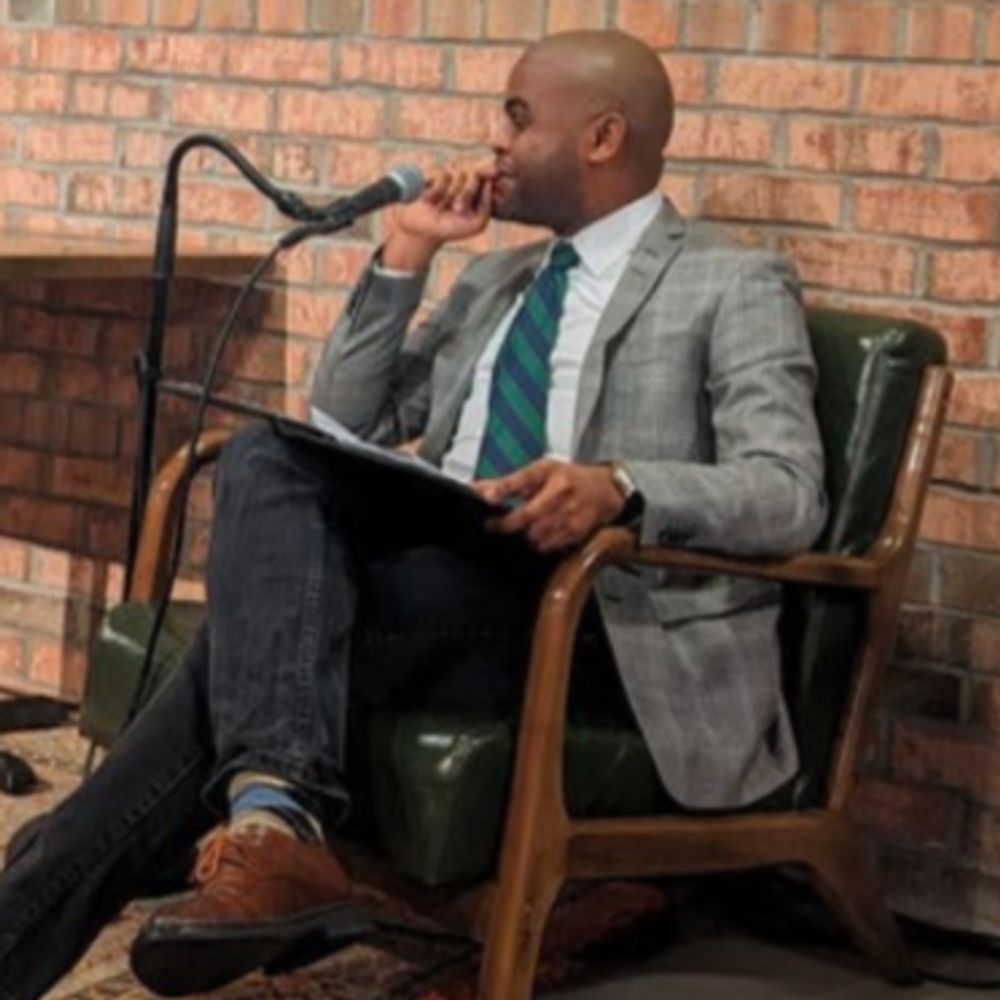
Young Researchers' Seminar: Herb Susmann and Juraj Bodík
YouTube video by Online Causal Inference Seminar
www.youtube.com
February 11, 2026 at 12:37 AM
Check out my talk at the Online Causal Inference Seminar last week on a practical way to deal with positivity violations using bounds 👇 #causalsky
New joint work published with @adrianraftery.bsky.social on methods for Bayesian probabilistic projections of migration

In “Bayesian Projection of Extant Refugee & Asylum Seeker Populations,” @herbps10.bsky.social & @adrianraftery.bsky.social propose a time-series model for projecting refugee & asylum seeker population statistics by country of origin. @nyumedpostdocs.bsky.social read.dukeupress.edu/demography/a...


December 5, 2025 at 10:35 PM
New joint work published with @adrianraftery.bsky.social on methods for Bayesian probabilistic projections of migration
They also have a very neat way of deriving the efficient influence function for their infinite-dimensional parameter of interest based on Luedtke's autodiff work

October 22, 2025 at 2:47 PM
They also have a very neat way of deriving the efficient influence function for their infinite-dimensional parameter of interest based on Luedtke's autodiff work
The "basic" notions of semiparametric theory, from today's arxiv.org/abs/2510.18843 from Morzywolek, Gilbert, & Luedtke

October 22, 2025 at 2:47 PM
The "basic" notions of semiparametric theory, from today's arxiv.org/abs/2510.18843 from Morzywolek, Gilbert, & Luedtke
great great plenty of time to procrastinate on this

October 17, 2025 at 12:53 AM
great great plenty of time to procrastinate on this
Ideally letters wouldn't be required at all, but I'd settle for them only being required at a much later stage of the process after the first stage of review

The wild jumble of (i) prompts from institutions (with links ranging from simple to impenetrable), (ii) centralized services like Interfolio, (iii) emails for direct sending of letters, and (iv) forms that require you to type your letter in a box, is seriously crazy-making.
Can't we fix this??
Can't we fix this??
October 16, 2025 at 3:06 PM
Ideally letters wouldn't be required at all, but I'd settle for them only being required at a much later stage of the process after the first stage of review
trying to find a way to compare against previous years, unfortunately the archive.org snapshots of the job board are spotty
October 11, 2025 at 9:12 PM
trying to find a way to compare against previous years, unfortunately the archive.org snapshots of the job board are spotty
State of the stats job market:
here's the cumulative number of stats tenure-track jobs posted on the UF Statistics Job Board so far, since August
#statsky
here's the cumulative number of stats tenure-track jobs posted on the UF Statistics Job Board so far, since August
#statsky

October 11, 2025 at 9:12 PM
State of the stats job market:
here's the cumulative number of stats tenure-track jobs posted on the UF Statistics Job Board so far, since August
#statsky
here's the cumulative number of stats tenure-track jobs posted on the UF Statistics Job Board so far, since August
#statsky
Reposted by Herb Susmann

I love living in a city full of immigrants and tons and tons of people who are not at all like me and not like each other. It makes us all better and it makes our city better. I know I’m preaching to the choir by saying this on the lib app but I sometimes just get so overwhelmed by how special it is
October 8, 2025 at 12:35 AM
I love living in a city full of immigrants and tons and tons of people who are not at all like me and not like each other. It makes us all better and it makes our city better. I know I’m preaching to the choir by saying this on the lib app but I sometimes just get so overwhelmed by how special it is
my interest in putting bounds on things now
September 25, 2025 at 5:23 PM
my interest in putting bounds on things now
some of the tricks we found useful -- the last bullet especially, I learned a lot from working closely with @alecmcclean.bsky.social on this

September 25, 2025 at 5:23 PM
some of the tricks we found useful -- the last bullet especially, I learned a lot from working closely with @alecmcclean.bsky.social on this
what's neat about our approach is that you can vary the propensity score threshold that defines the overlap and non-overlap population, and then choose the threshold that yields the smallest bounds -- with frequentist guarantees

September 25, 2025 at 5:23 PM
what's neat about our approach is that you can vary the propensity score threshold that defines the overlap and non-overlap population, and then choose the threshold that yields the smallest bounds -- with frequentist guarantees
The idea is very simple: we divide the population into a part in which overlap is satisfied, and a part in which overlap is violated. The non-overlap part is the one that poses problems, so we just apply worst-case bounds on the ATE in that subpopulation.

September 25, 2025 at 5:23 PM
The idea is very simple: we divide the population into a part in which overlap is satisfied, and a part in which overlap is violated. The non-overlap part is the one that poses problems, so we just apply worst-case bounds on the ATE in that subpopulation.
New preprint out on a way to handle structural and practical violations of the overlap (also known as positivity) assumption in causal inference -- as long as the outcome is bounded, we derive simple partial identification bounds on the ATE. With @alecmcclean.bsky.social and @idiaz.bsky.social

September 25, 2025 at 5:23 PM
New preprint out on a way to handle structural and practical violations of the overlap (also known as positivity) assumption in causal inference -- as long as the outcome is bounded, we derive simple partial identification bounds on the ATE. With @alecmcclean.bsky.social and @idiaz.bsky.social
a related tip i've heard for talks is to use author + year + journal abbreviation for references on the slides (e.g. Robins 1995 JASA), makes it easier for people to find what you're talking about
September 5, 2025 at 12:39 AM
a related tip i've heard for talks is to use author + year + journal abbreviation for references on the slides (e.g. Robins 1995 JASA), makes it easier for people to find what you're talking about
The paper includes a friendly (I hope) introduction to causal inference and TMLE, and has sample R code you can use to run this type of analysis
September 3, 2025 at 3:07 PM
The paper includes a friendly (I hope) introduction to causal inference and TMLE, and has sample R code you can use to run this type of analysis
The insight is that while you can't point identify a treatment effect when the outcome is left-censored, it's possible to derive bounds on the true average treatment effect. It turns out you can estimate these bounds using standard causal inference methods like TMLE

September 3, 2025 at 3:07 PM
The insight is that while you can't point identify a treatment effect when the outcome is left-censored, it's possible to derive bounds on the true average treatment effect. It turns out you can estimate these bounds using standard causal inference methods like TMLE
I have a new paper out on a simple way to do causal inference with left-censored outcomes. This comes up with environmental data because measurements often have a lower limit of detection -- e.g. a chemical is undetectable below a certain level
www.tandfonline.com/doi/full/10....
www.tandfonline.com/doi/full/10....

Non-parametric treatment effect bounds for left-censored outcomes: estimating the effect of herbicide use on 2,4-D exposure
Causal inference is concerned with defining and estimating the effect of a exposure on an outcome. For example, the Average Treatment Effect (ATE), a causal inference concept, is defined as the pop...
www.tandfonline.com
September 3, 2025 at 3:07 PM
I have a new paper out on a simple way to do causal inference with left-censored outcomes. This comes up with environmental data because measurements often have a lower limit of detection -- e.g. a chemical is undetectable below a certain level
www.tandfonline.com/doi/full/10....
www.tandfonline.com/doi/full/10....
the setup in this template uses slurm job arrays to spin up a bunch of workers, each of which then simulates some data, runs your estimators, saves the results in a cache directory, and then helps you collect all the results and generate tables/figures
August 26, 2025 at 10:09 PM
the setup in this template uses slurm job arrays to spin up a bunch of workers, each of which then simulates some data, runs your estimators, saves the results in a cache directory, and then helps you collect all the results and generate tables/figures
if you are also in the niche position of needing to run a lot of simulation studies in R on slurm clusters, I have just the thing for you: github.com/herbps10/sim...
August 26, 2025 at 10:09 PM
if you are also in the niche position of needing to run a lot of simulation studies in R on slurm clusters, I have just the thing for you: github.com/herbps10/sim...
about that: www.sciencedirect.com/science/arti...

Is the “well-defined intervention assumption” politically conservative?
www.sciencedirect.com
June 20, 2025 at 1:32 PM
about that: www.sciencedirect.com/science/arti...
Reposted by Herb Susmann

Protect transgender scientist! 🏳️⚧️

Protect transgender scientists
Transgender and gender nonconforming (TGnC) people are a primary target of the Trump administration. Multiple executive orders seek to erase TGnC protections; mandate denial of gender identity; and ba...
www.science.org
June 19, 2025 at 6:28 PM
Protect transgender scientist! 🏳️⚧️
Just published: Antoine Chambaz and I did the formal work to prove you can use Super Learner (also known as model stacking) for estimating quantiles, both in i.i.d. and streaming data settings
www.sciencedirect.com/science/arti...
www.sciencedirect.com/science/arti...

Quantile Super Learning for independent and online settings with application to solar power forecasting
Estimating quantiles of an outcome conditional on covariates is of fundamental interest in statistics with broad application in probabilistic predicti…
www.sciencedirect.com
May 13, 2025 at 6:20 PM
Just published: Antoine Chambaz and I did the formal work to prove you can use Super Learner (also known as model stacking) for estimating quantiles, both in i.i.d. and streaming data settings
www.sciencedirect.com/science/arti...
www.sciencedirect.com/science/arti...

Reposted by Herb Susmann
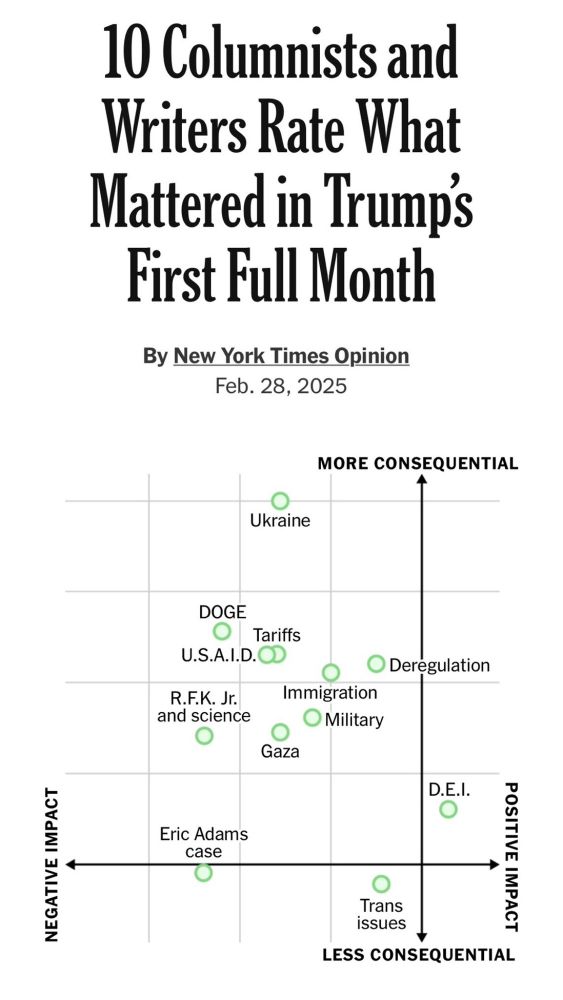
The placement of "trans issues" here is, without exaggeration, one of the most depraved things I've ever seen in the pages of this publication.
Of course the NYT sees the "DEI" stuff positively & is neutral on anti-trans discrimination
March 1, 2025 at 3:59 PM
The placement of "trans issues" here is, without exaggeration, one of the most depraved things I've ever seen in the pages of this publication.