


Ute Hellmich
@hellmichgroup.bsky.social
Biochemistry/Structural Bio at Uni Jena and Cluster of Excellence 'Balance of the Microverse'
(Membrane) protein dynamics admirer, parasite aficionado and coffee addict.
Action against #NTDs!
www.hellmich-group.de
(Membrane) protein dynamics admirer, parasite aficionado and coffee addict.
Action against #NTDs!
www.hellmich-group.de
Reposted by Ute Hellmich

UV radiation was discovered in Jena 225 years ago. To honour Johann Wilhelm Ritter's experiment, our University is holding an interdisciplinary symposium from 21 to 22 Feb with a focus on this historic leap in knowledge and its relevance to contemporary research. ➡️ www.uni-jena.de/en/387508/jen…

February 6, 2026 at 2:01 PM
UV radiation was discovered in Jena 225 years ago. To honour Johann Wilhelm Ritter's experiment, our University is holding an interdisciplinary symposium from 21 to 22 Feb with a focus on this historic leap in knowledge and its relevance to contemporary research. ➡️ www.uni-jena.de/en/387508/jen…
When it's the student's birthday AND the experiment they worked at so tirelessly finally worked out!!!
🥳🥳🥳 🍾🎁
🥳🥳🥳 🍾🎁
February 3, 2026 at 7:39 PM
When it's the student's birthday AND the experiment they worked at so tirelessly finally worked out!!!
🥳🥳🥳 🍾🎁
🥳🥳🥳 🍾🎁
🧪Bacterial DL-peptidases are key in coordindated predetor defenses AND powerful tools for natural product structure elucidation! 🦠✂️
New JACS paper with @pstallforth.bsky.social
@mlakemeyer.bsky.social @en-hxnu-enment.bsky.social & Hertweck labs
@microverse.bsky.social
pubs.acs.org/doi/10.1021/...
New JACS paper with @pstallforth.bsky.social
@mlakemeyer.bsky.social @en-hxnu-enment.bsky.social & Hertweck labs
@microverse.bsky.social
pubs.acs.org/doi/10.1021/...

Microbial dl-Peptidases Enable Predator Defense and Facilitate Structure Elucidation of Complex Natural Products
Peptidases are indispensable tools in biotechnology and chemical biology. However, the enzyme repertoire for the selective hydrolysis of dl-amide bonds in peptides is small. Here, we describe novel dl...
pubs.acs.org
January 31, 2026 at 10:28 AM
🧪Bacterial DL-peptidases are key in coordindated predetor defenses AND powerful tools for natural product structure elucidation! 🦠✂️
New JACS paper with @pstallforth.bsky.social
@mlakemeyer.bsky.social @en-hxnu-enment.bsky.social & Hertweck labs
@microverse.bsky.social
pubs.acs.org/doi/10.1021/...
New JACS paper with @pstallforth.bsky.social
@mlakemeyer.bsky.social @en-hxnu-enment.bsky.social & Hertweck labs
@microverse.bsky.social
pubs.acs.org/doi/10.1021/...
Reposted by Ute Hellmich
Thank you for the great talk @hellmichgroup.bsky.social 👏
Her lecture “Regulation through disorder” @mpip-mainz.mpg.de showed how IDPs are central to TRP channel regulation: example of how structural “disorder” is key to biological function. Wonderful to see Ute pushing this field forward in Jena.
Her lecture “Regulation through disorder” @mpip-mainz.mpg.de showed how IDPs are central to TRP channel regulation: example of how structural “disorder” is key to biological function. Wonderful to see Ute pushing this field forward in Jena.

January 29, 2026 at 8:26 AM
Thank you for the great talk @hellmichgroup.bsky.social 👏
Her lecture “Regulation through disorder” @mpip-mainz.mpg.de showed how IDPs are central to TRP channel regulation: example of how structural “disorder” is key to biological function. Wonderful to see Ute pushing this field forward in Jena.
Her lecture “Regulation through disorder” @mpip-mainz.mpg.de showed how IDPs are central to TRP channel regulation: example of how structural “disorder” is key to biological function. Wonderful to see Ute pushing this field forward in Jena.
Reposted by Ute Hellmich

TV feature alert! 📺 Great to see our PIs @hellmichgroup.bsky.social & Michael Bauer on MDR. They explain why understanding microbial balance is crucial for our future. 🦠
Catch the full clip here: www.mdr.de/video/mdr-vi...
🤝 @lifeprofile.bsky.social & @uni-jena.de
Catch the full clip here: www.mdr.de/video/mdr-vi...
🤝 @lifeprofile.bsky.social & @uni-jena.de

Forschung zu resistenten Keimen macht Fortschritte | MDR.DE
Seit 100 Jahren können Bakterien mit Antibiotika gut behandelt werden. Doch inzwischen sind auch multiresistente Keime im Umlauf, die immun gegen die Medikamente sind. An der Uni Jena forscht man an e...
www.mdr.de
January 26, 2026 at 1:40 PM
TV feature alert! 📺 Great to see our PIs @hellmichgroup.bsky.social & Michael Bauer on MDR. They explain why understanding microbial balance is crucial for our future. 🦠
Catch the full clip here: www.mdr.de/video/mdr-vi...
🤝 @lifeprofile.bsky.social & @uni-jena.de
Catch the full clip here: www.mdr.de/video/mdr-vi...
🤝 @lifeprofile.bsky.social & @uni-jena.de
Spying on ABC multidrug transporters in action, gently nudged by our Victor! 😍
ZDF Mittagsmagazin visited us & co-LIFE speaker Michael Bauer to discuss antibiotic resistance: mechanisms, why basic research matters, & clinical challenges
@microverse.bsky.social @uni-jena.de @lifeprofile.bsky.social
ZDF Mittagsmagazin visited us & co-LIFE speaker Michael Bauer to discuss antibiotic resistance: mechanisms, why basic research matters, & clinical challenges
@microverse.bsky.social @uni-jena.de @lifeprofile.bsky.social


January 22, 2026 at 12:56 PM
Spying on ABC multidrug transporters in action, gently nudged by our Victor! 😍
ZDF Mittagsmagazin visited us & co-LIFE speaker Michael Bauer to discuss antibiotic resistance: mechanisms, why basic research matters, & clinical challenges
@microverse.bsky.social @uni-jena.de @lifeprofile.bsky.social
ZDF Mittagsmagazin visited us & co-LIFE speaker Michael Bauer to discuss antibiotic resistance: mechanisms, why basic research matters, & clinical challenges
@microverse.bsky.social @uni-jena.de @lifeprofile.bsky.social
🧪If you love lipids,cell biology & chemical bioloy and wonder about the fundamental mechanisms of life, you'll be in for a treat! 🤩🥳
Don't miss the next @gbmev.bsky.social Lunch Seminar by @nadlerlab.bsky.social & Kristin Böhlig!
#ChemBio #LipidLove
Preregister for free
@gfg-chembio.bsky.social
Don't miss the next @gbmev.bsky.social Lunch Seminar by @nadlerlab.bsky.social & Kristin Böhlig!
#ChemBio #LipidLove
Preregister for free
@gfg-chembio.bsky.social
Join us for the GBM Lunch on January 28 at 12:30 PM (CET)!
André Nadler & Kristin Böhlig @nadlerlab.bsky.social (@mpi-cbg.de) will speak on “Quantifying Intracellular Lipid Transport.”
Chair: Oliver Thorn-Seshold (TU Dresden)
Organizer: Joint Study Group "Chemical Biology"
#GBMLunch #ChemicalBiology
André Nadler & Kristin Böhlig @nadlerlab.bsky.social (@mpi-cbg.de) will speak on “Quantifying Intracellular Lipid Transport.”
Chair: Oliver Thorn-Seshold (TU Dresden)
Organizer: Joint Study Group "Chemical Biology"
#GBMLunch #ChemicalBiology

January 22, 2026 at 5:19 AM
🧪If you love lipids,cell biology & chemical bioloy and wonder about the fundamental mechanisms of life, you'll be in for a treat! 🤩🥳
Don't miss the next @gbmev.bsky.social Lunch Seminar by @nadlerlab.bsky.social & Kristin Böhlig!
#ChemBio #LipidLove
Preregister for free
@gfg-chembio.bsky.social
Don't miss the next @gbmev.bsky.social Lunch Seminar by @nadlerlab.bsky.social & Kristin Böhlig!
#ChemBio #LipidLove
Preregister for free
@gfg-chembio.bsky.social
Reposted by Ute Hellmich
Forschende der Uni Jena haben einen Mechanismus entdeckt, wie Bakterien sich gegen Antibiotika wehren. Diese Entdeckung soll im Kampf gegen Resistenzen helfen.
💊💊💊
Es gibt zu viele negative News, deswegen poste ich jeden Tag eine #guteNewsdesTages.
💊💊💊
Es gibt zu viele negative News, deswegen poste ich jeden Tag eine #guteNewsdesTages.
January 17, 2026 at 6:18 PM
Forschende der Uni Jena haben einen Mechanismus entdeckt, wie Bakterien sich gegen Antibiotika wehren. Diese Entdeckung soll im Kampf gegen Resistenzen helfen.
💊💊💊
Es gibt zu viele negative News, deswegen poste ich jeden Tag eine #guteNewsdesTages.
💊💊💊
Es gibt zu viele negative News, deswegen poste ich jeden Tag eine #guteNewsdesTages.
Reposted by Ute Hellmich

Have you registered yet? Early bird registration and abstract submission are open until January 31.
mosbacher-kolloquium.org
mosbacher-kolloquium.org

January 5, 2026 at 3:14 PM
Have you registered yet? Early bird registration and abstract submission are open until January 31.
mosbacher-kolloquium.org
mosbacher-kolloquium.org
Reposted by Ute Hellmich
Researchers of @hellmichgroup.bsky.social at #UniJena Cluster of Excellence @microverse.bsky.social have deciphered a key mechanism of antibiotic resistance. They showed how the bacterium applies the energy required to transport the drug out of its cell.
➡️ www.uni-jena.de/en/381040/sp...
➡️ www.uni-jena.de/en/381040/sp...

Specific activation instead of continuous operation: How bacteria save energy and what this means for antibiotic resistances
Researchers in the Cluster of Excellence “Balance of the Microverse” at the University of Jena decipher a key mechanism of antibiotic resistance pumps
www.uni-jena.de
January 9, 2026 at 11:24 AM
Researchers of @hellmichgroup.bsky.social at #UniJena Cluster of Excellence @microverse.bsky.social have deciphered a key mechanism of antibiotic resistance. They showed how the bacterium applies the energy required to transport the drug out of its cell.
➡️ www.uni-jena.de/en/381040/sp...
➡️ www.uni-jena.de/en/381040/sp...
Consider joining us and many others at the German Peptide Symposium in Essen! Exciting talks in synthetic biology, natural products, antimicrobials, method development, chemical biology... 🧪🥽
POV: you don't need an entire protein to be happy 😜
www.uni-due.de/17gps/
POV: you don't need an entire protein to be happy 😜
www.uni-due.de/17gps/
17th German Peptide Symposium
17th German Peptide Symposium, University of Duisburg-Essen, 04.-06.03.2026, Group Professor Markus Kaiser
www.uni-due.de
January 5, 2026 at 4:22 PM
Consider joining us and many others at the German Peptide Symposium in Essen! Exciting talks in synthetic biology, natural products, antimicrobials, method development, chemical biology... 🧪🥽
POV: you don't need an entire protein to be happy 😜
www.uni-due.de/17gps/
POV: you don't need an entire protein to be happy 😜
www.uni-due.de/17gps/
🧪HAPPY 2026 EVERYONE!!!! 🥂🍾🥳
When you enjoy your bubbly this evening, do spare a thought about carbonic anhydrase - it's an amazing enzyme (almost as fast as 2025 felt! 😜), and it turns out, it's also responsible for tasting CO2's "fizziness"!!! 🍾
www.science.org/doi/10.1126/...
When you enjoy your bubbly this evening, do spare a thought about carbonic anhydrase - it's an amazing enzyme (almost as fast as 2025 felt! 😜), and it turns out, it's also responsible for tasting CO2's "fizziness"!!! 🍾
www.science.org/doi/10.1126/...

The Taste of Carbonation
The enzyme carbonic anhydrase mediates the taste sensation of carbonated drinks.
www.science.org
December 31, 2025 at 12:56 PM
🧪HAPPY 2026 EVERYONE!!!! 🥂🍾🥳
When you enjoy your bubbly this evening, do spare a thought about carbonic anhydrase - it's an amazing enzyme (almost as fast as 2025 felt! 😜), and it turns out, it's also responsible for tasting CO2's "fizziness"!!! 🍾
www.science.org/doi/10.1126/...
When you enjoy your bubbly this evening, do spare a thought about carbonic anhydrase - it's an amazing enzyme (almost as fast as 2025 felt! 😜), and it turns out, it's also responsible for tasting CO2's "fizziness"!!! 🍾
www.science.org/doi/10.1126/...
Lego mission 2025 successfully completed!!! 🦖🥳

December 26, 2025 at 6:15 PM
Lego mission 2025 successfully completed!!! 🦖🥳
Reposted by Ute Hellmich
📽️ 3 Questions for Pierre Stallforth
A cluster perspective on chemistry, microbiomes, and the distant past. From microbial interactions to natural products reconstructed from ancient DNA, including Neanderthal dental calculus.
▶️ Watch the clip: www.youtube.com/watch?v=-Ei0...
A cluster perspective on chemistry, microbiomes, and the distant past. From microbial interactions to natural products reconstructed from ancient DNA, including Neanderthal dental calculus.
▶️ Watch the clip: www.youtube.com/watch?v=-Ei0...

THREE QUESTIONS FOR: Pierre Stallforth
YouTube video by Universität Jena
www.youtube.com
December 19, 2025 at 8:38 AM
📽️ 3 Questions for Pierre Stallforth
A cluster perspective on chemistry, microbiomes, and the distant past. From microbial interactions to natural products reconstructed from ancient DNA, including Neanderthal dental calculus.
▶️ Watch the clip: www.youtube.com/watch?v=-Ei0...
A cluster perspective on chemistry, microbiomes, and the distant past. From microbial interactions to natural products reconstructed from ancient DNA, including Neanderthal dental calculus.
▶️ Watch the clip: www.youtube.com/watch?v=-Ei0...
Wonderful @microverse.bsky.social collaboration led by Stallforth lab on the diversity of AMPs in ancient and modern dental biofilms from humans, Neanderthals, and nonhuman primates spanning 100,000 years 🧪🥳
We'll call it a paper wrap for 2025... maybe 😉
pubs.acs.org/doi/10.1021/...
We'll call it a paper wrap for 2025... maybe 😉
pubs.acs.org/doi/10.1021/...

Actifensin Evolution in the Human Oral Cavity over the Past 100,000 Years
Bacterially produced antimicrobial peptides (AMPs), or bacteriocins, play key roles in shaping microbial communities via interspecies competition. Unlike the more temporally dynamic gut microbiome, the oral microbiome exhibits long-term stability and is preserved into deep time in dental calculus, enabling evolutionary analysis across time. Here, we combine metagenomics, structural modeling, and experimental validation to investigate AMP diversity in ancient and modern dental biofilms from humans, Neanderthals, and nonhuman primates spanning 100,000 years. Using our newly developed platform, AMPcombi, we uncover evolutionary trajectories of bacteriocins and elucidate their ecological functions. Among these, we identify a conserved family of Actinomyces-derived defensin-like peptides, termed actifensins, present across all time periods. Phylogenetic, structural, and functional analyses revealed shared ancestry and adaptive diversification between ancient (paleo-) and modern actifensins, with evidence of positive selection and maintained antimicrobial activity. Our findings position the oral microbiome as a valuable reservoir for natural product discovery. In the face of rising antimicrobial resistance, evolutionary insights into AMP function open a door to next-generation therapeutics. AMPcombi streamlines this process, linking ancient biomolecules with biotechnology.
pubs.acs.org
December 18, 2025 at 10:25 AM
Wonderful @microverse.bsky.social collaboration led by Stallforth lab on the diversity of AMPs in ancient and modern dental biofilms from humans, Neanderthals, and nonhuman primates spanning 100,000 years 🧪🥳
We'll call it a paper wrap for 2025... maybe 😉
pubs.acs.org/doi/10.1021/...
We'll call it a paper wrap for 2025... maybe 😉
pubs.acs.org/doi/10.1021/...
🧪 TRPV4 likes to play and its ARD is where other proteins hang out to party!!!! 🥳🥰
We found old & new friends in this systematic study on the V4-ARD interactome and its disruption by disease mutants
led by Sullivan/Sumner labs. So happy we could contribute!
www.jbc.org/article/S002...
We found old & new friends in this systematic study on the V4-ARD interactome and its disruption by disease mutants
led by Sullivan/Sumner labs. So happy we could contribute!
www.jbc.org/article/S002...

PROFILING THE TRPV4 ANKYRIN REPEAT DOMAIN INTERACTOME AND ITS DISRUPTION BY NEUROMUSCULAR DISEASE-CAUSING MUTATIONS
The ankyrin repeat is one of the most abundant protein-protein interaction motifs
in eukaryotes yet occurs in only a small number of ion channels. These channels are
all members of the transient recep...
www.jbc.org
December 2, 2025 at 1:55 PM
🧪 TRPV4 likes to play and its ARD is where other proteins hang out to party!!!! 🥳🥰
We found old & new friends in this systematic study on the V4-ARD interactome and its disruption by disease mutants
led by Sullivan/Sumner labs. So happy we could contribute!
www.jbc.org/article/S002...
We found old & new friends in this systematic study on the V4-ARD interactome and its disruption by disease mutants
led by Sullivan/Sumner labs. So happy we could contribute!
www.jbc.org/article/S002...
Super nice to wake up to the news that our paper on bidirectional communication in an ABC transporter has been selected as a Nature Communications Editors’ Highlight in “Structural biology, biochemistry and biophysics"! 🥳 🥳 🥳
www.nature.com/articles/s41...
@microverse.bsky.social
www.nature.com/articles/s41...
@microverse.bsky.social

Bidirectional communication between nucleotide and substrate binding sites in a type IV multidrug ABC transporter - Nature Communications
The communication hinge, found in type IV ABC transporters, forms a bidirectional communication between ATP- and substrate-binding sites. This is an unexplored allosteric pathway critical for function...
www.nature.com
November 28, 2025 at 7:15 AM
Super nice to wake up to the news that our paper on bidirectional communication in an ABC transporter has been selected as a Nature Communications Editors’ Highlight in “Structural biology, biochemistry and biophysics"! 🥳 🥳 🥳
www.nature.com/articles/s41...
@microverse.bsky.social
www.nature.com/articles/s41...
@microverse.bsky.social
🧪How does an ABC transporter 'know' nucleotides & substrates bound to far apart binding sites? Using 1H15N, 19F NMR, HDX-MS, PET-FCS & activity assays with Neuweiler, Marcoux, Orelle & Jault labs, we found a communication hinge! 😍🥳
@microverse.bsky.social @lifeprofile.bsky.social
rdcu.be/ePm4C
@microverse.bsky.social @lifeprofile.bsky.social
rdcu.be/ePm4C
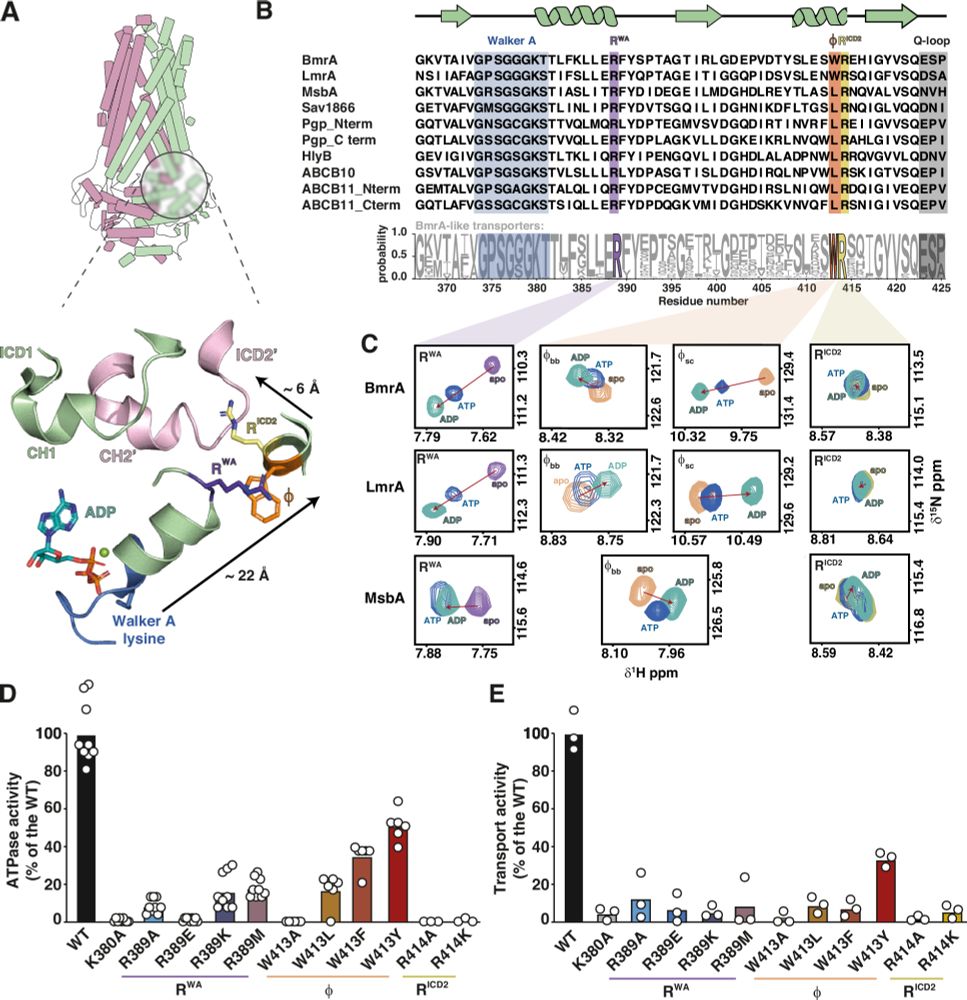
Bidirectional communication between nucleotide and substrate binding sites in a type IV multidrug ABC transporter
Nature Communications - The communication hinge, found in type IV ABC transporters, forms a bidirectional communication between ATP- and substrate-binding sites. This is an unexplored allosteric...
rdcu.be
November 12, 2025 at 11:15 AM
🧪How does an ABC transporter 'know' nucleotides & substrates bound to far apart binding sites? Using 1H15N, 19F NMR, HDX-MS, PET-FCS & activity assays with Neuweiler, Marcoux, Orelle & Jault labs, we found a communication hinge! 😍🥳
@microverse.bsky.social @lifeprofile.bsky.social
rdcu.be/ePm4C
@microverse.bsky.social @lifeprofile.bsky.social
rdcu.be/ePm4C
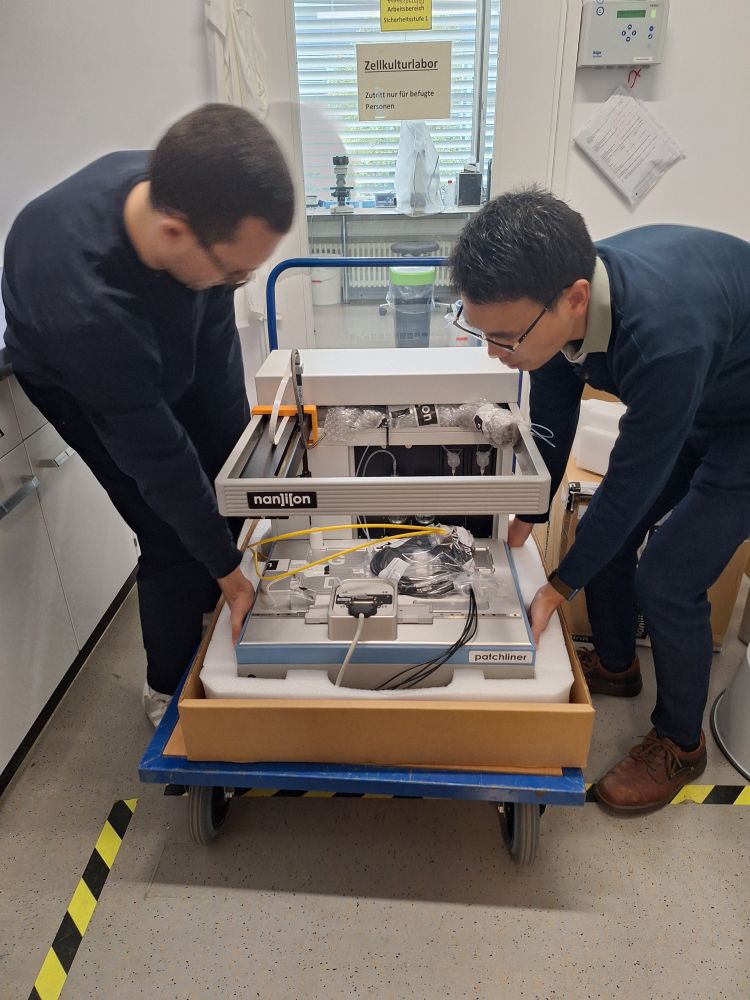
Our newest lab member has arrived! 😍🥳
Meet James, starring in our new production From Jena with Love. 🎬
#YouOnlyPatchTwice
#TRPChannelsRule
@naniontech.bsky.social
Meet James, starring in our new production From Jena with Love. 🎬
#YouOnlyPatchTwice
#TRPChannelsRule
@naniontech.bsky.social


November 4, 2025 at 1:59 PM
Our newest lab member has arrived! 😍🥳
Meet James, starring in our new production From Jena with Love. 🎬
#YouOnlyPatchTwice
#TRPChannelsRule
@naniontech.bsky.social
Meet James, starring in our new production From Jena with Love. 🎬
#YouOnlyPatchTwice
#TRPChannelsRule
@naniontech.bsky.social
We proudly present:
the 2025 Halloween Lab Pumpkin Carving Edition!!! 😁🥳👻
the 2025 Halloween Lab Pumpkin Carving Edition!!! 😁🥳👻

October 29, 2025 at 11:13 PM
We proudly present:
the 2025 Halloween Lab Pumpkin Carving Edition!!! 😁🥳👻
the 2025 Halloween Lab Pumpkin Carving Edition!!! 😁🥳👻
Confirming both sample integrity and quantifying homodimer interactions? Not so easy - unless you have native MS! ⚖️
Check out our new preprint with Morgner lab using homomeric models and chemically induced dimers of an essential T. brucei enzyme!🧪🥳
@crc1507.bsky.social
arxiv.org/abs/2510.08324
Check out our new preprint with Morgner lab using homomeric models and chemically induced dimers of an essential T. brucei enzyme!🧪🥳
@crc1507.bsky.social
arxiv.org/abs/2510.08324

Quantification of protein homodimer affinity using native mass spectrometry
Biological processes rely on finely tuned homo- and heteromeric interactions between (biomacro)molecules. The strength of an interaction, typically given by the dissociation constant (KD), plays a cru...
arxiv.org
October 10, 2025 at 6:20 PM
Confirming both sample integrity and quantifying homodimer interactions? Not so easy - unless you have native MS! ⚖️
Check out our new preprint with Morgner lab using homomeric models and chemically induced dimers of an essential T. brucei enzyme!🧪🥳
@crc1507.bsky.social
arxiv.org/abs/2510.08324
Check out our new preprint with Morgner lab using homomeric models and chemically induced dimers of an essential T. brucei enzyme!🧪🥳
@crc1507.bsky.social
arxiv.org/abs/2510.08324
Reposted by Ute Hellmich
Our new PNAS paper "Enhanced PIEZO1 function contributes to the pathogenesis of sickle cell disease" is out: www.pnas.org/doi/10.1073/... 1/3

Enhanced PIEZO1 function contributes to the pathogenesis of sickle cell disease | PNAS
Sickle cell disease (SCD), an inherited blood disorder caused by a mutation in the
β-globin gene, is characterized by sickle erythrocytes that are ...
www.pnas.org
October 3, 2025 at 4:53 PM
Our new PNAS paper "Enhanced PIEZO1 function contributes to the pathogenesis of sickle cell disease" is out: www.pnas.org/doi/10.1073/... 1/3
Reposted by Ute Hellmich
The final version of our article about PLD3 AMPylation is now out shorturl.at/iTxWx. One protein, many proteoforms. Congratulations to Laura and thanks to @marleenberouti.bsky.social @v-hornung.bsky.social @jaelab.bsky.social @hellmichgroup.bsky.social

September 23, 2025 at 7:11 AM
The final version of our article about PLD3 AMPylation is now out shorturl.at/iTxWx. One protein, many proteoforms. Congratulations to Laura and thanks to @marleenberouti.bsky.social @v-hornung.bsky.social @jaelab.bsky.social @hellmichgroup.bsky.social
Reposted by Ute Hellmich
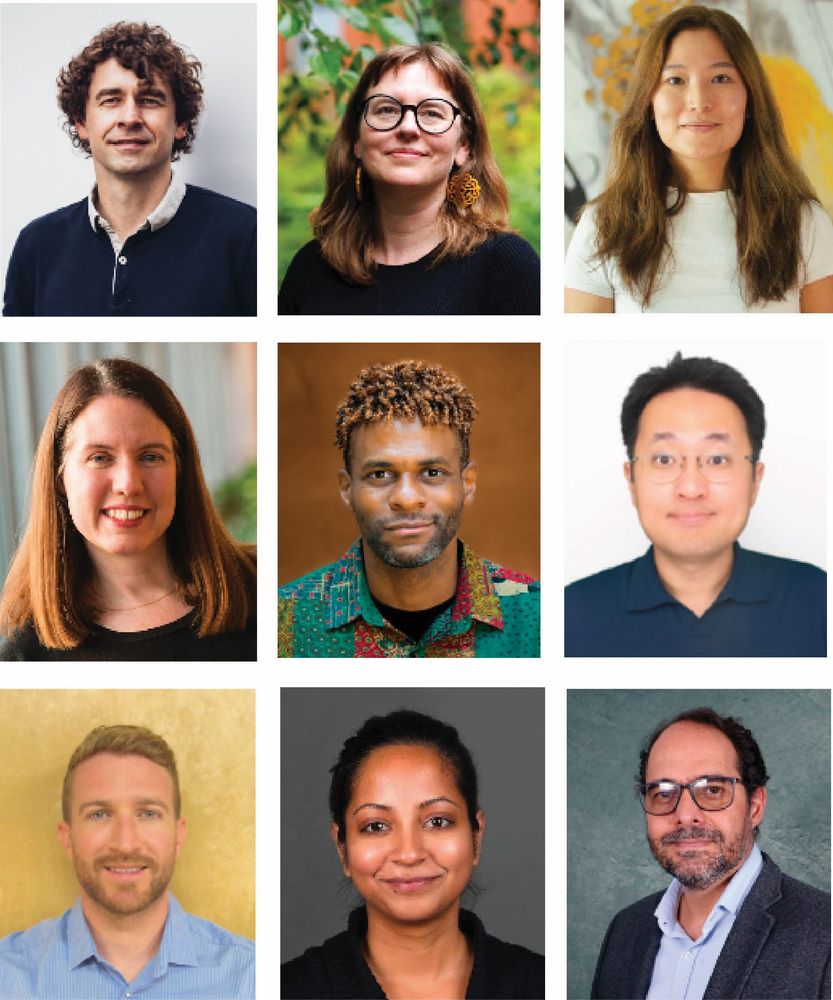
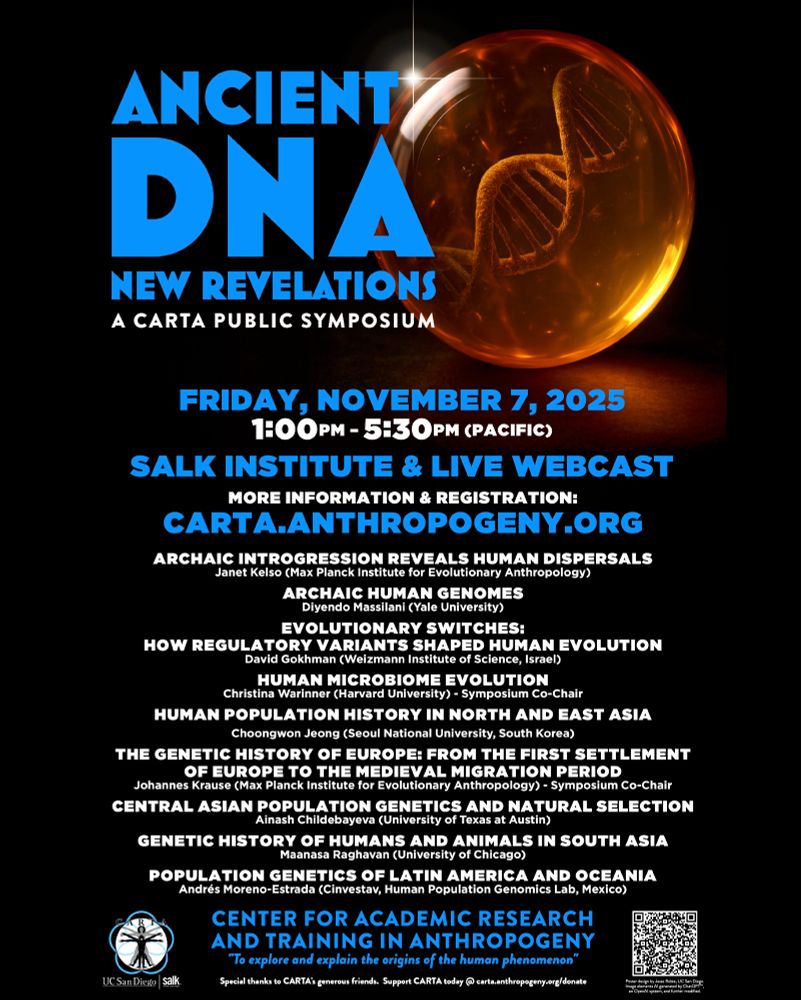
We're organizing a new CARTA symposium this November 7 on "Ancient DNA: New Revelations"! We have an amazing lineup of speakers who will showcase the biggest discoveries in ancient DNA over the past 5 years - and offer a sneak peek of what's next. Mark your calendars and don't miss it!
September 15, 2025 at 5:40 PM
We're organizing a new CARTA symposium this November 7 on "Ancient DNA: New Revelations"! We have an amazing lineup of speakers who will showcase the biggest discoveries in ancient DNA over the past 5 years - and offer a sneak peek of what's next. Mark your calendars and don't miss it!
Took a TRP to beautiful Leuven and the sensory neurons are all firing....
Came for the Belgian 🍫,
stayed for the🌶🧅 🧊
#TRPChannels #LipidLove
Came for the Belgian 🍫,
stayed for the🌶🧅 🧊
#TRPChannels #LipidLove


September 17, 2025 at 1:43 PM
Took a TRP to beautiful Leuven and the sensory neurons are all firing....
Came for the Belgian 🍫,
stayed for the🌶🧅 🧊
#TRPChannels #LipidLove
Came for the Belgian 🍫,
stayed for the🌶🧅 🧊
#TRPChannels #LipidLove