




Gemma Dipoppa
@gemmadipoppa.bsky.social
Assistant Professor Columbia Political Science - Political Economy, Migration, Crime, Environmental
https://www.gemmadipoppa.com/
https://www.gemmadipoppa.com/
Reposted by Gemma Dipoppa
Thrilled to see our paper on “Spending Limits, Public Funding, and Election Outcomes” published in the @jeeanews.bsky.social! 👇👇
We investigate the effects of far-reaching campaign finance rules, with Nikolaj Broberg and Clemence Tricaud.
Short thread on what we do and find (1/n).
We investigate the effects of far-reaching campaign finance rules, with Nikolaj Broberg and Clemence Tricaud.
Short thread on what we do and find (1/n).
Forthcoming article "Spending Limits, Public Funding, and Election Outcomes" by Nikolaj Broberg @vinpons.bsky.social and Clemence Tricaud
@eeanews.bsky.social
doi.org/10.1093/jeea...
@eeanews.bsky.social
doi.org/10.1093/jeea...

Spending Limits, Public Funding, and Election Outcomes
Abstract. This paper investigates the effects of campaign finance rules on electoral outcomes. In French local elections, candidates competing in districts
doi.org
December 5, 2025 at 1:26 PM
Thrilled to see our paper on “Spending Limits, Public Funding, and Election Outcomes” published in the @jeeanews.bsky.social! 👇👇
We investigate the effects of far-reaching campaign finance rules, with Nikolaj Broberg and Clemence Tricaud.
Short thread on what we do and find (1/n).
We investigate the effects of far-reaching campaign finance rules, with Nikolaj Broberg and Clemence Tricaud.
Short thread on what we do and find (1/n).
Reposted by Gemma Dipoppa
Forthcoming article "Spending Limits, Public Funding, and Election Outcomes" by Nikolaj Broberg @vinpons.bsky.social and Clemence Tricaud
@eeanews.bsky.social
doi.org/10.1093/jeea...
@eeanews.bsky.social
doi.org/10.1093/jeea...
Spending Limits, Public Funding, and Election Outcomes
Abstract. This paper investigates the effects of campaign finance rules on electoral outcomes. In French local elections, candidates competing in districts
doi.org
December 4, 2025 at 6:34 AM
Forthcoming article "Spending Limits, Public Funding, and Election Outcomes" by Nikolaj Broberg @vinpons.bsky.social and Clemence Tricaud
@eeanews.bsky.social
doi.org/10.1093/jeea...
@eeanews.bsky.social
doi.org/10.1093/jeea...
Feedbacks are most welcome!
Working paper 👉 www.nber.org/papers/w34492
Coauthor: Annalisa Pezone 🙌 sites.google.com/nyu.edu/anna...
Working paper 👉 www.nber.org/papers/w34492
Coauthor: Annalisa Pezone 🙌 sites.google.com/nyu.edu/anna...

The Logic of State Surveillance
Founded in 1920, the NBER is a private, non-profit, non-partisan organization dedicated to conducting economic research and to disseminating research findings among academics, public policy makers, an...
www.nber.org
November 24, 2025 at 11:41 PM
Feedbacks are most welcome!
Working paper 👉 www.nber.org/papers/w34492
Coauthor: Annalisa Pezone 🙌 sites.google.com/nyu.edu/anna...
Working paper 👉 www.nber.org/papers/w34492
Coauthor: Annalisa Pezone 🙌 sites.google.com/nyu.edu/anna...
11/
🎯 The takeaway:
States use surveillance as a preventive tool against the empowerment of educated but excluded groups.
👉 As excluded groups gain political empowerment, surveillance may reproduce inequalities by silencing them exactly as they gain political voice.
🎯 The takeaway:
States use surveillance as a preventive tool against the empowerment of educated but excluded groups.
👉 As excluded groups gain political empowerment, surveillance may reproduce inequalities by silencing them exactly as they gain political voice.
November 24, 2025 at 11:41 PM
11/
🎯 The takeaway:
States use surveillance as a preventive tool against the empowerment of educated but excluded groups.
👉 As excluded groups gain political empowerment, surveillance may reproduce inequalities by silencing them exactly as they gain political voice.
🎯 The takeaway:
States use surveillance as a preventive tool against the empowerment of educated but excluded groups.
👉 As excluded groups gain political empowerment, surveillance may reproduce inequalities by silencing them exactly as they gain political voice.
10/ Across democracy and dictatorship, and with more and less technology to collect data, the logic of surveillance was similar:
States target those combining political capacity (education) with radical grievances (subalternity).
States target those combining political capacity (education) with radical grievances (subalternity).
November 24, 2025 at 11:41 PM
10/ Across democracy and dictatorship, and with more and less technology to collect data, the logic of surveillance was similar:
States target those combining political capacity (education) with radical grievances (subalternity).
States target those combining political capacity (education) with radical grievances (subalternity).
9/ ➡️ Result 3:
Across 5 indicators of political activism—voting, protests, strikes, holding political roles, and armed resistance—educated cohorts did not become more engaged.
Surveillance expanded preventively, not in reaction to mobilization.
Across 5 indicators of political activism—voting, protests, strikes, holding political roles, and armed resistance—educated cohorts did not become more engaged.
Surveillance expanded preventively, not in reaction to mobilization.
November 24, 2025 at 11:41 PM
9/ ➡️ Result 3:
Across 5 indicators of political activism—voting, protests, strikes, holding political roles, and armed resistance—educated cohorts did not become more engaged.
Surveillance expanded preventively, not in reaction to mobilization.
Across 5 indicators of political activism—voting, protests, strikes, holding political roles, and armed resistance—educated cohorts did not become more engaged.
Surveillance expanded preventively, not in reaction to mobilization.
8/ ➡️ Result 2:
Who faced the brunt of surveillance? The working class. The newly educated poor were watched longer, more harshly, and more intensively, consistently with the state fearing their empowerment.
Who faced the brunt of surveillance? The working class. The newly educated poor were watched longer, more harshly, and more intensively, consistently with the state fearing their empowerment.

November 24, 2025 at 11:41 PM
8/ ➡️ Result 2:
Who faced the brunt of surveillance? The working class. The newly educated poor were watched longer, more harshly, and more intensively, consistently with the state fearing their empowerment.
Who faced the brunt of surveillance? The working class. The newly educated poor were watched longer, more harshly, and more intensively, consistently with the state fearing their empowerment.
7/ The effect persists even when individuals move elsewhere, in line with surveillance following a portable asset (education) rather than municipal-level changes.
November 24, 2025 at 11:41 PM
7/ The effect persists even when individuals move elsewhere, in line with surveillance following a portable asset (education) rather than municipal-level changes.
6/ We present 3 results:
➡️ Result 1:
Municipality-cohorts exposed to more schooling were 64% more likely to be surveilled.
The effect increases as the state expands education and disappears when later reforms equalize schooling across municipalities.
➡️ Result 1:
Municipality-cohorts exposed to more schooling were 64% more likely to be surveilled.
The effect increases as the state expands education and disappears when later reforms equalize schooling across municipalities.


November 24, 2025 at 11:41 PM
6/ We present 3 results:
➡️ Result 1:
Municipality-cohorts exposed to more schooling were 64% more likely to be surveilled.
The effect increases as the state expands education and disappears when later reforms equalize schooling across municipalities.
➡️ Result 1:
Municipality-cohorts exposed to more schooling were 64% more likely to be surveilled.
The effect increases as the state expands education and disappears when later reforms equalize schooling across municipalities.
5/ 🎲 The shock:
The Casati Law mandated primary schooling for 2 years everywhere but extended it for +2 years in towns >4,000 inhabitants and cohorts born post 1854.
We show the reform reduced illiteracy and use it in a difference-in-discontinuity design by population and cohort.
The Casati Law mandated primary schooling for 2 years everywhere but extended it for +2 years in towns >4,000 inhabitants and cohorts born post 1854.
We show the reform reduced illiteracy and use it in a difference-in-discontinuity design by population and cohort.

November 24, 2025 at 11:41 PM
5/ 🎲 The shock:
The Casati Law mandated primary schooling for 2 years everywhere but extended it for +2 years in towns >4,000 inhabitants and cohorts born post 1854.
We show the reform reduced illiteracy and use it in a difference-in-discontinuity design by population and cohort.
The Casati Law mandated primary schooling for 2 years everywhere but extended it for +2 years in towns >4,000 inhabitants and cohorts born post 1854.
We show the reform reduced illiteracy and use it in a difference-in-discontinuity design by population and cohort.
4/ 📃 📄 Descriptively, educated people were more likely to be watched. But education may proxy for background, status, or other fixed attributes.
We need a shock to education that affects otherwise similar people.
We need a shock to education that affects otherwise similar people.
November 24, 2025 at 11:41 PM
4/ 📃 📄 Descriptively, educated people were more likely to be watched. But education may proxy for background, status, or other fixed attributes.
We need a shock to education that affects otherwise similar people.
We need a shock to education that affects otherwise similar people.
3/ Unsupervised LLM on 1,200+ police files shows that mobilization capacity – and a particular marker of it, education, – together with potential for subversion are recurring traits noted by the surveillance state. 📚

November 24, 2025 at 11:41 PM
3/ Unsupervised LLM on 1,200+ police files shows that mobilization capacity – and a particular marker of it, education, – together with potential for subversion are recurring traits noted by the surveillance state. 📚
2/ 💡 We propose that states strategically target those combining capacity to mobilize with grievances for radical mobilization – educated but subaltern individuals perceived as most threatening to state stability.
This idea is rooted in descriptive data:
This idea is rooted in descriptive data:
November 24, 2025 at 11:41 PM
2/ 💡 We propose that states strategically target those combining capacity to mobilize with grievances for radical mobilization – educated but subaltern individuals perceived as most threatening to state stability.
This idea is rooted in descriptive data:
This idea is rooted in descriptive data:
🚨 New WP 🚨:
All states monitor the political activity of their citizens. But who do they choose to surveil, and why?
We study this question with the universe of Italian political surveillance files: 152,000 individuals born 1816–1932, across democracy and autocracy.
🧵 1/11
All states monitor the political activity of their citizens. But who do they choose to surveil, and why?
We study this question with the universe of Italian political surveillance files: 152,000 individuals born 1816–1932, across democracy and autocracy.
🧵 1/11
Studying the logic of state surveillance based on the universe of Italian files finds that states target educated and subaltern groups, with mobilization and radical change potential, from Gemma Dipoppa and Annalisa Pezone www.nber.org/papers/w34492

November 24, 2025 at 11:41 PM
🚨 New WP 🚨:
All states monitor the political activity of their citizens. But who do they choose to surveil, and why?
We study this question with the universe of Italian political surveillance files: 152,000 individuals born 1816–1932, across democracy and autocracy.
🧵 1/11
All states monitor the political activity of their citizens. But who do they choose to surveil, and why?
We study this question with the universe of Italian political surveillance files: 152,000 individuals born 1816–1932, across democracy and autocracy.
🧵 1/11
Reposted by Gemma Dipoppa

Call for Submissions: Democratic Resilience and the Politics of Belonging
Columbia, June 4-5, 2026
Co-Organizers: @aalrababah.bsky.social (Bocconi), @gemmadipoppa.bsky.social (Columbia), Shigeo Hirano (Columbia), @ginvernizzi.bsky.social (Bocconi)
Submit: lnkd.in/eiPgt_w5
Details ⬇️
Columbia, June 4-5, 2026
Co-Organizers: @aalrababah.bsky.social (Bocconi), @gemmadipoppa.bsky.social (Columbia), Shigeo Hirano (Columbia), @ginvernizzi.bsky.social (Bocconi)
Submit: lnkd.in/eiPgt_w5
Details ⬇️

November 7, 2025 at 9:02 PM
Call for Submissions: Democratic Resilience and the Politics of Belonging
Columbia, June 4-5, 2026
Co-Organizers: @aalrababah.bsky.social (Bocconi), @gemmadipoppa.bsky.social (Columbia), Shigeo Hirano (Columbia), @ginvernizzi.bsky.social (Bocconi)
Submit: lnkd.in/eiPgt_w5
Details ⬇️
Columbia, June 4-5, 2026
Co-Organizers: @aalrababah.bsky.social (Bocconi), @gemmadipoppa.bsky.social (Columbia), Shigeo Hirano (Columbia), @ginvernizzi.bsky.social (Bocconi)
Submit: lnkd.in/eiPgt_w5
Details ⬇️
Reposted by Gemma Dipoppa

🧾NEW WP! New data, old divide 🧵
🇮🇹Our new @theifs.bsky.social WP
"The #Geography of #Child #Disability in #Italy: New Evidence from Administrative Data" (w/ P Biasi & De Paola) uses administrative data on the 2024 Universal Child Allowance, covering 4m children under 10.
🔗 tinyurl.com/yk89t39e
🇮🇹Our new @theifs.bsky.social WP
"The #Geography of #Child #Disability in #Italy: New Evidence from Administrative Data" (w/ P Biasi & De Paola) uses administrative data on the 2024 Universal Child Allowance, covering 4m children under 10.
🔗 tinyurl.com/yk89t39e

October 15, 2025 at 1:05 AM
🧾NEW WP! New data, old divide 🧵
🇮🇹Our new @theifs.bsky.social WP
"The #Geography of #Child #Disability in #Italy: New Evidence from Administrative Data" (w/ P Biasi & De Paola) uses administrative data on the 2024 Universal Child Allowance, covering 4m children under 10.
🔗 tinyurl.com/yk89t39e
🇮🇹Our new @theifs.bsky.social WP
"The #Geography of #Child #Disability in #Italy: New Evidence from Administrative Data" (w/ P Biasi & De Paola) uses administrative data on the 2024 Universal Child Allowance, covering 4m children under 10.
🔗 tinyurl.com/yk89t39e
Reposted by Gemma Dipoppa

@gemmadipoppa.bsky.social and I summarize the main findings from our @nature.com article on air pollution, crop burning, and public health in South Asia in @voxdev.bsky.social 👇🏽

🆕 Strengthening bureaucrat incentives can curb crop burning and save lives in India and Pakistan
Today on VoxDev w/ @gemmadipoppa.bsky.social (@columbiauniversity.bsky.social) & @saadgulzar.bsky.social (@notredame.bsky.social): voxdev.org/topic/energy...
Today on VoxDev w/ @gemmadipoppa.bsky.social (@columbiauniversity.bsky.social) & @saadgulzar.bsky.social (@notredame.bsky.social): voxdev.org/topic/energy...

Strengthening bureaucrat incentives can curb crop burning and save lives in India and Pakistan
Evidence from India and Pakistan shows that harnessing district officials’ local pollution incentives reduces crop fires by up to 14.5% and deters burns by a further 13%, significantly lowering infant...
voxdev.org
July 18, 2025 at 5:27 AM
@gemmadipoppa.bsky.social and I summarize the main findings from our @nature.com article on air pollution, crop burning, and public health in South Asia in @voxdev.bsky.social 👇🏽
Reposted by Gemma Dipoppa

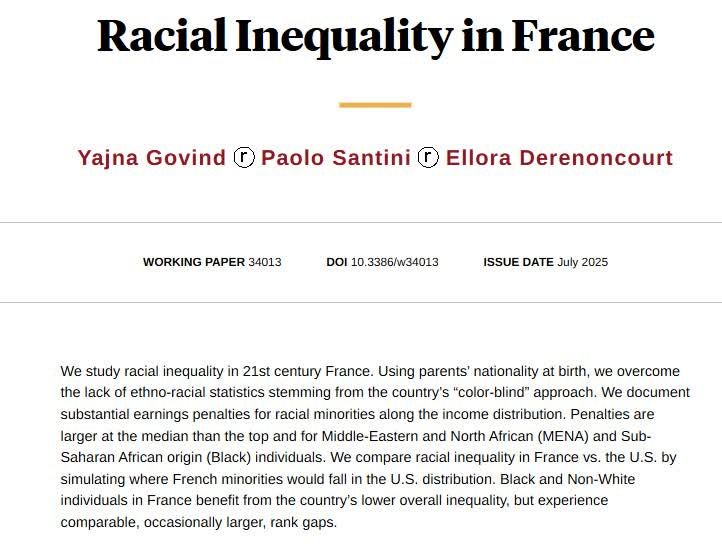
Substantial earnings penalties exist for racial minorities in France. Compared to the US, lower overall inequality benefits French racial minorities, but rank gaps are comparable, from Yajna Govind, Paolo Santini, and Ellora Derenoncourt https://www.nber.org/papers/w34013
July 16, 2025 at 9:00 PM
Substantial earnings penalties exist for racial minorities in France. Compared to the US, lower overall inequality benefits French racial minorities, but rank gaps are comparable, from Yajna Govind, Paolo Santini, and Ellora Derenoncourt https://www.nber.org/papers/w34013
Thank you @voxdev.bsky.social for covering our (w @saadgulzar.bsky.social) work on bureaucrat incentives to reduce crop-related fires and air pollution! Full paper at www.nature.com/articles/s41...
🆕 Strengthening bureaucrat incentives can curb crop burning and save lives in India and Pakistan
Today on VoxDev w/ @gemmadipoppa.bsky.social (@columbiauniversity.bsky.social) & @saadgulzar.bsky.social (@notredame.bsky.social): voxdev.org/topic/energy...
Today on VoxDev w/ @gemmadipoppa.bsky.social (@columbiauniversity.bsky.social) & @saadgulzar.bsky.social (@notredame.bsky.social): voxdev.org/topic/energy...
Strengthening bureaucrat incentives can curb crop burning and save lives in India and Pakistan
Evidence from India and Pakistan shows that harnessing district officials’ local pollution incentives reduces crop fires by up to 14.5% and deters burns by a further 13%, significantly lowering infant...
voxdev.org
July 16, 2025 at 12:45 PM
Thank you @voxdev.bsky.social for covering our (w @saadgulzar.bsky.social) work on bureaucrat incentives to reduce crop-related fires and air pollution! Full paper at www.nature.com/articles/s41...
Reposted by Gemma Dipoppa
In Italy, a major tax credit favored middle earners and boosted votes for incumbents, revealing a political-economy tradeoff, from Silvia Vannutelli https://www.nber.org/papers/w33973

July 6, 2025 at 12:00 PM
In Italy, a major tax credit favored middle earners and boosted votes for incumbents, revealing a political-economy tradeoff, from Silvia Vannutelli https://www.nber.org/papers/w33973
Reposted by Gemma Dipoppa

🚨 Big News for European Political Science 🚨
We’re thrilled to announce the launch of the European Political Science Society (EPSS): a new, member-led, not-for-profit association built to support our scholarly community.
🔗 epssnet.org
Here’s a thread with everything you need to know.
🧵
We’re thrilled to announce the launch of the European Political Science Society (EPSS): a new, member-led, not-for-profit association built to support our scholarly community.
🔗 epssnet.org
Here’s a thread with everything you need to know.
🧵
June 26, 2025 at 5:07 PM
🚨 Big News for European Political Science 🚨
We’re thrilled to announce the launch of the European Political Science Society (EPSS): a new, member-led, not-for-profit association built to support our scholarly community.
🔗 epssnet.org
Here’s a thread with everything you need to know.
🧵
We’re thrilled to announce the launch of the European Political Science Society (EPSS): a new, member-led, not-for-profit association built to support our scholarly community.
🔗 epssnet.org
Here’s a thread with everything you need to know.
🧵
Reposted by Gemma Dipoppa

🚨 June 30th deadline approaching 🚨
📣 Call for papers - CEMIR Junior Economist Workshop on #Migration Research 2025
📅 Event held October 28-29, 2025 in Munich at
@cesifo.org
🗣️ With a keynote from Jens Hainmueller of
@stanford.edu
⌛ Details/Submit here: www.ifo.de/w/85244ca1
📣 Call for papers - CEMIR Junior Economist Workshop on #Migration Research 2025
📅 Event held October 28-29, 2025 in Munich at
@cesifo.org
🗣️ With a keynote from Jens Hainmueller of
@stanford.edu
⌛ Details/Submit here: www.ifo.de/w/85244ca1

June 25, 2025 at 9:22 AM
🚨 June 30th deadline approaching 🚨
📣 Call for papers - CEMIR Junior Economist Workshop on #Migration Research 2025
📅 Event held October 28-29, 2025 in Munich at
@cesifo.org
🗣️ With a keynote from Jens Hainmueller of
@stanford.edu
⌛ Details/Submit here: www.ifo.de/w/85244ca1
📣 Call for papers - CEMIR Junior Economist Workshop on #Migration Research 2025
📅 Event held October 28-29, 2025 in Munich at
@cesifo.org
🗣️ With a keynote from Jens Hainmueller of
@stanford.edu
⌛ Details/Submit here: www.ifo.de/w/85244ca1
Reposted by Gemma Dipoppa
Version 2.0 of the National Elections Database is online! nationalelectionsdatabase.com
We cover presidential and parliamentary elections 1789–2023, extending the post-1945 data of Electoral Turnovers @reveconstudies.bsky.social (academic.oup.com/restud/advan...)
w/ Benjamin Marx and Vincent Rollet
We cover presidential and parliamentary elections 1789–2023, extending the post-1945 data of Electoral Turnovers @reveconstudies.bsky.social (academic.oup.com/restud/advan...)
w/ Benjamin Marx and Vincent Rollet
June 5, 2025 at 12:17 PM
Version 2.0 of the National Elections Database is online! nationalelectionsdatabase.com
We cover presidential and parliamentary elections 1789–2023, extending the post-1945 data of Electoral Turnovers @reveconstudies.bsky.social (academic.oup.com/restud/advan...)
w/ Benjamin Marx and Vincent Rollet
We cover presidential and parliamentary elections 1789–2023, extending the post-1945 data of Electoral Turnovers @reveconstudies.bsky.social (academic.oup.com/restud/advan...)
w/ Benjamin Marx and Vincent Rollet
Reposted by Gemma Dipoppa
Now available for preorder from Oxford University Press. Makes good beach reading too. www.amazon.com/Workplace-Po...

Workplace Politics: How Politicians and Employers Subvert Elections
In many countries politicians rely on employers to influence the voting behavior of their employees, but this type of voter mobilization has received very little attention. draws on unique surveys ...
www.amazon.com
June 2, 2025 at 8:55 PM
Now available for preorder from Oxford University Press. Makes good beach reading too. www.amazon.com/Workplace-Po...
Reposted by Gemma Dipoppa

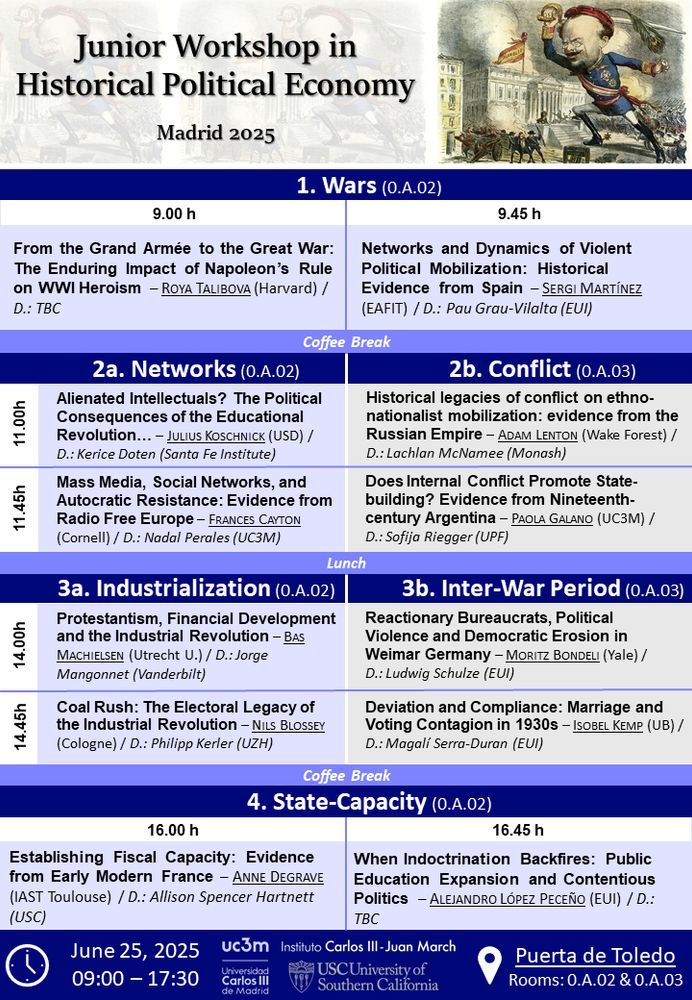
We have a great lineup of papers for the Junior Workshop in HPE. A limited number of spots are available for scholars interested in attending the workshop. Fill this form if you want to join us next June 25 at UC3M forms.gle/DckGoQDfniTU... @tinepaulsen.bsky.social @franvillamil.bsky.social
June 2, 2025 at 7:44 AM
We have a great lineup of papers for the Junior Workshop in HPE. A limited number of spots are available for scholars interested in attending the workshop. Fill this form if you want to join us next June 25 at UC3M forms.gle/DckGoQDfniTU... @tinepaulsen.bsky.social @franvillamil.bsky.social