


Dr Precious Chiwara
@drpeechiwara.bsky.social
Postdoctoral Research Fellow @UCT Geology | Archaeologist | Stone tools | Early modern humans | She/Her/Hers
Reposted by Dr Precious Chiwara
Thrilled to share that the 2025 SAJS paper with the highest attention score was led by our @palaeoprotpalesa.bsky.social, with nearly 4,000 abstract views!
The study identified 2 Myr-old proteins from Paranthropus robustus, revealing biological sex & genetic variability
sajs.co.za/article/view...
The study identified 2 Myr-old proteins from Paranthropus robustus, revealing biological sex & genetic variability
sajs.co.za/article/view...

January 28, 2026 at 8:01 AM
Thrilled to share that the 2025 SAJS paper with the highest attention score was led by our @palaeoprotpalesa.bsky.social, with nearly 4,000 abstract views!
The study identified 2 Myr-old proteins from Paranthropus robustus, revealing biological sex & genetic variability
sajs.co.za/article/view...
The study identified 2 Myr-old proteins from Paranthropus robustus, revealing biological sex & genetic variability
sajs.co.za/article/view...
Reminder: ASAPA abstract deadline 31 Jan ⏰
We invite abstracts for our session on the Pleistocene record of the Kalahari and interior southern Africa, including comparative studies with other regions of southern Africa or Africa.
Submit via the ASAPA portal: asapa2026.co.za/submissions....
We invite abstracts for our session on the Pleistocene record of the Kalahari and interior southern Africa, including comparative studies with other regions of southern Africa or Africa.
Submit via the ASAPA portal: asapa2026.co.za/submissions....

January 21, 2026 at 10:02 AM
Reminder: ASAPA abstract deadline 31 Jan ⏰
We invite abstracts for our session on the Pleistocene record of the Kalahari and interior southern Africa, including comparative studies with other regions of southern Africa or Africa.
Submit via the ASAPA portal: asapa2026.co.za/submissions....
We invite abstracts for our session on the Pleistocene record of the Kalahari and interior southern Africa, including comparative studies with other regions of southern Africa or Africa.
Submit via the ASAPA portal: asapa2026.co.za/submissions....
Reposted by Dr Precious Chiwara
Imagine surviving in the Kalahari thousands of years ago—one of #Africa’s driest environments.
Evidence shows that early humans didn’t just endure it; they adapted with remarkable skill.
🔗 www.heriuct.co.za/news-content/surviving-the-drylands-stone-tools-as-evidence-of-early-social-networks
Evidence shows that early humans didn’t just endure it; they adapted with remarkable skill.
🔗 www.heriuct.co.za/news-content/surviving-the-drylands-stone-tools-as-evidence-of-early-social-networks

January 14, 2026 at 8:01 AM
Imagine surviving in the Kalahari thousands of years ago—one of #Africa’s driest environments.
Evidence shows that early humans didn’t just endure it; they adapted with remarkable skill.
🔗 www.heriuct.co.za/news-content/surviving-the-drylands-stone-tools-as-evidence-of-early-social-networks
Evidence shows that early humans didn’t just endure it; they adapted with remarkable skill.
🔗 www.heriuct.co.za/news-content/surviving-the-drylands-stone-tools-as-evidence-of-early-social-networks
Reposted by Dr Precious Chiwara
New work by HERI's @drpeechiwara.bsky.social & colleagues reviews Middle Stone Age evidence in #Africa to explore how early humans built complex social networks
Looking at context & patterns, the paper sheds light on the deep roots of human cooperation & collaboration.
doi.org/10.17159/saj...
Looking at context & patterns, the paper sheds light on the deep roots of human cooperation & collaboration.
doi.org/10.17159/saj...

January 7, 2026 at 8:01 AM
New work by HERI's @drpeechiwara.bsky.social & colleagues reviews Middle Stone Age evidence in #Africa to explore how early humans built complex social networks
Looking at context & patterns, the paper sheds light on the deep roots of human cooperation & collaboration.
doi.org/10.17159/saj...
Looking at context & patterns, the paper sheds light on the deep roots of human cooperation & collaboration.
doi.org/10.17159/saj...
Reposted by Dr Precious Chiwara
Women in science in #Africa 🌍
Christina Mutinda, a HERI PhD candidate at @UCT_news, explores how early humans adapted to changing environments.
Using fossils, isotopes and ecological clues, she reconstructs East Africa’s Early Pleistocene habitats, when Paranthropus boisei roamed.
Christina Mutinda, a HERI PhD candidate at @UCT_news, explores how early humans adapted to changing environments.
Using fossils, isotopes and ecological clues, she reconstructs East Africa’s Early Pleistocene habitats, when Paranthropus boisei roamed.

December 17, 2025 at 8:01 AM
Women in science in #Africa 🌍
Christina Mutinda, a HERI PhD candidate at @UCT_news, explores how early humans adapted to changing environments.
Using fossils, isotopes and ecological clues, she reconstructs East Africa’s Early Pleistocene habitats, when Paranthropus boisei roamed.
Christina Mutinda, a HERI PhD candidate at @UCT_news, explores how early humans adapted to changing environments.
Using fossils, isotopes and ecological clues, she reconstructs East Africa’s Early Pleistocene habitats, when Paranthropus boisei roamed.
Reposted by Dr Precious Chiwara
HERI’s Dr Rieneke Weij has led a rare update of U-Th & U-Pb dating in palaeoscience.
Published with our Dr Tara Edwards, the review highlights advances & potential for carbonate geochronology — and the implications for #humanevolution research.
www.heriuct.co.za/news-content...
Published with our Dr Tara Edwards, the review highlights advances & potential for carbonate geochronology — and the implications for #humanevolution research.
www.heriuct.co.za/news-content...


December 10, 2025 at 10:21 AM
HERI’s Dr Rieneke Weij has led a rare update of U-Th & U-Pb dating in palaeoscience.
Published with our Dr Tara Edwards, the review highlights advances & potential for carbonate geochronology — and the implications for #humanevolution research.
www.heriuct.co.za/news-content...
Published with our Dr Tara Edwards, the review highlights advances & potential for carbonate geochronology — and the implications for #humanevolution research.
www.heriuct.co.za/news-content...
Reposted by Dr Precious Chiwara
A great step forward for Kalahari archaeology. @drpeechiwara.bsky.social and the team’s work offer important new insights into early Homo sapiens technological choices in interior southern Africa.
December 3, 2025 at 12:22 PM
A great step forward for Kalahari archaeology. @drpeechiwara.bsky.social and the team’s work offer important new insights into early Homo sapiens technological choices in interior southern Africa.
Reposted by Dr Precious Chiwara
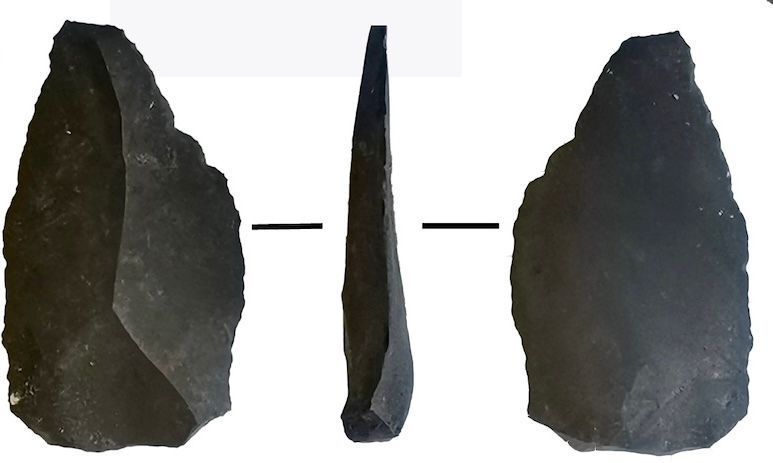
105,000 years ago, Homo sapiens left their mark at Gamohana Hill North Rockshelter in the Kalahari. They crafted points from galaxy tuff, a 2.4-billion-year-old glass-like stone. Not just a rock, but evidence of skill, planning, and ingenuity.
📖 Read more at
www.sciencedirect.com/science/arti...
📖 Read more at
www.sciencedirect.com/science/arti...
December 3, 2025 at 8:01 AM
105,000 years ago, Homo sapiens left their mark at Gamohana Hill North Rockshelter in the Kalahari. They crafted points from galaxy tuff, a 2.4-billion-year-old glass-like stone. Not just a rock, but evidence of skill, planning, and ingenuity.
📖 Read more at
www.sciencedirect.com/science/arti...
📖 Read more at
www.sciencedirect.com/science/arti...
Reposted by Dr Precious Chiwara
HERI’s Drs @drpeechiwara.bsky.social & Ben Schoville are organising a session at ASAPA 2026 on Pleistocene adaptations in the Kalahari and other interior drylands of southern Africa.
Researchers working in these regions are invited to submit abstracts and join the discussion.
asapa2026.co.za
Researchers working in these regions are invited to submit abstracts and join the discussion.
asapa2026.co.za


November 28, 2025 at 8:01 AM
HERI’s Drs @drpeechiwara.bsky.social & Ben Schoville are organising a session at ASAPA 2026 on Pleistocene adaptations in the Kalahari and other interior drylands of southern Africa.
Researchers working in these regions are invited to submit abstracts and join the discussion.
asapa2026.co.za
Researchers working in these regions are invited to submit abstracts and join the discussion.
asapa2026.co.za
New publication alert!‼️ Wrapping up 2025 with my fifth paper of the year in the SAJS!
The paper reviews how stone tools reveal social connections, noting similar patterns can also arise independently and suggesting ways to better distinguish the two. 💫
🔗 doi.org/10.17159/saj...
The paper reviews how stone tools reveal social connections, noting similar patterns can also arise independently and suggesting ways to better distinguish the two. 💫
🔗 doi.org/10.17159/saj...

November 26, 2025 at 12:32 PM
New publication alert!‼️ Wrapping up 2025 with my fifth paper of the year in the SAJS!
The paper reviews how stone tools reveal social connections, noting similar patterns can also arise independently and suggesting ways to better distinguish the two. 💫
🔗 doi.org/10.17159/saj...
The paper reviews how stone tools reveal social connections, noting similar patterns can also arise independently and suggesting ways to better distinguish the two. 💫
🔗 doi.org/10.17159/saj...
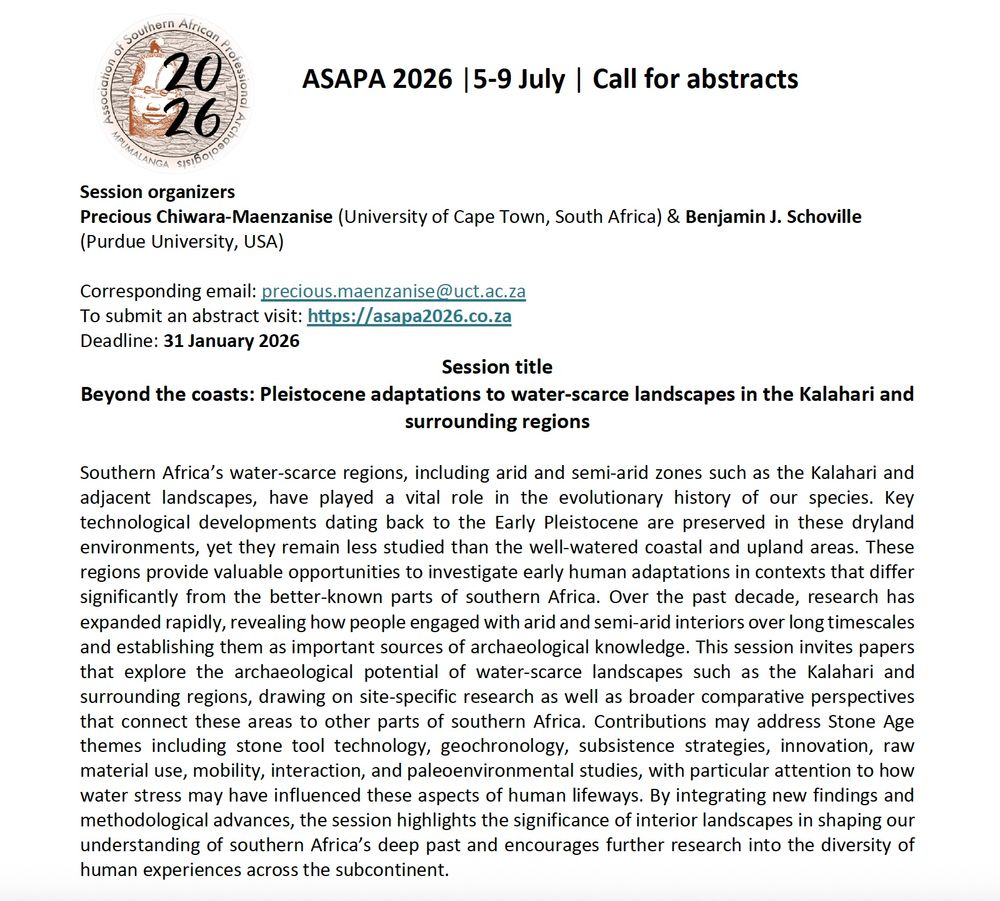
ASAPA 2026 Call for Abstracts is open!
Ben Schoville and I are organising a session on Pleistocene adaptations in the Kalahari and other interior drylands of southern Africa.
Working in these landscapes? We’d love your contribution.
Submit here: asapa2026.co.za
Deadline: 31 Jan 2026
Ben Schoville and I are organising a session on Pleistocene adaptations in the Kalahari and other interior drylands of southern Africa.
Working in these landscapes? We’d love your contribution.
Submit here: asapa2026.co.za
Deadline: 31 Jan 2026

November 20, 2025 at 1:35 PM
ASAPA 2026 Call for Abstracts is open!
Ben Schoville and I are organising a session on Pleistocene adaptations in the Kalahari and other interior drylands of southern Africa.
Working in these landscapes? We’d love your contribution.
Submit here: asapa2026.co.za
Deadline: 31 Jan 2026
Ben Schoville and I are organising a session on Pleistocene adaptations in the Kalahari and other interior drylands of southern Africa.
Working in these landscapes? We’d love your contribution.
Submit here: asapa2026.co.za
Deadline: 31 Jan 2026
Reposted by Dr Precious Chiwara
Ancient tooth proteins reveal the biological sex and genetic diversity of Paranthropus robustus.
Led by Dr. Palesa Madupe of the University of Copenhagen and UCT’s HERI, this study provides the oldest human genetic data from Africa.
🔗 www.science.org/doi/10.1126/...
Led by Dr. Palesa Madupe of the University of Copenhagen and UCT’s HERI, this study provides the oldest human genetic data from Africa.
🔗 www.science.org/doi/10.1126/...

November 19, 2025 at 8:38 AM
Ancient tooth proteins reveal the biological sex and genetic diversity of Paranthropus robustus.
Led by Dr. Palesa Madupe of the University of Copenhagen and UCT’s HERI, this study provides the oldest human genetic data from Africa.
🔗 www.science.org/doi/10.1126/...
Led by Dr. Palesa Madupe of the University of Copenhagen and UCT’s HERI, this study provides the oldest human genetic data from Africa.
🔗 www.science.org/doi/10.1126/...
Reposted by Dr Precious Chiwara
Flowstones from the Cradle of Humankind in #SouthAfrica reveal no evidence of intrusion.
New work, led by HERI’s Georgina Luti, counters arguments that the flowstones are uniform & intrusive, adding support for their role in dating fossils.
🔗 www.heriuct.co.za/news-content...
New work, led by HERI’s Georgina Luti, counters arguments that the flowstones are uniform & intrusive, adding support for their role in dating fossils.
🔗 www.heriuct.co.za/news-content...

November 12, 2025 at 8:31 AM
Flowstones from the Cradle of Humankind in #SouthAfrica reveal no evidence of intrusion.
New work, led by HERI’s Georgina Luti, counters arguments that the flowstones are uniform & intrusive, adding support for their role in dating fossils.
🔗 www.heriuct.co.za/news-content...
New work, led by HERI’s Georgina Luti, counters arguments that the flowstones are uniform & intrusive, adding support for their role in dating fossils.
🔗 www.heriuct.co.za/news-content...
Reposted by Dr Precious Chiwara
🦴 The #TaungChild fossil changed how we understand human origins in #Africa. Its story is shaped by prejudice, rivalry and hidden hands.
🎧 Unburied Season 2: The Taung Child from HERI and ARC explores its history and legacy.
Listen here 👉 linktr.ee/arcdocs
🎧 Unburied Season 2: The Taung Child from HERI and ARC explores its history and legacy.
Listen here 👉 linktr.ee/arcdocs
November 5, 2025 at 8:01 AM
🦴 The #TaungChild fossil changed how we understand human origins in #Africa. Its story is shaped by prejudice, rivalry and hidden hands.
🎧 Unburied Season 2: The Taung Child from HERI and ARC explores its history and legacy.
Listen here 👉 linktr.ee/arcdocs
🎧 Unburied Season 2: The Taung Child from HERI and ARC explores its history and legacy.
Listen here 👉 linktr.ee/arcdocs
Reposted by Dr Precious Chiwara
Science is stronger when every voice is heard. At HERI, diversity drives discovery, challenges assumptions, and creates richer stories of our shared human story.

October 29, 2025 at 8:01 AM
Science is stronger when every voice is heard. At HERI, diversity drives discovery, challenges assumptions, and creates richer stories of our shared human story.
Reposted by Dr Precious Chiwara
Applications are open for the 2025 Student Development Workshop (SDW) at Skukuza, Kruger National Park! 🌿🦓
A great opportunity for students in archaeology & heritage management.
📅 6–10 Dec 2025
See details on SAASS social media & website: www.saassarchaeology.com/upcoming-eve...
A great opportunity for students in archaeology & heritage management.
📅 6–10 Dec 2025
See details on SAASS social media & website: www.saassarchaeology.com/upcoming-eve...

October 24, 2025 at 11:30 AM
Applications are open for the 2025 Student Development Workshop (SDW) at Skukuza, Kruger National Park! 🌿🦓
A great opportunity for students in archaeology & heritage management.
📅 6–10 Dec 2025
See details on SAASS social media & website: www.saassarchaeology.com/upcoming-eve...
A great opportunity for students in archaeology & heritage management.
📅 6–10 Dec 2025
See details on SAASS social media & website: www.saassarchaeology.com/upcoming-eve...
Reposted by Dr Precious Chiwara
Africa’s caves are timekeepers of climate and life. 🌍
An all-women research team, led by HERI’s Georgina Luti, has revealed how rock layers called speleothems record shifts in Africa’s past and help us date fossils more reliably.
#WomenInScience & rooted in Africa.
An all-women research team, led by HERI’s Georgina Luti, has revealed how rock layers called speleothems record shifts in Africa’s past and help us date fossils more reliably.
#WomenInScience & rooted in Africa.

October 22, 2025 at 8:01 AM
Africa’s caves are timekeepers of climate and life. 🌍
An all-women research team, led by HERI’s Georgina Luti, has revealed how rock layers called speleothems record shifts in Africa’s past and help us date fossils more reliably.
#WomenInScience & rooted in Africa.
An all-women research team, led by HERI’s Georgina Luti, has revealed how rock layers called speleothems record shifts in Africa’s past and help us date fossils more reliably.
#WomenInScience & rooted in Africa.
Reposted by Dr Precious Chiwara
HERI brings #Africa to the heart of #humanevolution research, blending innovation, inclusivity and transformative training. From ancient biomolecules to archaeology, we’re shaping a more ethical and African-centered science.

October 15, 2025 at 8:00 AM
HERI brings #Africa to the heart of #humanevolution research, blending innovation, inclusivity and transformative training. From ancient biomolecules to archaeology, we’re shaping a more ethical and African-centered science.
Reposted by Dr Precious Chiwara
As a primatologist, Jane Goodall was a huge inspiration to me. I admired the way she describes chimpanzee behavior with such detail and empathy, and she’s inspired so many people and advocated for chimpanzee conservation and welfare.
However, I'm dismayed at what her narrative leaves out (1/10)
However, I'm dismayed at what her narrative leaves out (1/10)

October 2, 2025 at 4:18 PM
As a primatologist, Jane Goodall was a huge inspiration to me. I admired the way she describes chimpanzee behavior with such detail and empathy, and she’s inspired so many people and advocated for chimpanzee conservation and welfare.
However, I'm dismayed at what her narrative leaves out (1/10)
However, I'm dismayed at what her narrative leaves out (1/10)
Today I'm giving my 1st seminar @UCTgeology titled "Sourcing Quartzite: Using Geochemistry to Trace Early Human Raw Material Selection Strategies in the Southern Kalahari."
My postdoc research explores where early humans obtained the raw materials they used to make tools.
My postdoc research explores where early humans obtained the raw materials they used to make tools.

October 14, 2025 at 10:40 AM
Today I'm giving my 1st seminar @UCTgeology titled "Sourcing Quartzite: Using Geochemistry to Trace Early Human Raw Material Selection Strategies in the Southern Kalahari."
My postdoc research explores where early humans obtained the raw materials they used to make tools.
My postdoc research explores where early humans obtained the raw materials they used to make tools.
Reposted by Dr Precious Chiwara
The #TaungChild has been silent for over 2 million years — until now.
Our new podcast takes you back to 1924 #SouthAfrica, where one fossil would upend colonial narratives to centre human origins #Africa.
🌍Unburied Season 2: The Taung Child
🔗 Listen: linktr.ee/arcdocs
Our new podcast takes you back to 1924 #SouthAfrica, where one fossil would upend colonial narratives to centre human origins #Africa.
🌍Unburied Season 2: The Taung Child
🔗 Listen: linktr.ee/arcdocs

October 8, 2025 at 8:30 AM
The #TaungChild has been silent for over 2 million years — until now.
Our new podcast takes you back to 1924 #SouthAfrica, where one fossil would upend colonial narratives to centre human origins #Africa.
🌍Unburied Season 2: The Taung Child
🔗 Listen: linktr.ee/arcdocs
Our new podcast takes you back to 1924 #SouthAfrica, where one fossil would upend colonial narratives to centre human origins #Africa.
🌍Unburied Season 2: The Taung Child
🔗 Listen: linktr.ee/arcdocs
Reposted by Dr Precious Chiwara
📍 Sunday morning at #campHERI, camping at the West Coast Fossil Park: Participants took part in a stone tool knapping exercise, engaging with ancient technologies through hands-on learning in an immersive outdoor setting.


September 28, 2025 at 11:45 AM
📍 Sunday morning at #campHERI, camping at the West Coast Fossil Park: Participants took part in a stone tool knapping exercise, engaging with ancient technologies through hands-on learning in an immersive outdoor setting.
Reposted by Dr Precious Chiwara
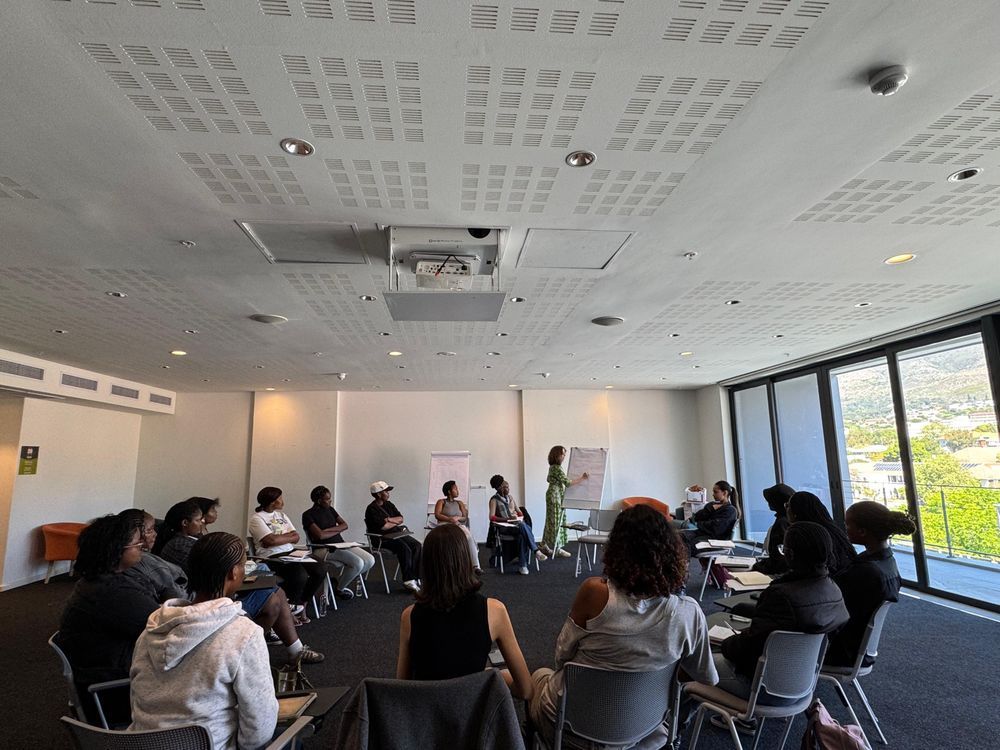
This sexual harassment workshop, led by our Co-director Rebecca Ackermann, is one of the most important parts of #campHERI.
The session invites women to share experiences, learnings and concerns about harassment in the field.
The session invites women to share experiences, learnings and concerns about harassment in the field.


September 27, 2025 at 8:45 AM
This sexual harassment workshop, led by our Co-director Rebecca Ackermann, is one of the most important parts of #campHERI.
The session invites women to share experiences, learnings and concerns about harassment in the field.
The session invites women to share experiences, learnings and concerns about harassment in the field.
Reposted by Dr Precious Chiwara
#campHERI is here! Today is the start of our annual camp that gives students from UCT and partner institutions a safe and supportive environment to develop skills, build community & address challenges faced in field-based sciences.

September 26, 2025 at 8:15 AM
#campHERI is here! Today is the start of our annual camp that gives students from UCT and partner institutions a safe and supportive environment to develop skills, build community & address challenges faced in field-based sciences.
Reposted by Dr Precious Chiwara
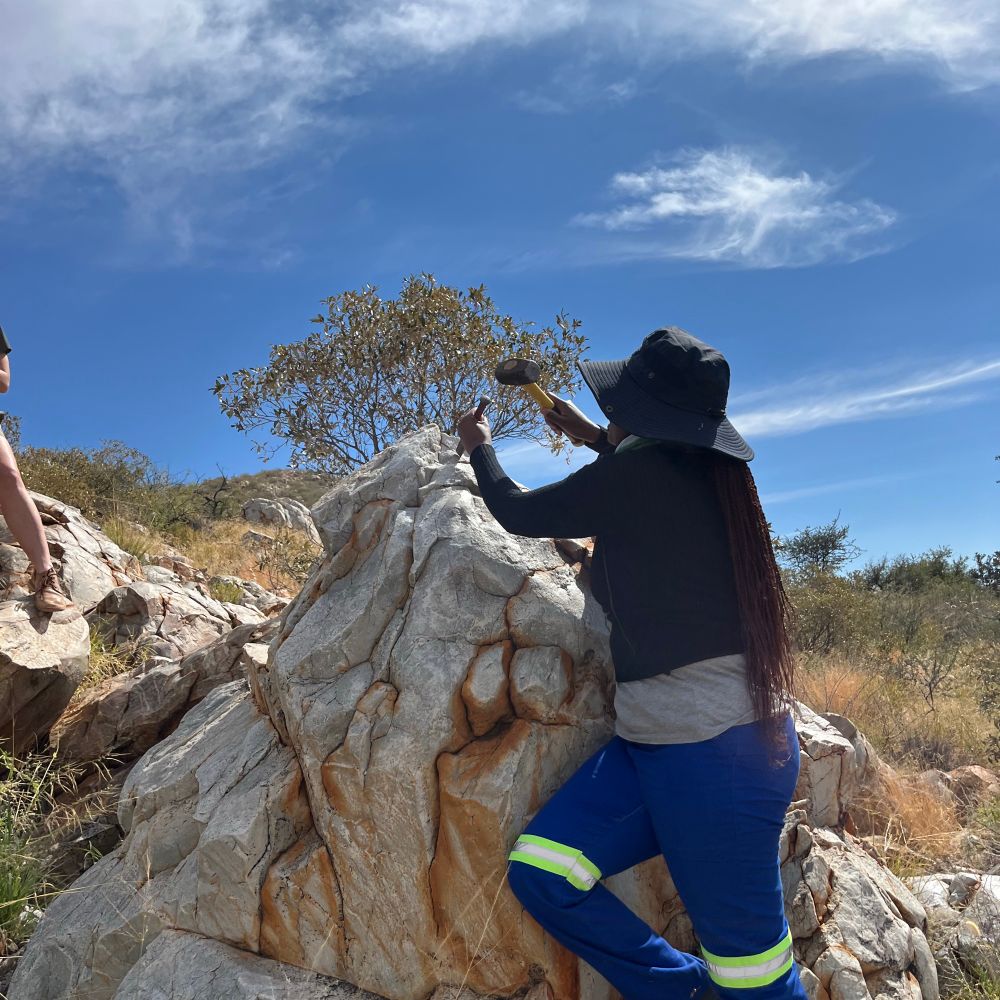
This is what #womeninscience look like!
Our @drpeechiwara.bsky.social is extracting a quartzite block to be geochemically tested. Part of her #postdoc field work, the aim is to pinpoint where raw materials used to make ESA & MSA stone tools in Kalahari of #SouthAfrica were obtained.
Our @drpeechiwara.bsky.social is extracting a quartzite block to be geochemically tested. Part of her #postdoc field work, the aim is to pinpoint where raw materials used to make ESA & MSA stone tools in Kalahari of #SouthAfrica were obtained.

August 20, 2025 at 11:22 AM
This is what #womeninscience look like!
Our @drpeechiwara.bsky.social is extracting a quartzite block to be geochemically tested. Part of her #postdoc field work, the aim is to pinpoint where raw materials used to make ESA & MSA stone tools in Kalahari of #SouthAfrica were obtained.
Our @drpeechiwara.bsky.social is extracting a quartzite block to be geochemically tested. Part of her #postdoc field work, the aim is to pinpoint where raw materials used to make ESA & MSA stone tools in Kalahari of #SouthAfrica were obtained.