




Derosa Lab
@derosalab.bsky.social
Research group at Boston University interested in electrochemistry, organometallic chemistry, organic synthesis, and catalysis.
www.derosalab.com
www.derosalab.com
Pinned
Derosa Lab
@derosalab.bsky.social
· Dec 5

Electrochemical Azolation of Electron‐rich Fluoroarenes: A Controlled Redox Chain Unlocks C─N Bond‐forming e‐SNAr
Anodic oxidation unlocks C─N bond formation in electron-rich fluoroarenes. Spatial separation of redox events extends the lifetime of active intermediates, expands the scope of nucleophilic aromatic ...
onlinelibrary.wiley.com
Congrats to Brett and Jillian on their e-SNAr strategy to enable azolation of electron-rich fluoroarenes now published in @angewandtechemie.bsky.social at a "Hot Paper"! Simple, scalable, and energy efficient - with new strategies to expand scope underway!
onlinelibrary.wiley.com/doi/10.1002/...
onlinelibrary.wiley.com/doi/10.1002/...
Reposted by Derosa Lab
The next @organicdivision.org Virtual Symposium on Jan 14 @ 12 noon ET ft. Prof. Christian Malapit @camalapit.bsky.social & Dr. Kaid Harper #AbbVieChemistry
#Electrochem
Free to watch
YouTube: orgn.link/watch
Zoom: emory.zoom.us/j/18563507
#ChemSky #ChemChat
#Electrochem
Free to watch
YouTube: orgn.link/watch
Zoom: emory.zoom.us/j/18563507
#ChemSky #ChemChat

January 3, 2026 at 8:53 PM
The next @organicdivision.org Virtual Symposium on Jan 14 @ 12 noon ET ft. Prof. Christian Malapit @camalapit.bsky.social & Dr. Kaid Harper #AbbVieChemistry
#Electrochem
Free to watch
YouTube: orgn.link/watch
Zoom: emory.zoom.us/j/18563507
#ChemSky #ChemChat
#Electrochem
Free to watch
YouTube: orgn.link/watch
Zoom: emory.zoom.us/j/18563507
#ChemSky #ChemChat
Reposted by Derosa Lab

N-N coupling through Fe-catalyzed N-H dehydrocoupling! Check out our latest V2 on chemrxiv where we show you can catalyze PCET reactions using mild reagents below the thermodynamic limit of initial H• abstraction, make hard-to-access 2H-indazoles, and even skeletal edit! chemrxiv.org/engage/chemr...

December 31, 2025 at 8:36 PM
N-N coupling through Fe-catalyzed N-H dehydrocoupling! Check out our latest V2 on chemrxiv where we show you can catalyze PCET reactions using mild reagents below the thermodynamic limit of initial H• abstraction, make hard-to-access 2H-indazoles, and even skeletal edit! chemrxiv.org/engage/chemr...
Congrats to @leylaguo.bsky.social and Siyuan on their Perspective in ACS Electrochemistry! We highlight strategies over the last ~10 years in Shono-type functionalization from tunable conditions to mediators, outlining exciting prospects for further development.
pubs.acs.org/doi/full/10....
pubs.acs.org/doi/full/10....
pubs.acs.org
December 22, 2025 at 3:21 PM
Congrats to @leylaguo.bsky.social and Siyuan on their Perspective in ACS Electrochemistry! We highlight strategies over the last ~10 years in Shono-type functionalization from tunable conditions to mediators, outlining exciting prospects for further development.
pubs.acs.org/doi/full/10....
pubs.acs.org/doi/full/10....
Reposted by Derosa Lab

Excited to share our and first-author Lauren's last paper of 2025. This is a big advance for TTFtt-based qubits, demonstrating spin coherence in a concentrated crystal and showing the first evidence for optical spin-polarization and spin-dependent relaxation.
pubs.acs.org/doi/full/10....
pubs.acs.org/doi/full/10....

Telecom-Luminescent and Room Temperature Coherent Tetrathiafulvalene-Based Qubits in Spin-Rich Solids
One of the main challenges facing quantum information science (QIS) is the development of robust qubits that can be operated under ambient conditions. Current state-of-the-art anionic nitrogen-vacancy...
pubs.acs.org
December 18, 2025 at 2:32 PM
Excited to share our and first-author Lauren's last paper of 2025. This is a big advance for TTFtt-based qubits, demonstrating spin coherence in a concentrated crystal and showing the first evidence for optical spin-polarization and spin-dependent relaxation.
pubs.acs.org/doi/full/10....
pubs.acs.org/doi/full/10....
Just in time for break, we are thrilled to see our collaborative work with the Gutierrez group published in ACS Catalysis @pubs.acs.org today! Congrats to Bryan and team on an impressive study! More to come in this area soon, building on exciting mechanistic insights.
pubs.acs.org/doi/10.1021/...
pubs.acs.org/doi/10.1021/...

Mediator-Enabled Co-Catalyzed Z-Selective Semihydrogenation via Hydride-Free Multisite Proton-Coupled Electron Transfer
Redox mediators continue to emerge as powerful tools for driving electrochemical reactions, preventing electrode surface fouling and/or facilitating redox processes at milder operating potentials than direct electrolysis requires. In this study, we demonstrate a tandem electrocatalytic approach using a Cp2Co redox mediator and (dppe)CoCl2 precatalyst to selectively hydrogenate a variety of alkynes to cis-alkenes. Controlled potential electrolysis (CPE) at the potential of the mediator (Eapp = −1.45 V vs Fc+/0) successfully generates a variety of terminal and internal alkenes in moderate to good yields. Notably, substrates with tethered Lewis bases further drive selectivity almost exclusively for the Z isomer. Mechanistic investigation of the tandem catalytic reaction via CV and DFT point toward a multisite proton-coupled electron transfer (MS-PCET) step involving a hydride-free pathway where Cp2Co facilitates the reduction of alkyne- and acid-bound (dppe)Co(I)/(0). This developed methodology can be applied toward the synthesis of cis-stilbenoid natural products, as demonstrated with combretastatin A-4. It is also amenable to more practical gram-scale setup and proceeds with up to 99% Faradaic efficiency.
pubs.acs.org
December 19, 2025 at 5:23 PM
Just in time for break, we are thrilled to see our collaborative work with the Gutierrez group published in ACS Catalysis @pubs.acs.org today! Congrats to Bryan and team on an impressive study! More to come in this area soon, building on exciting mechanistic insights.
pubs.acs.org/doi/10.1021/...
pubs.acs.org/doi/10.1021/...
Congrats to Brett and Jillian on their e-SNAr strategy to enable azolation of electron-rich fluoroarenes now published in @angewandtechemie.bsky.social at a "Hot Paper"! Simple, scalable, and energy efficient - with new strategies to expand scope underway!
onlinelibrary.wiley.com/doi/10.1002/...
onlinelibrary.wiley.com/doi/10.1002/...
Electrochemical Azolation of Electron‐rich Fluoroarenes: A Controlled Redox Chain Unlocks C─N Bond‐forming e‐SNAr
Anodic oxidation unlocks C─N bond formation in electron-rich fluoroarenes. Spatial separation of redox events extends the lifetime of active intermediates, expands the scope of nucleophilic aromatic ...
onlinelibrary.wiley.com
December 5, 2025 at 2:12 PM
Congrats to Brett and Jillian on their e-SNAr strategy to enable azolation of electron-rich fluoroarenes now published in @angewandtechemie.bsky.social at a "Hot Paper"! Simple, scalable, and energy efficient - with new strategies to expand scope underway!
onlinelibrary.wiley.com/doi/10.1002/...
onlinelibrary.wiley.com/doi/10.1002/...
Congrats to Zi and team on the publication of our study on a redox mediator strategy to electroreductively harness Fe(I) in alkyne semi-hydrogenation! This work is now published in ACS Catalysis - stay tuned for more from #TeamFe. #chemsky #newPI
pubs.acs.org/doi/10.1021/...
pubs.acs.org/doi/10.1021/...

Electroreductive Iron Catalysis Enabled by a Redox Mediator: Alkyne Semi-Hydrogenation as a Model System
The development of electroreductive Fe-catalyzed processes for organic synthesis has remained scarce compared to other earth-abundant metals despite inherent advantages such as cost, low-toxicity, and accessible redox. Through stability of the Fe center using polydentate and/or redox-active ligand frameworks, pioneering work in reductive chemical catalysis for C–C π-bond hydrogenation and electrocatalytic CO2 reduction sheds light on strategies to harness reduced Fe species electrochemically for organic transformations. Using a tetraphos ligand (P3P), we demonstrate that electroreductive Fe catalysis can be achieved using cobaltocene (Cp2Co) as a redox mediator with alkyne semi-hydrogenation as a model system; the hydrogen evolution reaction (HER) is mitigated by operating at the potential of the redox mediator (Eapp = −1.45 V vs Fc+/0) to access Fe(II/I) reduction as opposed to Fe(II/0) over-reduction. A combination of cyclic voltammetry and controlled potential electrolysis (CPE) studies support a rate-limiting electron transfer step to generate a crystallographically characterized (P3P)Fe(I) which can engage in a nonstereoselective reductive protonation step with internal aryl alkynes and acid. Stoichiometric studies involving a related (P3P)Fe(II)-H ligand suggest that this tandem electrocatalytic system does not operate through a canonical Fe–H mechanism. Lastly, a small survey of diaryl alkynes with unique functional group tolerance is conducted, giving stilbene products with up to 8 turnovers per Fe.
pubs.acs.org
July 30, 2025 at 4:11 PM
Congrats to Zi and team on the publication of our study on a redox mediator strategy to electroreductively harness Fe(I) in alkyne semi-hydrogenation! This work is now published in ACS Catalysis - stay tuned for more from #TeamFe. #chemsky #newPI
pubs.acs.org/doi/10.1021/...
pubs.acs.org/doi/10.1021/...
SNAr powers the engine of drug discovery and production, but electronic demands restrict access to important chemical space. We describe an e-SNAr strategy to bridge this gap that operates under air at RT with catalytic charge, simplifying scalability.
chemrxiv.org/engage/chemr...
chemrxiv.org/engage/chemr...

May 28, 2025 at 2:16 PM
SNAr powers the engine of drug discovery and production, but electronic demands restrict access to important chemical space. We describe an e-SNAr strategy to bridge this gap that operates under air at RT with catalytic charge, simplifying scalability.
chemrxiv.org/engage/chemr...
chemrxiv.org/engage/chemr...
Harnessing reduced Fe in electrocatalysis faces many challenges with respect over-reduction and catalyst instability. In this preprint, we describe a redox mediator strategy to tame a (P3P)Fe(I) species for semi-hydrogenation of alkynes as a model study:
chemrxiv.org/engage/chemr...
chemrxiv.org/engage/chemr...

May 26, 2025 at 1:53 PM
Harnessing reduced Fe in electrocatalysis faces many challenges with respect over-reduction and catalyst instability. In this preprint, we describe a redox mediator strategy to tame a (P3P)Fe(I) species for semi-hydrogenation of alkynes as a model study:
chemrxiv.org/engage/chemr...
chemrxiv.org/engage/chemr...
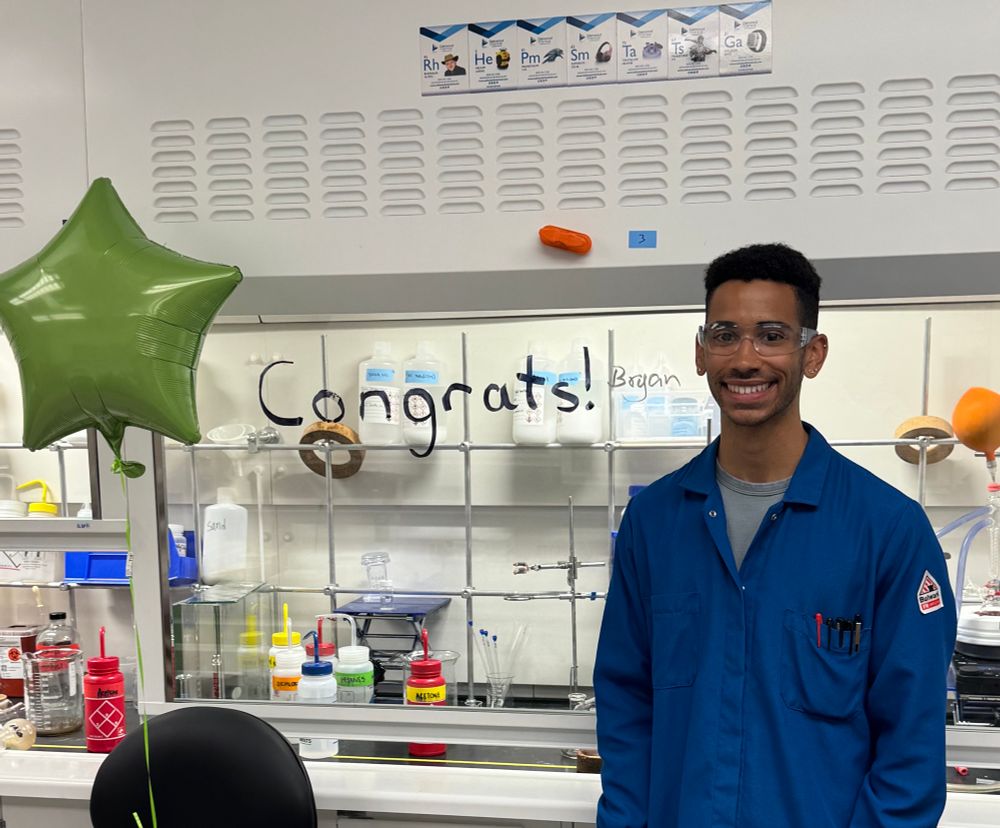
Huge congrats to our very own Bryan Parnitzke for being recognized by an award from the NSF GRFP! We are very proud of you! 🎉🥳
April 8, 2025 at 3:54 PM
Huge congrats to our very own Bryan Parnitzke for being recognized by an award from the NSF GRFP! We are very proud of you! 🎉🥳
San Diego, here we come! For anyone interested in what we've been up to, please consider stopping by one of our talks next week at ACS Spring 2025! #ACSSpring2025 #chemsky

March 20, 2025 at 1:34 AM
San Diego, here we come! For anyone interested in what we've been up to, please consider stopping by one of our talks next week at ACS Spring 2025! #ACSSpring2025 #chemsky

With the Gutierrez group at UCLA, we report a unique mode of electrocatalytic semi-hydrogenation to generate Z-alkenes using a redox mediator strategy. Distortion analyses by DFT reveal a distinct origin of stereoselectivity. Exciting times ahead!
chemrxiv.org/engage/chemr...
chemrxiv.org/engage/chemr...

A Voltage-Controlled Redox Mediator Strategy Enables Electrocatalytic Z-Selective Semi-Hydrogenation
Selective semi-hydrogenation to generate alkenes from alkynes is an invaluable method to access olefins for materials, pharmaceuticals, and nat-ural products. Electrochemical transition-metal-catalyze...
chemrxiv.org
January 17, 2025 at 3:01 PM
With the Gutierrez group at UCLA, we report a unique mode of electrocatalytic semi-hydrogenation to generate Z-alkenes using a redox mediator strategy. Distortion analyses by DFT reveal a distinct origin of stereoselectivity. Exciting times ahead!
chemrxiv.org/engage/chemr...
chemrxiv.org/engage/chemr...
Reposted by Derosa Lab

If you like molecular sandwiches and their applications in biology, don't forget to register to the 2025 International Symposium on Bioorganometallic Chemistry that we will host with @gassergroup.bsky.social in August in Paris.
isbomc25.sciencesconf.org?lang=en
isbomc25.sciencesconf.org?lang=en
January 5, 2025 at 4:47 PM
If you like molecular sandwiches and their applications in biology, don't forget to register to the 2025 International Symposium on Bioorganometallic Chemistry that we will host with @gassergroup.bsky.social in August in Paris.
isbomc25.sciencesconf.org?lang=en
isbomc25.sciencesconf.org?lang=en
Reposted by Derosa Lab
Happy #OPRDitemsOfInterest Day!* Absolute gems from Maulide Engle Schoenebeck and many more! Check it out for a great list of recent synthetic highlights
*it was actually yesterday
#ChemSky
*it was actually yesterday
#ChemSky

Some Items of Interest to Process R&D Chemists and Engineers
OR SEARCH CITATIONS
pubs.acs.org
December 12, 2024 at 12:54 AM
Happy #OPRDitemsOfInterest Day!* Absolute gems from Maulide Engle Schoenebeck and many more! Check it out for a great list of recent synthetic highlights
*it was actually yesterday
#ChemSky
*it was actually yesterday
#ChemSky
Reposted by Derosa Lab
Our OrgChem Starter Pack is growing with already 122 entries, but we will start a volume 2 if we go over the 150 limit!
go.bsky.app/NSEFPFJ
go.bsky.app/NSEFPFJ
December 5, 2024 at 6:37 PM
Our OrgChem Starter Pack is growing with already 122 entries, but we will start a volume 2 if we go over the 150 limit!
go.bsky.app/NSEFPFJ
go.bsky.app/NSEFPFJ
Reposted by Derosa Lab

Introducing a new, automated approach for constructing Zone Diagrams in #Electrochemistry. Check out how it is possible to decipher complexity in electrochemical systems through the lens of geometry, out now in JACS! #ChemSky pubs.acs.org/doi/10.1021/...

A Geometric Interpretation of Kinetic Zone Diagrams in Electrochemistry
Electrochemical systems with increasing complexity are gaining importance in catalytic energy conversion applications. Due to the interplay between transport phenomena and chemical kinetics, predicting optimization is a challenge, with numerous parameters controlling the overall performance. Zone diagrams provide a way to identify specific kinetic regimes and track how variations in the governing parameters translate the system between either adverse or optimal kinetic states. However, the current procedures for constructing zone diagrams are restricted to simplified systems with a minimal number of governing parameters. We present a computationally based method that maps the entire parameter space of multidimensional electrochemical systems and automatically identifies kinetic regimes. Once the current output over a discrete set of parameters is interpreted as a geometric surface, its geometry encodes all of the information needed to construct a zone diagram. Zone boundaries and limiting zones are defined by curved and flat regions, respectively. This geometric framework enables a systematic exploration of the parameter space, which is not readily accessible by analytical or direct numerical methods. This will become increasingly valuable for the rational design of electrochemical systems with intrinsically high complexity.
pubs.acs.org
December 4, 2024 at 3:41 PM
Introducing a new, automated approach for constructing Zone Diagrams in #Electrochemistry. Check out how it is possible to decipher complexity in electrochemical systems through the lens of geometry, out now in JACS! #ChemSky pubs.acs.org/doi/10.1021/...
Reposted by Derosa Lab
The Accounts of Chemical Research on our work on transition metal hydricity is finally out! Thanks to GS (soon to be Dr.) Andrew Cypcar who put in a tremendous amount of work to get it finished! pubs.acs.org/doi/full/10....

Controlling Hydrogen Evolution and CO2 Reduction at Transition Metal Hydrides
ConspectusFuel-forming reactions such as the hydrogen evolution reaction (HER) and CO2 reduction (CO2R) are vital to transitioning to a carbon-neutral economy. The equivalent oxidation reactions are a...
pubs.acs.org
November 26, 2024 at 5:57 PM
The Accounts of Chemical Research on our work on transition metal hydricity is finally out! Thanks to GS (soon to be Dr.) Andrew Cypcar who put in a tremendous amount of work to get it finished! pubs.acs.org/doi/full/10....

Reposted by Derosa Lab

November 13, 2024 at 1:59 AM
Greetings #Chemsky! We are so excited by all of the amazing chemistry discourse and warm welcomes. We are a synthetic organic electrochemistry group studying catalysis. For a recent paper (our first!), feel free to check out the link below:
pubs.acs.org/doi/10.1021/...
pubs.acs.org/doi/10.1021/...

A Voltage-Controlled Strategy for Modular Shono-Type Amination
Shono-type oxidation to generate functionalized heterocycles is a powerful method for late-stage diversification of relevant pharmacophores; however, development beyond oxygen-based nucleophiles remai...
pubs.acs.org
November 19, 2024 at 8:38 PM
Greetings #Chemsky! We are so excited by all of the amazing chemistry discourse and warm welcomes. We are a synthetic organic electrochemistry group studying catalysis. For a recent paper (our first!), feel free to check out the link below:
pubs.acs.org/doi/10.1021/...
pubs.acs.org/doi/10.1021/...