


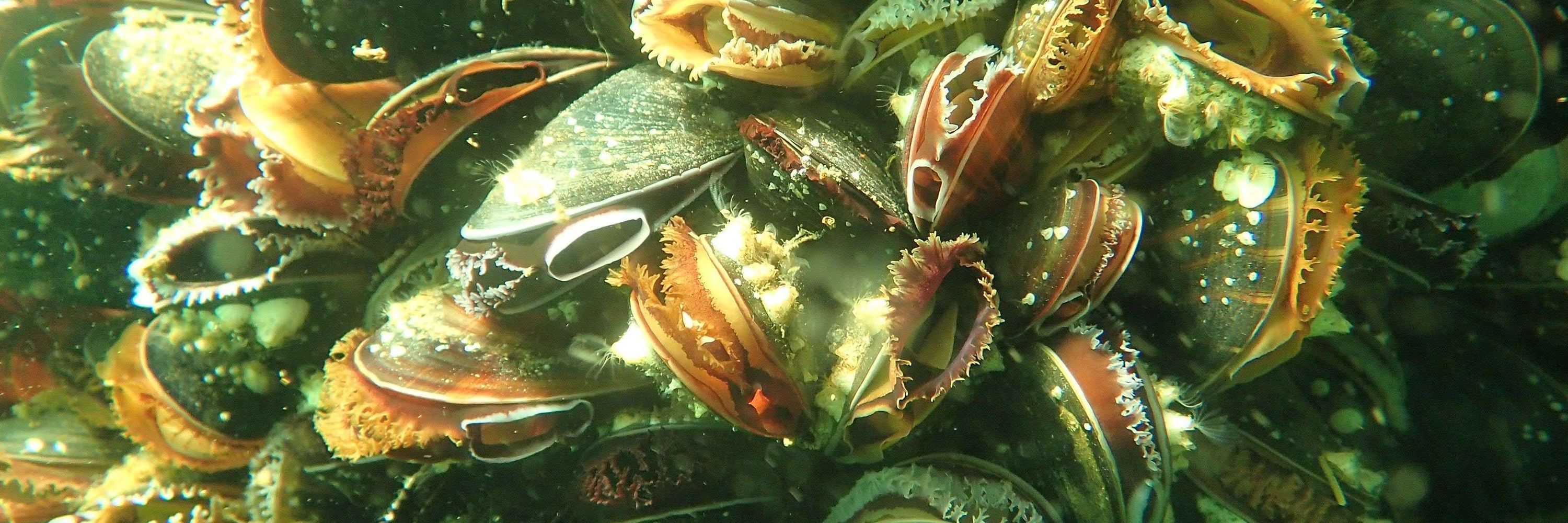

Nicolas Bierne
@couplingdmi.bsky.social
CNRS researcher at @isemevol.bsky.social Montpellier
Population Genetics, Evolution, Marine Biology, Transmissible Cancers
#PopGen #Hybridization #Introgression #MarEvol #Transcan #MusselsAreCool
Population Genetics, Evolution, Marine Biology, Transmissible Cancers
#PopGen #Hybridization #Introgression #MarEvol #Transcan #MusselsAreCool
Reposted by Nicolas Bierne

New paper out: “allopatric” Drosophila species aren’t so allopatric after all. We show that most currently allopatric species pairs probably overlapped in the past and exchanged genes at levels similar to sympatric pairs. @evolletters.bsky.social
doi.org/10.1093/evle... [1/6]
doi.org/10.1093/evle... [1/6]

Genomic analyses in Drosophila do not support the classic allopatric model of speciation
Abstract. The allopatric model of speciation has dominated our understanding of speciation biology and biogeography since the Modern Synthesis. It is uncon
doi.org
January 15, 2026 at 11:58 AM
New paper out: “allopatric” Drosophila species aren’t so allopatric after all. We show that most currently allopatric species pairs probably overlapped in the past and exchanged genes at levels similar to sympatric pairs. @evolletters.bsky.social
doi.org/10.1093/evle... [1/6]
doi.org/10.1093/evle... [1/6]
Two-way native-invasive introgression and structural variants in invasive moth species. Admixture and exchange of adaptive alleles can facilitate adaptation, but this is also true for pests. Amazing work by @henrylnorth.bsky.social, @chrisjiggins.bsky.social and others, with a lot to think about.

I got to think about lots of cool/scary things working on this: (very) rapid adaptation, introgression of structural variants, invasive species, reproductive isolation, pesticide resistance, the precarity of food production. Grateful to have worked on such a big dataset with amazing collaborators
Excited about our new preprint showing bidirectional adaptive introgression between invasive and native crop pests over ecological timescales www.biorxiv.org/content/10.6...
January 4, 2026 at 11:19 AM
Two-way native-invasive introgression and structural variants in invasive moth species. Admixture and exchange of adaptive alleles can facilitate adaptation, but this is also true for pests. Amazing work by @henrylnorth.bsky.social, @chrisjiggins.bsky.social and others, with a lot to think about.
Reposted by Nicolas Bierne

Excited about our new preprint showing bidirectional adaptive introgression between invasive and native crop pests over ecological timescales www.biorxiv.org/content/10.6...

The collision of two genomes threatens global food security
Human activity alters selection pressures and species' ranges, creating opportunities for hybridisation through secondary contact. Ancient hybridization has enabled adaptive radiation, but its role in...
www.biorxiv.org
December 26, 2025 at 11:21 AM
Excited about our new preprint showing bidirectional adaptive introgression between invasive and native crop pests over ecological timescales www.biorxiv.org/content/10.6...
Reposted by Nicolas Bierne
Happy to highlight an essay I wrote together with @marcdemanuel.bsky.social,
@natanaels.bsky.social and Anastasia Stolyarova, trying to think through what sets the mutation rate of a cell type in an animal species: www.biorxiv.org/content/10.6... 1/n
@natanaels.bsky.social and Anastasia Stolyarova, trying to think through what sets the mutation rate of a cell type in an animal species: www.biorxiv.org/content/10.6... 1/n

What sets the mutation rate of a cell type in an animal species?
Germline mutation rates per generation are strikingly similar across animals, despite vast differences in life histories. Analogously, in at least one somatic cell type, mutation rates at the end of l...
www.biorxiv.org
December 22, 2025 at 3:09 PM
Happy to highlight an essay I wrote together with @marcdemanuel.bsky.social,
@natanaels.bsky.social and Anastasia Stolyarova, trying to think through what sets the mutation rate of a cell type in an animal species: www.biorxiv.org/content/10.6... 1/n
@natanaels.bsky.social and Anastasia Stolyarova, trying to think through what sets the mutation rate of a cell type in an animal species: www.biorxiv.org/content/10.6... 1/n
Reposted by Nicolas Bierne

New preprint from the lab on bioRxiv, led by Grace Zhang!
Quick summary: Lots of studies have examined costs and benefits associated with resistance. Most focus on a single stressor, leaving unclear how resistance shapes fitness and evolution under multiple interacting stresses.
Quick summary: Lots of studies have examined costs and benefits associated with resistance. Most focus on a single stressor, leaving unclear how resistance shapes fitness and evolution under multiple interacting stresses.

Context dependence shapes the evolution of glyphosate and herbivory resistance in Ipomoea purpurea https://www.biorxiv.org/content/10.64898/2025.12.20.695696v1
December 23, 2025 at 2:53 PM
New preprint from the lab on bioRxiv, led by Grace Zhang!
Quick summary: Lots of studies have examined costs and benefits associated with resistance. Most focus on a single stressor, leaving unclear how resistance shapes fitness and evolution under multiple interacting stresses.
Quick summary: Lots of studies have examined costs and benefits associated with resistance. Most focus on a single stressor, leaving unclear how resistance shapes fitness and evolution under multiple interacting stresses.
J'ai été interviewé dans l'émission Soyons Nature sur radio campus Montpellier pour expliquer comment l'analyse de l'ADN révèle l'impact des activités humaines sur la biodiversité et l'évolution des espèces marines. www.radiocampusmontpellier.fr/podcast/soyo...

Soyons Nature - 10/12/25 - Radio Campus Montpellier
Dans cette émission nous recevons Nicolas Bierne, directeur de recherche au CNRS à l'Institut des Sciences de l'Évolution de Montpellier dans l'équipe biologie évolution marine, venu nous parler de la...
www.radiocampusmontpellier.fr
December 11, 2025 at 12:15 PM
J'ai été interviewé dans l'émission Soyons Nature sur radio campus Montpellier pour expliquer comment l'analyse de l'ADN révèle l'impact des activités humaines sur la biodiversité et l'évolution des espèces marines. www.radiocampusmontpellier.fr/podcast/soyo...
"les cellules buissonnières" now translated into English with the title "Hidden Guests". I loved this reading and I offered 5 to friends and family for christmas last year, a suggestion for you folks.

Ohhh. Check out this new book review on Hidden Guests by Lise Barnéoud! undark.org/2025/11/28/b...

Book Review: The Strangers Within Us
“Hidden Guests” explores how the emerging field of microchimerism is upending medicine, genetics, and our sense of self.
undark.org
December 4, 2025 at 7:29 PM
"les cellules buissonnières" now translated into English with the title "Hidden Guests". I loved this reading and I offered 5 to friends and family for christmas last year, a suggestion for you folks.
Fatigue 😩
"Conditions d’éligibilité - L’appel est ouvert à des jeunes chercheurs ou chercheuses, de toute nationalité, ayant soutenu leur thèse depuis moins de deux ans à la date de prise de fonction. Cette règle des « moins de deux ans » doit impérativement être respectée"
"Conditions d’éligibilité - L’appel est ouvert à des jeunes chercheurs ou chercheuses, de toute nationalité, ayant soutenu leur thèse depuis moins de deux ans à la date de prise de fonction. Cette règle des « moins de deux ans » doit impérativement être respectée"
December 4, 2025 at 4:26 PM
Fatigue 😩
"Conditions d’éligibilité - L’appel est ouvert à des jeunes chercheurs ou chercheuses, de toute nationalité, ayant soutenu leur thèse depuis moins de deux ans à la date de prise de fonction. Cette règle des « moins de deux ans » doit impérativement être respectée"
"Conditions d’éligibilité - L’appel est ouvert à des jeunes chercheurs ou chercheuses, de toute nationalité, ayant soutenu leur thèse depuis moins de deux ans à la date de prise de fonction. Cette règle des « moins de deux ans » doit impérativement être respectée"
Does anyone here know about Hi-C heatmaps? What do you think of this one? I feel like the patterns of the first and last five chromosomes are different. Would you agree? What do you think that is? Asking for a friend.

December 2, 2025 at 10:52 PM
Does anyone here know about Hi-C heatmaps? What do you think of this one? I feel like the patterns of the first and last five chromosomes are different. Would you agree? What do you think that is? Asking for a friend.
Improving two-step cancer treatment strategies based on evolutionary models, but above all a nice evolutionary rescue model that should be of interest to everyone. #PopGen #CanEcoEvo
Now free to read in Genetics (@genetics-gsa.bsky.social): "Preventing evolutionary rescue in cancer using two-strike therapy" #mathonco study by @srishtipatil.bsky.social, @armaanahmed.bsky.social, Yannick Viossat and me, determining the optimal time to switch treatments. doi.org/10.1093/gene...

Preventing evolutionary rescue in cancer using two-strike therapy
Abstract. First-line cancer treatment frequently fails due to initially rare therapeutic resistance. An important clinical question is then how to schedule
doi.org
November 29, 2025 at 11:16 AM
Improving two-step cancer treatment strategies based on evolutionary models, but above all a nice evolutionary rescue model that should be of interest to everyone. #PopGen #CanEcoEvo
Reposted by Nicolas Bierne

Now free to read in Genetics (@genetics-gsa.bsky.social): "Preventing evolutionary rescue in cancer using two-strike therapy" #mathonco study by @srishtipatil.bsky.social, @armaanahmed.bsky.social, Yannick Viossat and me, determining the optimal time to switch treatments. doi.org/10.1093/gene...
Preventing evolutionary rescue in cancer using two-strike therapy
Abstract. First-line cancer treatment frequently fails due to initially rare therapeutic resistance. An important clinical question is then how to schedule
doi.org
November 29, 2025 at 9:29 AM
Now free to read in Genetics (@genetics-gsa.bsky.social): "Preventing evolutionary rescue in cancer using two-strike therapy" #mathonco study by @srishtipatil.bsky.social, @armaanahmed.bsky.social, Yannick Viossat and me, determining the optimal time to switch treatments. doi.org/10.1093/gene...
Reposted by Nicolas Bierne

We are excited to share our recent work on the surprising robustness of Ancestral Recombination Graph (ARG) inference tools to computational phasing errors, now available on BioRxiv: biorxiv.org/content/10.1....
This work is co-advised by @yundeng.bsky.social and Rasmus Nielsen.
1/7
This work is co-advised by @yundeng.bsky.social and Rasmus Nielsen.
1/7

Robustness of Ancestral Recombination Graph Inference Tools to Phasing Errors
Ancestral Recombination Graphs (ARGs) are fundamental population genetic structures that encode the genealogical history of a sample of haplotypes along the genome. They have recently received substan...
biorxiv.org
November 26, 2025 at 5:09 PM
We are excited to share our recent work on the surprising robustness of Ancestral Recombination Graph (ARG) inference tools to computational phasing errors, now available on BioRxiv: biorxiv.org/content/10.1....
This work is co-advised by @yundeng.bsky.social and Rasmus Nielsen.
1/7
This work is co-advised by @yundeng.bsky.social and Rasmus Nielsen.
1/7
Reposted by Nicolas Bierne

First paper from #TanguyMuller, PhD student in @cbgpmontpellier.bsky.social: Population genomics of incipient allochronic divergence in an infamous moth. #WGS #demography #inbreeding #mutation-load #genome-scan onlinelibrary.wiley.com/doi/10.1111/...

November 28, 2025 at 2:04 PM
First paper from #TanguyMuller, PhD student in @cbgpmontpellier.bsky.social: Population genomics of incipient allochronic divergence in an infamous moth. #WGS #demography #inbreeding #mutation-load #genome-scan onlinelibrary.wiley.com/doi/10.1111/...
Reposted by Nicolas Bierne

Roussel, Suh, @fjruizruano.bsky.social & @amdioncote.bsky.social characterized TE content in naturally occurring killifish hybrids, finding higher TE load and accumulation of Neptune subfamilies in hybrids.
🔗 doi.org/10.1093/molbev/msaf266
#evobio #molbio #TEsky
🔗 doi.org/10.1093/molbev/msaf266
#evobio #molbio #TEsky

Accumulation of a Biparentally Inherited Neptune Transposable Element in Natural Killifish Hybrids (Fundulus diaphanus × F. heteroclitus)
Abstract. Transposable elements (TEs) are abundant selfish genetic elements that can mobilize in their host genome, causing DNA damage, mutations, and chro
doi.org
November 20, 2025 at 2:45 PM
Roussel, Suh, @fjruizruano.bsky.social & @amdioncote.bsky.social characterized TE content in naturally occurring killifish hybrids, finding higher TE load and accumulation of Neptune subfamilies in hybrids.
🔗 doi.org/10.1093/molbev/msaf266
#evobio #molbio #TEsky
🔗 doi.org/10.1093/molbev/msaf266
#evobio #molbio #TEsky
Reposted by Nicolas Bierne

Amanda Sabatino, @jpjahner.bsky.social and I have a new paper on @biorxiv-evobio.bsky.social. Amanda, in her undergraduate thesis work, found variation in Colias colour phenotypes is associated with different metrics of urbanization in Toronto. www.biorxiv.org/content/10.1...

Anthropogenic factors explain wing colour variation in Colias (Lepidoptera: Pieridae) butterflies across the Toronto urbanization gradient
Hybridization, or interbreeding between two previously diverged populations, is increasing due to human influences on the environment. Rates of hybridization might be increasing particularly quickly a...
www.biorxiv.org
November 19, 2025 at 7:10 PM
Amanda Sabatino, @jpjahner.bsky.social and I have a new paper on @biorxiv-evobio.bsky.social. Amanda, in her undergraduate thesis work, found variation in Colias colour phenotypes is associated with different metrics of urbanization in Toronto. www.biorxiv.org/content/10.1...
Reposted by Nicolas Bierne

Seeking a postdoc position?
Balancing selection is a fascinating process: malaria resistance, self-incompatibility,etc. Yet, countless examples remain hidden in genomes!
If this question intrigues you, the project led by Laure Segurel and Violaine Llaurens (Paris + Lyon) is perfect! urlr.me/Huj2De
Balancing selection is a fascinating process: malaria resistance, self-incompatibility,etc. Yet, countless examples remain hidden in genomes!
If this question intrigues you, the project led by Laure Segurel and Violaine Llaurens (Paris + Lyon) is perfect! urlr.me/Huj2De
Portail Emploi CNRS - Offre d'emploi - Post-doctoral fellow (M/F): Assessing the power of current methods to detect balancing selection in population genomic datasets
urlr.me
November 18, 2025 at 10:16 AM
Seeking a postdoc position?
Balancing selection is a fascinating process: malaria resistance, self-incompatibility,etc. Yet, countless examples remain hidden in genomes!
If this question intrigues you, the project led by Laure Segurel and Violaine Llaurens (Paris + Lyon) is perfect! urlr.me/Huj2De
Balancing selection is a fascinating process: malaria resistance, self-incompatibility,etc. Yet, countless examples remain hidden in genomes!
If this question intrigues you, the project led by Laure Segurel and Violaine Llaurens (Paris + Lyon) is perfect! urlr.me/Huj2De
Reposted by Nicolas Bierne
Save the date! On behalf of the Society, I’m delighted to announce that the next International Society for Evolution, Ecology and Cancer conference will be taking place in Hersonissos, Crete, on May 21-24, 2026. Abstract submissions will open soon. More details: www.evocancer.com

November 19, 2025 at 11:06 AM
Save the date! On behalf of the Society, I’m delighted to announce that the next International Society for Evolution, Ecology and Cancer conference will be taking place in Hersonissos, Crete, on May 21-24, 2026. Abstract submissions will open soon. More details: www.evocancer.com
Reposted by Nicolas Bierne
We have another publication out! 🎉🎉🎉
“Hybrids along a natural–anthropogenic gradient: improving policy and management across all levels of biodiversity.”
We explore how to deal with hybrids in conservation — scientifically and practically. A thread 🧵
conbio.onlinelibrary.wiley.com/doi/10.1111/...
“Hybrids along a natural–anthropogenic gradient: improving policy and management across all levels of biodiversity.”
We explore how to deal with hybrids in conservation — scientifically and practically. A thread 🧵
conbio.onlinelibrary.wiley.com/doi/10.1111/...

Hybrids Along a Natural‐Anthropogenic Gradient: Improving Policy and Management Across All Levels of Biodiversity
Hybridization has long been a central topic in evolution and conservation. Recent developments in genomics have increased the ability to detect hybridization, defined here as breeding between species....
conbio.onlinelibrary.wiley.com
November 14, 2025 at 3:37 PM
We have another publication out! 🎉🎉🎉
“Hybrids along a natural–anthropogenic gradient: improving policy and management across all levels of biodiversity.”
We explore how to deal with hybrids in conservation — scientifically and practically. A thread 🧵
conbio.onlinelibrary.wiley.com/doi/10.1111/...
“Hybrids along a natural–anthropogenic gradient: improving policy and management across all levels of biodiversity.”
We explore how to deal with hybrids in conservation — scientifically and practically. A thread 🧵
conbio.onlinelibrary.wiley.com/doi/10.1111/...
Reposted by Nicolas Bierne

Il reste encore des places pour notre formation @ephe-psl.bsky.social à R (27 janvier au 5 février à Paris), avec une focalisation complète sur le traitement de données (pas de statistiques).
Il y a un module pour chaque niveau et chaque besoin ! 👇
#rstats #formationcontinue
Il y a un module pour chaque niveau et chaque besoin ! 👇
#rstats #formationcontinue
Marre de passer vos journées à Ctrl+C/Ctrl+V vos données dans un tableur et devoir tout refaire à cause d'un soucis de formatage imprévu ? 😡
Suivez la formation @ephe-psl.bsky.social (27 janvier au 5 février) pour apprendre à utiliser R pour traiter vos données :👇
www.ephe.psl.eu/formations-q...
Suivez la formation @ephe-psl.bsky.social (27 janvier au 5 février) pour apprendre à utiliser R pour traiter vos données :👇
www.ephe.psl.eu/formations-q...

Apprentissage du logiciel R | École Pratique des Hautes Études
L’EPHE − PSL propose une formation pratique à l’utilisation du logiciel libre R pour la gestion et la manipulation des données avant l’analyse statistique (non traitée dans cette formation).Le contenu...
www.ephe.psl.eu
November 17, 2025 at 9:02 AM
Il reste encore des places pour notre formation @ephe-psl.bsky.social à R (27 janvier au 5 février à Paris), avec une focalisation complète sur le traitement de données (pas de statistiques).
Il y a un module pour chaque niveau et chaque besoin ! 👇
#rstats #formationcontinue
Il y a un module pour chaque niveau et chaque besoin ! 👇
#rstats #formationcontinue
Do you know the ‘a-prize-every-time’ genome scan method? You should. Popular in the mol ecol literature. Take beasts, stress them in the lab, sequence stressed and unstressed, make filters that anyway retains a list of SNPs or genes, look at their functions, claim selection and unfold your story 🍾
November 13, 2025 at 8:55 AM
Do you know the ‘a-prize-every-time’ genome scan method? You should. Popular in the mol ecol literature. Take beasts, stress them in the lab, sequence stressed and unstressed, make filters that anyway retains a list of SNPs or genes, look at their functions, claim selection and unfold your story 🍾
The disappearance (much better word than extinction) of the Neanderthals could be attributed solely to admixture and an asymmetrical demographic wave. The hypothesis takes the form of equations and receives support in this interesting article.
www.nature.com/articles/s41...
www.nature.com/articles/s41...

A simple analytical model for Neanderthal disappearance due to genetic dilution by recurrent small-scale immigrations of modern humans - Scientific Reports
Scientific Reports - A simple analytical model for Neanderthal disappearance due to genetic dilution by recurrent small-scale immigrations of modern humans
www.nature.com
November 10, 2025 at 9:26 AM
The disappearance (much better word than extinction) of the Neanderthals could be attributed solely to admixture and an asymmetrical demographic wave. The hypothesis takes the form of equations and receives support in this interesting article.
www.nature.com/articles/s41...
www.nature.com/articles/s41...
Reposted by Nicolas Bierne
New paper published together with John Welch on hybrid fitness and how it depends on ploidy and # of distinct ancestries, incl some remarkable fits of data & theory 😶. Keen to hear any thoughts/comments/questions! doi.org/10.1093/gene... Thanks to the team @ Genetics for the smooth experience :)

Predicting Hybrid Fitness: The Effects of Ploidy and Complex Ancestry
Abstract. Hybridization between divergent populations places alleles in novel genomic contexts. This can inject adaptive variation – which is useful for br
doi.org
November 9, 2025 at 1:04 PM
New paper published together with John Welch on hybrid fitness and how it depends on ploidy and # of distinct ancestries, incl some remarkable fits of data & theory 😶. Keen to hear any thoughts/comments/questions! doi.org/10.1093/gene... Thanks to the team @ Genetics for the smooth experience :)
Again in Roscoff 🤩

November 6, 2025 at 8:31 AM
Again in Roscoff 🤩
Reposted by Nicolas Bierne

Reminder: we still welcome applications! 📩
November 6, 2025 at 7:36 AM
Reminder: we still welcome applications! 📩
Reposted by Nicolas Bierne

The second Ph.D. chapter of Diane's thesis is out as a preprint. She studied the joint evolution of autopolyploidy and self-fertilization under a gametophytic self-incompatibility context.
Feel free to comment, and congratulations, Diane!
www.biorxiv.org/content/10.1...
Feel free to comment, and congratulations, Diane!
www.biorxiv.org/content/10.1...

Autopolyploid establishment under gametophytic self-incompatibility: the impact of self-fertilization and pollen limitation
Polyploidy is widespread in plants, yet the establishment of neo-polyploids is limited by minority cytotype exclusion (MCE). As polyploidy has been associated with higher selfing rates in empirical st...
www.biorxiv.org
October 31, 2025 at 8:17 AM
The second Ph.D. chapter of Diane's thesis is out as a preprint. She studied the joint evolution of autopolyploidy and self-fertilization under a gametophytic self-incompatibility context.
Feel free to comment, and congratulations, Diane!
www.biorxiv.org/content/10.1...
Feel free to comment, and congratulations, Diane!
www.biorxiv.org/content/10.1...