




Ea Blaabæk
@blaabaek.bsky.social
Sociologist interested in educational and cultural stratification, parenting, and the unequal impact of health shocks. Researcher ROCKWOOL Foundation. Blaabaek.dk
Pinned
Ea Blaabæk
@blaabaek.bsky.social
· Mar 15

Nudging Loan of Children's Books – Quasi-Experimental Evidence from a Library Book Giveaway Program
Libraries play a crucial role in providing children with access to reading materials, which is essential for developing reading skills. This paper examines whether a library book giveaway program w...
www.tandfonline.com
I have a new paper out. 🥳 It’s about libraries, inequality and an intervention trying to get more families to loan more books for their children! 📚📖📓
www.tandfonline.com/doi/full/10....
#library #booksky#sociology #econsky
www.tandfonline.com/doi/full/10....
#library #booksky#sociology #econsky
Reposted by Ea Blaabæk

Experimental evidence that students are more likely to contest grades when they are delivered by an evaluator with a female-sounding name.
"These findings suggest that women in evaluative positions face disproportionate resistance when delivering negative assessments."
"These findings suggest that women in evaluative positions face disproportionate resistance when delivering negative assessments."


December 24, 2025 at 11:21 PM
Experimental evidence that students are more likely to contest grades when they are delivered by an evaluator with a female-sounding name.
"These findings suggest that women in evaluative positions face disproportionate resistance when delivering negative assessments."
"These findings suggest that women in evaluative positions face disproportionate resistance when delivering negative assessments."
Reposted by Ea Blaabæk

New paper out with @kchihaya.bsky.social and @eduardotapia.bsky.social. We show how a tendency to move near kin can preserve patterns of segregation, using a combination of discrete choice models and micro-simulations applied to the case of immigrants and their descendants living in Stockholm.
“Kin Propinquity, Residential Mobility & Segregation”: @benjarvis.bsky.social, @kchihaya.bsky.social & @eduardotapia.bsky.social examine ancestry & segregation; they find ancestry sorting effects are 3X greater than kin propinquity effects. @iasliu.bsky.social read.dukeupress.edu/demography/a...

December 21, 2025 at 7:01 PM
New paper out with @kchihaya.bsky.social and @eduardotapia.bsky.social. We show how a tendency to move near kin can preserve patterns of segregation, using a combination of discrete choice models and micro-simulations applied to the case of immigrants and their descendants living in Stockholm.
Reposted by Ea Blaabæk
People are willing to forgo a significant portion of their earnings—between 12-36% of their wages—to avoid hostile work environments.
Women exhibit a stronger aversion to exclusionary workplaces and environments with sexual harassment.
Women exhibit a stronger aversion to exclusionary workplaces and environments with sexual harassment.


December 18, 2025 at 4:49 PM
People are willing to forgo a significant portion of their earnings—between 12-36% of their wages—to avoid hostile work environments.
Women exhibit a stronger aversion to exclusionary workplaces and environments with sexual harassment.
Women exhibit a stronger aversion to exclusionary workplaces and environments with sexual harassment.
Reposted by Ea Blaabæk
⁉️What do people read into names? ⁉️
✨New publication in Nature’s Scientific Data ✨
When people see an ethnic minority-sounding name, do they infer race, religion, gender, or social background?
🤓First @equalstrength.bsky.social publication 😅
Check it out here: 🧵
✨New publication in Nature’s Scientific Data ✨
When people see an ethnic minority-sounding name, do they infer race, religion, gender, or social background?
🤓First @equalstrength.bsky.social publication 😅
Check it out here: 🧵

The Perception of Names in Experimental Studies on Ethnic Origin: A Cross-National Validation in Europe - Scientific Data
Scientific Data - The Perception of Names in Experimental Studies on Ethnic Origin: A Cross-National Validation in Europe
www.nature.com
December 17, 2025 at 1:07 PM
⁉️What do people read into names? ⁉️
✨New publication in Nature’s Scientific Data ✨
When people see an ethnic minority-sounding name, do they infer race, religion, gender, or social background?
🤓First @equalstrength.bsky.social publication 😅
Check it out here: 🧵
✨New publication in Nature’s Scientific Data ✨
When people see an ethnic minority-sounding name, do they infer race, religion, gender, or social background?
🤓First @equalstrength.bsky.social publication 😅
Check it out here: 🧵
Reposted by Ea Blaabæk

Big new blogpost!
My guide to data visualization, which includes a very long table of contents, tons of charts, and more.
--> Why data visualization matters and how to make charts more effective, clear, transparent, and sometimes, beautiful.
www.scientificdiscovery.dev/p/salonis-gu...
My guide to data visualization, which includes a very long table of contents, tons of charts, and more.
--> Why data visualization matters and how to make charts more effective, clear, transparent, and sometimes, beautiful.
www.scientificdiscovery.dev/p/salonis-gu...

December 9, 2025 at 8:28 PM
Big new blogpost!
My guide to data visualization, which includes a very long table of contents, tons of charts, and more.
--> Why data visualization matters and how to make charts more effective, clear, transparent, and sometimes, beautiful.
www.scientificdiscovery.dev/p/salonis-gu...
My guide to data visualization, which includes a very long table of contents, tons of charts, and more.
--> Why data visualization matters and how to make charts more effective, clear, transparent, and sometimes, beautiful.
www.scientificdiscovery.dev/p/salonis-gu...
Reposted by Ea Blaabæk

Our #menopause #penalty paper is now available as @rfberlin.bsky.social DP!👇🏻
@rginja.bsky.social @bartonwillage.com
@rginja.bsky.social @bartonwillage.com

🆕 RFBerlin Discussion Paper!
Gabriella Conti, Rita Ginja, Petra Persson & Barton Willage quantify the "menopause penalty" and its effects on earnings, job stability, and labor-market participation.
🔗 www.rfberlin.com/wp-content/u...
Gabriella Conti, Rita Ginja, Petra Persson & Barton Willage quantify the "menopause penalty" and its effects on earnings, job stability, and labor-market participation.
🔗 www.rfberlin.com/wp-content/u...

December 9, 2025 at 12:44 PM
Our #menopause #penalty paper is now available as @rfberlin.bsky.social DP!👇🏻
@rginja.bsky.social @bartonwillage.com
@rginja.bsky.social @bartonwillage.com
Reposted by Ea Blaabæk

📢 New dataset for researchers!
The new European Parenting Leave Policies (EPLP) Dataset tracks parenting leave regulations over five decades! It provides harmonised data on maternity, co-parent, paid parental, and job-protected leave across 21 countries from 1970 to 2024.
🔗 eplp-dataset.org
The new European Parenting Leave Policies (EPLP) Dataset tracks parenting leave regulations over five decades! It provides harmonised data on maternity, co-parent, paid parental, and job-protected leave across 21 countries from 1970 to 2024.
🔗 eplp-dataset.org

December 3, 2025 at 7:58 AM
📢 New dataset for researchers!
The new European Parenting Leave Policies (EPLP) Dataset tracks parenting leave regulations over five decades! It provides harmonised data on maternity, co-parent, paid parental, and job-protected leave across 21 countries from 1970 to 2024.
🔗 eplp-dataset.org
The new European Parenting Leave Policies (EPLP) Dataset tracks parenting leave regulations over five decades! It provides harmonised data on maternity, co-parent, paid parental, and job-protected leave across 21 countries from 1970 to 2024.
🔗 eplp-dataset.org
Reposted by Ea Blaabæk

📢New publication:
The poor want redistribution regardless of whether they think society is meritocratic.
🎉 Big congrats to my former supervisees — now co-authors, @irenepaneda.bsky.social, @jonnekamphorst.bsky.social, and Bala Battu!
🔗 www.sciencedirect.com/science/arti...
The poor want redistribution regardless of whether they think society is meritocratic.
🎉 Big congrats to my former supervisees — now co-authors, @irenepaneda.bsky.social, @jonnekamphorst.bsky.social, and Bala Battu!
🔗 www.sciencedirect.com/science/arti...

The relevance of meritocratic beliefs for redistributive preferences increases with income
A leading explanation for why in democratic societies the rich are not taxed more is that meritocratic beliefs breed tolerance for inequality. We prob…
www.sciencedirect.com
November 29, 2025 at 9:48 AM
📢New publication:
The poor want redistribution regardless of whether they think society is meritocratic.
🎉 Big congrats to my former supervisees — now co-authors, @irenepaneda.bsky.social, @jonnekamphorst.bsky.social, and Bala Battu!
🔗 www.sciencedirect.com/science/arti...
The poor want redistribution regardless of whether they think society is meritocratic.
🎉 Big congrats to my former supervisees — now co-authors, @irenepaneda.bsky.social, @jonnekamphorst.bsky.social, and Bala Battu!
🔗 www.sciencedirect.com/science/arti...
Reposted by Ea Blaabæk

Look ma I'm on substack! (Courtesy of @toteraltermann.bsky.social)
wondrousmachine.substack.com/p/default
wondrousmachine.substack.com/p/default

November 26, 2025 at 4:11 PM
Look ma I'm on substack! (Courtesy of @toteraltermann.bsky.social)
wondrousmachine.substack.com/p/default
wondrousmachine.substack.com/p/default
Reposted by Ea Blaabæk

*Women receive substantially lower "potential" ratings despite receiving higher performance ratings
*Differences in potential ratings account for half of the gender promotion gap
*Women’s lower potential ratings do not reflect future performance: women subsequently outperform male colleagues
*Differences in potential ratings account for half of the gender promotion gap
*Women’s lower potential ratings do not reflect future performance: women subsequently outperform male colleagues

Forthcoming in the AER: "“Potential” and the Gender Promotion Gap" by Alan Benson, Danielle Li, and Kelly Shue. www.aeaweb.org/articles?id=...
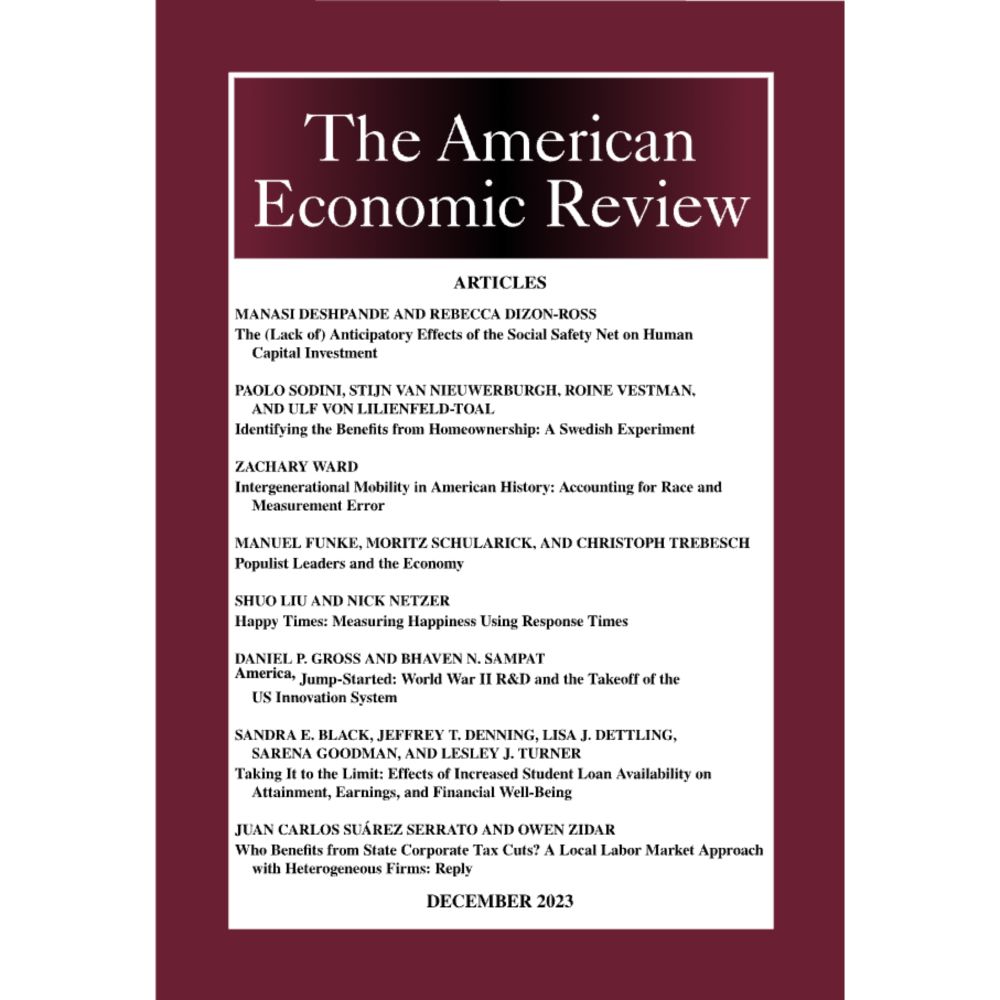
“Potential” and the Gender Promotion Gap
(Forthcoming Article) - We show that subjective assessments of employee “potential” contribute to gender gaps
in promotion and pay. Using data on 29,809 management-track employees from a
large retail ...
www.aeaweb.org
November 10, 2025 at 2:54 PM
*Women receive substantially lower "potential" ratings despite receiving higher performance ratings
*Differences in potential ratings account for half of the gender promotion gap
*Women’s lower potential ratings do not reflect future performance: women subsequently outperform male colleagues
*Differences in potential ratings account for half of the gender promotion gap
*Women’s lower potential ratings do not reflect future performance: women subsequently outperform male colleagues
Reposted by Ea Blaabæk

I have decided to make the final chapter of my cumulative dissertation available as a preprint: doi.org/10.31235/osf...

October 29, 2025 at 6:44 PM
I have decided to make the final chapter of my cumulative dissertation available as a preprint: doi.org/10.31235/osf...
Reposted by Ea Blaabæk
Seneste DØR rapport:
Børnenes trivsel og fravær i skolen forværres i årene til henvisning til udredning i børne- og ungdomspsykiatrien
Længere ventetid fra barnets henvisning til udredningen mindsker især mødrenes arbejdstid
Politiske fokus: ventetid & indsatskvalitet
dors.dk/vismandsrapp...
Børnenes trivsel og fravær i skolen forværres i årene til henvisning til udredning i børne- og ungdomspsykiatrien
Længere ventetid fra barnets henvisning til udredningen mindsker især mødrenes arbejdstid
Politiske fokus: ventetid & indsatskvalitet
dors.dk/vismandsrapp...

October 26, 2025 at 6:37 AM
Seneste DØR rapport:
Børnenes trivsel og fravær i skolen forværres i årene til henvisning til udredning i børne- og ungdomspsykiatrien
Længere ventetid fra barnets henvisning til udredningen mindsker især mødrenes arbejdstid
Politiske fokus: ventetid & indsatskvalitet
dors.dk/vismandsrapp...
Børnenes trivsel og fravær i skolen forværres i årene til henvisning til udredning i børne- og ungdomspsykiatrien
Længere ventetid fra barnets henvisning til udredningen mindsker især mødrenes arbejdstid
Politiske fokus: ventetid & indsatskvalitet
dors.dk/vismandsrapp...
Reposted by Ea Blaabæk

New article out in @sociusjournal.bsky.social.
It shows how closely linked motherhood penalties 🤰📉 and gender inequalities 👨💼💰👩💼 are by studying many local labour markets.
Thread 👇
journals.sagepub.com/doi/10.1177/...
It shows how closely linked motherhood penalties 🤰📉 and gender inequalities 👨💼💰👩💼 are by studying many local labour markets.
Thread 👇
journals.sagepub.com/doi/10.1177/...


October 13, 2025 at 4:37 PM
New article out in @sociusjournal.bsky.social.
It shows how closely linked motherhood penalties 🤰📉 and gender inequalities 👨💼💰👩💼 are by studying many local labour markets.
Thread 👇
journals.sagepub.com/doi/10.1177/...
It shows how closely linked motherhood penalties 🤰📉 and gender inequalities 👨💼💰👩💼 are by studying many local labour markets.
Thread 👇
journals.sagepub.com/doi/10.1177/...
Reposted by Ea Blaabæk

🚨New publication alert🚨
I'm thrilled Economics of Education Review has just published my work w/ @abbyfrancis.bsky.social:
"School enrollment shifts five years after the pandemic"
Abstract below, but read the next few posts for the story told via a handful of graphs.
doi.org/10.1016/j.ec...
I'm thrilled Economics of Education Review has just published my work w/ @abbyfrancis.bsky.social:
"School enrollment shifts five years after the pandemic"
Abstract below, but read the next few posts for the story told via a handful of graphs.
doi.org/10.1016/j.ec...

October 24, 2025 at 12:33 PM
🚨New publication alert🚨
I'm thrilled Economics of Education Review has just published my work w/ @abbyfrancis.bsky.social:
"School enrollment shifts five years after the pandemic"
Abstract below, but read the next few posts for the story told via a handful of graphs.
doi.org/10.1016/j.ec...
I'm thrilled Economics of Education Review has just published my work w/ @abbyfrancis.bsky.social:
"School enrollment shifts five years after the pandemic"
Abstract below, but read the next few posts for the story told via a handful of graphs.
doi.org/10.1016/j.ec...
Reposted by Ea Blaabæk

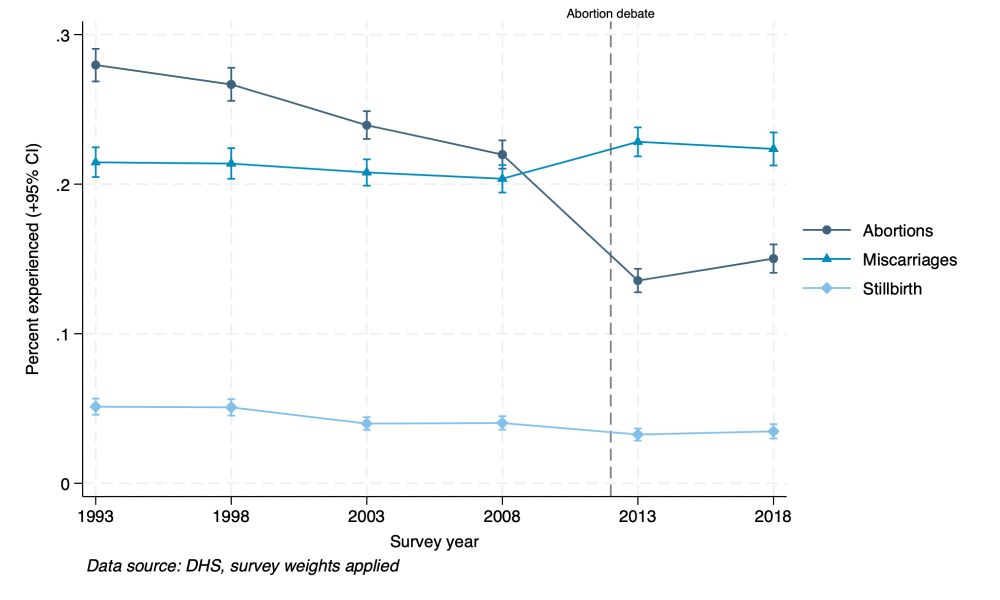
What happens when abortion access becomes restricted even without a law officially passing?
With Francesco Billari and @aksoyundan.bsky.social, we investigated how incidence of abortion, miscarriage and stillbirth changed under the anti-abortion campaign in Turkey.
With Francesco Billari and @aksoyundan.bsky.social, we investigated how incidence of abortion, miscarriage and stillbirth changed under the anti-abortion campaign in Turkey.
October 22, 2025 at 10:18 AM
What happens when abortion access becomes restricted even without a law officially passing?
With Francesco Billari and @aksoyundan.bsky.social, we investigated how incidence of abortion, miscarriage and stillbirth changed under the anti-abortion campaign in Turkey.
With Francesco Billari and @aksoyundan.bsky.social, we investigated how incidence of abortion, miscarriage and stillbirth changed under the anti-abortion campaign in Turkey.
Reposted by Ea Blaabæk

📣 Let's talk about menopause and the midlife collision. 📣
Our new qualitative paper in Social Science and Medicine investigates how menopause intersects with a range of pressures and challenges that women experience during midlife.
Free to read here ▶️
www.sciencedirect.com/science/arti...
Our new qualitative paper in Social Science and Medicine investigates how menopause intersects with a range of pressures and challenges that women experience during midlife.
Free to read here ▶️
www.sciencedirect.com/science/arti...

October 21, 2025 at 1:00 AM
📣 Let's talk about menopause and the midlife collision. 📣
Our new qualitative paper in Social Science and Medicine investigates how menopause intersects with a range of pressures and challenges that women experience during midlife.
Free to read here ▶️
www.sciencedirect.com/science/arti...
Our new qualitative paper in Social Science and Medicine investigates how menopause intersects with a range of pressures and challenges that women experience during midlife.
Free to read here ▶️
www.sciencedirect.com/science/arti...
Reposted by Ea Blaabæk

Call for Research Proposals: GESIS Panel.dbd
We offer researchers the opportunity to conduct their studies for free!
We grant:
Access to ~ 7,000 participants
Free participation in surveys & web tracking
Deadline: Nov 1, 2025
Details: www.gesis.org/en/gesis-pan...
We look forward to your proposals!
We offer researchers the opportunity to conduct their studies for free!
We grant:
Access to ~ 7,000 participants
Free participation in surveys & web tracking
Deadline: Nov 1, 2025
Details: www.gesis.org/en/gesis-pan...
We look forward to your proposals!

October 15, 2025 at 2:14 PM
Call for Research Proposals: GESIS Panel.dbd
We offer researchers the opportunity to conduct their studies for free!
We grant:
Access to ~ 7,000 participants
Free participation in surveys & web tracking
Deadline: Nov 1, 2025
Details: www.gesis.org/en/gesis-pan...
We look forward to your proposals!
We offer researchers the opportunity to conduct their studies for free!
We grant:
Access to ~ 7,000 participants
Free participation in surveys & web tracking
Deadline: Nov 1, 2025
Details: www.gesis.org/en/gesis-pan...
We look forward to your proposals!
Reposted by Ea Blaabæk

I'm excited to share my new paper: "What Do Culture Vouchers Really Buy? Evidence from France's ‘pass Culture’ Policy Effects" now published on SocArxiv. This research dives into a major cultural policy experiment.
doi.org/10.31235/osf...
#sociology #culturalpolicy #culturalconsumption
doi.org/10.31235/osf...
#sociology #culturalpolicy #culturalconsumption


October 15, 2025 at 2:13 PM
I'm excited to share my new paper: "What Do Culture Vouchers Really Buy? Evidence from France's ‘pass Culture’ Policy Effects" now published on SocArxiv. This research dives into a major cultural policy experiment.
doi.org/10.31235/osf...
#sociology #culturalpolicy #culturalconsumption
doi.org/10.31235/osf...
#sociology #culturalpolicy #culturalconsumption
Reposted by Ea Blaabæk

Applications are open for our postdoctoral scholars program! These 2-year positions start in Aug. 2026 and are based at the GC CUNY Stone Center. One is focused on #mobility and #poverty, the other on #wealth and/or wealth inequality. Apply by Nov. 3!
#EconSky #Sociology #PoliSciSky
bit.ly/40TZR6J
#EconSky #Sociology #PoliSciSky
bit.ly/40TZR6J

Applications Are Open for Two Postdoctoral Positions at the GC CUNY Stone Center - Stone Center on Socio-Economic Inequality
The Stone Center on Socio-Economic Inequality is seeking applicants for an eighth cohort of postdoctoral scholars. These full-time, two-year positions will begin in August 2026.
stonecenter.gc.cuny.edu
September 9, 2025 at 1:14 PM
Applications are open for our postdoctoral scholars program! These 2-year positions start in Aug. 2026 and are based at the GC CUNY Stone Center. One is focused on #mobility and #poverty, the other on #wealth and/or wealth inequality. Apply by Nov. 3!
#EconSky #Sociology #PoliSciSky
bit.ly/40TZR6J
#EconSky #Sociology #PoliSciSky
bit.ly/40TZR6J
Reposted by Ea Blaabæk

New work: do teachers grade some student types more generously than others? (yes)
Important evidence for policymakers considering reducing the use of standardised testing.
And a great paper to work on with my colleagues @lindseymacmillan.bsky.social @opmc1.bsky.social @richmurphy-econ.bsky.social
Important evidence for policymakers considering reducing the use of standardised testing.
And a great paper to work on with my colleagues @lindseymacmillan.bsky.social @opmc1.bsky.social @richmurphy-econ.bsky.social

🚨🚨New working paper!! 🚨🚨
"Measuring gaps in teacher judgements: A new approach"
with @lindseymacmillan.bsky.social, @richmurphy-econ.bsky.social and @gillwyness.bsky.social
Read the paper here: econpapers.repec.org/paper/uclcep...
🧵below
"Measuring gaps in teacher judgements: A new approach"
with @lindseymacmillan.bsky.social, @richmurphy-econ.bsky.social and @gillwyness.bsky.social
Read the paper here: econpapers.repec.org/paper/uclcep...
🧵below
EconPapers: Measuring systematic gaps in teacher judgement: A new approach
By Oliver Cassagneau-Francis, Lindsey Macmillan, Richard Murphy and Gill Wyness; Abstract: We propose a new approach to test for systematic biases in teacher evaluations. We exploit a setting where te...
econpapers.repec.org
October 14, 2025 at 11:25 AM
New work: do teachers grade some student types more generously than others? (yes)
Important evidence for policymakers considering reducing the use of standardised testing.
And a great paper to work on with my colleagues @lindseymacmillan.bsky.social @opmc1.bsky.social @richmurphy-econ.bsky.social
Important evidence for policymakers considering reducing the use of standardised testing.
And a great paper to work on with my colleagues @lindseymacmillan.bsky.social @opmc1.bsky.social @richmurphy-econ.bsky.social
Reposted by Ea Blaabæk

Dating your boss comes with risks and rewards.
New research from Finland shows subordinatesä earnings rise 6% after starting a relationship with their manager but fall 18% after a breakup.
Unsurprisingly, it also hurts team morale and retention.
www.nber.org/papers/w34346
New research from Finland shows subordinatesä earnings rise 6% after starting a relationship with their manager but fall 18% after a breakup.
Unsurprisingly, it also hurts team morale and retention.
www.nber.org/papers/w34346

October 13, 2025 at 2:23 PM
Dating your boss comes with risks and rewards.
New research from Finland shows subordinatesä earnings rise 6% after starting a relationship with their manager but fall 18% after a breakup.
Unsurprisingly, it also hurts team morale and retention.
www.nber.org/papers/w34346
New research from Finland shows subordinatesä earnings rise 6% after starting a relationship with their manager but fall 18% after a breakup.
Unsurprisingly, it also hurts team morale and retention.
www.nber.org/papers/w34346
Reposted by Ea Blaabæk

The GSS asked the same people about their childhood income rank three different times. 56% changed their answer, even though what was trying to be measured couldn’t change! We dig into this in a new article at @socialindicators.bsky.social.
doi.org/10.1007/s112...
🧵👇 (1/5)
doi.org/10.1007/s112...
🧵👇 (1/5)
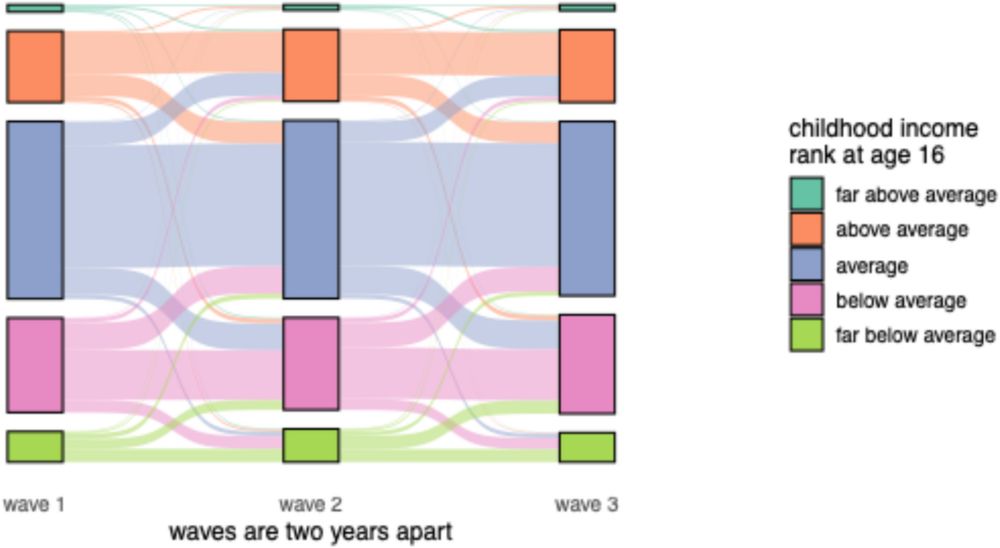
Growing up Different(ly than Last Time We Asked): Social Status and Changing Reports of Childhood Income Rank - Social Indicators Research
How we remember our past can be shaped by the realities of our present. This study examines how changes to present circumstances influence retrospective reports of family income rank at age 16. While retrospective survey data can be used to assess the long-term effects of childhood conditions, present-day circumstances may “anchor” memories, causing shifts in how individuals recall and report past experiences. Using panel data from the 2006–2014 General Social Surveys (8,602 observations from 2,883 individuals in the United States), we analyze how changes in objective and subjective indicators of current social status—income, financial satisfaction, and perceived income relative to others—are associated with changes in reports of childhood income rank, and how this varies by sex and race/ethnicity. Fixed-effects models reveal no significant association between changes in income and in childhood income rank. However, changes in subjective measures of social status show contrasting effects, as increases in current financial satisfaction are associated with decreases in childhood income rank, but increases in current perceived relative income are associated with increases in childhood income rank. We argue these opposing effects follow from theories of anchoring in recall bias. We further find these effects are stronger among males but are consistent across racial/ethnic groups. This demographic heterogeneity suggests that recall bias is not evenly distributed across the population and has important implications for how different groups perceive their own pasts. Our findings further highlight the malleability of retrospective perceptions and their sensitivity to current social conditions, offering methodological insights into survey reliability and recall bias.
doi.org
October 10, 2025 at 2:05 PM
The GSS asked the same people about their childhood income rank three different times. 56% changed their answer, even though what was trying to be measured couldn’t change! We dig into this in a new article at @socialindicators.bsky.social.
doi.org/10.1007/s112...
🧵👇 (1/5)
doi.org/10.1007/s112...
🧵👇 (1/5)
Reposted by Ea Blaabæk
Inspiring paper on social stratification of library borrowing!
Read here: doi.org/10.1093/esr/...
▶️"...although cultural tastes always seem to be socially stratified, the type of stratification likely depends on the nature of the wider inequalities within a given context"
Read here: doi.org/10.1093/esr/...
▶️"...although cultural tastes always seem to be socially stratified, the type of stratification likely depends on the nature of the wider inequalities within a given context"

October 8, 2025 at 1:19 PM
Inspiring paper on social stratification of library borrowing!
Read here: doi.org/10.1093/esr/...
▶️"...although cultural tastes always seem to be socially stratified, the type of stratification likely depends on the nature of the wider inequalities within a given context"
Read here: doi.org/10.1093/esr/...
▶️"...although cultural tastes always seem to be socially stratified, the type of stratification likely depends on the nature of the wider inequalities within a given context"
Reposted by Ea Blaabæk

Do school meals work?
No: according to a new meta study by Sara Ayllón and Samuel Lad summarizing results from 42 studies.
I discuss that study in slightly more detail here: hanshenriksievertsen.substack.com/p/the-causal...
No: according to a new meta study by Sara Ayllón and Samuel Lad summarizing results from 42 studies.
I discuss that study in slightly more detail here: hanshenriksievertsen.substack.com/p/the-causal...

October 8, 2025 at 1:38 PM
Do school meals work?
No: according to a new meta study by Sara Ayllón and Samuel Lad summarizing results from 42 studies.
I discuss that study in slightly more detail here: hanshenriksievertsen.substack.com/p/the-causal...
No: according to a new meta study by Sara Ayllón and Samuel Lad summarizing results from 42 studies.
I discuss that study in slightly more detail here: hanshenriksievertsen.substack.com/p/the-causal...
Reposted by Ea Blaabæk

📣 New special issue in the Journal of Economic Inequality on inequality perceptions and fairness judgments:
This collection of papers focuses on the core issues of individual and social preferences in the field of inequality.
Read more ⬇️
buff.ly/CWl4ADl
This collection of papers focuses on the core issues of individual and social preferences in the field of inequality.
Read more ⬇️
buff.ly/CWl4ADl

Measuring distributional preferences: opportunities and challenges - The Journal of Economic Inequality
This article introduces, and puts in context, the fourteen papers in the special issue, "Inequality perceptions and fairness judgments."
link.springer.com
October 8, 2025 at 12:15 PM
📣 New special issue in the Journal of Economic Inequality on inequality perceptions and fairness judgments:
This collection of papers focuses on the core issues of individual and social preferences in the field of inequality.
Read more ⬇️
buff.ly/CWl4ADl
This collection of papers focuses on the core issues of individual and social preferences in the field of inequality.
Read more ⬇️
buff.ly/CWl4ADl