




Macrobe qui aime les microbes
http://www.shapirolab.ca/
Jesse M. Shapiro is an American economist who has served as the George Gund Professor of Economics and Business Administration at Harvard University since 2022. He was previously the George S. and Nancy B. Parker Professor of Economics at Brown University from 2015 to 2019, and the Eastman Professor of Political Economy at Brown from 2019 to 2021. He received a MacArthur Fellowship in 2021. .. more
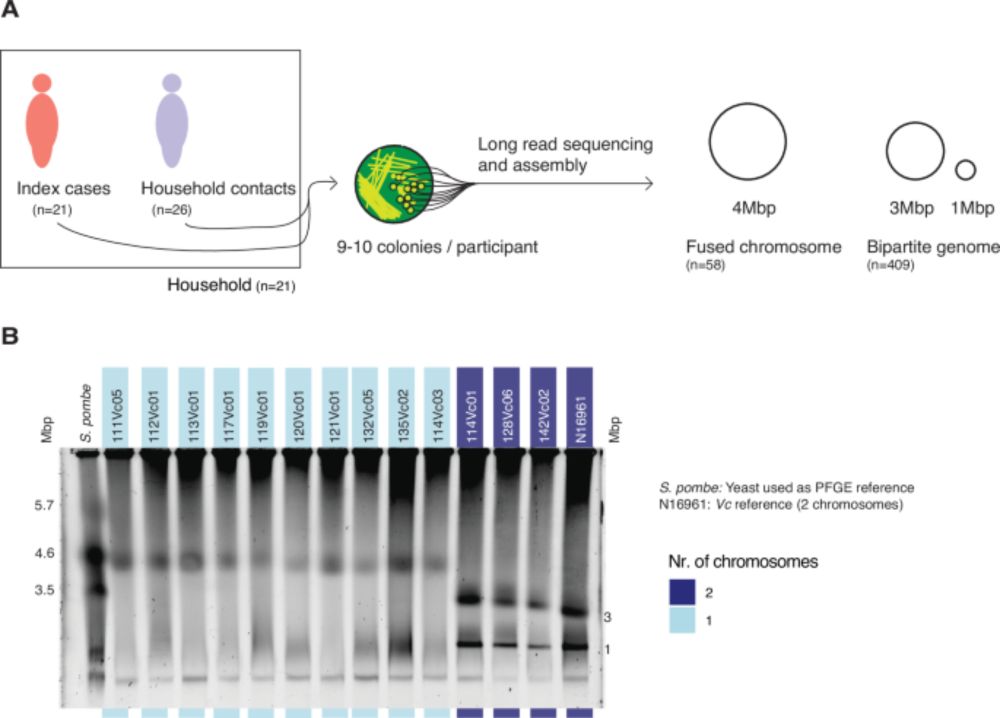
Vibrio cholerae, which is "supposed to" have TWO circular chromosomes (3 + 1 million base pairs) often has just ONE fused chromosome (4 Mbp).
www.nature.com/articles/s41...
(1/n)
Reposted by Jesse M. Shapiro


#methylobacterium #lichenibacterium #lichenifustis #lichenihabitans and even more to discover in #Hyphomicrobiales (former Rhizobiales) inhabiting leave surfaces!
www.sciencedirect.com/science/arti...

Thanks to @gmdouglas.bsky.social & @cyanophage.bsky.social for herding the cats and doing most of the work!
/fin

1) Co-occurrence (physical proximity) drives HGT.
2) HGT drives co-occurrence?
Answer #1 is the classic, but I think #2 deserves attention: HGT of habitat-specific genes allows species sharing those genes to thrive in a habitat, and thus to co-occur.
5/n

(4/n)


www.nature.com/articles/s41...
(2/n)

A big analysis of ocean genomes & metagenomes co-led by former postdocs, now PIs, @gmdouglas.bsky.social & @cyanophage.bsky.social along with co-PIs @lbobay.bsky.social & Samuel Chaffron.
A few highlights... 🧵 (1/n)
doi.org/10.1093/isme...
Reposted by Jesse M. Shapiro


thewalrus.ca/quebecs-olym...


Reposted by Jesse M. Shapiro, Simon Roux


New work with @ckarakoc.bsky.social and @shoestrapped.bsky.social in @pnas.org
Reposted by Jesse M. Shapiro

Reposted by Jonathan A. Eisen, Jesse M. Shapiro


a) correcting errors in 4.5 million genomes & their phylogeny
b) improving representation of the Global South in public data
www.nature.com/articles/s41...
(thread 1/n)
Reposted by Jonathan A. Eisen, Jesse M. Shapiro, Alan McNally


Fitting a mechanistic model to 450 species from allthebacteria.org suggesting fast vs slow gene exchange (i.e. amount of MGEs) is a major differentiating factor, correlated with phylogeny rather than lifestyle
