




Christian Bick
@bickmath.bsky.social
Dynamics, Networks, and Dynamics. Based at VU Amsterdam but also roaming around Exeter, Munich, and Oxford (family permitting). Personal webpage at https://www.math.vu.nl/~bick/ and more social media at https://linktr.ee/cbick.
Fantastic, well deserved.
January 5, 2026 at 8:50 PM
Fantastic, well deserved.
Simply: The dynamics themselves do not go away, but making things more generic helps understand how they organize the dynamics more generally.
December 15, 2025 at 8:24 AM
Simply: The dynamics themselves do not go away, but making things more generic helps understand how they organize the dynamics more generally.
Not the interactions themselves. Sometimes they are just too special and give rise to extra symmetries.
December 15, 2025 at 8:20 AM
Not the interactions themselves. Sometimes they are just too special and give rise to extra symmetries.
Let's break some structures imposed by higher-order interactions! We compute how things deform and what remains when continuous symmetries are broken. For now freely available at www.aimsciences.org/article/doi/... (but also at arXiv:2408.02119).

Dynamics on invariant tori emerging through forced symmetry breaking in phase oscillator networks
We consider synchrony patterns in coupled phase oscillator networks that correspond to invariant tori. For specific nongeneric coupling, these tori are equilibria relative to a continuous symmetry act...
www.aimsciences.org
December 15, 2025 at 8:12 AM
Let's break some structures imposed by higher-order interactions! We compute how things deform and what remains when continuous symmetries are broken. For now freely available at www.aimsciences.org/article/doi/... (but also at arXiv:2408.02119).
A summary of the results are now also part of a @oxfordmathematics.bsky.social Research Case Study: www.maths.ox.ac.uk/node/74552
Reducing the dimensions of adaptive networks - a case study by Christian Bick | Mathematical Institute
www.maths.ox.ac.uk
November 4, 2025 at 7:52 AM
A summary of the results are now also part of a @oxfordmathematics.bsky.social Research Case Study: www.maths.ox.ac.uk/node/74552
"Higher-order phase reduction for delay-coupled oscillators beyond the phase-shift approximation" now on the arXiv at arxiv.org/abs/2510.27524.

Higher-order phase reduction for delay-coupled oscillators beyond the phase-shift approximation
Network interactions between dynamical units are often subject to time delay. We develop a phase reduction method for delay-coupled oscillator networks. The method is based on rewriting the delay-diff...
arxiv.org
November 3, 2025 at 7:31 AM
"Higher-order phase reduction for delay-coupled oscillators beyond the phase-shift approximation" now on the arXiv at arxiv.org/abs/2510.27524.
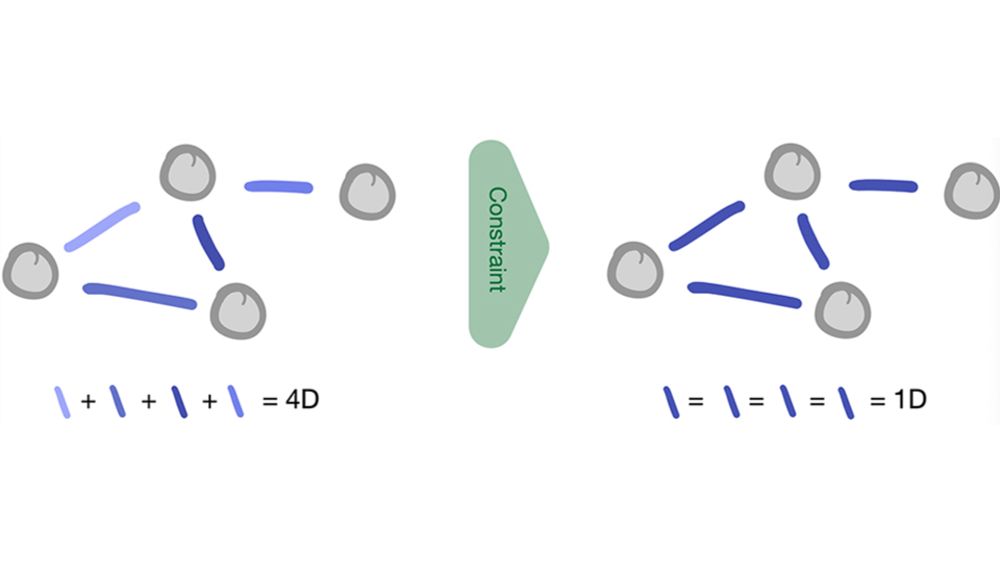
The nice summary "Reducing the dimensions of adaptive networks" for a broader audience was published alongside the paper at doi.org/10.1063/10.0...
Reducing the dimensions of adaptive networks
Framework for decreasing the dimensionality of complex systems facilitates analysis of complexity.
doi.org
October 28, 2025 at 4:01 PM
The nice summary "Reducing the dimensions of adaptive networks" for a broader audience was published alongside the paper at doi.org/10.1063/10.0...
This motivates new mathematical insights into the multiple time scale dynamics of adaptive networks. And opens up questions how constraints and adaptive dependency is realized in real world adaptive networks.
October 28, 2025 at 4:01 PM
This motivates new mathematical insights into the multiple time scale dynamics of adaptive networks. And opens up questions how constraints and adaptive dependency is realized in real world adaptive networks.
We introduce constraints to the adaptive dynamics as a way to reduce dimensionality. These may be intrinsic, for example, if the adaptation rule is nondirectional. Or they may be forced by a homeostasis mechanism.
October 28, 2025 at 4:01 PM
We introduce constraints to the adaptive dynamics as a way to reduce dimensionality. These may be intrinsic, for example, if the adaptation rule is nondirectional. Or they may be forced by a homeostasis mechanism.
Adaptivity is a crucial ingredient of many networked systems, but a key issue is their high-dimensionality. A dense network of N nodes has O(N^2) adaptive connections.
October 28, 2025 at 4:01 PM
Adaptivity is a crucial ingredient of many networked systems, but a key issue is their high-dimensionality. A dense network of N nodes has O(N^2) adaptive connections.
New paper with @math-martens.bsky.social on "Multiple timescale dynamics of network adaptation with constraints" now available Open Access in Chaos: doi.org/10.1063/5.02...

Multiple timescale dynamics of network adaptation with constraints
Adaptive network dynamical systems describe the co-evolution of dynamical quantities on the nodes and the dynamics of the network connections themselves. For de
doi.org
October 28, 2025 at 4:01 PM
New paper with @math-martens.bsky.social on "Multiple timescale dynamics of network adaptation with constraints" now available Open Access in Chaos: doi.org/10.1063/5.02...
Reposted by Christian Bick
🥼Global South Fellowship!
DIEP is co-hosting one fellowship for a researcher from the Global South to work on subjects related to the Research Priority Area: Emergent Phenomena in Society in Amsterdam!
🚨Deadline to apply: 15/11 midnight
Please share!
More info: www.uva.nl/en/about-the...
DIEP is co-hosting one fellowship for a researcher from the Global South to work on subjects related to the Research Priority Area: Emergent Phenomena in Society in Amsterdam!
🚨Deadline to apply: 15/11 midnight
Please share!
More info: www.uva.nl/en/about-the...

Global South Fellowship Scheme
The Global South Plan of the Faculty of Science (FNWI) at the University of Amsterdam (UvA) offers four fellowships to talented scientists from the Global South to visit our Faculty for a few months a...
www.uva.nl
September 19, 2025 at 11:15 AM
🥼Global South Fellowship!
DIEP is co-hosting one fellowship for a researcher from the Global South to work on subjects related to the Research Priority Area: Emergent Phenomena in Society in Amsterdam!
🚨Deadline to apply: 15/11 midnight
Please share!
More info: www.uva.nl/en/about-the...
DIEP is co-hosting one fellowship for a researcher from the Global South to work on subjects related to the Research Priority Area: Emergent Phenomena in Society in Amsterdam!
🚨Deadline to apply: 15/11 midnight
Please share!
More info: www.uva.nl/en/about-the...
Reposted by Christian Bick

We just advertised the Hooke Fellowships for exceptional researchers (typically after their first post-doc).
You are completely free to set up your own research agenda for three years.
RT please
my.corehr.com/pls/uoxrecru...
You are completely free to set up your own research agenda for three years.
RT please
my.corehr.com/pls/uoxrecru...
my.corehr.com
October 21, 2025 at 5:38 PM
We just advertised the Hooke Fellowships for exceptional researchers (typically after their first post-doc).
You are completely free to set up your own research agenda for three years.
RT please
my.corehr.com/pls/uoxrecru...
You are completely free to set up your own research agenda for three years.
RT please
my.corehr.com/pls/uoxrecru...
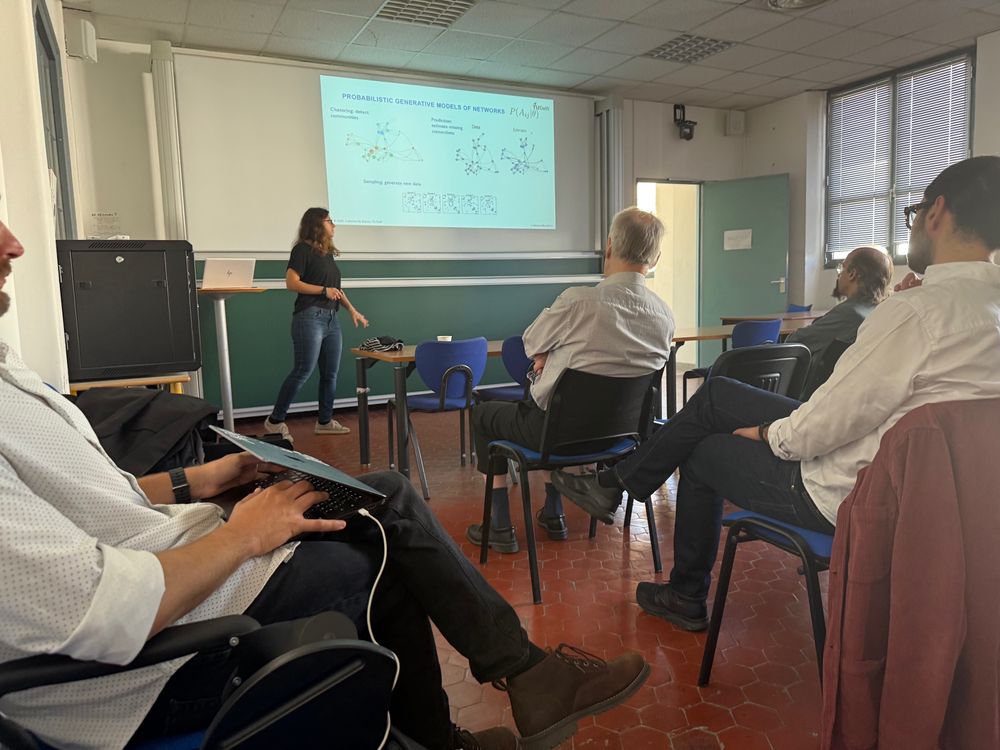
Lots of higher-order interactions at the joint @beyondtheedge.network and RUNES workshop at AMU in Marseille this week. Thanks to @alainbarrat.bsky.social and @lordgrilo.bsky.social!
October 8, 2025 at 6:24 AM
Lots of higher-order interactions at the joint @beyondtheedge.network and RUNES workshop at AMU in Marseille this week. Thanks to @alainbarrat.bsky.social and @lordgrilo.bsky.social!
Happening soon with the fantastic @haharrington.bsky.social. Join us!
Join us Tue, 30 Sept (11:00 CET) as the #BeyondTheEdge Seminar series returns after the summer break!
🎙 Prof. Heather Harrington (Oxford & MPI-CBG)
📖 Topological Data Analysis for Multiscale Biology
📍 Online → beyondtheedge.network/event/semina...
#TDA #ComplexSystems #Networks
🎙 Prof. Heather Harrington (Oxford & MPI-CBG)
📖 Topological Data Analysis for Multiscale Biology
📍 Online → beyondtheedge.network/event/semina...
#TDA #ComplexSystems #Networks

BeyondTheEdge Seminar; Heather Harrington
Heather Harrington (Oxford & MPI-CBG Dresden) speaks in the BeyondTheEdge Seminar
beyondtheedge.network
September 30, 2025 at 7:25 AM
Happening soon with the fantastic @haharrington.bsky.social. Join us!
Ever wondered how many points converge to a heteroclinic network in an aperiodic way? doi.org/10.1080/1468...

How many points converge to a heteroclinic network in an aperiodic way?
Homoclinic and heteroclinic connections can form cycles and networks in phase space, which organize global phenomena in dynamical systems. On the one hand, stability notions for (omni)cycles give i...
doi.org
September 22, 2025 at 7:27 AM
Ever wondered how many points converge to a heteroclinic network in an aperiodic way? doi.org/10.1080/1468...
Reposted by Christian Bick

BeyondTheEdge at the School of Complexity on "Higher-order interactions: mechanisms, behaviors, and networks" by our own @lordgrilo.bsky.social and @gin-bianconi.bsky.social with @aliceschwarze.bsky.social, @danielemarinazzo.bsky.social. Great perspectives! www.beyondtheedge.network/articles/bey...

BeyondTheEdge goes to Sicily
BeyondTheEdge researchers participated in the School of Complexity on
www.beyondtheedge.network
September 8, 2025 at 7:08 AM
BeyondTheEdge at the School of Complexity on "Higher-order interactions: mechanisms, behaviors, and networks" by our own @lordgrilo.bsky.social and @gin-bianconi.bsky.social with @aliceschwarze.bsky.social, @danielemarinazzo.bsky.social. Great perspectives! www.beyondtheedge.network/articles/bey...
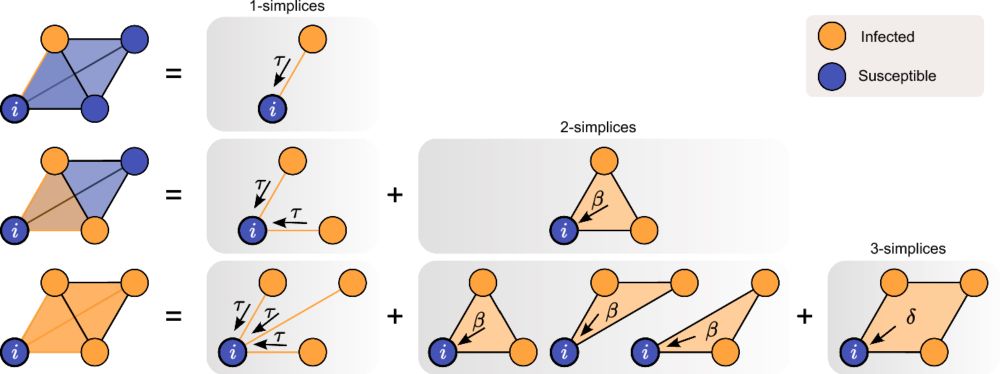
Fun collaborative project with Istvan Z. Kiss (London) and Peter Simon to understand how higher-order interactions affect the dynamics of contagion processes now out in J Math Bio: doi.org/10.1007/s002...
Decoding how higher-order network interactions shape contagion dynamics - Journal of Mathematical Biology
Complex contagion models that involve contagion along higher-order structures, such as simplicial complexes and hypergraphs, yield new classes of mean-field models. Interestingly, the differential equ...
doi.org
August 28, 2025 at 10:30 AM
Fun collaborative project with Istvan Z. Kiss (London) and Peter Simon to understand how higher-order interactions affect the dynamics of contagion processes now out in J Math Bio: doi.org/10.1007/s002...
I am extremely excited that my Istvan Z. Kiss number now is one with multiplicity 2!
August 28, 2025 at 8:41 AM
I am extremely excited that my Istvan Z. Kiss number now is one with multiplicity 2!
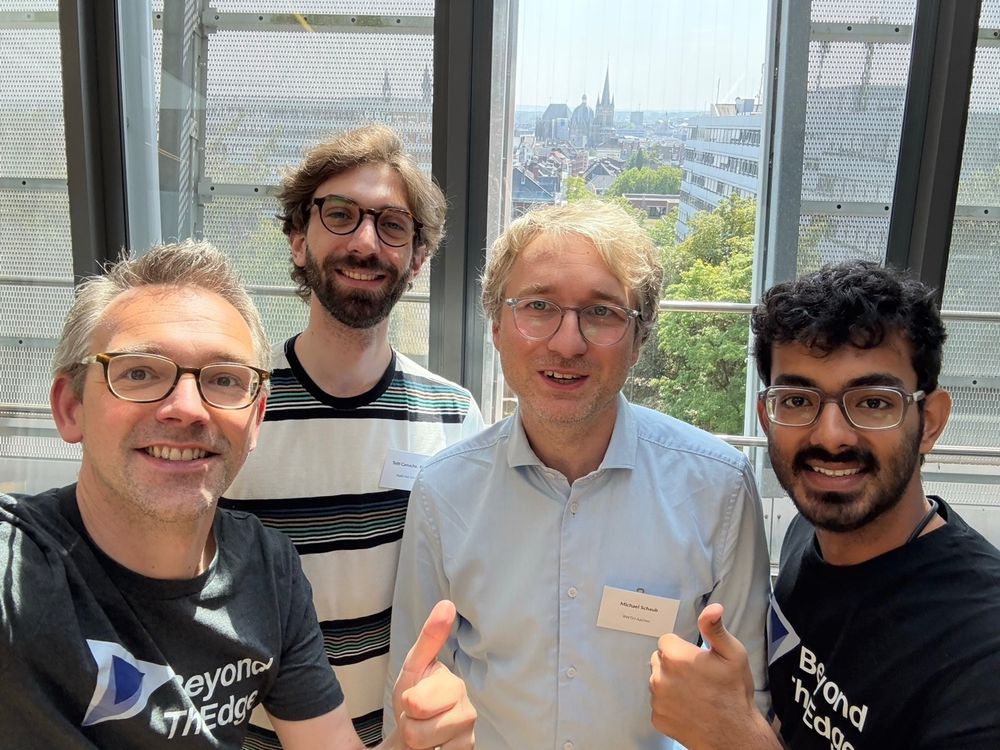
Going #BeyondTheEdge in Aachen! Great fun catching up with @beyondtheedge.network colleagues at the HOOC workshop organized by M Schaub: conf.netsci.rwth-aachen.de
August 12, 2025 at 3:52 PM
Going #BeyondTheEdge in Aachen! Great fun catching up with @beyondtheedge.network colleagues at the HOOC workshop organized by M Schaub: conf.netsci.rwth-aachen.de
"Free yourself with constraints" is a good summary of the work.
July 14, 2025 at 11:52 AM
"Free yourself with constraints" is a good summary of the work.
Adaptive network dynamics are too high dimensional? Constrain! Or maybe adaptation may be naturally constrained to low-dimensional dynamics? Joint work with
@math-martens.bsky.social
now on the arXiv at arxiv.org/abs/2507.06359.
@math-martens.bsky.social
now on the arXiv at arxiv.org/abs/2507.06359.

Multiple Timescale Dynamics of Network Adaptation with Constraints
Adaptive network dynamical systems describe the co-evolution of dynamical quantities on the nodes as well as dynamics of the network connections themselves. For dense networks of many nodes, the resul...
arxiv.org
July 14, 2025 at 11:44 AM
Adaptive network dynamics are too high dimensional? Constrain! Or maybe adaptation may be naturally constrained to low-dimensional dynamics? Joint work with
@math-martens.bsky.social
now on the arXiv at arxiv.org/abs/2507.06359.
@math-martens.bsky.social
now on the arXiv at arxiv.org/abs/2507.06359.
Maybe I should use generative AI to plot any vector field in the style of ancient nails...
June 30, 2025 at 12:38 PM
Maybe I should use generative AI to plot any vector field in the style of ancient nails...
Ancient vector fields excavated close to Dynamics Days Europe 2025 in Thessaloniki. It was a fun conference (just too short), see you in Lisbon next year!

June 28, 2025 at 4:57 PM
Ancient vector fields excavated close to Dynamics Days Europe 2025 in Thessaloniki. It was a fun conference (just too short), see you in Lisbon next year!
If you couple two systems with bistability between oscillations of distinct effective frequencies, you have to make them different for the distinct states to synchronize in frequency. Some theory and experiments now in Science Advances. doi.org/10.1126/scia...
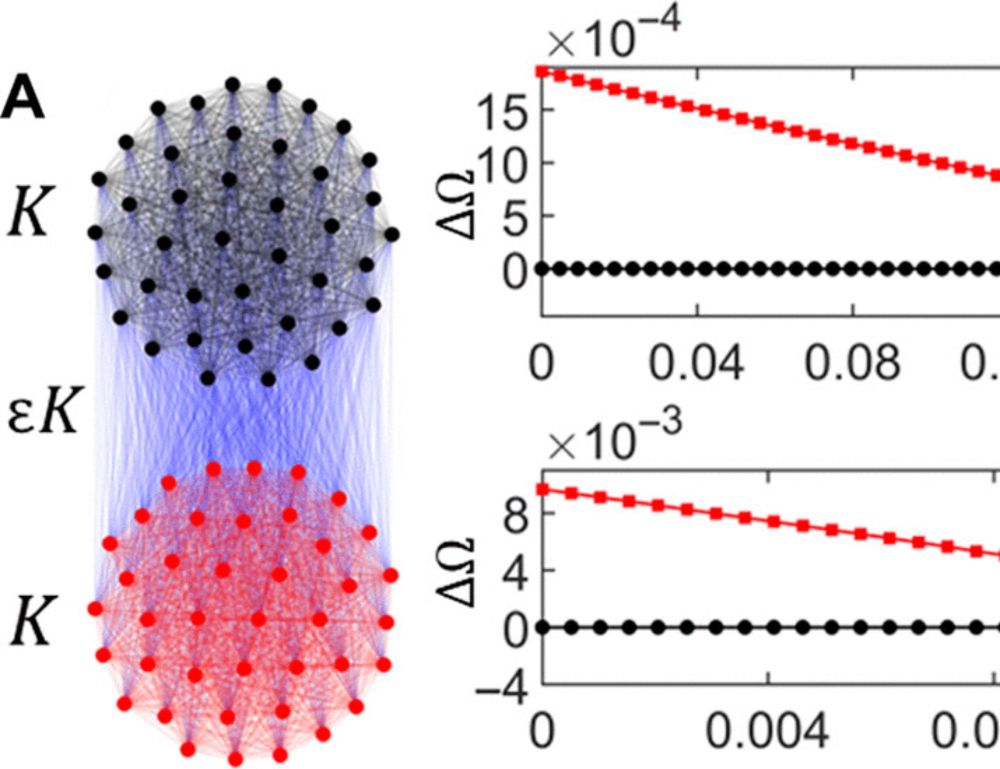
Frequency synchronization induced by frequency detuning
Analyses and experiments on multistable networks show that frequency detuning can promote synchronization.
doi.org
June 23, 2025 at 6:19 PM
If you couple two systems with bistability between oscillations of distinct effective frequencies, you have to make them different for the distinct states to synchronize in frequency. Some theory and experiments now in Science Advances. doi.org/10.1126/scia...