


Benjamin Wee
@bennywee.bsky.social
I like statistics, programming and reproducible workflows. Mostly Bayesian stats, #Rstats, #Python
🌐 bennywee.github.io
🌐 bennywee.github.io
Pinned
Benjamin Wee
@bennywee.bsky.social
· Dec 2

Comparing MCMC algorithms in Stochastic Volatility Models using Simulation Based Calibration
Simulation Based Calibration (SBC) is applied to analyse two commonly used, competing Markov chain Monte Carlo algorithms for estimating the posterior distribution of a stochastic volatility model. In...
arxiv.org
I completed my Master's in Applied Econometrics 🎉 To celebrate, I'm re-posting a summary of my research on using Simulation Based Calibration (SBC) to compare MCMC algorithms in the context of stochastic volatility (SV) models arxiv.org/abs/2402.12384 🧵:
Reposted by Benjamin Wee
I’m especially proud of this article I wrote about Gaussian Processes for the Recast blog! 🥳
GPs are super interesting, but it’s not easy to wrap your head around them at first 🤔
This is a medium level (more intuition than math) introduction to GPs for time series.
getrecast.com/gaussian-pro...
GPs are super interesting, but it’s not easy to wrap your head around them at first 🤔
This is a medium level (more intuition than math) introduction to GPs for time series.
getrecast.com/gaussian-pro...

August 29, 2025 at 5:11 PM
I’m especially proud of this article I wrote about Gaussian Processes for the Recast blog! 🥳
GPs are super interesting, but it’s not easy to wrap your head around them at first 🤔
This is a medium level (more intuition than math) introduction to GPs for time series.
getrecast.com/gaussian-pro...
GPs are super interesting, but it’s not easy to wrap your head around them at first 🤔
This is a medium level (more intuition than math) introduction to GPs for time series.
getrecast.com/gaussian-pro...
Reposted by Benjamin Wee

How many years after undergrad stats did you discover that common statistical tests are linear models? lindeloev.github.io/tests-as-lin...

August 7, 2025 at 10:35 AM
How many years after undergrad stats did you discover that common statistical tests are linear models? lindeloev.github.io/tests-as-lin...
Reposted by Benjamin Wee

New blog post! Let's say you've measured two variables repeatedly and want to investigate how one affects the other over time. Here are some recommendations for how to do that well.
www.the100.ci/2025/06/25/r...
www.the100.ci/2025/06/25/r...
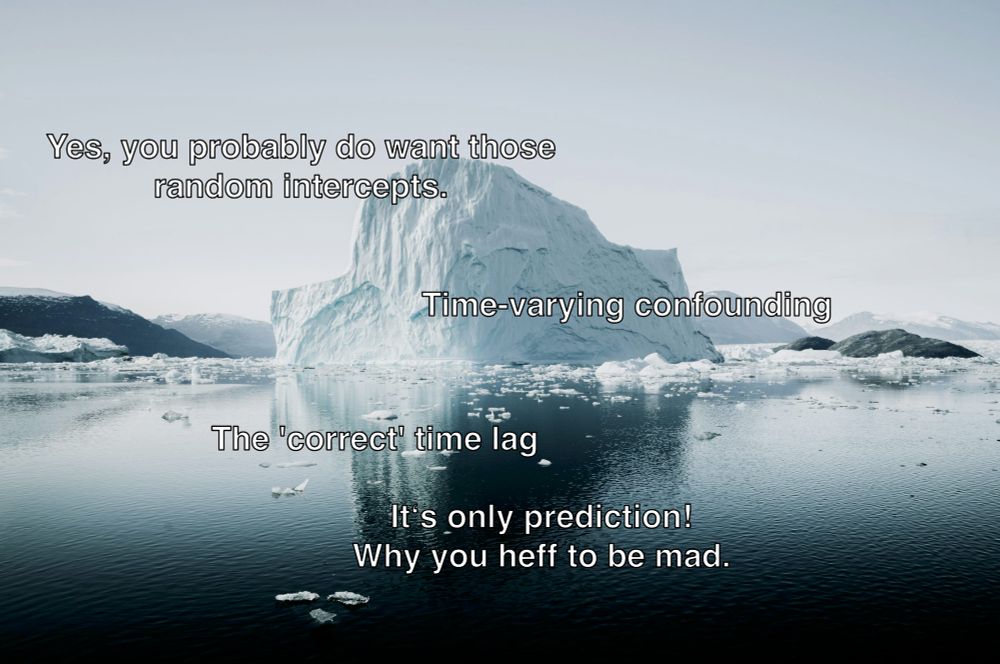
Reviewer notes: So you’re interested in “lagged effects.”
In some fields, researchers who end up with time series of two variables of interest (X and Y) like to analyze (reciprocal) lagged effects between them. Does X affect Y at a later point in time, and d...
www.the100.ci
June 25, 2025 at 12:27 PM
New blog post! Let's say you've measured two variables repeatedly and want to investigate how one affects the other over time. Here are some recommendations for how to do that well.
www.the100.ci/2025/06/25/r...
www.the100.ci/2025/06/25/r...
Reposted by Benjamin Wee
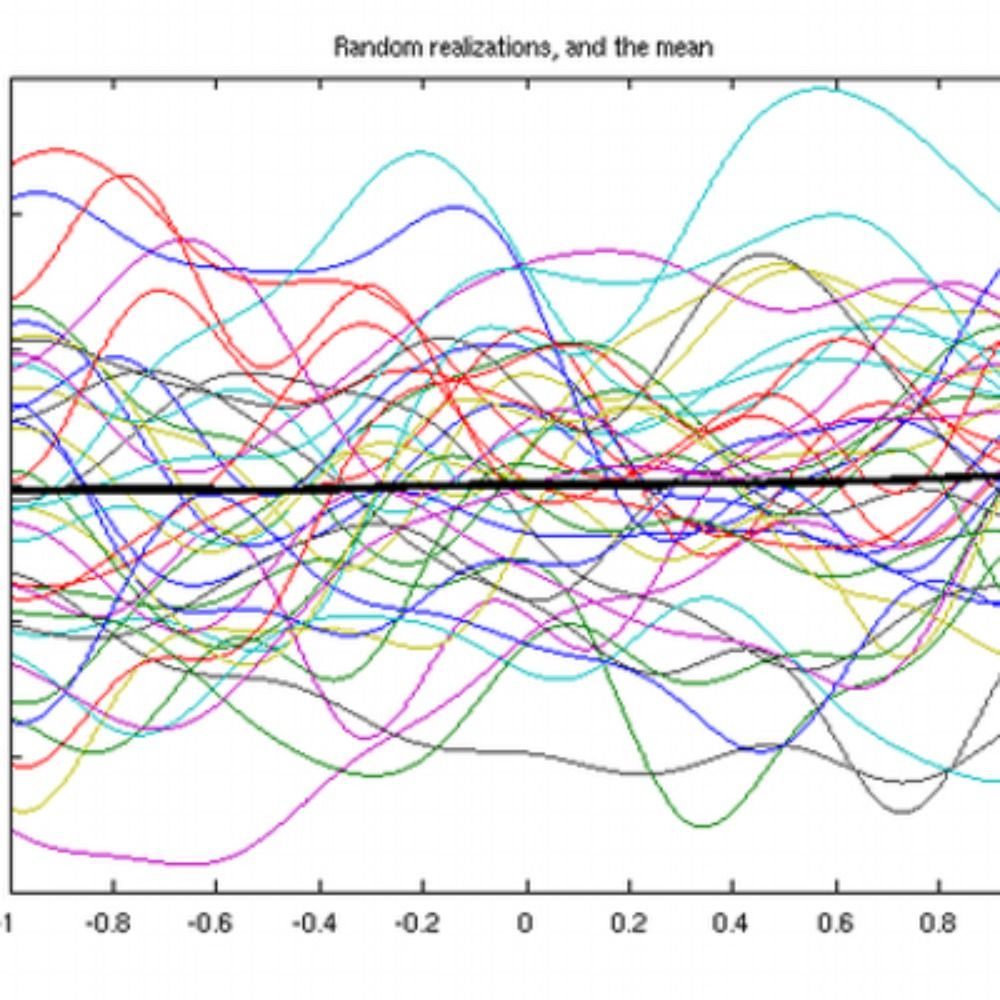
PSA that Sequential Monte Carlo ("particle filtering") can be used on general models now. You can motivate it as implementing gradient descent in Fisher-Rao metric, like HMC is abstractly Wasserstein gradient descent. This leads to tuning parameter advice, too: more MCMC steps.
New Chopin seminar:
New Chopin seminar:
February 15, 2025 at 2:08 PM
PSA that Sequential Monte Carlo ("particle filtering") can be used on general models now. You can motivate it as implementing gradient descent in Fisher-Rao metric, like HMC is abstractly Wasserstein gradient descent. This leads to tuning parameter advice, too: more MCMC steps.
New Chopin seminar:
New Chopin seminar:
Self learning is hard and doing it in a way which works for me required lots of trial and error. I've tried
1. Reading books, watching lectures if available and doing problem sets (McElreath's Statistical rethinking, Gil Strang's linear algebra)
2. Reading as a reference, sometimes annotating
1. Reading books, watching lectures if available and doing problem sets (McElreath's Statistical rethinking, Gil Strang's linear algebra)
2. Reading as a reference, sometimes annotating
December 15, 2024 at 11:23 PM
Self learning is hard and doing it in a way which works for me required lots of trial and error. I've tried
1. Reading books, watching lectures if available and doing problem sets (McElreath's Statistical rethinking, Gil Strang's linear algebra)
2. Reading as a reference, sometimes annotating
1. Reading books, watching lectures if available and doing problem sets (McElreath's Statistical rethinking, Gil Strang's linear algebra)
2. Reading as a reference, sometimes annotating
I completed my Master's in Applied Econometrics 🎉 To celebrate, I'm re-posting a summary of my research on using Simulation Based Calibration (SBC) to compare MCMC algorithms in the context of stochastic volatility (SV) models arxiv.org/abs/2402.12384 🧵:
Comparing MCMC algorithms in Stochastic Volatility Models using Simulation Based Calibration
Simulation Based Calibration (SBC) is applied to analyse two commonly used, competing Markov chain Monte Carlo algorithms for estimating the posterior distribution of a stochastic volatility model. In...
arxiv.org
December 2, 2024 at 7:10 AM
I completed my Master's in Applied Econometrics 🎉 To celebrate, I'm re-posting a summary of my research on using Simulation Based Calibration (SBC) to compare MCMC algorithms in the context of stochastic volatility (SV) models arxiv.org/abs/2402.12384 🧵:
I can summarise how I learn things with a single comic, especially as a new parent:
Source: www.facebook.com/webcomicname...
Source: www.facebook.com/webcomicname...

November 28, 2024 at 11:29 PM
I can summarise how I learn things with a single comic, especially as a new parent:
Source: www.facebook.com/webcomicname...
Source: www.facebook.com/webcomicname...
I'm starting an informal statistics book club on discord. First off is Multilevel/Hierarchical models by Gelman and Hill (2007). Channel is there to ask questions, discuss topics or problem sets in the book. Read at your own pace, start wherever you want. Open invite for those who want to join :)
November 20, 2024 at 4:14 AM
I'm starting an informal statistics book club on discord. First off is Multilevel/Hierarchical models by Gelman and Hill (2007). Channel is there to ask questions, discuss topics or problem sets in the book. Read at your own pace, start wherever you want. Open invite for those who want to join :)