



Francesco Costa
@atsocf.bsky.social
Reposted by Francesco Costa

Overjoyed to finally have our isopeptide bond paper out! If you're interested in the types of proteins and organisms that use a cool intramolecular covalent bond, check it out:
bit.ly/4od3ux8
Plenty of future SynBio/EngBio applications planned! Thanks to all involved (character limits suck).
bit.ly/4od3ux8
Plenty of future SynBio/EngBio applications planned! Thanks to all involved (character limits suck).
November 22, 2025 at 5:33 AM
Overjoyed to finally have our isopeptide bond paper out! If you're interested in the types of proteins and organisms that use a cool intramolecular covalent bond, check it out:
bit.ly/4od3ux8
Plenty of future SynBio/EngBio applications planned! Thanks to all involved (character limits suck).
bit.ly/4od3ux8
Plenty of future SynBio/EngBio applications planned! Thanks to all involved (character limits suck).
⚠️⚠️⚠️Preprint alert⚠️⚠️⚠️
We mapped intramolecular isopeptide bonds across the AlphaFold database and found that they are widely distributed in microbial surface proteins, such as fibrillar adhesins or pilins, suggesting new targets for broad-spectrum antimicrobial strategies.
We mapped intramolecular isopeptide bonds across the AlphaFold database and found that they are widely distributed in microbial surface proteins, such as fibrillar adhesins or pilins, suggesting new targets for broad-spectrum antimicrobial strategies.
Happy to say that I have a preprint out! This one is a big step as it's my first last author paper. It focusses on assessing the distribution and key characteristics of intramolecular isopeptide bonds in nature, thanks to a really great collaborative effort:
www.biorxiv.org/content/10.1...
www.biorxiv.org/content/10.1...

A global survey of intramolecular isopeptide bonds
Many protein domains harbour covalent intramolecular bonds that enhance their stability and resistance to thermal, mechanical and proteolytic insults. Intramolecular isopeptide bonds represent one suc...
www.biorxiv.org
May 13, 2025 at 4:43 PM
⚠️⚠️⚠️Preprint alert⚠️⚠️⚠️
We mapped intramolecular isopeptide bonds across the AlphaFold database and found that they are widely distributed in microbial surface proteins, such as fibrillar adhesins or pilins, suggesting new targets for broad-spectrum antimicrobial strategies.
We mapped intramolecular isopeptide bonds across the AlphaFold database and found that they are widely distributed in microbial surface proteins, such as fibrillar adhesins or pilins, suggesting new targets for broad-spectrum antimicrobial strategies.
📢 Just published! Introducing Isopeptor: a computational tool for detecting intramolecular isopeptide bonds in protein structures with high precision and recall.
academic.oup.com/bioinformati...
academic.oup.com/bioinformati...

Isopeptor: a tool for detecting intramolecular isopeptide bonds in protein structures
AbstractMotivation. Intramolecular isopeptide bonds contribute to the structural stability of proteins, and have primarily been identified in domains of ba
academic.oup.com
March 20, 2025 at 10:55 AM
📢 Just published! Introducing Isopeptor: a computational tool for detecting intramolecular isopeptide bonds in protein structures with high precision and recall.
academic.oup.com/bioinformati...
academic.oup.com/bioinformati...
Check out this article about my research at @embl.org where I focus on protein modelling and on the study of fibrillar adhesins. Recently, we developed a method to detect isopeptide bonds, a key stabilizing feature in bacterial proteins. Thanks @oanastroe.bsky.social for putting this together!👇 👇 👇

Meet Francesco Costa @atsocf.bsky.social 🇮🇹 – a PhD student at EMBL-EBI studying protein science.
Francesco is fascinated by protein design. His recent work helped ‘rescue’ low-confidence #AlphaFold protein structure predictions.
www.embl.org/news/people-...
🧬🧶#MolBiol
@ebi.embl.org
Francesco is fascinated by protein design. His recent work helped ‘rescue’ low-confidence #AlphaFold protein structure predictions.
www.embl.org/news/people-...
🧬🧶#MolBiol
@ebi.embl.org

We are EMBL: Francesco Costa on protein design and the EMBL PhD programme | EMBL
EMBL-EBI PhD student Francesco Costa talks about his work on protein structure predictions and the field of protein engineering.
www.embl.org
February 18, 2025 at 6:43 PM
Check out this article about my research at @embl.org where I focus on protein modelling and on the study of fibrillar adhesins. Recently, we developed a method to detect isopeptide bonds, a key stabilizing feature in bacterial proteins. Thanks @oanastroe.bsky.social for putting this together!👇 👇 👇
Reposted by Francesco Costa

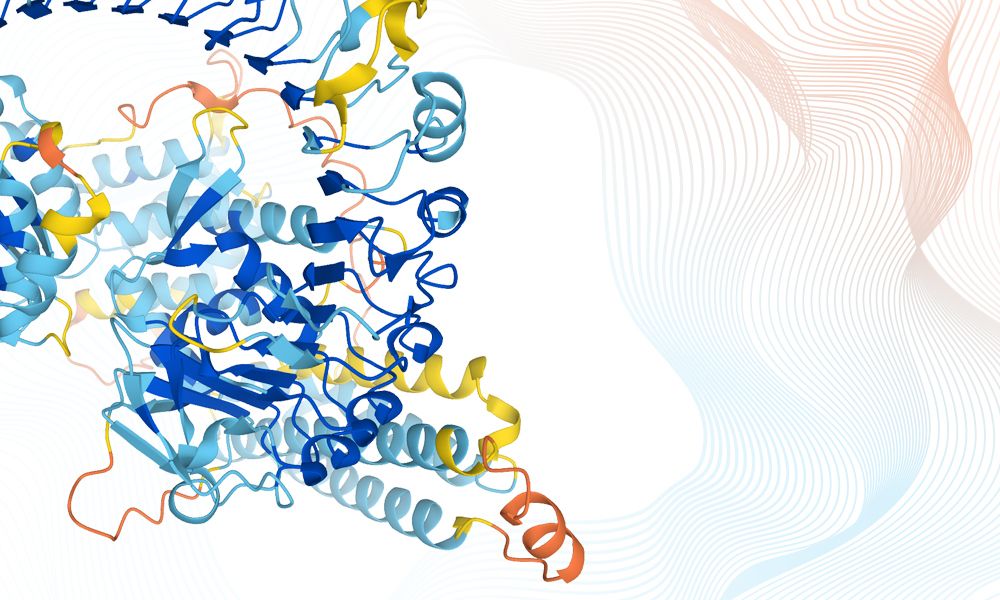
Prediction confidence scores help #AlphaFold users gauge the reliability of protein structure predictions. 🖥️🧬
But things get more challenging for protein families.
A new method helps improve low confidence predictions within protein families.
academic.oup.com/bioinformati...
But things get more challenging for protein families.
A new method helps improve low confidence predictions within protein families.
academic.oup.com/bioinformati...
December 16, 2024 at 9:28 AM
Prediction confidence scores help #AlphaFold users gauge the reliability of protein structure predictions. 🖥️🧬
But things get more challenging for protein families.
A new method helps improve low confidence predictions within protein families.
academic.oup.com/bioinformati...
But things get more challenging for protein families.
A new method helps improve low confidence predictions within protein families.
academic.oup.com/bioinformati...
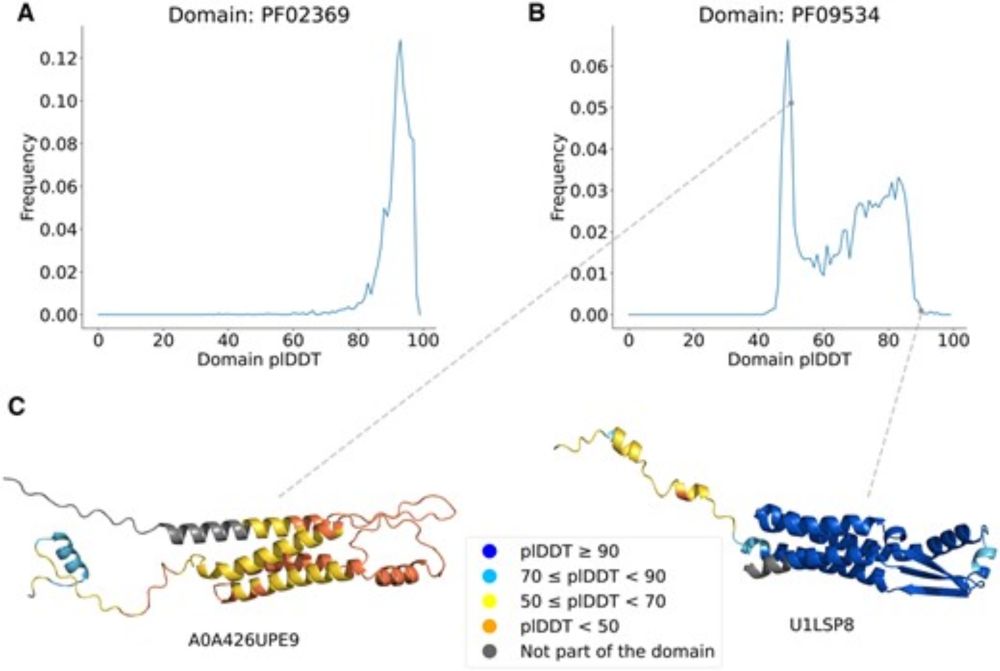
Excited to announce our latest publication: “Keeping it in the family: Using protein family templates to rescue low confidence AlphaFold2 models” where we explore plDDT variability in #AF2 models of @pfamdb.bsky.social
domains. doi.org/10.1093/bioa... 1/7
domains. doi.org/10.1093/bioa... 1/7
Keeping it in the family: using protein family templates to rescue low confidence AlphaFold2 models
AbstractMotivation. High confidence structure prediction models have become available for nearly all protein sequences. More than 200 million AlphaFold2 mo
doi.org
December 9, 2024 at 1:57 PM
Excited to announce our latest publication: “Keeping it in the family: Using protein family templates to rescue low confidence AlphaFold2 models” where we explore plDDT variability in #AF2 models of @pfamdb.bsky.social
domains. doi.org/10.1093/bioa... 1/7
domains. doi.org/10.1093/bioa... 1/7