



T. Anderson Keller
@andykeller.bsky.social
Postdoctoral Fellow at Harvard Kempner Institute. Trying to bring natural structure to artificial neural representations. Prev: PhD at UvA. Intern @ Apple MLR, Work @ Intel Nervana
Pinned
In the physical world, almost all information is transmitted through traveling waves -- why should it be any different in your neural network?
Super excited to share recent work with the brilliant @mozesjacobs.bsky.social: "Traveling Waves Integrate Spatial Information Through Time"
1/14
Super excited to share recent work with the brilliant @mozesjacobs.bsky.social: "Traveling Waves Integrate Spatial Information Through Time"
1/14
Reposted by T. Anderson Keller
The hippocampal map has its own attentional control signal!
Our new study reveals that theta #sweeps can be instantly biased towards behaviourally relevant locations. See 📹 in post 4/6 and preprint here 👉
www.biorxiv.org/content/10.6...
🧵(1/6)
Our new study reveals that theta #sweeps can be instantly biased towards behaviourally relevant locations. See 📹 in post 4/6 and preprint here 👉
www.biorxiv.org/content/10.6...
🧵(1/6)
Attention-like regulation of theta sweeps in the brain's spatial navigation circuit
Spatial attention supports navigation by prioritizing information from selected locations. A candidate neural mechanism is provided by theta-paced sweeps in grid- and place-cell population activity, which sample nearby space in a left-right-alternating pattern coordinated by parasubicular direction signals. During exploration, this alternation promotes uniform spatial coverage, but whether sweeps can be flexibly tuned to locations of particular interest remains unclear. Using large-scale Neuropixels recordings in freely-behaving rats, we show that sweeps and direction signals are rapidly and dynamically modulated: they track moving targets during pursuit, precede orienting responses during immobility, and reverse during backward locomotion — without prior spatial learning. Similar modulation occurs during REM sleep. Canonical head-direction signals remain head-aligned. These findings identify sweeps as a flexible, attention-like mechanism for selectively sampling allocentric cognitive maps. ### Competing Interest Statement The authors have declared no competing interest. European Research Council, Synergy Grant 951319 (EIM) The Research Council of Norway, Centre of Neural Computation 223262 (EIM, MBM), Centre for Algorithms in the Cortex 332640 (EIM, MBM), National Infrastructure grant (NORBRAIN, 295721 and 350201) The Kavli Foundation, https://ror.org/00kztt736 Ministry of Science and Education, Norway (EIM, MBM) Faculty of Medicine and Health Sciences; NTNU, Norway (AZV)
www.biorxiv.org
January 28, 2026 at 10:03 AM
The hippocampal map has its own attentional control signal!
Our new study reveals that theta #sweeps can be instantly biased towards behaviourally relevant locations. See 📹 in post 4/6 and preprint here 👉
www.biorxiv.org/content/10.6...
🧵(1/6)
Our new study reveals that theta #sweeps can be instantly biased towards behaviourally relevant locations. See 📹 in post 4/6 and preprint here 👉
www.biorxiv.org/content/10.6...
🧵(1/6)
Reposted by T. Anderson Keller
How do brain areas control each other? 🧠🎛️
✨In our NeurIPS 2025 Spotlight paper, we introduce a data-driven framework to answer this question using deep learning, nonlinear control, and differential geometry.🧵⬇️
✨In our NeurIPS 2025 Spotlight paper, we introduce a data-driven framework to answer this question using deep learning, nonlinear control, and differential geometry.🧵⬇️

November 26, 2025 at 7:32 PM
How do brain areas control each other? 🧠🎛️
✨In our NeurIPS 2025 Spotlight paper, we introduce a data-driven framework to answer this question using deep learning, nonlinear control, and differential geometry.🧵⬇️
✨In our NeurIPS 2025 Spotlight paper, we introduce a data-driven framework to answer this question using deep learning, nonlinear control, and differential geometry.🧵⬇️
Reposted by T. Anderson Keller
@andykeller.bsky.social @kempnerinstitute.bsky.social presented “Flow Equivariant Cybernetics”, a blueprint for agents that learn through continuous feedback with their environment.

October 15, 2025 at 1:55 PM
@andykeller.bsky.social @kempnerinstitute.bsky.social presented “Flow Equivariant Cybernetics”, a blueprint for agents that learn through continuous feedback with their environment.
Reposted by T. Anderson Keller

New in the #DeeperLearningBlog: #KempnerInstitute research fellow @andykeller.bsky.social introduces the first flow equivariant neural networks, which reflect motion symmetries, greatly enhancing generalization and sequence modeling.
bit.ly/451fQ48
#AI #NeuroAI
bit.ly/451fQ48
#AI #NeuroAI
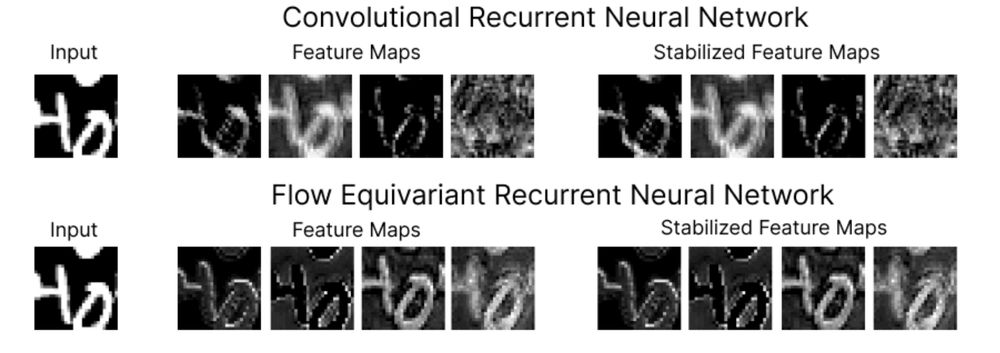
Flow Equivariant Recurrent Neural Networks - Kempner Institute
Sequence transformations, like visual motion, dominate the world around us, but are poorly handled by current models. We introduce the first flow equivariant models that respect these motion symmetrie...
bit.ly
July 22, 2025 at 1:21 PM
New in the #DeeperLearningBlog: #KempnerInstitute research fellow @andykeller.bsky.social introduces the first flow equivariant neural networks, which reflect motion symmetries, greatly enhancing generalization and sequence modeling.
bit.ly/451fQ48
#AI #NeuroAI
bit.ly/451fQ48
#AI #NeuroAI
Reposted by T. Anderson Keller
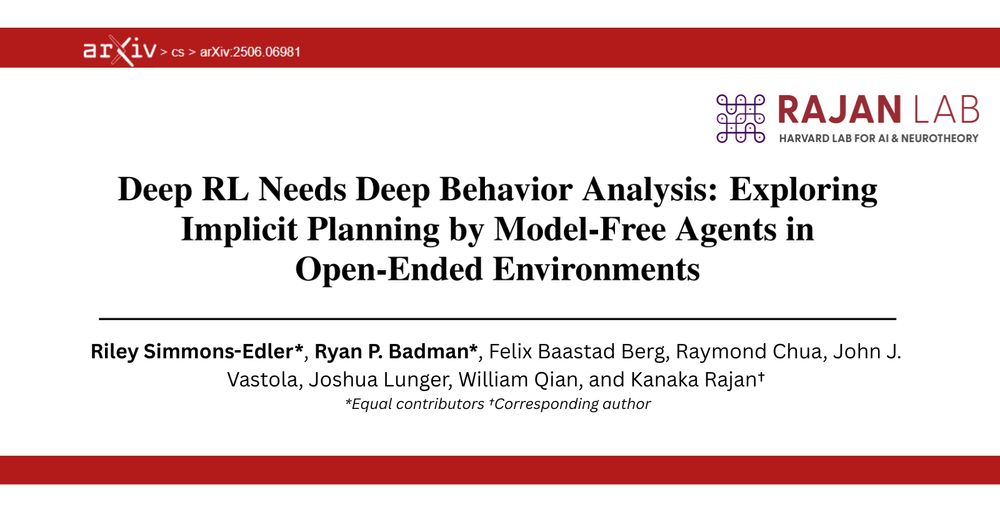
(1/7) New preprint from Rajan lab! 🧠🤖
@ryanpaulbadman1.bsky.social & Riley Simmons-Edler show–through cog sci, neuro & ethology–how an AI agent with fewer ‘neurons’ than an insect can forage, find safety & dodge predators in a virtual world. Here's what we built
Preprint: arxiv.org/pdf/2506.06981
@ryanpaulbadman1.bsky.social & Riley Simmons-Edler show–through cog sci, neuro & ethology–how an AI agent with fewer ‘neurons’ than an insect can forage, find safety & dodge predators in a virtual world. Here's what we built
Preprint: arxiv.org/pdf/2506.06981
July 2, 2025 at 6:34 PM
(1/7) New preprint from Rajan lab! 🧠🤖
@ryanpaulbadman1.bsky.social & Riley Simmons-Edler show–through cog sci, neuro & ethology–how an AI agent with fewer ‘neurons’ than an insect can forage, find safety & dodge predators in a virtual world. Here's what we built
Preprint: arxiv.org/pdf/2506.06981
@ryanpaulbadman1.bsky.social & Riley Simmons-Edler show–through cog sci, neuro & ethology–how an AI agent with fewer ‘neurons’ than an insect can forage, find safety & dodge predators in a virtual world. Here's what we built
Preprint: arxiv.org/pdf/2506.06981
Reposted by T. Anderson Keller
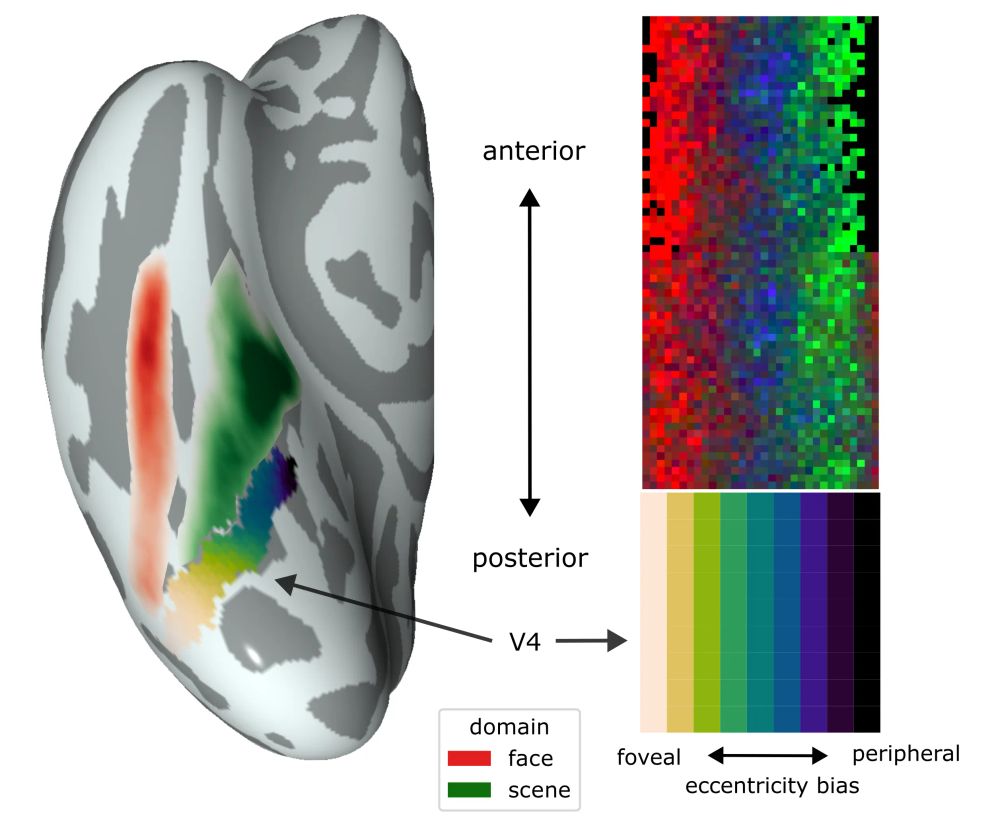
What shapes the topography of high-level visual cortex?
Excited to share a new pre-print addressing this question with connectivity-constrained interactive topographic networks, titled "Retinotopic scaffolding of high-level vision", w/ Marlene Behrmann & David Plaut.
🧵 ↓ 1/n
Excited to share a new pre-print addressing this question with connectivity-constrained interactive topographic networks, titled "Retinotopic scaffolding of high-level vision", w/ Marlene Behrmann & David Plaut.
🧵 ↓ 1/n
June 16, 2025 at 3:11 PM
What shapes the topography of high-level visual cortex?
Excited to share a new pre-print addressing this question with connectivity-constrained interactive topographic networks, titled "Retinotopic scaffolding of high-level vision", w/ Marlene Behrmann & David Plaut.
🧵 ↓ 1/n
Excited to share a new pre-print addressing this question with connectivity-constrained interactive topographic networks, titled "Retinotopic scaffolding of high-level vision", w/ Marlene Behrmann & David Plaut.
🧵 ↓ 1/n
Reposted by T. Anderson Keller
Are you an RL PhD at Harvard who has had your funding wrecked by the government and working on topics related to multi-agent? Reach out, I am happy to try to find a way to support you.
May 23, 2025 at 12:30 AM
Are you an RL PhD at Harvard who has had your funding wrecked by the government and working on topics related to multi-agent? Reach out, I am happy to try to find a way to support you.
Reposted by T. Anderson Keller
Looking forward to presenting our work on cortico-hippocampal coupling and wave-wave interactions as a basis for some core human cognitions
5pm May 6th EST (US)
8am May 7th AEST (Sydney)
Zoom link: columbiacuimc.zoom.us/j/92736430185
Thanks to WaveClub conveners Erfan Zabeh & Uma Mohan
5pm May 6th EST (US)
8am May 7th AEST (Sydney)
Zoom link: columbiacuimc.zoom.us/j/92736430185
Thanks to WaveClub conveners Erfan Zabeh & Uma Mohan
May 6, 2025 at 8:59 AM
Looking forward to presenting our work on cortico-hippocampal coupling and wave-wave interactions as a basis for some core human cognitions
5pm May 6th EST (US)
8am May 7th AEST (Sydney)
Zoom link: columbiacuimc.zoom.us/j/92736430185
Thanks to WaveClub conveners Erfan Zabeh & Uma Mohan
5pm May 6th EST (US)
8am May 7th AEST (Sydney)
Zoom link: columbiacuimc.zoom.us/j/92736430185
Thanks to WaveClub conveners Erfan Zabeh & Uma Mohan
Reposted by T. Anderson Keller
It’s another big day for the #KempnerInstitute at @CosyneMeeting! Check out our work highlighted in poster session 3 today! #COSYNE2025


March 29, 2025 at 1:11 PM
It’s another big day for the #KempnerInstitute at @CosyneMeeting! Check out our work highlighted in poster session 3 today! #COSYNE2025
Reposted by T. Anderson Keller
Super interesting thread!
In the physical world, almost all information is transmitted through traveling waves -- why should it be any different in your neural network?
Super excited to share recent work with the brilliant @mozesjacobs.bsky.social: "Traveling Waves Integrate Spatial Information Through Time"
1/14
Super excited to share recent work with the brilliant @mozesjacobs.bsky.social: "Traveling Waves Integrate Spatial Information Through Time"
1/14
March 10, 2025 at 7:58 PM
Super interesting thread!
Reposted by T. Anderson Keller
Traveling waves of neural activity are observed all over the brain. Can they be used to augment neural networks?
I am thrilled to share our new work, "Traveling Waves Integrate Spatial Information Through Time" with @andykeller.bsky.social!
1/13
I am thrilled to share our new work, "Traveling Waves Integrate Spatial Information Through Time" with @andykeller.bsky.social!
1/13
March 10, 2025 at 4:47 PM
Traveling waves of neural activity are observed all over the brain. Can they be used to augment neural networks?
I am thrilled to share our new work, "Traveling Waves Integrate Spatial Information Through Time" with @andykeller.bsky.social!
1/13
I am thrilled to share our new work, "Traveling Waves Integrate Spatial Information Through Time" with @andykeller.bsky.social!
1/13
Reposted by T. Anderson Keller

Really interesting RNN work.
And based on some spiking simulations I've tinkered with, it seems plausible that PV, CB & CR interneurons can contribute to changing the boundary conditions and the 'elasticity' of the oscillating 'rubber sheet' of cortex (and probably hippocampus and amygdala too). 🤓
And based on some spiking simulations I've tinkered with, it seems plausible that PV, CB & CR interneurons can contribute to changing the boundary conditions and the 'elasticity' of the oscillating 'rubber sheet' of cortex (and probably hippocampus and amygdala too). 🤓
In the physical world, almost all information is transmitted through traveling waves -- why should it be any different in your neural network?
Super excited to share recent work with the brilliant @mozesjacobs.bsky.social: "Traveling Waves Integrate Spatial Information Through Time"
1/14
Super excited to share recent work with the brilliant @mozesjacobs.bsky.social: "Traveling Waves Integrate Spatial Information Through Time"
1/14
March 10, 2025 at 3:58 PM
Really interesting RNN work.
And based on some spiking simulations I've tinkered with, it seems plausible that PV, CB & CR interneurons can contribute to changing the boundary conditions and the 'elasticity' of the oscillating 'rubber sheet' of cortex (and probably hippocampus and amygdala too). 🤓
And based on some spiking simulations I've tinkered with, it seems plausible that PV, CB & CR interneurons can contribute to changing the boundary conditions and the 'elasticity' of the oscillating 'rubber sheet' of cortex (and probably hippocampus and amygdala too). 🤓
In the physical world, almost all information is transmitted through traveling waves -- why should it be any different in your neural network?
Super excited to share recent work with the brilliant @mozesjacobs.bsky.social: "Traveling Waves Integrate Spatial Information Through Time"
1/14
Super excited to share recent work with the brilliant @mozesjacobs.bsky.social: "Traveling Waves Integrate Spatial Information Through Time"
1/14
March 10, 2025 at 3:34 PM
In the physical world, almost all information is transmitted through traveling waves -- why should it be any different in your neural network?
Super excited to share recent work with the brilliant @mozesjacobs.bsky.social: "Traveling Waves Integrate Spatial Information Through Time"
1/14
Super excited to share recent work with the brilliant @mozesjacobs.bsky.social: "Traveling Waves Integrate Spatial Information Through Time"
1/14
Reposted by T. Anderson Keller
New research shows neurons learn to encode and transmit information to other spatially distant neurons through traveling waves. Read more in the #KempnerInstitute’s blog: bit.ly/3DrIPEq

March 10, 2025 at 3:18 PM
New research shows neurons learn to encode and transmit information to other spatially distant neurons through traveling waves. Read more in the #KempnerInstitute’s blog: bit.ly/3DrIPEq