



Anders Nelson
@andersnelson.bsky.social
Neuroscientist | exploring motor control circuits in the brain and spinal cord | NYU Center for Neural Science
andersnelsonlab.com
andersnelsonlab.com
Reposted by Anders Nelson

Where does learning through imitation happen in the brain?
In juvenile zebra finches, we pinpoint a synaptic locus of song learning in a cortico-basal ganglia circuit and leverage this localization to measure the timescale of consolidation and make birds learn faster! #neuroskyence (1/14)
In juvenile zebra finches, we pinpoint a synaptic locus of song learning in a cortico-basal ganglia circuit and leverage this localization to measure the timescale of consolidation and make birds learn faster! #neuroskyence (1/14)
A synaptic locus of song learning
Learning by imitation is the foundation for verbal and musical expression, but its underlying neural basis remains obscure. A juvenile male zebra finch imitates the multisyllabic song of an adult tutor in a process that depends on a song-specialized cortico-basal ganglia circuit, affording a powerful system to identify the synaptic substrates of imitative motor learning. Plasticity at a particular set of cortico-basal ganglia synapses is hypothesized to drive rapid learning-related changes in song before these changes are subsequently consolidated in downstream circuits. Nevertheless, this hypothesis is untested and the synaptic locus where learning initially occurs is unknown. By combining a computational framework to quantify song learning with synapse-specific optogenetic and chemogenetic manipulations within and directly downstream of the cortico-basal ganglia circuit, we identified the specific cortico-basal ganglia synapses that drive the acquisition and expression of rapid vocal changes during juvenile song learning and characterized the hours-long timescale over which these changes consolidate. Furthermore, transiently augmenting postsynaptic activity in the basal ganglia briefly accelerates learning rates and persistently alters song, demonstrating a direct link between basal ganglia activity and rapid learning. These results localize the specific cortico-basal ganglia synapses that enable a juvenile songbird to learn to sing and reveal the circuit logic and behavioral timescales of this imitative learning paradigm. ### Competing Interest Statement The authors have declared no competing interest. National Institutes of Health, K99 NS144525 (DCS), F32 MH132152 (DCS), F31 HD098772 (SB), R01 NS099288 (RM), RF1 NS118424 (RM and JP)
www.biorxiv.org
January 21, 2026 at 4:39 PM
Where does learning through imitation happen in the brain?
In juvenile zebra finches, we pinpoint a synaptic locus of song learning in a cortico-basal ganglia circuit and leverage this localization to measure the timescale of consolidation and make birds learn faster! #neuroskyence (1/14)
In juvenile zebra finches, we pinpoint a synaptic locus of song learning in a cortico-basal ganglia circuit and leverage this localization to measure the timescale of consolidation and make birds learn faster! #neuroskyence (1/14)
Reposted by Anders Nelson
Excited to share @rbrianroome.bsky.social ‘s beautiful paper on development of the dorsal horn of the mouse spinal cord @science.org
This is how the anatomical organization and cell types that process pain, touch, body position and more are laid down.
www.science.org/doi/10.1126/...
This is how the anatomical organization and cell types that process pain, touch, body position and more are laid down.
www.science.org/doi/10.1126/...

Ontogeny of the spinal cord dorsal horn
The dorsal horn of the mammalian spinal cord is organized into laminae where each layer is populated by different neuron types, has distinctive circuit connections, and plays specialized roles in beha...
www.science.org
January 8, 2026 at 7:59 PM
Excited to share @rbrianroome.bsky.social ‘s beautiful paper on development of the dorsal horn of the mouse spinal cord @science.org
This is how the anatomical organization and cell types that process pain, touch, body position and more are laid down.
www.science.org/doi/10.1126/...
This is how the anatomical organization and cell types that process pain, touch, body position and more are laid down.
www.science.org/doi/10.1126/...
Reposted by Anders Nelson

Now out in @nature.com: Our study discovering a neural circuit in Drosophila that predictively inhibits proprioceptor axons during voluntary leg movements, such as walking and grooming. www.nature.com/articles/s41...
September 17, 2025 at 3:14 PM
Now out in @nature.com: Our study discovering a neural circuit in Drosophila that predictively inhibits proprioceptor axons during voluntary leg movements, such as walking and grooming. www.nature.com/articles/s41...
Reposted by Anders Nelson
We are hiring a new research assistant! Official job post to follow. Please reach out or visit markrossilab.org if you are interested.
June 16, 2025 at 3:56 PM
We are hiring a new research assistant! Official job post to follow. Please reach out or visit markrossilab.org if you are interested.
Reposted by Anders Nelson
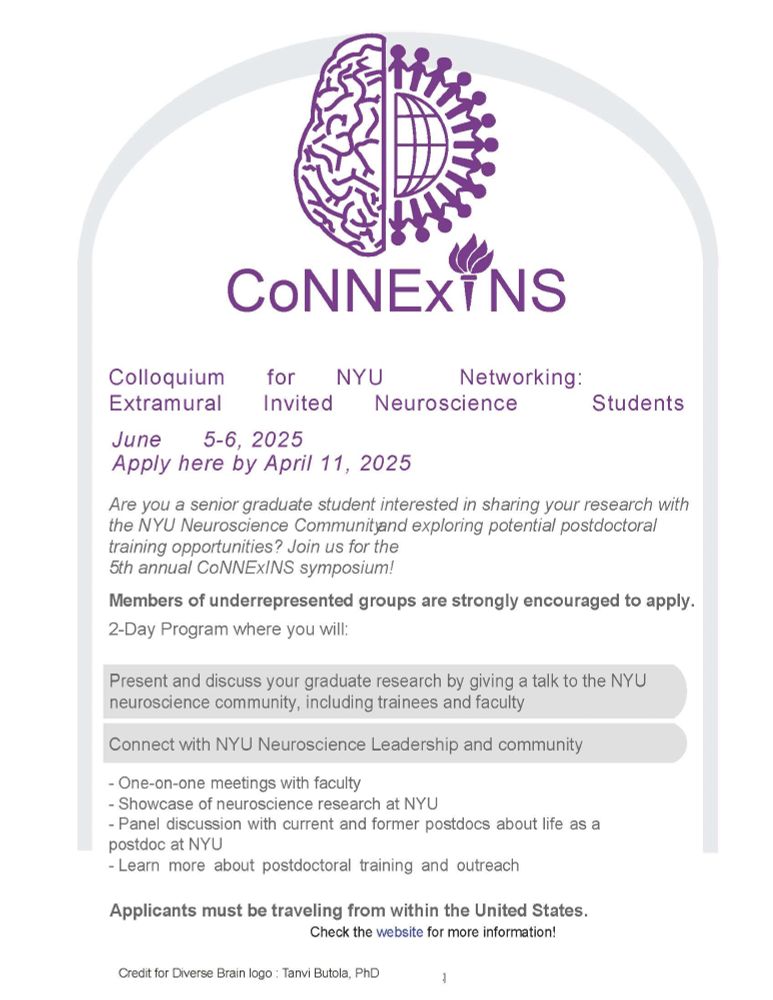
📣📣📣 This is a call for PhD students in neuroscience!
✅ Are you a senior PhD student in neuroscience? 🧠
✅ Looking for career development opportunities?💼
✅ Want to visit NYC in spring?🗽
✅ Considering a postdoc at NYU? 🥼
✅Apply for CoNNExINS!
wp.nyu.edu/connexins/
Deadline extended to April 11th!
✅ Are you a senior PhD student in neuroscience? 🧠
✅ Looking for career development opportunities?💼
✅ Want to visit NYC in spring?🗽
✅ Considering a postdoc at NYU? 🥼
✅Apply for CoNNExINS!
wp.nyu.edu/connexins/
Deadline extended to April 11th!
March 31, 2025 at 6:27 PM
📣📣📣 This is a call for PhD students in neuroscience!
✅ Are you a senior PhD student in neuroscience? 🧠
✅ Looking for career development opportunities?💼
✅ Want to visit NYC in spring?🗽
✅ Considering a postdoc at NYU? 🥼
✅Apply for CoNNExINS!
wp.nyu.edu/connexins/
Deadline extended to April 11th!
✅ Are you a senior PhD student in neuroscience? 🧠
✅ Looking for career development opportunities?💼
✅ Want to visit NYC in spring?🗽
✅ Considering a postdoc at NYU? 🥼
✅Apply for CoNNExINS!
wp.nyu.edu/connexins/
Deadline extended to April 11th!
Reposted by Anders Nelson
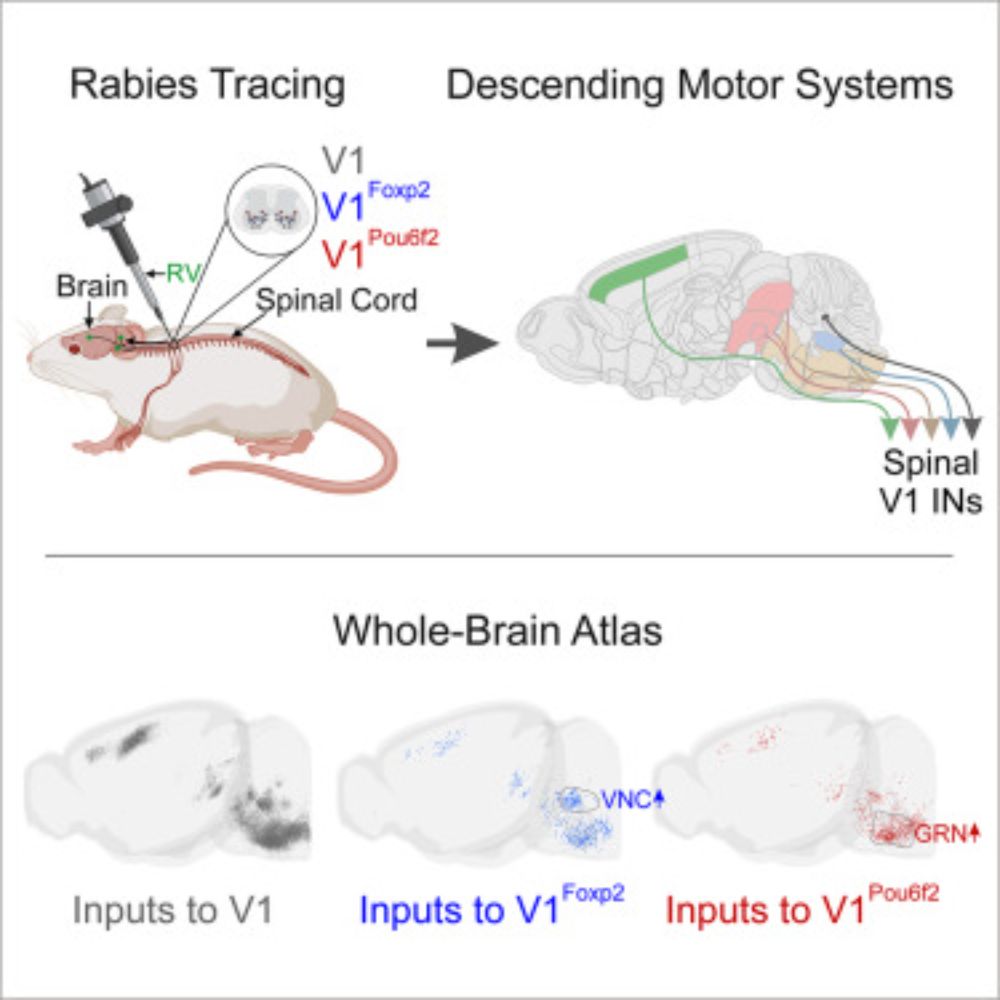
And science continues… check out our new work led by @rbrianroome.bsky.social

Ontogeny of the spinal cord dorsal horn https://www.biorxiv.org/content/10.1101/2025.03.14.643370v1
March 16, 2025 at 3:01 PM
And science continues… check out our new work led by @rbrianroome.bsky.social
Reposted by Anders Nelson

More compelling evidence that axoaxonal GABA release in the spinal cord can increase sensory transmission. Cell Reports www.cell.com/cell-reports...
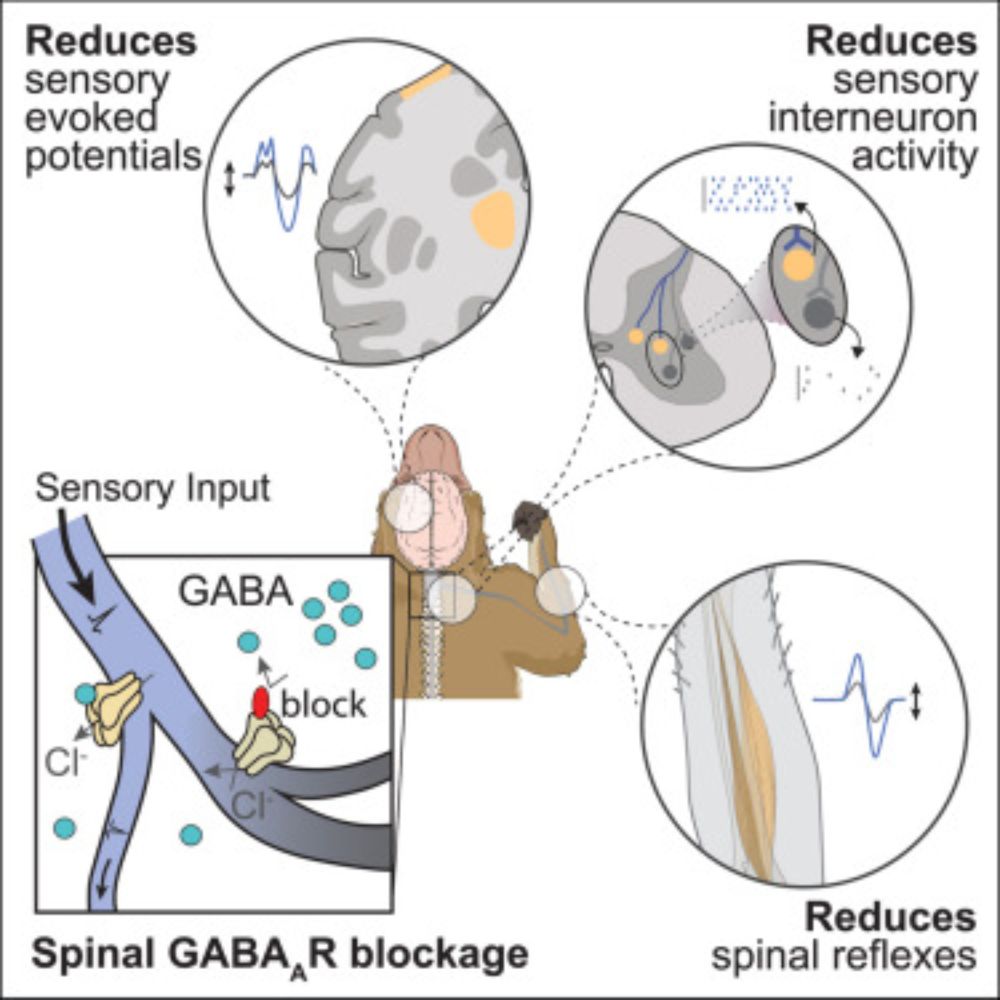
Pharmacological blocking of spinal GABAA receptors in monkeys reduces sensory transmission to the spinal cord, thalamus, and cortex
Mahrous et al. examine the controversial role of GABAARs in sensory transmission in
the monkey cervical spinal cord. They find that blocking spinal GABAARs reduces sensory
input to both motoneurons an...
www.cell.com
January 30, 2025 at 7:08 PM
More compelling evidence that axoaxonal GABA release in the spinal cord can increase sensory transmission. Cell Reports www.cell.com/cell-reports...
Reposted by Anders Nelson
📣📣📣
✅ Are you a senior PhD student in neuroscience? 🧠
✅ Looking for career development opportunities?💼
✅ Want to visit NYC in spring?🗽
✅ Considering a postdoc at NYU? 🥼
✅Apply for CoNNExINS!
wp.nyu.edu/connexins/
Please RT!
✅ Are you a senior PhD student in neuroscience? 🧠
✅ Looking for career development opportunities?💼
✅ Want to visit NYC in spring?🗽
✅ Considering a postdoc at NYU? 🥼
✅Apply for CoNNExINS!
wp.nyu.edu/connexins/
Please RT!
January 21, 2025 at 4:17 PM
📣📣📣
✅ Are you a senior PhD student in neuroscience? 🧠
✅ Looking for career development opportunities?💼
✅ Want to visit NYC in spring?🗽
✅ Considering a postdoc at NYU? 🥼
✅Apply for CoNNExINS!
wp.nyu.edu/connexins/
Please RT!
✅ Are you a senior PhD student in neuroscience? 🧠
✅ Looking for career development opportunities?💼
✅ Want to visit NYC in spring?🗽
✅ Considering a postdoc at NYU? 🥼
✅Apply for CoNNExINS!
wp.nyu.edu/connexins/
Please RT!
Reposted by Anders Nelson
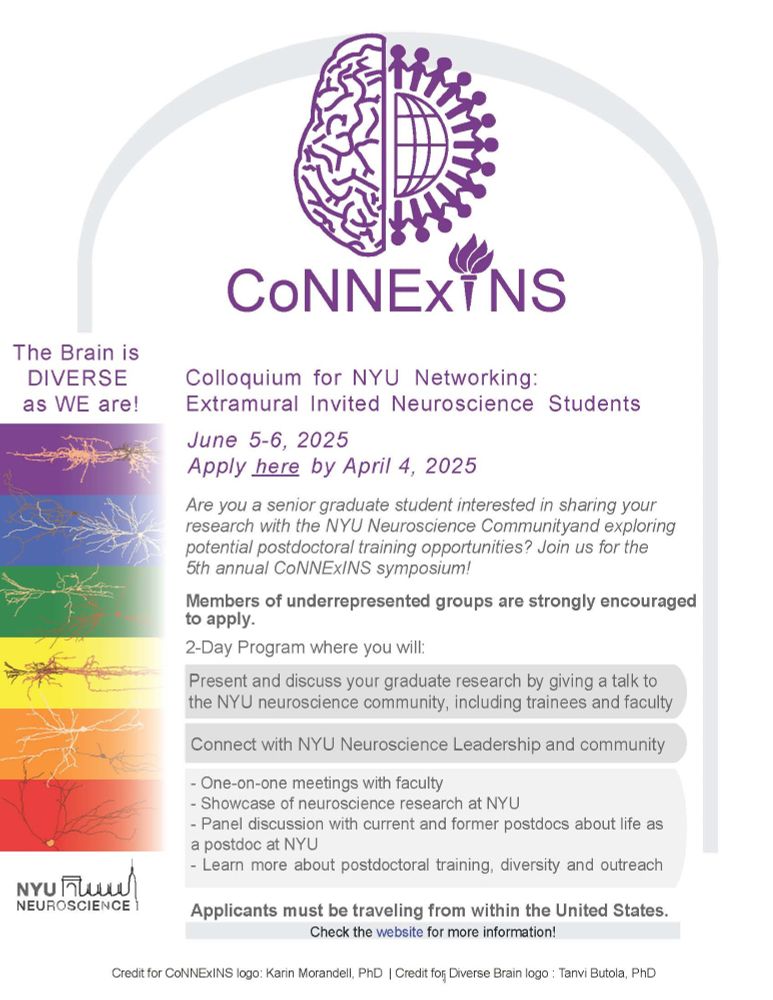
We are now accepting applications for 2025 Connexins! This is an in person symposium for senior graduate students to share their works with the NYU neuroscience community. Please RT!!! wp.nyu.edu/connexins/
CoNNExINS
CoNNExINS (Colloquium at NYU for Networking: Extramural for Invited Neuroscience Students)
wp.nyu.edu
January 15, 2025 at 6:50 PM
We are now accepting applications for 2025 Connexins! This is an in person symposium for senior graduate students to share their works with the NYU neuroscience community. Please RT!!! wp.nyu.edu/connexins/
Reposted by Anders Nelson
It's official, the Rich lab is now part of the Center for Neural Science at NYU! I'm thrilled to be joining CNS! At the same time, I'll miss my amazing colleagues at Sinai (even though we're not going far).
Here's to new adventures in the new year!🥂
Here's to new adventures in the new year!🥂
as.nyu.edu
January 2, 2025 at 5:48 PM
It's official, the Rich lab is now part of the Center for Neural Science at NYU! I'm thrilled to be joining CNS! At the same time, I'll miss my amazing colleagues at Sinai (even though we're not going far).
Here's to new adventures in the new year!🥂
Here's to new adventures in the new year!🥂
This year WPI reformulated Kwik-Cast to have a lower concentration of pigment. This increases the shelf stability of the product but unfortunately makes it transparent. Are there alternative cold-curing and biocompatible products?
December 4, 2024 at 4:42 PM
This year WPI reformulated Kwik-Cast to have a lower concentration of pigment. This increases the shelf stability of the product but unfortunately makes it transparent. Are there alternative cold-curing and biocompatible products?
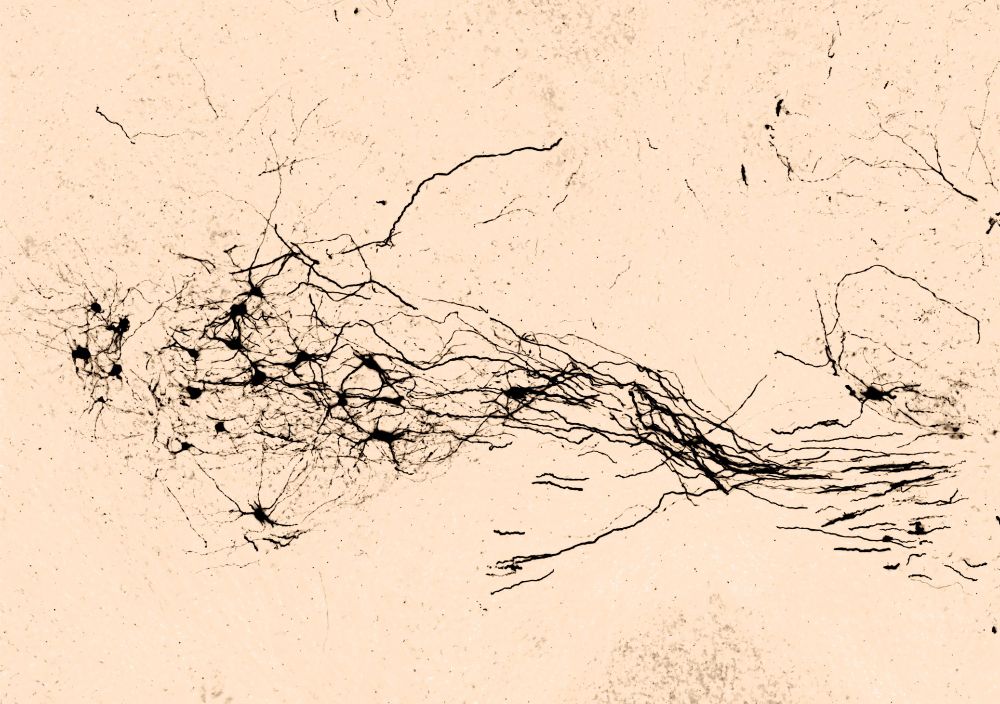
old school 🤝 new school
November 21, 2024 at 8:30 PM
old school 🤝 new school