
Axel Dreher
banner
adreher.bsky.social
Axel Dreher
@adreher.bsky.social

Professor of International and Development Politics, Editor of RIO. #china, #aid, www.axel-dreher.de.

Axel Dreher is a German economist.

Source: Wikipedia
Economics 43%
Political science 24%
Pinned
The RIO allows manuscripts rejected at APSR, IO, ISQ to be transferred to the RIO (and v.v.). Interested in discussing the draft of RIO’s transfer policy? Share your thoughts and suggstions for improvement: shorturl.at/9jbQb,
@the-peio.bsky.social, @iojournal.bsky.social, @apsrjournal.bsky.social
www.wp.peio.me

Reposted by Axel Dreher

Reposted by Axel Dreher

Disasters are rising, while poor households remain least insured.
On 10 Dec 2025 we discuss how to protect them through better insurance and anticipatory action at Wyss Academy Bern with World Bank experts.
Join on site or online. Register here: forms.office.com/Pages/Respon...
Happy to share that our paper on the ideological biases of international organizations is now out in the current issue of the AJPS (@ajpseditor.bsky.social):

dx.doi.org/10.1111/ajps...

@the-peio.bsky.social @mzesunimannheim.bsky.social @akentikelenis.bsky.social
Call for two Stephan Klasen Fellowships at the University of Göttingen,
for postdoctoral researchers in development economics from low- and middle-income countries.

Applications close 16th November 2025.

www.uni-goettingen.de/en/632637.html

Reposted by Axel Dreher

🙌 Recommended reading: rising powers can use international organisations to improve their image among foreign publics. These efforts may have negative effects on the perceived legitimacy of international organisations. Based on novel survey #Brazil #China #polisky @the-peio.bsky.social 👇

Reposted by Axel Dreher

Reposted by Axel Dreher

Reposted by Axel Dreher

Reposted by Axel Dreher

As the US steps back from leading in global governance institutions, China has increasingly stepped into leadership roles, serving as head of WHO, FAO, and other important UN agencies in recent years. In new (open access!) work with
@rhulvey.bsky.social in @the-peio.bsky.social we ask: why? 1/5

Reposted by Axel Dreher
Reposted by Axel Dreher

Another call for better aid reporting. Axel Dreher says we should distinguish & report separately on:

1. Humanitarian aid
2. Global public goods
3. Development aid

www.sciencedirect.com/science/arti...
www.sciencedirect.com

Reposted by Axel Dreher

Reposted by Axel Dreher

Reposted by Axel Dreher

We're increasingly using data on donor funding trends & combining it with strategic foresight to understand what the state of multilateralism could plausibly be in the coming years. This analysis from
@the-peio.bsky.social on government donor funding is very interesting: bit.ly/4mkkUqB
The far right and international organizations: How the far right in government affects foreign aid funding - The Review of International Organizations
The far right is on the rise, winning elections, entering governments globally, and politicizing international cooperation. Existing research finds only very limited effects of far-right governments o...
bit.ly

Reposted by Andrea Presbitero

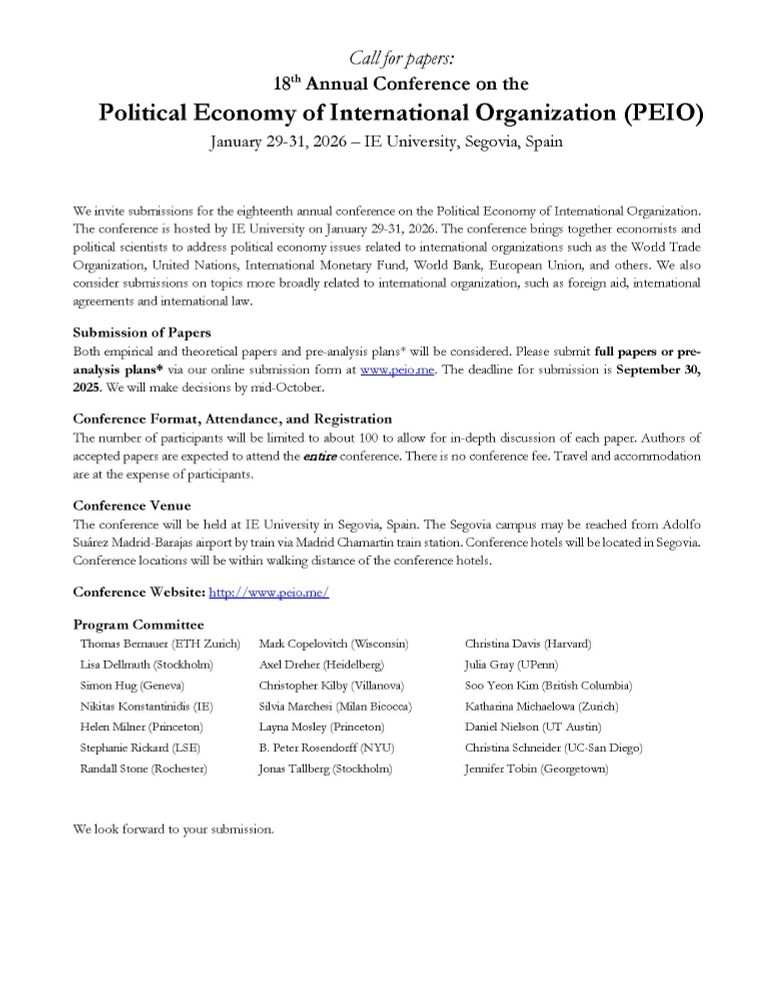
Deadline for PEIO 2026: September 30.
Join us for the Political Economy of International Organization Conference (@the-peio.bsky.social) at IE University in Segovia, Spain, January 29-31, 2026. Submission is now open at peio.me. Thanks to Nikitas Konstantinidis for hosting!

Reposted by Lars P. Feld

Reposted by Axel Dreher

Reposted by Axel Dreher

Reposted by Axel Dreher

@adreher.bsky.social, Jingke Pan, & @cjschneider.bsky.social find that in regions receiving foreign aid, targeted killings of politicians are 15-20% higher in the years with aid inflows. Direct cash transfers should be considered in fragile contexts.
cepr.org/voxeu/column...
#EconSky

Reposted by Axel Dreher

UN funding is under pressure. In a new article @the-peio.bsky.social, my colleagues Alex Tokhi and Lisbeth Zimmermann (@goetheuni.bsky.social) show that the participation of far-right parties in government has significant negative effects on the funding of IOs.

link.springer.com/article/10.1...
The far right and international organizations: How the far right in government affects foreign aid funding - The Review of International Organizations
The far right is on the rise, winning elections, entering governments globally, and politicizing international cooperation. Existing research finds only very limited effects of far-right governments on international organizations (IOs), however.. We argue that the far right in government undermines IOs by systematically reducing their earmarked funding, as it cannot fully align its anti-migration agenda with the liberal mandates and purposes of most IOs. Using new data on earmarked funding to IOs from 37 OECD donor states between 1990 and 2020, we examine how far-right participation in government affects IO funding. Expanding the data on far-right parties beyond Western Europe, we employ three-way fixed effects and dynamic balancing weights to address both static and dynamic confounding with marginal structural models. Our results show that governments with far-right parties reduce earmarked funding contributions to IOs by almost 30%, without affecting bilateral aid commitments. This suggests that the far right not only politicizes IOs but also attempts to directly undermine their operation when IOs cannot be aligned with their anti-migration agenda.
link.springer.com

Reposted by Axel Dreher

Interested in geocoded aid? Submit a one-page proposal for a paper to be presented at the workshop “Analyzing Global Development with the Geocoded Official Development Assistance Dataset (GODAD),” University of Göttingen, Germany, in March 13-14. Deadline Sep 30, CfP at godad.me

Reposted by Axel Dreher

Join us for the Political Economy of International Organization (PEIO) Conference at Harvard University, January 23-25, 2025. Submission is now open at peio.me. Thanks to
Stephen Chaudoin, Christina Davis, and Christoph Mikulaschek for hosting!

Reposted by Axel Dreher

How can we measure informal influence of leaders’ unelected spouses?

We use our Geocoded ODA Data (GODAD) to test whether sub-national regions where leaders’ spouses are born receive more aid. They do - from European donors, the US, China! Paper and data: godad.me

Reposted by Axel Dreher

CESifo @cesifo.org · Jul 15
New Paper Alert!📢
"Foreign Aid and Targeted Political Violence" by @adreher.bsky.social‬ Jingke Pan @cjschneider.bsky.social

To understand how foreign aid can unintentionally fuel political violence in fragile democracies, read the full study here:
🔗 www.ifo.de/en/cesifo/pu...

Reposted by Axel Dreher

Many thanks to Michael Breen @dublincityuni.bsky.social for this thoughtful review of my book, Cooperative Complexity: The Next Level of Global Economic Governance, in The Review of International Organizations @the-peio.bsky.social link.springer.com/article/10.1...
Richard Clark. 2025. Cooperative Complexity: The Next Level of Global Economic Governance. (Cambridge: Cambridge University Press) - The Review of International Organizations
The Review of International Organizations -
link.springer.com
Looking forward to present new research (with @hannaeback.bsky.social and @michaelimre.bsky.social) on the relationship between ideological polarization, coalition governance and the number of party members in the German states at the Sogang Conference on Party Activism and Democracy next week 😊

Reposted by Axel Dreher

Reposted by Axel Dreher