



We are nearing the end of the week and let’s talk about our last student - The anxious or avoidant student.
For tips visit
@edpsyched.bsky.social
's blog post:
www.edpsyched.co.uk/blog/4-strat...
#AnxietyinEd #StudentWellbeing #AvoidanceBehavior #UKTeaching #EduSkyUK
For tips visit
@edpsyched.bsky.social
's blog post:
www.edpsyched.co.uk/blog/4-strat...
#AnxietyinEd #StudentWellbeing #AvoidanceBehavior #UKTeaching #EduSkyUK


September 25, 2025 at 6:13 AM
We are nearing the end of the week and let’s talk about our last student - The anxious or avoidant student.
For tips visit
@edpsyched.bsky.social
's blog post:
www.edpsyched.co.uk/blog/4-strat...
#AnxietyinEd #StudentWellbeing #AvoidanceBehavior #UKTeaching #EduSkyUK
For tips visit
@edpsyched.bsky.social
's blog post:
www.edpsyched.co.uk/blog/4-strat...
#AnxietyinEd #StudentWellbeing #AvoidanceBehavior #UKTeaching #EduSkyUK

This often leads to #AvoidanceBehavior in real life. As an example, (unpleasant) tasks are not even started, in the belief that they can not be completed.
In addition, #ADHD symptoms have an impact on #self-esteem.
6|7
In addition, #ADHD symptoms have an impact on #self-esteem.
6|7
July 30, 2025 at 11:37 AM
This often leads to #AvoidanceBehavior in real life. As an example, (unpleasant) tasks are not even started, in the belief that they can not be completed.
In addition, #ADHD symptoms have an impact on #self-esteem.
6|7
In addition, #ADHD symptoms have an impact on #self-esteem.
6|7

If I never finish the last season of WWDITS then it’ll never be over in my mind 🫠
#avoidancebehavior
#avoidancebehavior

a man with a beard is giving a thumbs up in front of an fx logo
ALT: a man with a beard is giving a thumbs up in front of an fx logo
media.tenor.com
January 26, 2025 at 10:33 PM
If I never finish the last season of WWDITS then it’ll never be over in my mind 🫠
#avoidancebehavior
#avoidancebehavior

Source: scontent-bru2-1.cdninstagram.com/v/t51.2885-1...
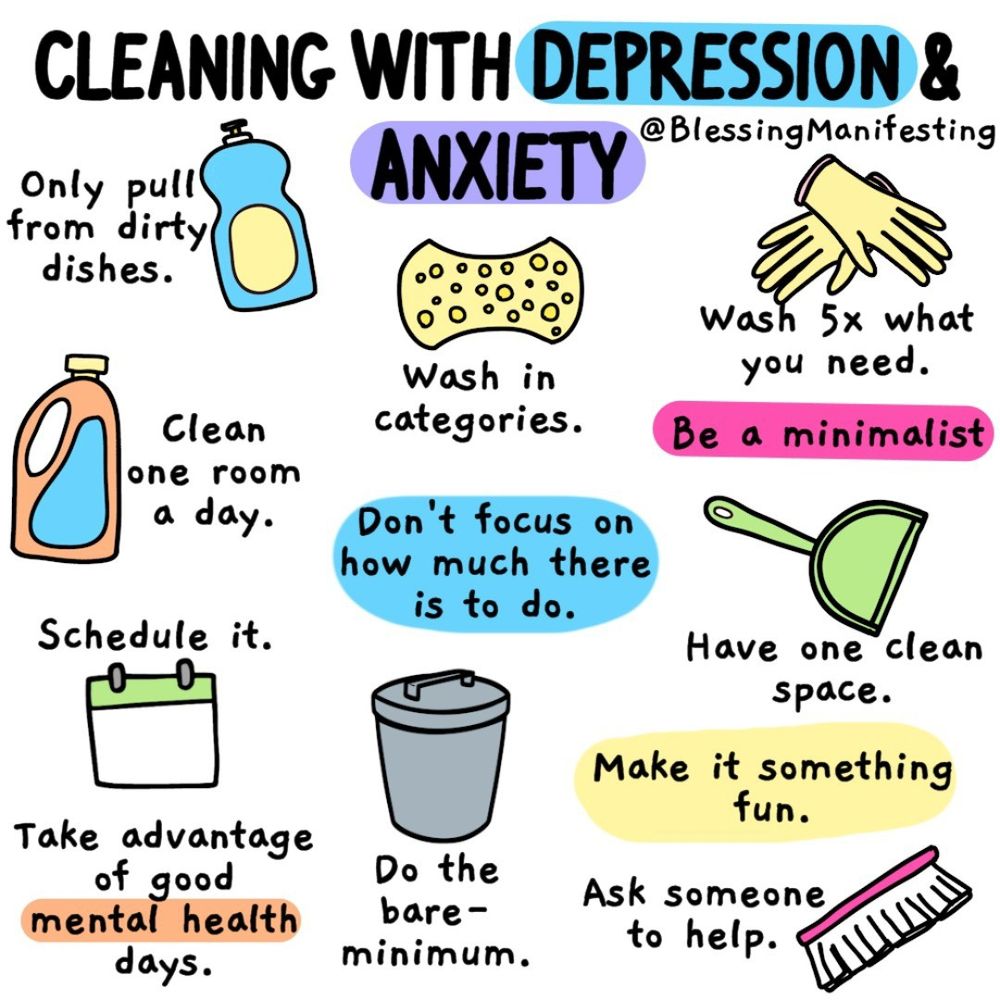
#avoidancebehavior #cleaningwithdepression #depressionsigns #mentalillness #mentalhealth #anxiety
#avoidancebehavior #cleaningwithdepression #depressionsigns #mentalillness #mentalhealth #anxiety
December 27, 2024 at 2:04 AM

Nouveau #article dont notre collègue Msc. Maya Burckhardt est deuxième autrice ✍️ 🍀
Ici l’article complet:#article #research #university #amygdala #functionalconnectivity #approachbehavior #avoidancebehavior
direct.mit.edu/jocn/article/3…
Ici l’article complet:#article #research #university #amygdala #functionalconnectivity #approachbehavior #avoidancebehavior
direct.mit.edu/jocn/article/3…
Amygdala in Action: Functional Connectivity during Approach and Avoidance Behaviors
Abstract. Motivation is an important feature of emotion. By driving approach to positive events and promoting avoidance of negative stimuli, motivation drives adaptive actions and goal pursuit. The amygdala has been associated with a variety of affective processes, particularly the appraisal of stimulus valence that is assumed to play a crucial role in the generation of approach and avoidance behaviors. Here, we measured amygdala functional connectivity patterns while participants played a video game manipulating goal conduciveness through the presence of good, neutral, or bad monsters. As expected, good versus bad monsters elicited opposing motivated behaviors, whereby good monsters induced more approach and bad monsters triggered more avoidance. These opposing directional behaviors were paralleled by increased connectivity between the amygdala and medial brain areas, such as the OFC and posterior cingulate, for good relative to bad, and between amygdala and caudate for bad relative to good monsters. Moreover, in both conditions, individual connectivity strength between the amygdala and medial prefrontal regions was positively correlated with brain scores from a latent component representing efficient goal pursuit, which was identified by a partial least squares analysis determining the multivariate association between amygdala connectivity and behavioral motivation indices during gameplay. At the brain level, this latent component highlighted a widespread pattern of amygdala connectivity, including a dorsal frontoparietal network and motor areas. These results suggest that amygdala-medial prefrontal interactions captured the overall subjective relevance of ongoing events, which could consecutively drive the engagement of attentional, executive, and motor circuits necessary for implementing successful goal-pursuit, irrespective of approach or avoidance directions.
direct.mit.edu
February 20, 2025 at 11:03 AM
Nouveau #article dont notre collègue Msc. Maya Burckhardt est deuxième autrice ✍️ 🍀
Ici l’article complet:#article #research #university #amygdala #functionalconnectivity #approachbehavior #avoidancebehavior
direct.mit.edu/jocn/article/3…
Ici l’article complet:#article #research #university #amygdala #functionalconnectivity #approachbehavior #avoidancebehavior
direct.mit.edu/jocn/article/3…