




Reposted by Zu
March 28, 2025 at 4:02 AM
Reposted by Zu

What would you love to know about #robot learning and decision making?
Later this season, I'll be chatting to Prof. Lerrel Pinto (@lerrelpinto.com) from NYU about using machine learning to train robots to adapt to new environments.
Send me your questions for Lerrel: robottalk.org/ask-a-question/
Later this season, I'll be chatting to Prof. Lerrel Pinto (@lerrelpinto.com) from NYU about using machine learning to train robots to adapt to new environments.
Send me your questions for Lerrel: robottalk.org/ask-a-question/

March 18, 2025 at 10:11 AM
What would you love to know about #robot learning and decision making?
Later this season, I'll be chatting to Prof. Lerrel Pinto (@lerrelpinto.com) from NYU about using machine learning to train robots to adapt to new environments.
Send me your questions for Lerrel: robottalk.org/ask-a-question/
Later this season, I'll be chatting to Prof. Lerrel Pinto (@lerrelpinto.com) from NYU about using machine learning to train robots to adapt to new environments.
Send me your questions for Lerrel: robottalk.org/ask-a-question/
Reposted by Zu
We just released AnySense, an iPhone app for effortless data acquisition and streaming for robotics. We leverage Apple’s development frameworks to record and stream:
1. RGBD + Pose data
2. Audio from the mic or custom contact microphones
3. Seamless Bluetooth integration for external sensors
1. RGBD + Pose data
2. Audio from the mic or custom contact microphones
3. Seamless Bluetooth integration for external sensors
February 26, 2025 at 3:14 PM
We just released AnySense, an iPhone app for effortless data acquisition and streaming for robotics. We leverage Apple’s development frameworks to record and stream:
1. RGBD + Pose data
2. Audio from the mic or custom contact microphones
3. Seamless Bluetooth integration for external sensors
1. RGBD + Pose data
2. Audio from the mic or custom contact microphones
3. Seamless Bluetooth integration for external sensors
Reposted by Zu
Thank you to @sloanfoundation.bsky.social for this generous award to our lab. Hopefully this will bring us closer to building truly general-purpose robots!

🎉Congrats to the 126 early-career scientists who have been awarded a Sloan Research Fellowship this year! These exceptional scholars are drawn from 51 institutions across the US and Canada, and represent the next generation of groundbreaking researchers. sloan.org/fellowships/...

February 18, 2025 at 4:50 PM
Thank you to @sloanfoundation.bsky.social for this generous award to our lab. Hopefully this will bring us closer to building truly general-purpose robots!
Reposted by Zu
Just found a new winner for the most hype-baiting, unscientific plot I have seen. (From the recent Figure AI release)

February 20, 2025 at 10:01 PM
Just found a new winner for the most hype-baiting, unscientific plot I have seen. (From the recent Figure AI release)
Reposted by Zu
In a new NYU video, CDS-affiliated Assistant Professor Lerrel Pinto (@lerrelpinto.com) explains why real robots are more like Roombas than science fiction heroes.
Pinto's GRAIL lab works to bridge that gap.
www.youtube.com/watch?v=esyD...
Pinto's GRAIL lab works to bridge that gap.
www.youtube.com/watch?v=esyD...

An NYU Roboticist Fact Checks 'The Wild Robot'
YouTube video by New York University
www.youtube.com
January 29, 2025 at 9:02 PM
In a new NYU video, CDS-affiliated Assistant Professor Lerrel Pinto (@lerrelpinto.com) explains why real robots are more like Roombas than science fiction heroes.
Pinto's GRAIL lab works to bridge that gap.
www.youtube.com/watch?v=esyD...
Pinto's GRAIL lab works to bridge that gap.
www.youtube.com/watch?v=esyD...
Reposted by Zu
two exciting directions for diffusion models in 2025: either going (extremely) small or going (extremely) big with your steps
January 17, 2025 at 2:36 PM
two exciting directions for diffusion models in 2025: either going (extremely) small or going (extremely) big with your steps

Reposted by Zu
At NYU Abu Dhabi today and in love how cat friendly the campus is!

December 18, 2024 at 4:39 AM
At NYU Abu Dhabi today and in love how cat friendly the campus is!
Beautiful work by Remi’s team!

HOT 🔥 fastest, most precise, and most capable hand control setup ever...
Less than $450 and fully open-source 🤯
by @huggingface, @therobotstudio, @NepYope
This tendon-driven technology will disrupt robotics! Retweet to accelerate its democratization 🚀
A thread 🧵
Less than $450 and fully open-source 🤯
by @huggingface, @therobotstudio, @NepYope
This tendon-driven technology will disrupt robotics! Retweet to accelerate its democratization 🚀
A thread 🧵
December 15, 2024 at 3:01 PM
Beautiful work by Remi’s team!
Reposted by Zu


Reposted by Zu
New paper! We show that by using keypoint-based image representation, robot policies become robust to different object types and background changes.
We call this method Prescriptive Point Priors for robot Policies or P3-PO in short. Full project is here: point-priors.github.io
We call this method Prescriptive Point Priors for robot Policies or P3-PO in short. Full project is here: point-priors.github.io
December 10, 2024 at 8:32 PM
New paper! We show that by using keypoint-based image representation, robot policies become robust to different object types and background changes.
We call this method Prescriptive Point Priors for robot Policies or P3-PO in short. Full project is here: point-priors.github.io
We call this method Prescriptive Point Priors for robot Policies or P3-PO in short. Full project is here: point-priors.github.io
Reading RUM is surprisingly beneficial for me to build intuitions on multimodal bc. Simple, elegant and also straight to the point.
Since we are nearing the end of the year, I'll revisit some of our work I'm most excited about from the last year and maybe a sneak peek of what we are up to next.
To start of, Robot Utility Models, which enables zero-shot deployment. In the video below, the robot hasnt seen these doors before.
To start of, Robot Utility Models, which enables zero-shot deployment. In the video below, the robot hasnt seen these doors before.
December 10, 2024 at 7:57 AM
Reading RUM is surprisingly beneficial for me to build intuitions on multimodal bc. Simple, elegant and also straight to the point.
Reposted by Zu
Modern policy architectures are unnecessarily complex. In our #NeurIPS2024 project called BAKU, we focus on what really matters for good policy learning.
BAKU is modular, language-conditioned, compatible with multiple sensor streams & action multi-modality, and importantly fully open-source!
BAKU is modular, language-conditioned, compatible with multiple sensor streams & action multi-modality, and importantly fully open-source!
December 9, 2024 at 11:33 PM
Modern policy architectures are unnecessarily complex. In our #NeurIPS2024 project called BAKU, we focus on what really matters for good policy learning.
BAKU is modular, language-conditioned, compatible with multiple sensor streams & action multi-modality, and importantly fully open-source!
BAKU is modular, language-conditioned, compatible with multiple sensor streams & action multi-modality, and importantly fully open-source!
Reposted by Zu
It doesn't look like much but it's hard to get the exact same thing working in sim as in the real world. Perception models don't transfer so well, control's tuned different, joints can be slightly off, etc.
Hopefully will have nicer things to show than this soon
Hopefully will have nicer things to show than this soon
December 4, 2024 at 9:33 PM
It doesn't look like much but it's hard to get the exact same thing working in sim as in the real world. Perception models don't transfer so well, control's tuned different, joints can be slightly off, etc.
Hopefully will have nicer things to show than this soon
Hopefully will have nicer things to show than this soon
This is the tutorial that brought me on board robot learning. Watched it on my plane to California. I have been a big fan of @notmahi.bsky.social since then.
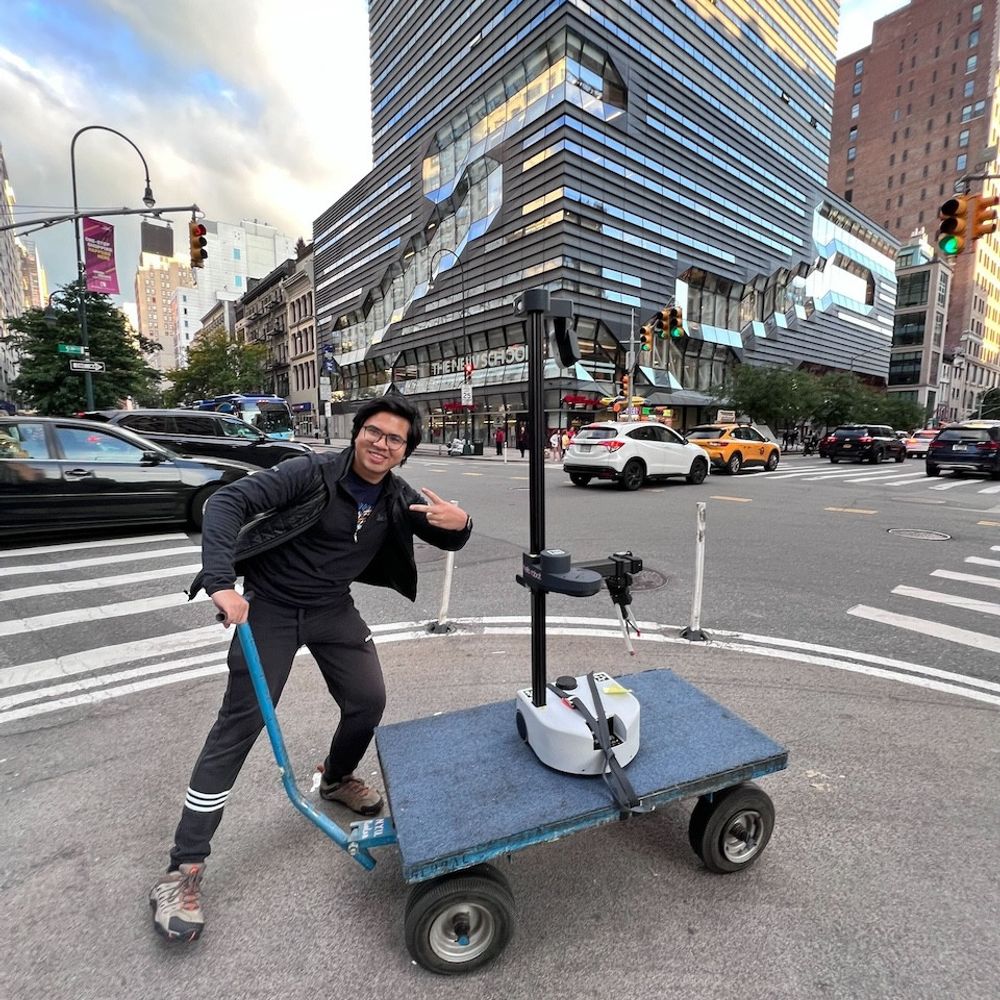
We took a bunch of them in robot learning and made a tutorial about them! I tried to put everything that I find myself regularly telling my students there somewhere. Really think it can save some days to months of a new grad students’ life.
supervised-robot-learning.github.io
supervised-robot-learning.github.io

Supervised Policy Learning for Real Robots
RSS 2024 Tutorial on Supervised Policy Learning for Real Robots. Friday, July 19 Afternoon (2PM - 6PM Central European time, 8AM - 12AM Eastern Time).
supervised-robot-learning.github.io
November 30, 2024 at 8:45 PM
This is the tutorial that brought me on board robot learning. Watched it on my plane to California. I have been a big fan of @notmahi.bsky.social since then.