



Vladislav Zhitenev
@zhitenev.bsky.social
Archeologist, Ph.D., Doctor of History;
Lomonosov Moscow State University;
South Ural archeological expedition
Lomonosov Moscow State University;
South Ural archeological expedition
Reposted by Vladislav Zhitenev

Sky blue – for the first time discovered the fourth color in the Paleolithic parietal Kapova cave.
The unknown earlier bright color of Paleolithic artists in Kapova cave (the Southern Urals, Russia).
www.hist.msu.ru/about/gen_ne...
The unknown earlier bright color of Paleolithic artists in Kapova cave (the Southern Urals, Russia).
www.hist.msu.ru/about/gen_ne...


July 13, 2025 at 8:19 AM
Sky blue – for the first time discovered the fourth color in the Paleolithic parietal Kapova cave.
The unknown earlier bright color of Paleolithic artists in Kapova cave (the Southern Urals, Russia).
www.hist.msu.ru/about/gen_ne...
The unknown earlier bright color of Paleolithic artists in Kapova cave (the Southern Urals, Russia).
www.hist.msu.ru/about/gen_ne...
An Upper Second Molar from Akhshtyrskaya Cave and Population Affinities of the Middle Paleolithic Hominins of the Caucasus
archaeology.nsc.ru/en/publicati...
archaeology.nsc.ru/en/publicati...

June 28, 2025 at 8:20 AM
An Upper Second Molar from Akhshtyrskaya Cave and Population Affinities of the Middle Paleolithic Hominins of the Caucasus
archaeology.nsc.ru/en/publicati...
archaeology.nsc.ru/en/publicati...
Boomerang and bones: Refining the chronology of the Early Upper Paleolithic at Obłazowa Cave, Poland
journals.plos.org/plosone/arti...
journals.plos.org/plosone/arti...

June 26, 2025 at 9:28 AM
Boomerang and bones: Refining the chronology of the Early Upper Paleolithic at Obłazowa Cave, Poland
journals.plos.org/plosone/arti...
journals.plos.org/plosone/arti...
Reposted by Vladislav Zhitenev

🏺🦣🗃️ Great to see this out from Emma Pomeroy & wider team, continuing to piece together the Shanidar jigsaw: its site archive, and complex spatial relationships of skeletal remains.
Currently best evidence for sustained deposition of #Neanderthal bodies we have.
journals.openedition.org/bmsap/15560
Currently best evidence for sustained deposition of #Neanderthal bodies we have.
journals.openedition.org/bmsap/15560


April 14, 2025 at 1:09 PM
🏺🦣🗃️ Great to see this out from Emma Pomeroy & wider team, continuing to piece together the Shanidar jigsaw: its site archive, and complex spatial relationships of skeletal remains.
Currently best evidence for sustained deposition of #Neanderthal bodies we have.
journals.openedition.org/bmsap/15560
Currently best evidence for sustained deposition of #Neanderthal bodies we have.
journals.openedition.org/bmsap/15560
Reposted by Vladislav Zhitenev

Sorprendentemente hay pocos hogares detalladamente descritos del Último Máximo Glacial en Europa. Aquí van los de Korman' 9 (Ucrania).
Fire Use During the Last Glacial Maximum: Evidence From the Epigravettian at Korman' 9, Middle Dniester Valley, Ukraine
Fire Use During the Last Glacial Maximum: Evidence From the Epigravettian at Korman' 9, Middle Dniester Valley, Ukraine

doi.org
April 15, 2025 at 9:00 AM
Sorprendentemente hay pocos hogares detalladamente descritos del Último Máximo Glacial en Europa. Aquí van los de Korman' 9 (Ucrania).
Fire Use During the Last Glacial Maximum: Evidence From the Epigravettian at Korman' 9, Middle Dniester Valley, Ukraine
Fire Use During the Last Glacial Maximum: Evidence From the Epigravettian at Korman' 9, Middle Dniester Valley, Ukraine
On the Mousterian origin of bone-tipped hunting weapons in Europe: Evidence from Mezmaiskaya Cave, North Caucasus (Russia)
www.sciencedirect.com/science/arti...
www.sciencedirect.com/science/arti...

April 15, 2025 at 10:13 AM
On the Mousterian origin of bone-tipped hunting weapons in Europe: Evidence from Mezmaiskaya Cave, North Caucasus (Russia)
www.sciencedirect.com/science/arti...
www.sciencedirect.com/science/arti...
Reposted by Vladislav Zhitenev
A male Denisovan mandible from Pleistocene Taiwan | Science www.science.org/doi/10.1126/...

A male Denisovan mandible from Pleistocene Taiwan
Denisovans are an extinct hominin group defined by ancient genomes of Middle to Late Pleistocene fossils from southern Siberia. Although genomic evidence suggests their widespread distribution through...
www.science.org
April 10, 2025 at 6:15 PM
A male Denisovan mandible from Pleistocene Taiwan | Science www.science.org/doi/10.1126/...
Reposted by Vladislav Zhitenev
La mandíbula de Penghu (Taiwan) ¡es denisovana! ¿Homo juluensis?
A male Denisovan mandible from Pleistocene Taiwan www.science.org/doi/10.1126/...
A male Denisovan mandible from Pleistocene Taiwan www.science.org/doi/10.1126/...

A male Denisovan mandible from Pleistocene Taiwan
Denisovans are an extinct hominin group defined by ancient genomes of Middle to Late Pleistocene fossils from southern Siberia. Although genomic evidence suggests their widespread distribution through...
www.science.org
April 10, 2025 at 6:43 PM
La mandíbula de Penghu (Taiwan) ¡es denisovana! ¿Homo juluensis?
A male Denisovan mandible from Pleistocene Taiwan www.science.org/doi/10.1126/...
A male Denisovan mandible from Pleistocene Taiwan www.science.org/doi/10.1126/...
Reposted by Vladislav Zhitenev
Aurignacian groups at Isturitz (France) adapted to a shifting environment upon their arrival in Western Europe ∼42,000 years ago www.sciencedirect.com/science/arti...

Aurignacian groups at Isturitz (France) adapted to a shifting environment upon their arrival in Western Europe ∼42,000 years ago
The Marine Isotope Stage 3 is a context of considerable climatic instability. Establishing the link between global climate changes and their impact on…
www.sciencedirect.com
April 8, 2025 at 11:25 AM
Aurignacian groups at Isturitz (France) adapted to a shifting environment upon their arrival in Western Europe ∼42,000 years ago www.sciencedirect.com/science/arti...
Reposted by Vladislav Zhitenev
We are happy to share our pre-print on dating bone using a novel non-destructive protocol we developed. The paper is on the Biorxiv here (Luftensteiner et al. 2025):
www.biorxiv.org/content/10.1...
www.biorxiv.org/content/10.1...

Non-destructive radiocarbon dating of bone
Since the 1950s, radiocarbon measurements have anchored archaeological chronologies dating back to 50,000 years, with bone collagen being a commonly dated material. Despite advances in collagen extrac...
www.biorxiv.org
March 29, 2025 at 3:05 PM
We are happy to share our pre-print on dating bone using a novel non-destructive protocol we developed. The paper is on the Biorxiv here (Luftensteiner et al. 2025):
www.biorxiv.org/content/10.1...
www.biorxiv.org/content/10.1...
Reposted by Vladislav Zhitenev

Wanna read a digest of a fun anthro thing I've been up to lately? Our recent work on knots present and past has just been covered in @pnas.org Journal Club www.pnas.org/post/journal...

In knots, archaeologists see evidence of cultural exchange, and perhaps the early sparks of cognition
Knots have been a fixture for thousands of years. A recent database finds that many cultures share the same ones. Image credit: Shutterstock / UVgreen.
www.pnas.org
March 31, 2025 at 6:53 AM
Wanna read a digest of a fun anthro thing I've been up to lately? Our recent work on knots present and past has just been covered in @pnas.org Journal Club www.pnas.org/post/journal...
Reposted by Vladislav Zhitenev

Interesting thoughts from Chris regarding ancient population structure in Africa. Regarding how these populations might have remained separate for a million years or more, it's worth bearing in mind the following:
Firstly, our results don't necessarily imply complete separation ...
Firstly, our results don't necessarily imply complete separation ...
My initial thoughts on the Cousins et al. paper on a deep structure for Homo sapiens origins (Nature Genetics)

March 18, 2025 at 11:17 PM
Interesting thoughts from Chris regarding ancient population structure in Africa. Regarding how these populations might have remained separate for a million years or more, it's worth bearing in mind the following:
Firstly, our results don't necessarily imply complete separation ...
Firstly, our results don't necessarily imply complete separation ...
Reposted by Vladislav Zhitenev
And stomach contents too…https://www.sciencedirect.com/science/article/abs/pii/S0277379113003399
March 20, 2025 at 12:06 PM
And stomach contents too…https://www.sciencedirect.com/science/article/abs/pii/S0277379113003399
Reposted by Vladislav Zhitenev
Cultural evolution, social ratcheting and the evolution of human division of labour | Philosophical Transactions of the Royal Society B: Biological Sciences royalsocietypublishing.org/doi/10.1098/...

Cultural evolution, social ratcheting and the evolution of human division of labour | Philosophical Transactions of the Royal Society B: Biological Sciences
While ecological specialization, social differentiation and division of labour are found in many species, extensive and irreversible interdependence among culturally specialized producers is a characteristic feature of humans. By extending the concept of ...
royalsocietypublishing.org
March 23, 2025 at 10:53 AM
Cultural evolution, social ratcheting and the evolution of human division of labour | Philosophical Transactions of the Royal Society B: Biological Sciences royalsocietypublishing.org/doi/10.1098/...
Reposted by Vladislav Zhitenev

In @nature.com we show that humans lived in rainforests ~150,000 years ago – over double the previous oldest estimate. Their presence in West Africa’s rainforests demonstrates the spread of early humans and places ecological diversity at the heart of our species.
www.nature.com/articles/s41...
www.nature.com/articles/s41...
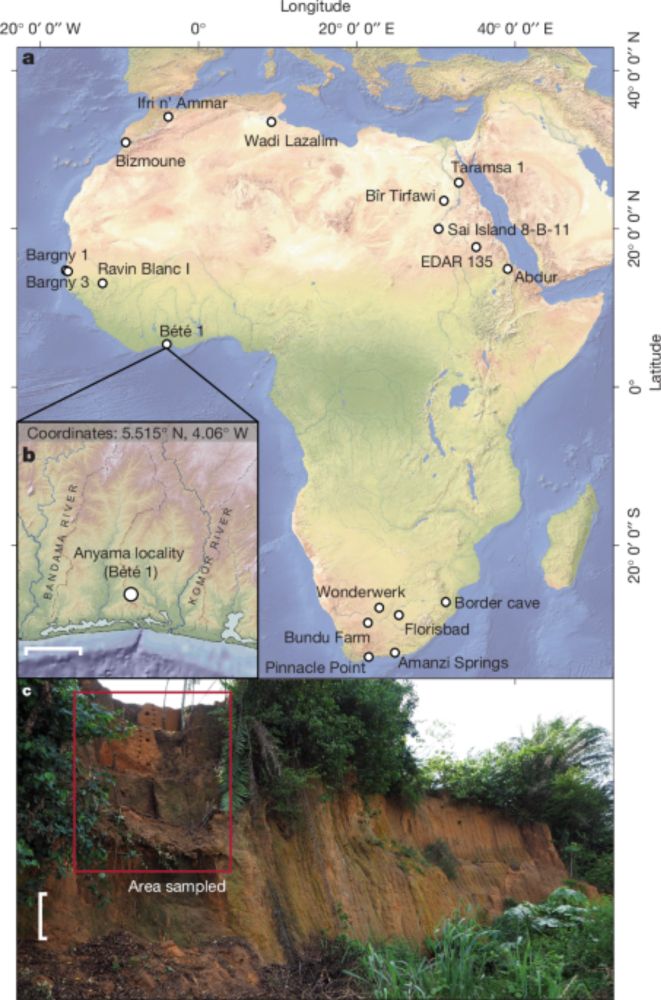
Humans in Africa’s wet tropical forests 150 thousand years ago - Nature
The identification of tools dated to the time of Homo sapiens associated with microfloral evidence of wet tropical forests indicates that West African forests were occupied by humans much earlier...
www.nature.com
February 26, 2025 at 4:10 PM
In @nature.com we show that humans lived in rainforests ~150,000 years ago – over double the previous oldest estimate. Their presence in West Africa’s rainforests demonstrates the spread of early humans and places ecological diversity at the heart of our species.
www.nature.com/articles/s41...
www.nature.com/articles/s41...
Reposted by Vladislav Zhitenev

Meanwhile, 150,000 years ago: hunter-gatherers thrived in rain forests, once considered too harsh for early Homo sapiens to survive. Here's my story [Gift link] nyti.ms/3EThoDL 🧪
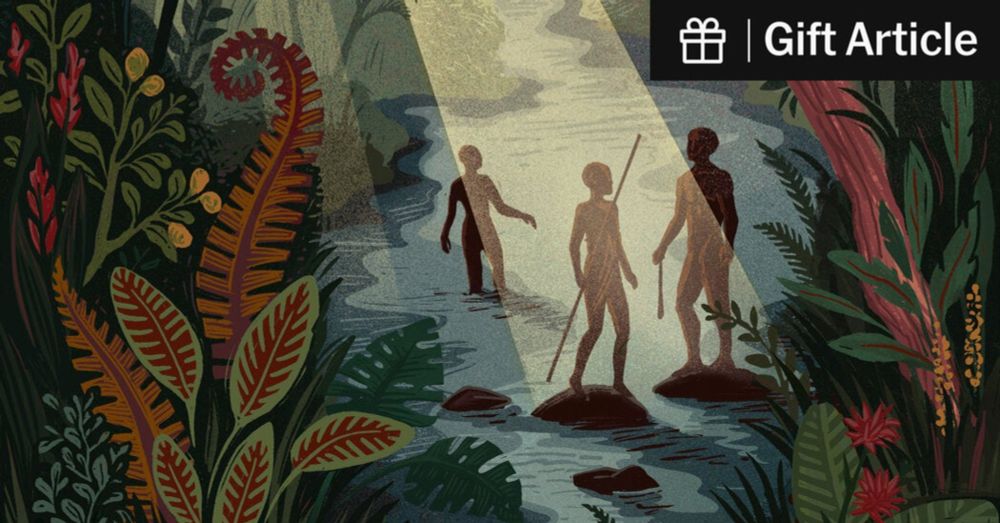
Early Humans Thrived in Rainforests (Gift Article)
The discovery clashes with the traditional image of humans evolving on the savannas of East Africa.
nyti.ms
February 26, 2025 at 5:19 PM
Meanwhile, 150,000 years ago: hunter-gatherers thrived in rain forests, once considered too harsh for early Homo sapiens to survive. Here's my story [Gift link] nyti.ms/3EThoDL 🧪
Revisiting palaeolithic rock art. Reading the graphic overlapping in terms of reuse behaviours in the Frieze of the Hands from the El Castillo cave (Cantabria, Spain)
www.sciencedirect.com/science/arti...
www.sciencedirect.com/science/arti...

Revisiting palaeolithic rock art. Reading the graphic overlapping in terms of reuse behaviours in the Frieze of the Hands from the El Castillo cave (Cantabria, Spain)
The study of figures overlapping in Palaeolithic rock art has been approached by the scientific discipline fundamentally from two perspectives. The fi…
www.sciencedirect.com
February 24, 2025 at 11:56 AM
Revisiting palaeolithic rock art. Reading the graphic overlapping in terms of reuse behaviours in the Frieze of the Hands from the El Castillo cave (Cantabria, Spain)
www.sciencedirect.com/science/arti...
www.sciencedirect.com/science/arti...
Reposted by Vladislav Zhitenev
A reassessment of the “hard-steps” model for the evolution of intelligent life | Science Advances www.science.org/doi/10.1126/...

A reassessment of the “hard-steps” model for the evolution of intelligent life
Humans—and analogous life beyond Earth—may represent the probable outcome of biological and planetary coevolution.
www.science.org
February 15, 2025 at 10:18 AM
A reassessment of the “hard-steps” model for the evolution of intelligent life | Science Advances www.science.org/doi/10.1126/...
Reposted by Vladislav Zhitenev
Stone disc production at Pincevent (France) reveals versatile uses of colouring materials in the Late Magdalenian www.sciencedirect.com/science/arti...

Stone disc production at Pincevent (France) reveals versatile uses of colouring materials in the Late Magdalenian
Level IV0 at Pincevent, dating from the Late Magdalenian (15-14 ka cal BP), has revealed a singular assemblage of more than 400 artefacts in colouring…
www.sciencedirect.com
February 15, 2025 at 7:29 PM
Stone disc production at Pincevent (France) reveals versatile uses of colouring materials in the Late Magdalenian www.sciencedirect.com/science/arti...
Reposted by Vladislav Zhitenev

An important new paper by @beademarch.bsky.social and her team challenges how we use ancient proteins to study the past.
Analysis of 1,832 sequences from waterfowl (ducks & geese) reveals why palaeoproteomics isn't the simple solution we hoped for...
👇🧵 1/4
www.researchsquare.com/article/rs-5...
Analysis of 1,832 sequences from waterfowl (ducks & geese) reveals why palaeoproteomics isn't the simple solution we hoped for...
👇🧵 1/4
www.researchsquare.com/article/rs-5...

February 16, 2025 at 8:24 AM
An important new paper by @beademarch.bsky.social and her team challenges how we use ancient proteins to study the past.
Analysis of 1,832 sequences from waterfowl (ducks & geese) reveals why palaeoproteomics isn't the simple solution we hoped for...
👇🧵 1/4
www.researchsquare.com/article/rs-5...
Analysis of 1,832 sequences from waterfowl (ducks & geese) reveals why palaeoproteomics isn't the simple solution we hoped for...
👇🧵 1/4
www.researchsquare.com/article/rs-5...
Reposted by Vladislav Zhitenev

Reposted by Vladislav Zhitenev

The Middle Danube region is a key area for understanding Upper Palaeolithic hunter-gatherer behaviours in a climatic context ... new approaches focusing on high-resolution studies ... have shown great new insights in human behaviour ...

A First Look at the Gravettian Open-Air Site Ollersdorf-Heidenberg (Austria): Recent Fieldwork and First Results on Stratigraphy, Chronology, Organic Preservation and Combustion Activity - Journal of ...
The Middle Danube region is a key area for understanding Upper Palaeolithic hunter-gatherer behaviours in a climatic context due to its long loess–palaeosol sequences and rich archaeological record sp...
link.springer.com
February 17, 2025 at 7:02 AM
The Middle Danube region is a key area for understanding Upper Palaeolithic hunter-gatherer behaviours in a climatic context ... new approaches focusing on high-resolution studies ... have shown great new insights in human behaviour ...
Reposted by Vladislav Zhitenev

Excited to share our new paper on human cannibalism during the Magdalenian period! 🏚️💀 Featuring new insights from Maszycka Cave (Poland). #Archaeology #Prehistory #Anthropology @palmirasaladie.bsky.social @whiterabbit36.bsky.social Available here: www.nature.com/articles/s41...
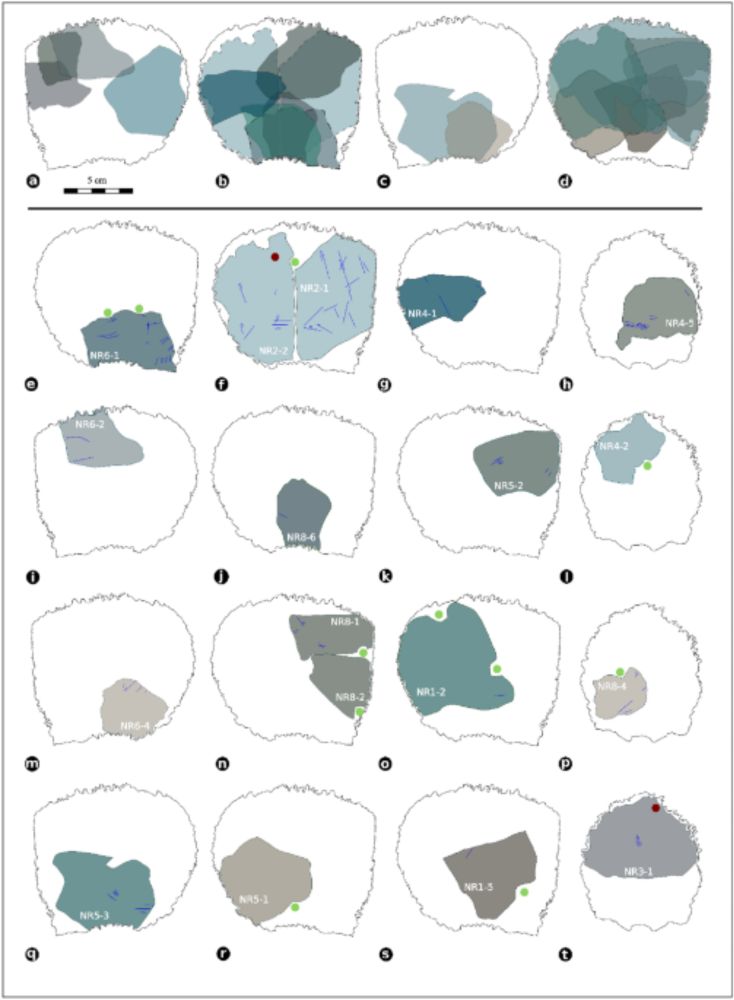
New insights of cultural cannibalism amongst Magdalenian groups at Maszycka Cave, Poland - Scientific Reports
Scientific Reports - New insights of cultural cannibalism amongst Magdalenian groups at Maszycka Cave, Poland
www.nature.com
February 6, 2025 at 10:54 AM
Excited to share our new paper on human cannibalism during the Magdalenian period! 🏚️💀 Featuring new insights from Maszycka Cave (Poland). #Archaeology #Prehistory #Anthropology @palmirasaladie.bsky.social @whiterabbit36.bsky.social Available here: www.nature.com/articles/s41...
Reposted by Vladislav Zhitenev
The sedaDNA revolution and archaeology: Progress, challenges, and a research agenda www.sciencedirect.com/science/arti...

The sedaDNA revolution and archaeology: Progress, challenges, and a research agenda
The uptake of sedimentary ancient DNA (sedaDNA) in archaeology appears to be rather behind that in areas such as palaeoecology, palaeolimnology and Qu…
www.sciencedirect.com
February 3, 2025 at 8:35 AM
The sedaDNA revolution and archaeology: Progress, challenges, and a research agenda www.sciencedirect.com/science/arti...