




Feeling excited and grateful to have one of my PhD papers finally published at JMIR Mental Health.
JMIR Mental Health: Toward #Digital Self-Monitoring of #MentalHealth in the General Population: Scoping Review of Existing #Approaches to Self-Report Measurement #MentalHealth #DigitalHealth #SelfMonitoring #MentalWellness #HealthTechnology

Toward #Digital Self-Monitoring of #MentalHealth in the General Population: Scoping Review of Existing #Approaches to Self-Report Measurement
Background: With the ubiquity of smartphones, #Digital self-report instruments have enormous potential to support the general population in monitoring their #MentalHealth. A primary challenge for researchers committed to advancing this work is simply to scope the plethora of widely used candidate instruments. The overarching aim of this study was to address this challenge to support and guide future research in this burgeoning area. Objective: This study aimed to conduct a literature review of self-report instruments used in empirical studies to measure #MentalHealth (1) in the general population, (2) delivered in a #Digital format, and (3) in longitudinal designs. Given the wide range of recognized “#MentalHealth” constructs, the review’s search strategies were guided by Keyes’ dual continua model of #MentalHealth, recognizing both deficits- and strengths-based constructs. This study’s primary objective was to develop a first-of-its-kind ranking and synthesis of the most frequently used instruments that are potentially suitable for #MentalHealth self-monitoring. It was not an objective of this study to evaluate psychometric properties of the identified instruments—we hope the present ranking and synthesis will provide the foundation for future research into optimal #Digital, prospective self-report of #MentalHealth. Methods: Five major electronic databases were searched. Studies that administered #Digital #MentalHealth instruments (in English) repeatedly to community dwellers in the general adult population were eligible. The included studies were grouped by instruments for synthesis using a narrative #Approach. Results: Preliminary screening of 95,849 records identified 8460 eligible records, among which 1000 records were randomly selected over 4 iterations for full-text screening. A total of 223 records were included. We found that the top 30 most commonly used instruments accounted for 78.4% (308/393) of the total usage across studies. These instruments predominantly measure deficits-based #MentalHealth constructs. The Patient #Health Questionnaire 9 Items and Generalized #anxiety Disorder 7 Items were by far the most used instruments. The most commonly measured strengths-based constructs were life satisfaction and mental well-being. Conclusions: The findings of this review strongly suggest that scientific investigation of #MentalHealth constructs across time on #Digital platforms still prioritizes deficits-focused instruments originally developed for pen-and-paper administration using classical test theory. These findings are discussed in light of evidence in the literature that deficits-focused instruments demonstrate inferior distributional properties (floor effects) in the general population and theory suggesting that both deficits- and strengths-focused measurements are required to holistically assess #MentalHealth. Limitations of the review include the restricted focus on English language instruments and the pragmatic #Approach to selecting records for full-text screening. It is concluded that, in the smartphone age, it would be timely to develop new #Digital instruments framed by holistic models of #MentalHealth and using contemporary test construction #Approaches. Trial Registration: PROSPERO CRD42022306547; https://www.crd.york.ac.uk/PROSPERO/view/CRD42022306547
dlvr.it
September 19, 2025 at 11:13 AM
Feeling excited and grateful to have one of my PhD papers finally published at JMIR Mental Health.
Reposted by Zhao Hui Koh

JMIR Mental Health: Toward #Digital Self-Monitoring of #MentalHealth in the General Population: Scoping Review of Existing #Approaches to Self-Report Measurement #MentalHealth #DigitalHealth #SelfMonitoring #MentalWellness #HealthTechnology
Toward #Digital Self-Monitoring of #MentalHealth in the General Population: Scoping Review of Existing #Approaches to Self-Report Measurement
Background: With the ubiquity of smartphones, #Digital self-report instruments have enormous potential to support the general population in monitoring their #MentalHealth. A primary challenge for researchers committed to advancing this work is simply to scope the plethora of widely used candidate instruments. The overarching aim of this study was to address this challenge to support and guide future research in this burgeoning area. Objective: This study aimed to conduct a literature review of self-report instruments used in empirical studies to measure #MentalHealth (1) in the general population, (2) delivered in a #Digital format, and (3) in longitudinal designs. Given the wide range of recognized “#MentalHealth” constructs, the review’s search strategies were guided by Keyes’ dual continua model of #MentalHealth, recognizing both deficits- and strengths-based constructs. This study’s primary objective was to develop a first-of-its-kind ranking and synthesis of the most frequently used instruments that are potentially suitable for #MentalHealth self-monitoring. It was not an objective of this study to evaluate psychometric properties of the identified instruments—we hope the present ranking and synthesis will provide the foundation for future research into optimal #Digital, prospective self-report of #MentalHealth. Methods: Five major electronic databases were searched. Studies that administered #Digital #MentalHealth instruments (in English) repeatedly to community dwellers in the general adult population were eligible. The included studies were grouped by instruments for synthesis using a narrative #Approach. Results: Preliminary screening of 95,849 records identified 8460 eligible records, among which 1000 records were randomly selected over 4 iterations for full-text screening. A total of 223 records were included. We found that the top 30 most commonly used instruments accounted for 78.4% (308/393) of the total usage across studies. These instruments predominantly measure deficits-based #MentalHealth constructs. The Patient #Health Questionnaire 9 Items and Generalized #anxiety Disorder 7 Items were by far the most used instruments. The most commonly measured strengths-based constructs were life satisfaction and mental well-being. Conclusions: The findings of this review strongly suggest that scientific investigation of #MentalHealth constructs across time on #Digital platforms still prioritizes deficits-focused instruments originally developed for pen-and-paper administration using classical test theory. These findings are discussed in light of evidence in the literature that deficits-focused instruments demonstrate inferior distributional properties (floor effects) in the general population and theory suggesting that both deficits- and strengths-focused measurements are required to holistically assess #MentalHealth. Limitations of the review include the restricted focus on English language instruments and the pragmatic #Approach to selecting records for full-text screening. It is concluded that, in the smartphone age, it would be timely to develop new #Digital instruments framed by holistic models of #MentalHealth and using contemporary test construction #Approaches. Trial Registration: PROSPERO CRD42022306547; https://www.crd.york.ac.uk/PROSPERO/view/CRD42022306547
dlvr.it
September 18, 2025 at 4:40 PM
JMIR Mental Health: Toward #Digital Self-Monitoring of #MentalHealth in the General Population: Scoping Review of Existing #Approaches to Self-Report Measurement #MentalHealth #DigitalHealth #SelfMonitoring #MentalWellness #HealthTechnology
HiTOP in personality neurosciencenews.com/personality-...

Big Five No More? New Study Uncovers Hidden Personality Traits - Neuroscience News
For 40 years, the Big Five personality model has dominated psychology, but new research suggests it may be incomplete.
neurosciencenews.com
August 26, 2025 at 9:38 PM
HiTOP in personality neurosciencenews.com/personality-...
Interesting study arxiv.org/abs/2506.08872

Your Brain on ChatGPT: Accumulation of Cognitive Debt when Using an AI Assistant for Essay Writing Task
This study explores the neural and behavioral consequences of LLM-assisted essay writing. Participants were divided into three groups: LLM, Search Engine, and Brain-only (no tools). Each completed thr...
arxiv.org
June 20, 2025 at 8:38 AM
Interesting study arxiv.org/abs/2506.08872
Great advice for graduate students!

An open letter to graduate students and other procrastinators: it’s time to write
Nature Biotechnology - An open letter to graduate students and other procrastinators: it’s time to write
www.nature.com
March 24, 2025 at 11:07 PM
Great advice for graduate students!
Reposted by Zhao Hui Koh

BREAKING NEWS: CDC orders mass retraction and revision of submitted research across all science and medicine journals. Banned terms must be scrubbed.
Goes beyond MMWR +other CDC pubs. Applies to research already submitted to top medical journals.
Take a look.
open.substack.com/pub/insideme...
Goes beyond MMWR +other CDC pubs. Applies to research already submitted to top medical journals.
Take a look.
open.substack.com/pub/insideme...
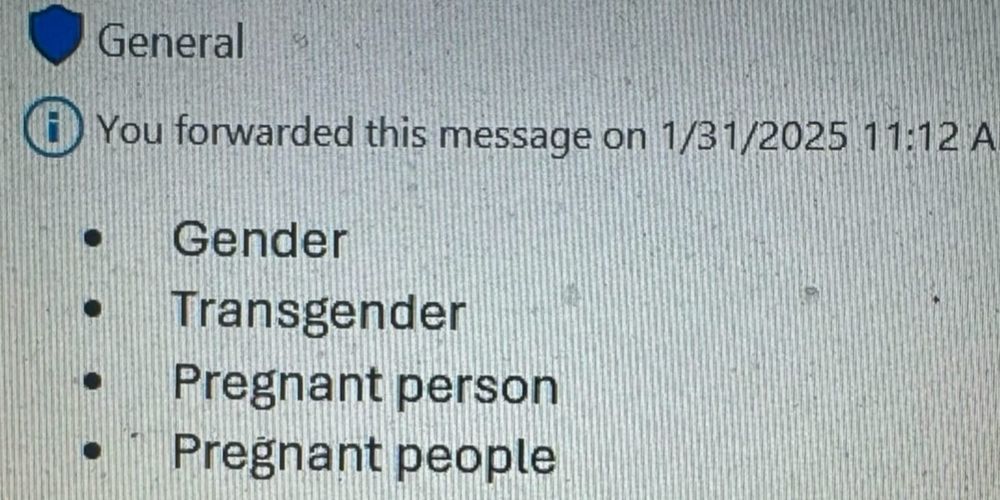
BREAKING NEWS: CDC orders mass retraction and revision of submitted research across all science and medicine journals. Banned terms must be scrubbed.
Any unpublished manuscript mentioning certain topics, including gender and "LGBT," must be pulled or revised.
open.substack.com
February 1, 2025 at 9:20 PM
BREAKING NEWS: CDC orders mass retraction and revision of submitted research across all science and medicine journals. Banned terms must be scrubbed.
Goes beyond MMWR +other CDC pubs. Applies to research already submitted to top medical journals.
Take a look.
open.substack.com/pub/insideme...
Goes beyond MMWR +other CDC pubs. Applies to research already submitted to top medical journals.
Take a look.
open.substack.com/pub/insideme...
Interesting summary on how subjective perception of time changes based on the state of consciousness

Time expansion experiences: why time slows down in altered states of consciousness
In time expansion experiences, time typically appears to expand by many orders of magnitude.
theconversation.com
January 3, 2025 at 6:13 AM
Interesting summary on how subjective perception of time changes based on the state of consciousness
Reposted by Zhao Hui Koh

Big news from Finnish publication forum. Almost all MDPI and Frontiers journals will be downgraded to level 0 and thus are not considered as properly peer reviewed trustworthy scientific journals.
julkaisufoorumi.fi/en/news/chan...
julkaisufoorumi.fi/en/news/chan...

Changes to the classification
julkaisufoorumi.fi
December 16, 2024 at 10:12 AM
Big news from Finnish publication forum. Almost all MDPI and Frontiers journals will be downgraded to level 0 and thus are not considered as properly peer reviewed trustworthy scientific journals.
julkaisufoorumi.fi/en/news/chan...
julkaisufoorumi.fi/en/news/chan...
Falsely accusing students of using AI in their assignments adds another level of stress and add tons of overhead for students to show evidence. Time to reduce written assignments and focus on practical in-class activities instead www.tandfonline.com/doi/full/10....

The Problem with False Positives: AI Detection Unfairly Accuses Scholars of AI Plagiarism
By examining the experiences of scholars from various institutions around the globe, this paper looks into how AI detection tools, which are meant to keep academic integrity intact, may backfire by...
www.tandfonline.com
December 20, 2024 at 10:39 PM
Falsely accusing students of using AI in their assignments adds another level of stress and add tons of overhead for students to show evidence. Time to reduce written assignments and focus on practical in-class activities instead www.tandfonline.com/doi/full/10....

Reposted by Zhao Hui Koh

Complementing semi-automated tools with text-mining techniques for a large-scale systematic review: a hybrid approach: http://osf.io/e25tn/
January 30, 2024 at 5:08 AM
Complementing semi-automated tools with text-mining techniques for a large-scale systematic review: a hybrid approach: http://osf.io/e25tn/
A sad consequence of over-trusting a biased AI system...
www.abc.net.au/news/science...
www.abc.net.au/news/science...
October 31, 2023 at 8:34 PM
A sad consequence of over-trusting a biased AI system...
www.abc.net.au/news/science...
www.abc.net.au/news/science...